Business Interruption Claim Negotiation: 5-Step Guide

November 05, 2026
Written by Collin Corcoran
Share


A business interruption settlement depends on the financial records behind it. Insurers commonly ask for one to two years of financial records before the loss, and the policy’s calculation method can change the result. A structured negotiation process helps you present a documented loss the carrier can verify.
Key Takeaways
- What insurers need to see: Proof of net profit and continuing normal operating expenses, including continuing payroll, for the periods before and after the disruption.
- Records to gather: Financial statements and records for at least one to two years before the loss, plus records of sales and continuing expenses during recovery.
- Proof of loss: Many policies require a signed, sworn proof of loss within 60 days of the insurer’s request; confirm your policy and state deadline.
- What controls the calculation: The policy defines the coverage, the loss formula and the limits.
- Professional help: On a large or disputed loss, an independent forensic accountant or other qualified professional can help you review the carrier’s calculation.
The Five Steps That Drive a Business Interruption Negotiation
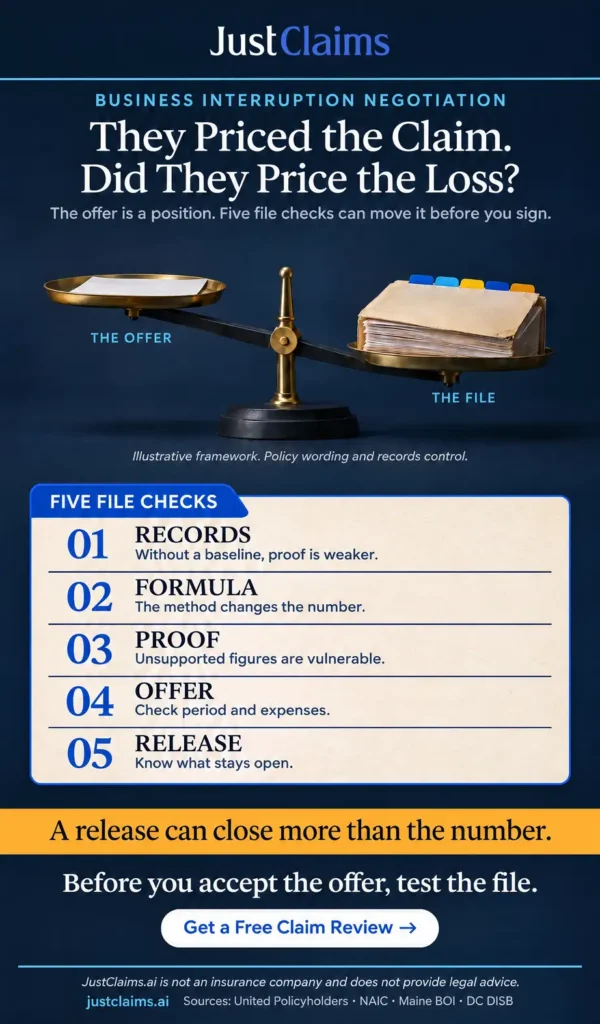
Negotiating a business interruption claim means proving your actual loss with records and policy language, not arguing from estimates. The five steps below follow a logical order for preparing and negotiating a claim. This guide covers negotiation strategy. For the mechanics of calculating the loss, see our guides on business interruption, extra expense and loss of rents and actual loss sustained business income.
1. Build the Documentation Foundation
To receive a business income settlement, a business must be able to show its net profit and continuing normal operating expenses, including continuing payroll, from before and after the event that disrupted it [1]. Insurers commonly ask for one to two years of financial records before the loss, so gather those statements early rather than waiting for the carrier to ask [2].
Keep detailed records of three things during recovery [1][2]:
- ongoing business activity and sales
- expenses at a temporary location
- expenses that continue while the business is closed, such as utilities and rent
2. Establish the Loss Calculation Method
The policy defines the coverage, the loss calculation method and the limits for a business interruption claim [2]. Depending on the policy, the loss can be measured as net profits plus continuing expenses, or as gross earnings less saved variable expenses [3]. Confirm which method applies before you present any figure, because the methods can produce significantly different totals [3].
A common sequence is to analyze financial statements from before and after the loss, then calculate the actual loss, supported by the policy and by expense documentation [1]. Before you present a figure, confirm the policy’s formula and the pre-loss period the carrier will use; both can change the result [2][3]. On a large or disputed loss, an independent forensic accountant or other qualified professional can review the carrier’s calculation [1].
3. Communicate With the Adjuster in Writing
Many commercial property policies require a signed, sworn proof of loss within 60 days after the insurer’s request. United Policyholders notes that 60 to 90 days is common, and your policy or state law may set a different deadline [1][4]. Missing that window can create avoidable problems, so calendar it the day the request arrives.
Beyond that deadline, you can strengthen your position by:
- submitting figures in writing
- tying each figure to a policy provision and a source record
- keeping a dated log of every request and response
Written exchanges give you a clear record if the carrier later questions a number.
4. Review the Settlement Offer Line by Line
Compare the carrier’s offer against your documented calculation, not against your expectations. Look for differences in the measurement method, the period of restoration, and which continuing expenses were counted. The calculation method and the pre-loss period can change the settlement materially, so each variance deserves an explanation in writing [2][3].
Also check whether the offer accounts for every coverage the policy provides, not just the headline business income figure. Waiting periods, limits on the period of restoration and exclusions can be easy to miss when the review focuses only on the headline number [2][5].
5. Finalize the Agreement Carefully
Before you sign a release, confirm what it closes. Check whether any part of the claim remains open, such as continuing losses or extra expenses. Claim requirements vary by policy, and state law can add deadlines or protections, so consider having a licensed professional review the final terms [4]. Do not treat an offer as final until its scope and the loss period it covers match your records.
Documentation Checklist for Business Interruption Claims
Because a negotiation depends on whether your loss figures can be verified, a complete file is your strongest tool. Use this checklist as a starting point:
- A complete copy of the business interruption policy, including endorsements [1]
- Financial statements from before and after the loss [2]
- Net profit and continuing expenses, including payroll that continues [1]
- One to two years of financial records before the loss [2]
- Records of business activity and sales during recovery [1][2]
- Expense records for any temporary location [2]
- Records of ongoing expenses during closure, such as utilities and rent [1]
- The signed, sworn proof of loss, submitted within the deadline [4]
- A written log of all adjuster communications and requests
Resolving Delayed Payouts and Disputed Loss Figures
Delays and disputes can weaken a negotiation, and both may trace back to gaps in the documentation and calculation steps above. Gaps in records or an unclear calculation method give a carrier reasons to pause or revise your numbers.
Delayed Payouts
Incomplete or inconsistent records can delay a payout. Responding to each request promptly and in writing, and meeting the deadlines in your policy, can help document that any further delay is not on your side. Keep the dated log current so you can show the timeline if you later escalate.
Disputed Loss Figures
Disputes can come down to method. Net profits plus continuing expenses and gross earnings less saved variable expenses can produce different totals [3]. Ask the adjuster to identify which method it used and which policy language supports it. Then compare that against your own calculation, supported by expense documentation [1].
Frequently Asked Questions
What do insurers need to see to pay a business interruption claim?
They look for proof of your net profit and the continuing normal operating expenses you carried, including continuing payroll. That proof should cover the periods before and after the disruption [1]. Carriers commonly ask for one to two years of financial records before the loss to judge what your income would normally have been [2].
How long do I have to submit a proof of loss?
Many policies require a signed, sworn proof of loss within 60 days of the insurer’s request, but the deadline can differ by policy and state [1][4]. Check your own policy and state rules, since terms and deadlines can differ. Treat the deadline as firm until you have confirmed otherwise in writing.
Why would an insurer’s loss figure differ from mine?
The policy decides how the loss is measured, and the available methods can produce different totals [2][3]. One approach counts net profits plus continuing expenses. Another subtracts saved variable expenses from gross earnings [3].
When should I bring in a forensic accountant?
Consider an independent forensic accountant or other qualified professional if the loss is large, the carrier disputes your valuation, or you cannot get clear answers in writing. United Policyholders notes that businesses commonly hire a forensic accountant, public adjuster, attorney or other expert, and recommends hiring your own independent experts on a large loss to scope the loss or give you a second opinion on the insurer’s numbers [1].
How to Negotiate Your Documented Business Losses
A documented process can strengthen a business interruption negotiation: gather the records, apply the policy’s calculation method, communicate in writing, compare the offer line by line, and confirm the final terms before signing. On a large or disputed loss, an independent forensic accountant or other qualified professional can help you review the carrier’s calculation [1]. Outcomes depend on your policy, your records and applicable law, so no settlement amount can be predicted in advance.
Upload your policy and start a free AI business interruption policy review with Justin before you negotiate.
Written from the perspective of a licensed public adjuster team. Public adjuster licensing requirements and permitted activities vary by state, and readers should confirm the license status of any public adjuster they hire with their state insurance regulator. This content is for informational purposes only and does not constitute legal or insurance advice. Coverage decisions depend on the specific terms, conditions, and exclusions of each policy and the laws of the applicable jurisdiction; policyholders and contractors should consult with a qualified professional for advice on their particular situation.
Sources
[1] Post-Disaster Insurance FAQs for Small Businesses — United Policyholders
[2] Getting (Back To) Business Interruption Insurance — United Policyholders

Collin Corcoran

Experienced Public Adjuster and Property Claims Specialist, Collin is licensed in New York (#1603393), New Jersey (#3003700204), and Connecticut (#19820270). With 20+ years of hands-on construction and property damage experience, he specializes in residential and commercial claims, complex loss inspections, policy review, detailed estimating, and strategic negotiation. Collin’s background in construction, asset management, emergency response, and claims documentation allows him to accurately identify damage, understand repair requirements, and advocate effectively for policyholders. He works with homeowners, business owners, contractors, and insurance professionals to move claims forward with clarity, accuracy, and confidence. Collin is committed to transparency, technical precision, strong communication, and securing fair outcomes for policyholders.