Estoppel in Insurance: Definition & Claim Rights

October 30, 2026
Written by Collin Corcoran
Share


When an insurer’s representative makes a statement that a commercial property owner reasonably relies on, the doctrine of estoppel may bar the carrier from reversing course later. The ALI’s Restatement of the Law, Liability Insurance says the reliance must be both reasonable and detrimental. How far the doctrine reaches depends heavily on state law.
Key Takeaways
- What it is: A party who makes a promise or representation that can reasonably be expected to induce detrimental reliance is estopped from denying it if the other party reasonably and detrimentally relies on it.
- How it differs from waiver: Waiver is the voluntary or intentional relinquishment of a known right, while estoppel does not require intentional relinquishment.
- Effect on coverage: If its elements are met, estoppel can expand coverage beyond what it would have been without it.
- Agent statements: An insurer can be estopped from using an exclusion or condition if its agent represented that it was waived or would not be applied.
- Timing: Estoppel can apply even when both the representation and the reliance happen after the loss in some states, though some courts limit this in first-party property claims.
- State variation: The Texas Supreme Court has held that waiver and estoppel cannot expand the contractual coverage of an insurance policy.
Estoppel vs. Waiver: Two Different Doctrines
An unfair denial can come after a carrier has already said or done something that shaped how you handled the claim. Estoppel and waiver are two doctrines that can be used to challenge that kind of reversal. They are easy to confuse, but they work differently.
What Estoppel Means
The ALI’s Restatement of the Law, Liability Insurance says a party to an insurance policy who makes a promise or representation that can reasonably be expected to induce detrimental reliance is estopped from denying it. This applies if the other party does reasonably and detrimentally rely on it [1]. Two key elements are that your reliance must be reasonable and that the reliance must have caused you harm, in addition to a representation by the insurer.
How Waiver Differs
Waiver is the voluntary or intentional relinquishment of a known right. Estoppel does not require that intent. It turns on the insurer’s conduct and whether that conduct reasonably caused the insured to rely to their detriment [2]. A carrier may never have meant to give up a policy defense, yet its statements and actions can still prevent it from asserting that defense.
Real-World Examples of Estoppel in Commercial Property Claims
Because estoppel exists to address carrier reversals after reliance, it helps to see the pattern in concrete terms. The scenarios below are hypothetical illustrations of the principles described in the ALI materials, not predictions of any outcome.
An Adjuster Represents That a Condition Will Not Apply
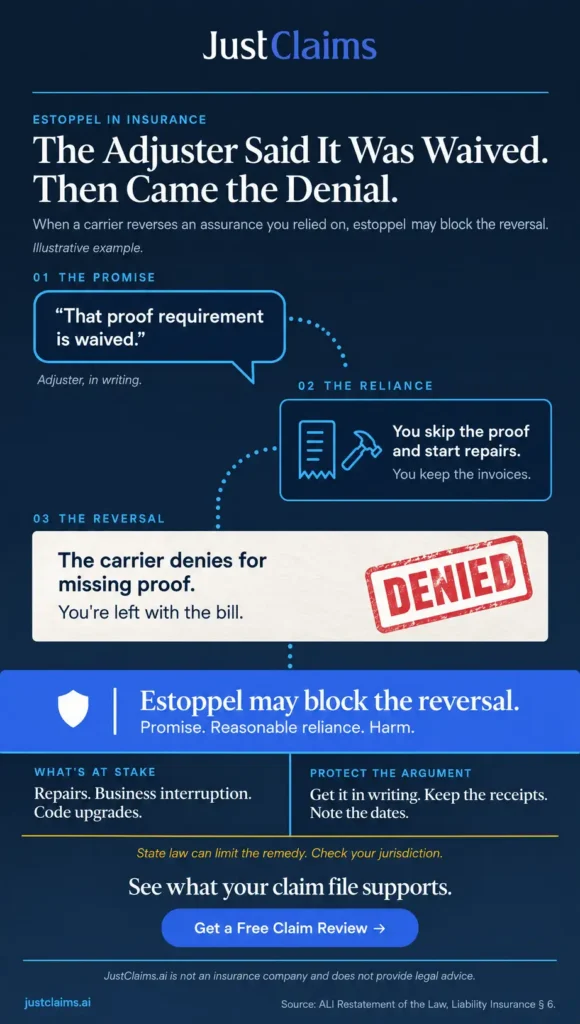
If an insurer’s agent represents that an exclusion or condition has been waived or will not be applied, and the insured reasonably and detrimentally relies on that, the insurer may be estopped from using it to deny coverage [1]. For example, an adjuster tells you in writing that a particular proof requirement is not needed. You skip it and proceed with repairs. The carrier later denies the claim for lack of that proof. Agency law supports the position that the adjuster’s statement can bind the insurer.
Statements Made After the Loss
Estoppel can apply even when both the representation and the reliance happen after the loss in some states, though some courts limit this in first-party property claims [1]. A carrier’s post-loss assurances, and your decisions based on them, can therefore matter as much as the policy’s original wording.
Handling a Claim Without Reserving Rights
Courts regularly use estoppel to stop an insurer that has been providing a defense without a reservation of rights from later raising a ground for contesting coverage [1]. The principle is that a carrier cannot act one way for a long time and then change its position without consequence. If a carrier handles your claim without flagging a coverage defense, that history may be relevant later. The reservation-of-rights rule comes from liability-insurance defense cases; in a property claim, the practical point is to note whether the carrier raised a coverage defense early or only after you relied on its handling.
State Law Limits on Estoppel
A carrier reversing itself after you relied on its statements is the core problem, but the remedy available to you depends on where the claim arises. Estoppel varies by state, and some jurisdictions restrict it.
- The Texas Supreme Court held that waiver and estoppel cannot be used to expand the contractual coverage of an insurance policy [3].
- The Wisconsin Supreme Court has held that estoppel based on an insurer’s conduct does not apply to matters of coverage, as distinct from grounds for forfeiture [4].
Courts in other states may treat the doctrine more broadly. The ALI notes that, if its elements are met, estoppel can expand coverage beyond what it would have been without it [1]. Whether that expansion is available is a state-law question. Those authorities are liability-insurance sources. A first-party property claim may be treated differently, so check your state’s rule before relying on the general principle.
Estoppel Is Not the Same as Bad Faith
Estoppel focuses on reliance: what the carrier represented and what you reasonably did in response [1]. Bad faith is a separate theory that turns on how the carrier handled the claim. State unfair-claims-practices rules, such as the NAIC model act, focus on whether the insurer adopted and followed reasonable standards for investigating and settling claims [5]. The two theories can arise from the same facts, but they ask different questions and can lead to different remedies. For a comparison, see our guide on bad faith insurance claims. Keeping them separate also helps you describe your dispute accurately. “The adjuster told me X and I relied on it” is an estoppel-type argument; it is not, by itself, proof of bad faith.
Policy Language and Claim Conduct Worth Reviewing for Estoppel
Since estoppel depends on a mismatch between what a carrier said and what it later asserted, a careful review should compare the policy text against the claim file. Complex claims require that same level of detail, because small valuation errors can compound. Business Interruption and Law & Ordinance provisions are two places where gaps tend to hide.
Items worth lining up side by side include:
- Policy conditions and exclusions the carrier later cites in a denial or partial payment.
- Written and recorded adjuster statements about coverage, documentation requirements, or whether a condition would be enforced.
- Business Interruption terms, including how the carrier described the covered period and what records it asked you to produce.
- Law & Ordinance terms, including what the carrier said about code-upgrade costs before repairs began.
- Timing, meaning when each statement was made and what decisions you made afterward.
A gap between those items does not prove estoppel. It identifies where the argument, if any, would need to be built.
Protecting Your Rights During the Claim Process
Get Coverage Statements in Writing
Oral assurances are difficult to prove. When an adjuster tells you something about coverage or requirements, ask for confirmation by email or letter, or send your own written summary of the conversation. Evidence beyond the policy, such as testimony and the parties’ conduct, can be used to show what was represented [1].
Document What You Did in Response
Reliance must be reasonable and detrimental [1]. Keep invoices, contractor communications, and notes explaining which decisions you made because of the carrier’s statements. Without that link, an estoppel argument is hard to support.
Watch for Shifts in the Carrier’s Position
Compare each new carrier letter against earlier communications. If a ground for denial appears that the carrier never mentioned while it was actively handling the claim, preserve both versions. That history may matter under the principle that insurers can be stopped from raising coverage grounds late [1].
Confirm How Your State Treats the Doctrine
Because some jurisdictions restrict estoppel’s ability to expand coverage [3], review your state’s rules, or have counsel do so, before building a strategy around it.
Frequently Asked Questions
What is estoppel in insurance?
Estoppel is a legal principle that stops a party from backing away from a promise or representation after the other side has reasonably relied on it and been harmed. In insurance, it can prevent a carrier from asserting a position that contradicts its earlier statements or conduct [1].
How is estoppel different from waiver?
Waiver means intentionally giving up a known right. Estoppel does not depend on intent. It looks at whether the carrier’s conduct reasonably led you to rely on something to your detriment [2].
Can estoppel create coverage that the policy does not provide?
In some jurisdictions, yes. The ALI materials say coverage can be expanded beyond what it would otherwise have been if estoppel’s elements are met [1]. Other states, including Texas, restrict that use [3], so the answer depends on where the claim is governed.
Does an adjuster’s statement really bind the insurance company?
It can. Under agency law, if an insurer’s agent represents that an exclusion or condition has been waived or will not be applied, and you reasonably and detrimentally rely on it, the insurer may be estopped from using that condition to deny coverage [1]. The facts and state law will determine whether that applies to your situation.
How You Can Protect Your Claim Rights
Estoppel gives commercial property owners a framework for challenging carrier reversals, but it depends on documentation, reasonable reliance, and favorable state law. A review of the policy against the full claim record can show where a carrier’s position has shifted.
JustClaims works on contingency, subject to state rules. No specific settlement outcome can be promised. Your documents, your jurisdiction, and the carrier’s conduct will shape what is possible.
Upload your policy and adjuster correspondence for a free commercial property policy review. Justin, built by JustClaims’ licensed adjusters, flags statements and coverage gaps in Business Interruption and Law & Ordinance that may support an estoppel argument.
Reviewed by a licensed public adjuster. This content is for informational purposes only and does not constitute legal or insurance advice. Estoppel rules vary by state, and coverage decisions depend on the specific terms, conditions, and exclusions of each policy. Policyholders should consult a qualified attorney or licensed professional about their particular situation.
Sources
[3] Texas Farmers Ins. Co. v. McGuire, 744 S.W.2d 601 (Tex. 1988) — Supreme Court of Texas
[4] Maxwell v. Hartford Union High Sch. Dist., 2012 WI 58, 814 N.W.2d 484 — Wisconsin Supreme Court

Collin Corcoran

Experienced Public Adjuster and Property Claims Specialist, Collin is licensed in New York (#1603393), New Jersey (#3003700204), and Connecticut (#19820270). With 20+ years of hands-on construction and property damage experience, he specializes in residential and commercial claims, complex loss inspections, policy review, detailed estimating, and strategic negotiation. Collin’s background in construction, asset management, emergency response, and claims documentation allows him to accurately identify damage, understand repair requirements, and advocate effectively for policyholders. He works with homeowners, business owners, contractors, and insurance professionals to move claims forward with clarity, accuracy, and confidence. Collin is committed to transparency, technical precision, strong communication, and securing fair outcomes for policyholders.