HOA Roof Insurance Claim: Contractor and Association Filing Guide for 2026
October 22, 2026
Written by Collin Corcoran
Share


An HO-6 policy generally covers the inside of a unit, not the building’s roof, so the association’s master policy is the policy that responds to a roof loss. For contractors, that puts the weight on board authorization, a documented scope, and knowing which policy terms apply before a bid reaches the carrier. This guide covers that workflow for association roof insurance claims, from filing through denial response.
Key Takeaways
- Master policy scope: The association’s master policy typically covers the roof, exterior walls and shared spaces.
- Unit owner policy: An HO-6 policy generally covers the unit interior, personal property and loss of use — not community property like the roof.
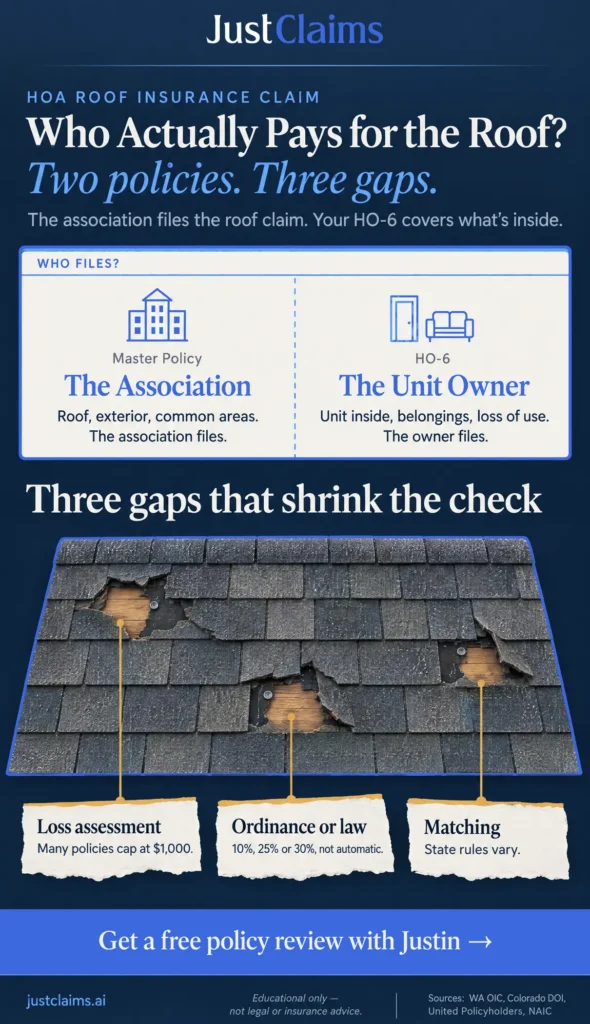
- Loss assessment limits: Many HO-6 policies cap loss assessment coverage at $1,000 toward the master deductible.
- Code upgrade limits: Ordinance or law coverage is often 10%, 25% or 30% of the dwelling limit — and it is not automatic.
- Maintenance exclusion: Wear and tear, deterioration over time and maintenance are commonly excluded; document the cause of loss.
- Reporting timeline: Report promptly; if prompt notice is a policy condition, a late report can become a coverage issue.
Who Owns the Roof Claim: Association or Unit Owner
Association vs. unit owner coverage
Every roof claim outcome starts with who holds the claim, because that decides who can authorize your scope. Condo owners usually carry two policies that work in tandem. The owner buys an HO-6 policy, and owner dues pay for the community master policy [1]. The master policy typically covers the roof, while the HO-6 typically covers the unit from the walls in and excludes community property [1][2].
If a covered peril damages the roof and water reaches a unit, the owner’s HO-6 can respond to interior repairs, personal property and loss of use [1][2]. Interior damage may therefore involve a second carrier and a second claim file alongside your roof scope. For how master-policy structures work, see HOA master insurance policy.
Deductibles and special assessments
The master policy’s coverage level depends on the community’s governing documents. Washington’s insurance regulator describes three structures: “all-in,” “all-in, excluding improvements or betterments,” and “bare walls or walls out” [1]. Under an “all-in” policy, unit owners are responsible for the master policy deductible through their own policies [1]. Ask the board for the governing documents and the master policy declarations page before you scope the roof.
Roof damage also shows up in special assessments. If wind damage to several roofs exceeds the master policy’s limits, the association may charge unit owners for the remainder [1].
Loss assessment coverage can help, but many policies cap the master-deductible portion at $1,000 [2]. Timing also matters: some insurers pay based on the date of loss, while others pay based on the date of the assessment; if the association changes insurers between those dates, coverage can be missed [2].
What Roof Damage Is Typically Covered
Because the master policy usually owns the roof claim, your scope has to fit what that policy actually covers. Colorado’s insurance division describes damage to common areas as typically covered by the master policy, with owners possibly responsible for the HOA’s deductible and any amounts above the master policy limits [2].
Wind, hail and the maintenance exclusion
Property policies commonly cover direct damage from fire and storms [2], but wear and tear, deterioration over time and maintenance are commonly excluded [3]. Some policies also exclude wind or hail altogether, so read the declarations page [4].
Maryland’s insurance administration notes that repairing damage due to wear and tear or deterioration of a roof over time generally will not be paid, and that a covered peril can leave part of the claim unpaid when the roof was already in need of maintenance [3]. Documenting the cause of loss, not just the condition, is how you separate storm damage from wear.
Hurricane and named-storm deductibles
Some policies apply a separate wind, hail or named-storm deductible, either as a flat amount or as a percentage of dwelling coverage [4]. Triggers vary by state and insurer, and the declarations page spells them out [4]. In Florida, a hurricane is defined by statute, and a roof deductible cannot be applied to a roof loss resulting from a hurricane [5]. Allocation among owners is covered in HOA hurricane deductible.
Matching and ordinance or law
Matching rules vary by state. The NAIC model claims regulation, which states may adopt, says that when replacement items do not match in quality, color or size, the insurer shall replace items in the area to conform to a reasonably uniform appearance [6].
Kentucky reads its version of that rule to require an entirely new roof when shingles cannot be matched, and it rejects a “line of sight” limit [7]. Tennessee’s rule uses similar language and applies to interior and exterior losses on replacement-cost policies [8]. Rhode Island’s rule also requires a reasonably uniform appearance [9]. North Carolina’s regulator, by contrast, says the insurer need only replace the damaged area, even if shingles do not match [4]. The policy and the state rule control.
Ordinance or law coverage is not automatic. It may be included in the policy or added by endorsement, and it is usually shown as a percentage of the dwelling limit — often 10%, 25% or 30% [10]. Without it, the owner may pay for code-required work out of pocket [10]. On a $200,000 dwelling limit, a 10% endorsement provides up to $20,000 for covered code upgrades. Check the policy language before promising the board that code items are covered.
How the Roof Claim Gets Filed
The way a claim is filed shapes how well your scope holds up later, so contractors benefit from knowing who sends what, and when.
Board authorization and the property manager
The association is the policyholder on the master policy. In practice, a board member or the property manager files through the association’s insurance agent or broker. Confirm in writing who has authority to sign your proposal and receive carrier communications.
Timing and the claim package
Report the claim promptly. If prompt notice is a written condition of the policy, a late report can become a coverage issue [6]. United Policyholders recommends reporting immediately, documenting the damage with photos and an inventory, making temporary repairs if it is safe to do so, keeping receipts, and communicating with the assigned adjuster [11].
The carrier will assign a claim number and send an adjuster, who becomes the primary point of contact [11]. The NAIC model regulation uses a 15-day acknowledgment and a 21-day accept-or-deny benchmark after proof of loss; your state’s version may differ [6].
Contractor bids
After the inspection, the board should obtain a detailed repair estimate and compare it with the adjuster’s scope. United Policyholders notes that an independent scope formatted like the insurer’s allows an “apples to apples” comparison, and that credible documentation increases negotiating power [12]. Your bid is that comparison document, so build it line by line. Contract terms are covered in roofing contract for insurance claim.
What Contractors Must Document on an Association Roof
Underpayment on a roof claim can trace back to gaps in the file, so documentation is one of the areas where a contractor’s work can carry real weight. For inspection technique and photo methods, see the wind damage roof inspection guide. The items below are the roof-specific records to add.
- Damaged area as a share of total roof area. Florida’s 25% reroof rule requires the entire roofing system or roof section to meet the current code when 25% or more of the roof area is repaired, replaced or recovered in a 12-month period, unless the existing roof was built, repaired or replaced under the 2007 or later Florida Building Code; in that case, only the repaired portion must comply [13]. Verify the current local code and inspection record before you rely on the threshold. Other jurisdictions may have similar thresholds.
- Shingle match. Photograph the existing shingles and the proposed replacement, and document any discontinued profile in writing. Matching standards vary by state [6][7][8][9][4].
- Code upgrades. Break out code-required work separately so the adjuster can see what the base repair excludes and what ordinance or law coverage would pay [10].
- Dry-in and mitigation. Document the damage first, then make temporary repairs if it is safe to do so, and keep receipts [11].
- Interior damage. Note water intrusion into units; the owner’s HO-6 may respond to interior repairs and personal property [1][2].
- Discontinued materials. If the shingle or tile profile is no longer made, document it; a match may be impossible, which can support a broader replacement scope [4][7].
Scope and Supplements: Repair vs. Replace, Matching and Code Items
Because matching and code items are frequent sources of scope disputes, each needs support in the file. On matching, the NAIC model regulation says the insurer must replace all items in the area to achieve a reasonably uniform appearance [6].
Kentucky reads that language to require an entirely new roof when shingles cannot be matched [7].
Tennessee’s rule requires replacement so as to conform to a reasonably uniform appearance and applies to interior and exterior losses on replacement-cost policies [8].
Rhode Island’s rule also requires a reasonably uniform appearance [9].
North Carolina’s regulator says the insurer need not replace the whole roof when only part is damaged [4].
On code items, ordinance or law coverage pays the added cost of bringing a damaged structure up to current codes, and whether a policy includes it varies [10]. With a 10% endorsement on $200,000 of dwelling coverage, the policy pays up to $20,000 for required upgrades after a covered peril. Without the coverage, the policyholder may pay out of pocket for code-required work during a roof replacement [10].
If repairs uncover additional damage, the board can submit a supplemental claim with documentation of the new damage and updated estimates. Mechanics are covered in the roofing supplements guide.
Denial and Underpayment Triggers
The same documentation gaps that weaken a scope can contribute to roof denials and low estimates. Typical triggers include:
- Late reporting, which can become a coverage issue when prompt notice is a policy condition [6].
- Maintenance or age characterization of the damage [1][3][4].
- Misapplied deductibles, missing items or incorrect measurements in the adjuster’s report [12].
- Partial replacement without a documented match, since the insurer need not replace a whole roof when only part is damaged in some states [4].
- Code items not itemized, or a policy without ordinance or law coverage [10].
A response sequence that follows the file:
1. Read the carrier’s stated reason and map it to a policy provision.
2. Review the adjuster’s report for missing items, incorrect measurements or misapplied deductibles [12].
3. Submit your itemized estimate, match statement and code breakout [10][12].
4. File a supplemental claim if repairs reveal new damage.
5. Keep mitigation receipts [11].
Getting Board and Carrier Action
When a claim stalls, the board is usually the party that can move it, so keep the board informed with specific requests. Ask the board or manager to report in writing, attend the adjuster’s inspection, and provide documentation, photos and vendor reports [11][12]. Send a side-by-side of your estimate and the adjuster’s numbers so the board can submit the differences [12].
For board refusal, appeals, appraisal or public adjuster remedies, see HOA insurance claim denied. Board duties are covered in HOA board insurance responsibilities.
Public Adjuster vs. Roofing Contractor
A contractor documents and prices the physical repair. A licensed public adjuster handles the insurance claim on the policyholder’s behalf. NAIC warns that roofers, contractors and emergency service providers sometimes present themselves as “de facto public adjusters” without a license, and it tells consumers to confirm that the person or company is a licensed public adjuster [14]. Licensing rules vary by state, so confirm what your state allows before discussing coverage on the association’s behalf [14]. If the dispute is about coverage rather than scope, the board may need a licensed public adjuster. The comparison of vendor estimates to the carrier’s numbers [12] is the factual starting point. See HOA insurance claim help.
Frequently Asked Questions
Who files an HOA roof insurance claim?
The master policy is the association’s policy [2], so the board or its manager files on the association’s behalf. A contractor supports the claim with estimates and documentation but is not the policyholder.
Does a unit owner’s HO-6 policy cover the roof?
Generally no. The HO-6 covers the unit interior, personal property and loss of use, while the master policy covers the roof and common areas [1][2]. The owner’s policy may help with interior repairs after a covered peril [1][2].
Will the insurer replace the entire roof?
Not automatically [4]. Matching rules vary by state. Some states require a reasonably uniform appearance, and Kentucky reads that to require a full roof when shingles cannot be matched [6][7][8][9]. North Carolina’s regulator says the insurer need only replace the damaged area [4].
What if repairs uncover more damage?
The board can submit a supplemental claim with documentation of the new damage and updated estimates. It should also mitigate further damage and keep receipts [11].
Is code-upgrade work covered?
Only if the policy includes ordinance or law coverage, which may be included or added by endorsement [10]. Without it, the policyholder may pay for code-required work out of pocket [10].
How to Strengthen Your HOA Roof Claim
An association roof claim rests on three things: knowing which policy responds, filing through the right board channel, and documenting scope, matching and code items before the adjuster’s numbers set the narrative [1][2][6][10]. We compare the carrier’s estimate against your documentation line by line, so gaps and missing line items surface before the file closes.
If your claim was denied or underpaid, upload your estimate and the carrier’s report to JustClaims for that comparison, or get a free AI policy review with Justin to see the policy language and limits that apply to the loss.
This content is for informational purposes only and does not constitute legal or insurance advice. Coverage decisions depend on the specific terms, conditions, and exclusions of each policy and the laws of the applicable jurisdiction; policyholders and contractors should consult with a qualified professional for advice on their particular situation. Public adjuster licensing requirements vary by state; confirm that anyone negotiating a claim on a property owner’s behalf holds a valid license where the property is located.
Sources
[1] Learn how condo insurance works — Washington Office of the Insurance Commissioner
[2] Toolkit for Homeowners and HOAs on Insurance — Colorado Division of Insurance
[3] Does homeowners insurance pay for the replacement of your roof? — Maryland Insurance Administration
[4] FAQs About Homeowners Insurance — North Carolina Department of Insurance
[5] Florida’s Hurricane Deductible — Florida Department of Financial Services
[6] Unfair Property/Casualty Claims Settlement Practices Model Regulation (Model #902) — NAIC
[7] Advisory Opinion 2023-08 on Matching Replacement Items — Kentucky Department of Insurance
[8] 0780-01-05 Unfair Claims Practices (Rule .10) — Tennessee Department of Commerce & Insurance
[10] Building Code, Ordinance or Law Compliance — United Policyholders
[11] How to File a Homeowners Insurance Claim — United Policyholders
[12] The Scoop on “Scope” (of Loss) — United Policyholders
[13] HB 3D Roof Repair, Replacement, and Recovering Requirements — Florida Senate

Collin Corcoran

Experienced Public Adjuster and Property Claims Specialist, Collin is licensed in New York (#1603393), New Jersey (#3003700204), and Connecticut (#19820270). With 20+ years of hands-on construction and property damage experience, he specializes in residential and commercial claims, complex loss inspections, policy review, detailed estimating, and strategic negotiation. Collin’s background in construction, asset management, emergency response, and claims documentation allows him to accurately identify damage, understand repair requirements, and advocate effectively for policyholders. He works with homeowners, business owners, contractors, and insurance professionals to move claims forward with clarity, accuracy, and confidence. Collin is committed to transparency, technical precision, strong communication, and securing fair outcomes for policyholders.