Ice Dam Roof Damage: What Insurance Owes in 2026
September 18, 2026
Written by Taylor Bezek
Share


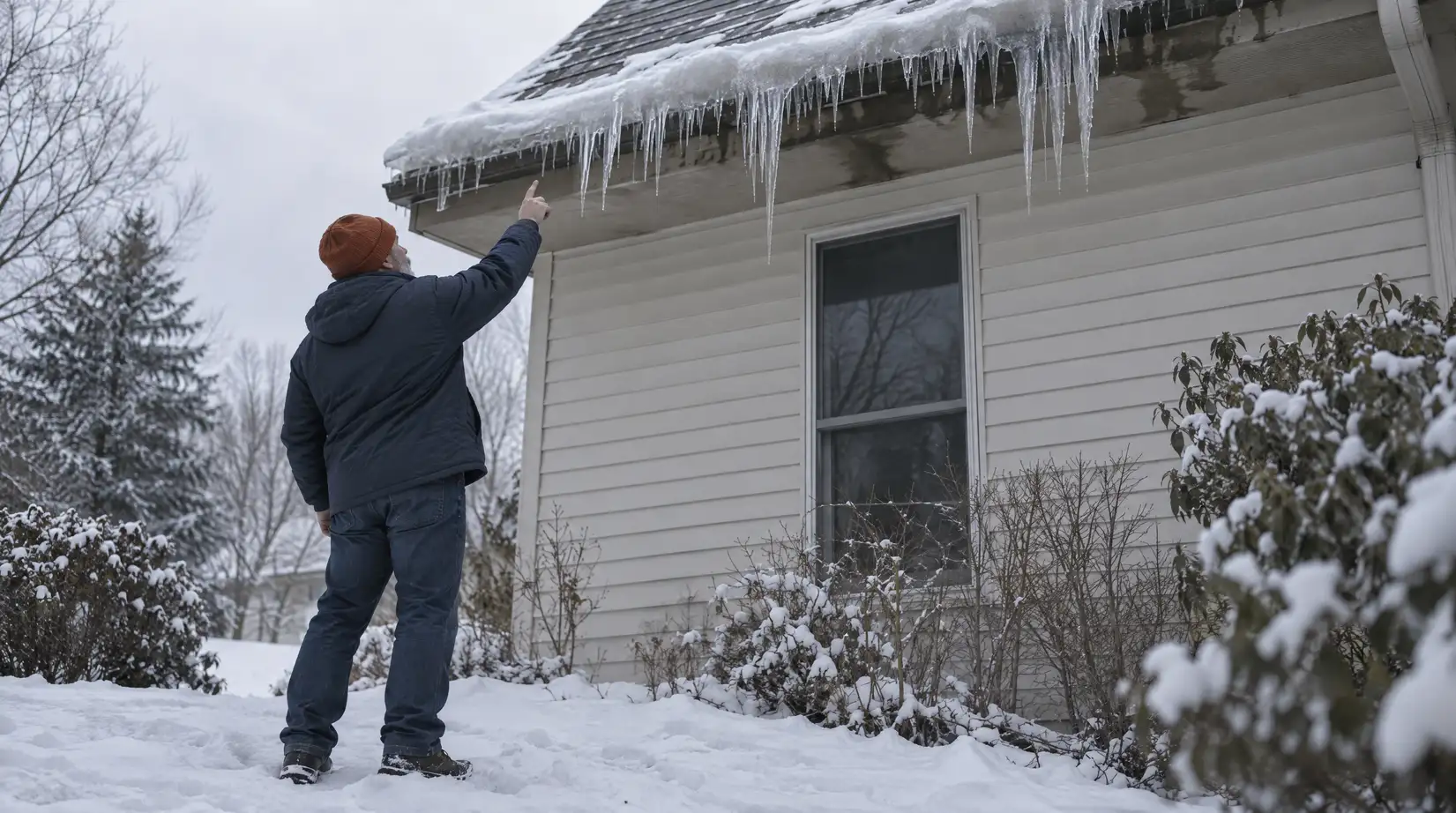
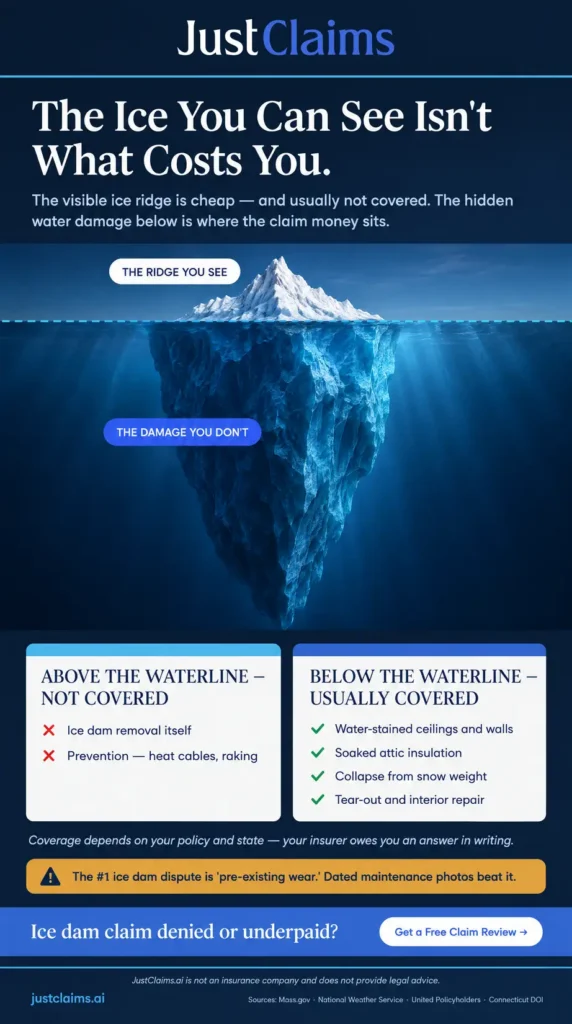
A frozen ridge of ice along the eaves looks harmless — until the meltwater trapped behind it starts backing up under the shingles. Ice dam damage sits in one of the most disputed corners of property insurance: the resulting water damage is generally covered, while removing the ice dam itself usually is not. Whether a claim gets paid often comes down to what gets documented in the first days after the damage appears.
Key Takeaways
- What’s typically covered: Interior or exterior damage caused by an ice dam on a roof is generally covered under standard property insurance.
- What’s typically excluded: Removal of the ice dam itself is generally not a covered expense — coverage applies to the resulting damage.
- What gets claims denied: Damage tied to age or a pre-existing roof condition can be denied, which is why documentation from day one matters.
- Prevention guidance: United Policyholders recommends keeping the lower 3–6 feet of the roof clear of snow buildup.
- Public adjuster rules vary by state: Licensing is state-regulated, and some states cap fees — Florida caps public adjuster compensation at 20% of a settlement for non-catastrophe claims and 10% during a declared state of emergency.
How Ice Dams Form — and What They Destroy
Ice dams begin with heat, not cold. When warm air from the living space leaks into the attic and raises the temperature of the roof sheathing, snow sitting on the upper roof melts even while outdoor temperatures stay well below freezing [1]. That meltwater runs downhill until it reaches the unheated eaves, where it refreezes into a ridge of ice. That ridge then traps further meltwater behind it, forcing water to back up under the shingles rather than draining off the roof [1].
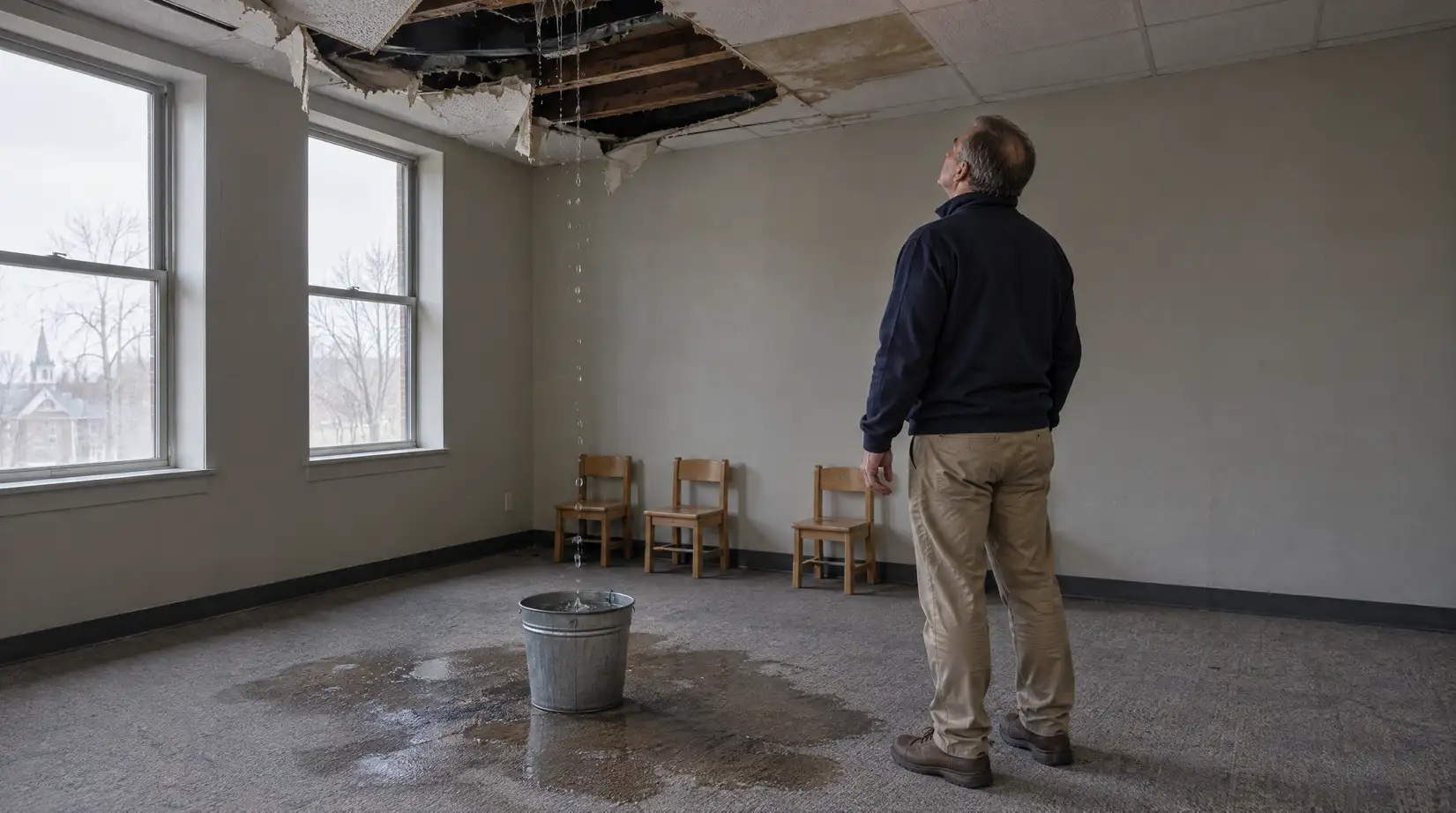
Once trapped water finds its way under the roofing material, it commonly works into the attic space. If the dam goes unnoticed for an extended period, the resulting damage can affect the sheathing, the roof structure, ceilings, walls, and personal belongings inside the home [2]. Massachusetts’ state energy office lists the range of consequences property owners should watch for: Water damage to the sheathing, the roof structure, and the ceiling and walls below [1].
The root cause traces back to the building envelope itself. State energy officials point to inadequate attic insulation and unsealed air leaks as the drivers that let heat reach the roof deck [1], and United Policyholders lists the usual suspects — vent pipes, exhaust fans, chimneys, attic hatches, and light fixtures — as the places where warm air escapes from the living space into the attic [3].
Property owners can check these leakage points when assessing why a dam formed in one location and not another. That distinction matters later: ice dam damage tied to a known, pre-existing roof condition is one of the most common dispute points insurers raise [3], so understanding where and why the dam formed helps frame the claim before an adjuster does it for you.
What Property Insurance Covers — Sudden Damage vs. Maintenance
Because insurers evaluate ice dam claims largely on whether the water intrusion was sudden or the product of ongoing neglect, understanding this distinction before filing shapes what a property owner can reasonably expect to recover.
Dwelling and Personal Property Coverage
Interior or exterior damage caused by an ice dam on a roof is generally covered under homeowners and property policies, according to state insurance regulators [4]. The dividing line is the condition of the roof before the dam formed: coverage generally holds as long as notice is timely and it’s reasonably clear the damage was not solely due to known, pre-existing roof damage [3]. Regulators are blunt about the flip side — damage caused by age or pre-existing damage can be denied [4].
Roof Collapse Coverage
Homeowner policies will normally cover sudden and accidental roof collapses, the Connecticut Insurance Department notes — while damage caused by age or pre-existing damage could be denied [4]. One related wrinkle for renters and condo owners: a landlord’s policy pays for winter damage to the building itself, but not for personal contents, which must be covered by the renter’s own insurance [4]. The weight behind these events is not trivial — Massachusetts officials warn that accumulated ice can lead to structural collapse of roof overhangs and that falling ice can be fatal [1].
Why Ice Dam Removal Isn’t Covered
Property owners often assume that if insurance covers ice dam damage, it should also cover clearing the dam itself. In most cases it does not: coverage applies to the resulting damage, not to preventive or routine removal of ice and snow from the roof [4]. Property owners weighing whether to hire a removal service before or after damage occurs should budget for that cost separately from any anticipated claim payout.
The Documentation That Separates Paid Claims From Denied Ones
Because the sudden-versus-gradual distinction drives so much of the outcome in an ice dam claim, the documentation gathered in the first days after discovery often determines which side of that line an adjuster places the loss on.
State insurance regulators recommend calling the insurer’s 24-hour claims line as soon as the damage is discovered, providing the policy number and details of the loss, and keeping a written record of everything reported [4].
Photographs and video of the damage — taken before anything is touched — give the clearest evidence of the loss as it appeared when discovered. That footage goes further when it is paired with a personal property inventory checklist covering every affected room and belonging.
Only temporary repairs necessary to prevent further damage should be made before the insurer’s inspection; permanent repairs made too early can eliminate the visual evidence an adjuster needs, and all receipts from temporary work should be saved [4]. Regulators also recommend keeping a diary of every conversation, email, and piece of correspondence exchanged with the insurance company throughout the claim [4].
Coverage generally requires that notice be given promptly and that it be reasonably clear the damage was not caused solely by pre-existing roof problems [3]. This is where many claims run into trouble: common disputes center on policy language that limits payment to actual cash value rather than replacement cost, insurer arguments that the damage reflects a pre-existing condition or construction defect, disagreements over the scope and cost of necessary repairs, and disputes over whether the insurer must restore the roof to a uniform, matching appearance rather than patching only the damaged section [3]. This is why the pre-existing-damage question dominates ice dam disputes: regulators caution that damage tied to age or pre-existing roof problems can be denied [4], and United Policyholders flags arguments over pre-existing damage or construction defects as one of the recurring flashpoints in these claims [3].
Why Ice Dam Claims Get Disputed — and How to Strengthen Yours
Because ice dam claims sit at the intersection of a covered peril and an excluded maintenance issue, they are disputed more often than many other water damage claims — but the outcome is not fixed from the start. When the insurer still comes back with a number that does not cover the loss, our guide to underpaid insurance claim steps lays out the escalation path.
Connecticut’s insurance department notes that damage caused by an ice dam is generally covered, but many policies specifically exclude the cost of removing the ice dam itself [4].
United Policyholders, a national consumer advocacy nonprofit, echoes that coverage generally applies as long as notice is timely and it’s reasonably clear the damage wasn’t caused solely by a pre-existing roof condition — while flagging the same recurring disputes over pre-existing damage claims and uniform roof restoration [3]. The organization recommends several preventive steps: keeping gutters clear of debris, having the roof and attic inspected for adequate ventilation and insulation, keeping the lower 3-6 feet of the roof clear of snow, and installing a rubberized ice-and-water shield beneath shingles near the eaves [3]. It also advises against chipping, breaking, or melting ice dams with a snow blower, shovel, or blowtorch, and recommends consulting a roofing professional instead [3]. If a dispute does arise, United Policyholders points to filing a complaint with the state Department of Insurance as an available option [3].
The common thread in regulator guidance is documentation: photograph or video the damage before anything is touched, make only the temporary repairs needed to prevent further damage, save every receipt, and keep a diary of every conversation and email with the insurer [4]. Pair that with the prevention steps above and an ice dam claim starts from a position of strength rather than ambiguity.
When to Get a Public Adjuster
Because so many ice dam disputes come down to actual cash value limits, pre-existing damage arguments, repair scope disagreements, and uniform-matching obligations, these are exactly the areas where a licensed public adjuster is typically brought in [3]. United Policyholders cautions property owners to be wary of unqualified or unethical roofing “experts,” including door-to-door solicitors who act as public adjusters without holding a license [3].
Compensation and licensing rules vary significantly by state, which is worth understanding before hiring anyone. Florida law caps public adjuster compensation at 20% of a settlement for non-catastrophe claims and 10% for claims filed during a declared state of emergency, with additional limits on reopened or supplemental claims [5]. The National Association of Insurance Commissioners has adopted a model law that many states use as the framework for their own public adjuster licensing and compliance rules [6].
| State | Public Adjuster Licensing Status |
|---|---|
| Colorado | License required — acting as a public adjuster without one is prohibited (C.R.S. § 10-2-417) [7] |
| Illinois | License required under the Public Adjusters Law (215 ILCS 5/1515) [8] |
| Massachusetts | License required, including a written exam (M.G.L. c. 175, § 172) [9] |
| Kansas | License required for commercial-lines claims; residential public adjusting is currently unregulated under Attorney General Opinion 2025-022 [10] |
Public adjuster licensing is state-regulated, not universal — the NAIC’s model law is the framework many states start from, but each state writes its own rules [6].
Property owners considering this route should confirm licensing status in their state and ask any prospective adjuster for proof of credentials before signing an agreement. Our plain-English guide to what a public adjuster does covers how they charge and what to ask before hiring one.
Frequently Asked Questions
Does property insurance cover ice dam damage?
In most cases, yes — interior or exterior damage caused by an ice dam on a roof is generally covered [4]. Coverage becomes vulnerable when the damage is tied to age or a known, pre-existing roof condition rather than the ice dam itself [4][3].
Will insurance pay to remove an ice dam from my roof?
Generally, no. Coverage typically applies to the damage the ice dam causes — to shingles, decking, insulation, and drywall — rather than the cost of physically removing the ice itself, which most policies treat as routine maintenance [4].
Why do ice dam insurance claims get denied so often?
The most common flashpoints are policy language limiting payment to actual cash value, arguments that the damage reflects a pre-existing condition or construction defect, disagreements over the scope and cost of repairs, and whether the insurer must restore a uniform, matching roof appearance [3]. Regulators add the blunt version: damage caused by age or pre-existing damage can be denied [4].
When should I hire a public adjuster for an ice dam claim?
A public adjuster is typically most useful when a dispute involves actual cash value limits, disagreements over pre-existing damage, or arguments about the scope of repairs and matching materials [3]. Because licensing requirements and fee caps vary by state, it’s worth confirming credentials and understanding the fee structure before signing any agreement [5][6].
What to Do Before Filing Your Ice Dam Claim
Ice dams sit in a gray zone between a covered sudden loss and an excluded maintenance failure, and that ambiguity is exactly what insurers weigh when deciding whether to pay a claim in full, pay it partially, or deny it. The property owners who fare best are the ones who document the damage immediately, keep a written record of every call and email, and understand which parts of their loss — the water damage itself versus the ice removal — their policy is actually designed to cover.
Before you file — or before you accept a denial — run your policy through a free AI insurance policy analysis and see in minutes whether your insurer missed coverage you’re owed.
This content is for informational purposes only and does not constitute legal or insurance advice. Coverage decisions depend on the specific terms, conditions, and exclusions of each policy and the laws of the applicable jurisdiction; policyholders and contractors should consult with a qualified professional for advice on their particular situation.
Sources
[1] Ice Dams — Mass.gov (Massachusetts Division of Energy Resources)
[2] Preventing Roof Ice Dams — National Weather Service, NOAA
[3] Ice Dams and Insurance — United Policyholders
[4] Winter Insurance Claim Tips — Connecticut Insurance Department
[5] Florida Statutes § 626.854 — “Public adjuster” defined; prohibitions — Florida Legislature
[6] Public Adjuster Licensing Model Act (MO-228) — National Association of Insurance Commissioners
[7] Colorado Revised Statutes § 10-2-417 — Colorado General Assembly
[8] 215 ILCS 5/1515, Public Adjusters Law — Illinois General Assembly
[9] M.G.L. c. 175, § 172 — Massachusetts Legislature
[10] Public Adjusters (per AG Opinion 2025-022) — Kansas Insurance Department

Taylor Bezek

As the General Manager at JustClaims, Taylor Bezek brings over a decade of experience managing complex residential, commercial, and large-loss claims. A licensed Public Adjuster in TX (#2125659), FL (#W455048), CO (#769172), and 10 additional states, Taylor founded his own firm before joining JustClaims to scale a tech-forward solution for the insured. He is committed to combining industry expertise with AI to enhance speed, clarity, and outcomes for every policyholder. Taylor's mission is to modernize the public adjusting profession and ensure owners get exactly what they are entitled to.