San Antonio Hail Damage Claims 2026
September 16, 2026
Written by Stephane Elias
Share


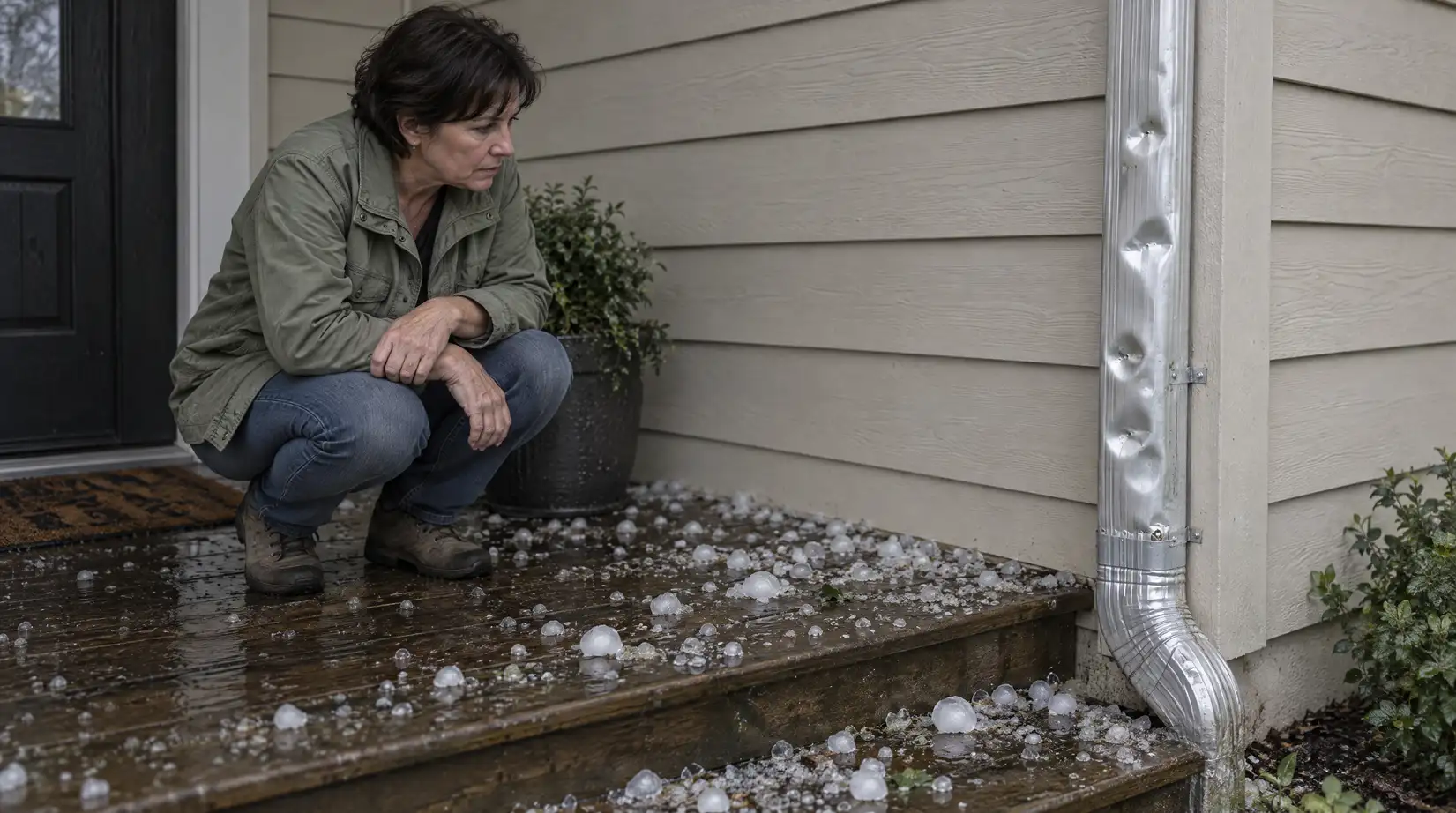
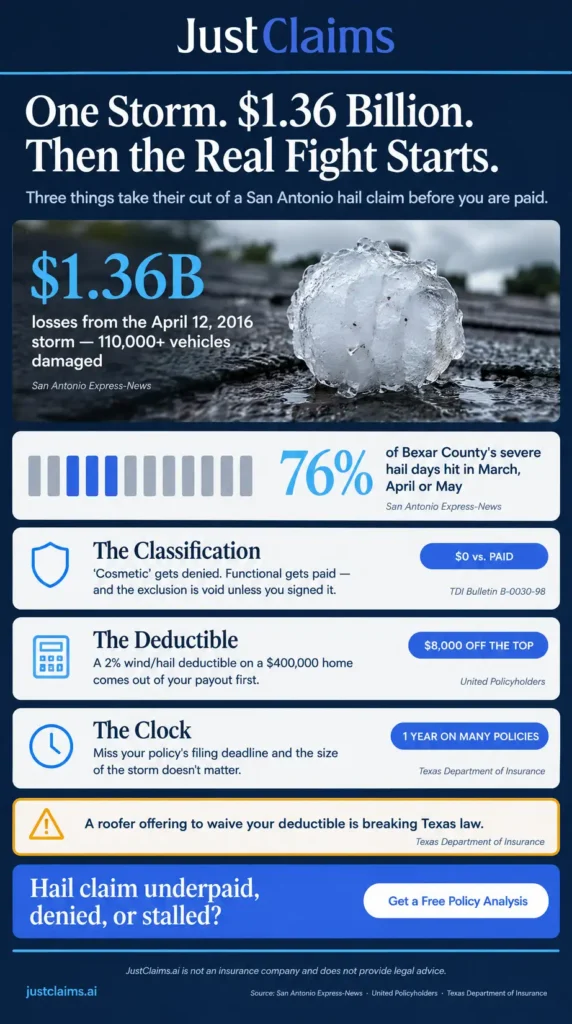
San Antonio’s costliest hailstorm on record dropped hail up to 4.5 inches across the North Side on April 12, 2016, damaging more than 110,000 vehicles and causing an estimated $1.36 billion in losses — one of the most expensive hailstorms in Texas history. And the threat concentrates in spring: 76% of Bexar County’s severe hail days land in March, April, or May. For San Antonio property owners, that spring concentration means the difference between a fully paid roof claim and a denied one often comes down to timing, documentation, and understanding what insurers are actually required to pay.
Key Takeaways
- Peak hail season: 76% of Bexar County’s severe hail days occur in March, April, or May, with April recording 57 hail days and May recording 49.
- Costliest storm on record: The April 12, 2016 hailstorm caused an estimated $1.36 billion in damage — one of the costliest in Texas history.
- Cosmetic vs. functional line: Texas Department of Insurance Bulletin B-0030-98 defines cosmetic hail damage as damage that does not allow water penetration or cause the roof covering to fail its job of keeping out the elements.
- Deductible standard: A 2 percent wind/hail deductible is now the dominant standard across most of Texas — that’s $8,000 on a $400,000 home.
- Filing deadline: Most policies set their own claim deadlines — some allow one year with good cause; TWIA wind/hail policies allow one year from the date of damage.
- Deductible waivers are illegal: Texas law makes it illegal for a contractor or roofer to waive or rebate your deductible, and insurers can demand proof you paid it.
San Antonio’s Spring Hail Spike
Severe hail is far from rare in San Antonio, but it is not spread evenly across the calendar. Since 1970, Bexar County has logged 176 days with at least one report of 1-inch-diameter or larger hail, and 76% of those hail days landed in March, April, or May [1]. April is the most active month, with 57 hail days recorded, followed by May with 49 [1].
From 2016 through 2025, San Antonio averaged 4.4 severe hail days per year — the highest 10-year stretch on record for the county, up from a long-term average of roughly 3.1 days per year since 1970 [1].
Some of those storms produce hail large enough to cause structural roof damage rather than just cosmetic marks. Bexar County has documented at least 99 instances of golf-ball-size hail since 1970 — about 1.8 times a year — while softball-size hail, 4 inches or larger, has been recorded on only five days [1].
The benchmark event remains the April 12, 2016 storm, when 4.5-inch hail battered the North Side, damaged more than 110,000 vehicles, and caused an estimated $1.36 billion in losses — one of the costliest hailstorms in Texas history [1]. Statewide, Texas led the nation with 902 major hail events in 2025 — more than double second-place Illinois’s 375 — making it the country’s hail damage capital for the 11th straight year [2].
What a San Antonio Hail Claim Should Pay
Because spring hail concentrates so much risk into a few months each year, knowing what a policy is actually supposed to pay after a strike matters as much as knowing when storms hit.
Texas Department of Insurance guidance explains that wind/hail deductibles can be written as either a specific dollar amount or a percentage of the home’s insured value [3].
On a $150,000 home with a 5 percent deductible ($7,500), a $6,500 roof repair estimate would result in a payment of $0, because the damage falls below the deductible threshold [3]. Replacement cost coverage pays the full current repair cost, while actual cash value coverage reduces the payout for the roof’s age and wear; insurers are not required to replace a roof simply because it is old [4]. Most replacement-cost claims are paid in two installments — an initial payment followed by the remainder once repairs begin [4].
The dollars at stake are large. State Farm processed 95,200 hail-related claims in Texas in 2025, with an average payment of $15,000 — roughly $1.4 billion in hail payouts from that single carrier [2]. Texas recorded 902 major hail events in 2025, more than double second-ranked Illinois’s 375 — the 11th consecutive year Texas has led the nation in hail damage [2].
A 2 percent wind/hail deductible has become the dominant standard across most of Texas; on a $400,000 home that means an $8,000 deductible, and on a $600,000 home approximately $12,000 — calculated against the full dwelling value, not just the roof[2]. Property owners should confirm their deductible type and dollar exposure before assuming a hail claim will result in a net payment.
Functional vs. Cosmetic Hail Damage on San Antonio Roofs
Because insurers calculate payment based on repair cost above the deductible, whether hail damage is even payable at all often hinges on a specific regulatory distinction: functional damage versus cosmetic damage.
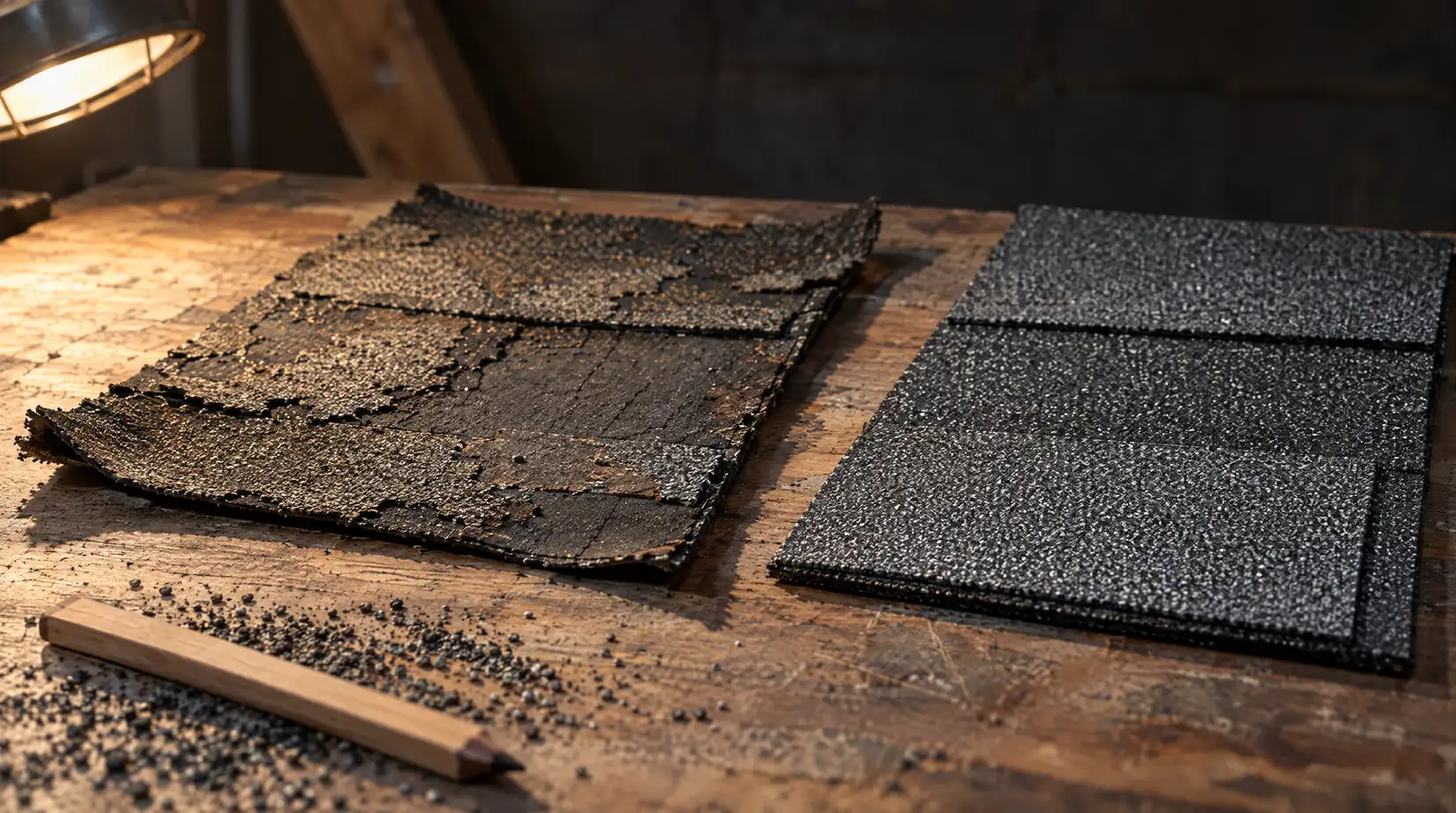
The Texas Department of Insurance defines cosmetic damage as harm that changes a roof covering’s appearance but does not allow water penetration and does not cause the roof to fail its intended purpose of keeping out the elements over time [5].
Damage crosses into functional territory — and becomes payable — when it results in water penetration or causes the roof covering to fail that protective function [5]. This functional/cosmetic line is the standard adjusters apply to San Antonio roof inspections after every spring storm. Our functional vs. cosmetic hail damage guide breaks down how carriers apply that test and when a cosmetic-only denial can be challenged.
Insurers can exclude purely cosmetic hail damage, but only under specific conditions. TDI adopted Endorsement HO-145 for homeowners policies and TDP-022 for dwelling policies, effective May 2, 1998, allowing a cosmetic-damage exclusion only on roofs eligible for, and receiving, a premium credit for impact-resistant roofing meeting UL Standard 2218 [5]. The endorsement is void unless the property owner signed it [5].
The Texas Windstorm Insurance Association applies a parallel exclusion, Endorsement TWIA-420, effective June 15, 1999, for coastal and TWIA-insured properties[6]. San Antonio property owners should check their policy declarations page for one of these endorsements before assuming a denial for “cosmetic damage only” is final — many standard policies never adopted the exclusion at all.
Documentation and the Supplement Cycle
Because the functional-versus-cosmetic distinction is often contested, the strength of a San Antonio hail claim usually comes down to the documentation gathered in the days after the storm.
TDI recommends photographing and recording video of all visible damage, keeping damaged materials until the adjuster has inspected them, and preserving a list of repairs and receipts [7].
Property owners should avoid making permanent repairs before the adjuster’s inspection, though temporary measures to prevent further damage, such as covering a hole, are appropriate [7]. If the insurer’s estimate seems too low, TDI recommends explaining the disagreement in writing and submitting supporting documentation, such as an independent contractor estimate, since the carrier may revise the payment after review [8]. This back-and-forth — commonly called the supplement cycle — is where additional damage found during repairs, or missed during the initial inspection, gets added to the claim.
When a disagreement over the amount of loss cannot be resolved through supplements alone, many Texas homeowner policies include an appraisal clause: each side hires an appraiser, the two appraisers select an umpire, and the umpire’s decision on the loss amount binds both the insurer and the property owner [8].
Deadlines to demand appraisal are set by each policy, so check yours for any appraisal deadline before the dispute process begins[8]. It is illegal in Texas for a contractor or roofer to offer to waive or rebate a property owner’s deductible, and insurers may request proof — a receipt or canceled check — that the deductible was actually paid before finalizing a claim [9].
When to Get Help
Because supplement negotiations and appraisal deadlines move quickly once a claim is open, knowing when to escalate a San Antonio hail claim protects against missed windows for recovery. Understanding what a public adjuster does before those windows close makes the escalation decision easier.
TDI advises filing a claim as soon as possible after hail or wind damage [12], and its consumer help line at 800-252-3439 answers claim-filing questions [7]. Deadlines to file a hail claim vary by policy — some policies set a one-year deadline unless you can show good cause for the delay, and TWIA wind and hail policies allow one year from the date of damage[10].
Texas law sets a floor under lawsuit deadlines: a policy’s suit-limitation period cannot expire before the earlier of two years from the date the insurer accepts or rejects the claim, or three years from the date of loss [11]. If a property owner believes the payment offered does not cover the actual damage, or that a denial was unfair, TDI confirms formal options exist to dispute the outcome, including filing a complaint directly with the department [8].
Frequently Asked Questions
When is hail season in San Antonio?
Severe hail activity in Bexar County concentrates heavily in spring, with April historically the most active month and May close behind [1]. Property owners should schedule roof inspections in early spring, before storm season peaks, to catch damage from the prior year before it worsens.
What’s the difference between cosmetic and functional hail damage in Texas?
Texas regulators distinguish between damage that only changes a roof’s appearance and damage that lets water through or breaks down the roof’s protective function [5]. Only the latter type is generally required to be paid under standard Texas homeowner policies, unless a signed cosmetic-exclusion endorsement applies to that roof.
How much will my wind/hail deductible cost me on a hail claim?
Most Texas homeowner policies now carry a percentage-based wind/hail deductible calculated against the home’s full dwelling value rather than a flat dollar figure [2]. On higher-value homes, that percentage can translate into a deductible of several thousand dollars, which is subtracted from the total repair cost before any payment is issued.
How long do I have to file a hail damage claim in Texas?
Deadlines vary by policy. Some policies require claims within one year of the loss unless you can show good cause for the delay, and TWIA wind and hail policies allow one year from the date of damage — so check your policy’s notice-of-loss provision right away [10]. Texas law prevents a policy’s lawsuit deadline from expiring before the earlier of two years from the insurer’s claim decision or three years from the date of loss [11]. The safest course is to report damage as soon as you discover it [12].
What should I do before the adjuster inspects my roof?
TDI recommends photographing and recording video of all visible damage and holding onto damaged materials until the adjuster has seen them, rather than making permanent repairs beforehand [7]. Temporary measures that prevent further damage, like covering an active leak, are fine and often expected between the storm date and the inspection.
How to Protect Your San Antonio Roof Claim
San Antonio’s spring hail spike is predictable, but insurance outcomes are not. Property owners who inspect roofs before storm season, document damage immediately afterward, and understand the functional-versus-cosmetic distinction are in a stronger position when a claim is contested. Confirming the type and dollar exposure of a wind/hail deductible before assuming a payout will follow, and tracking supplement and appraisal deadlines closely, can prevent a legitimate claim from stalling or being denied on a technicality.
Before the next storm rolls through, get a free AI policy analysis from Justin — upload your policy and see in minutes what your wind/hail deductible, cosmetic-damage terms, and appraisal rights actually say.
This content is for informational purposes only and does not constitute legal or insurance advice. Coverage decisions depend on the specific terms, conditions, and exclusions of each policy and the laws of the applicable jurisdiction; policyholders and contractors should consult with a qualified professional for advice on their particular situation.
Sources
[1] How often does large hail actually happen in San Antonio? — San Antonio Express-News
[2] For the 11th straight year, Texas is the hail damage capital of the US — United Policyholders
[3] What to know about deductibles — Texas Department of Insurance
[5] Bulletin B-0030-98: Amendments to the Texas Personal Lines Manual — Texas Department of Insurance
[6] Subchapter E. Texas Windstorm Insurance Association (Form TWIA-420) — Texas Department of Insurance
[7] Help after a storm — Texas Department of Insurance
[8] What if my insurance isn’t paying enough? — Texas Department of Insurance
[9] Is it OK for a contractor to waive my deductible? — Texas Department of Insurance
[10] Home insurance guide — Texas Department of Insurance
[11] Texas Insurance Code § 2301.010 — Texas Legislature
[12] Hail damage to your home or car? What to do next. — Texas Department of Insurance

Stephane Elias

A seasoned insurance professional with nearly a decade of experience, Stephane Elias is currently serving as a Senior Claims Professional and Public Adjuster with JustClaims. Throughout his career, Stephane has represented policyholders through leading public adjusting firms and served as a loss consultant for law firms specializing in insurance litigation, giving him extensive expertise in complex property insurance claims. A licensed public adjuster in TX (#2645032), FL (#W564547), and six other states, he specializes in commercial and residential property claims, claims management, appraisals, mediation, and strategic partnerships. Stephane is passionate about helping policyholders overcome delayed, denied, and underpaid insurance claims, ensuring they receive the full recovery they’re entitled to under their policy.