Subcontractor Insurance Requirements: 5 Risk Management Tips

November 03, 2026
Written by Taylor Bezek
Share


A general contractor can end up paying an injured worker’s benefits when a subcontractor does not have its own workers’ compensation coverage in place — and the certificate in the project file will not change that by itself. State labor agencies describe the exposure differently, but the practical lesson is the same: verification is a financial control, not a filing exercise. This guide gives you a repeatable five-step framework for checking entity names, limits, endorsements, and renewals across every active job.
Key Takeaways
- Minnesota: A general contractor is liable for all workers’ compensation benefits due to an injured employee of an uninsured subcontractor.
- South Carolina: Employees of a subcontractor are statutory employees of the general contractor, who is liable if the sub has no coverage.
- Missouri: An uninsured sub can make the general contractor liable for injuries, and the GC’s insurer may have to pay claims and charge premium for that sub.
- Florida: For a sub that carries its own policy, the state lists three proofs a contractor must obtain before the job begins — the policy’s Information Page, a Proof of Coverage database printout, or a certificate plus written confirmation from the producer or carrier.
- Certificate reality: A certificate is a synopsis of coverage as of the date it was issued. It is not the policy and cannot amend, extend, or alter coverage.
- Tracking: One shared register of certificates, endorsements, and renewal dates, owned by a named person, closes the gap between projects.
Rules vary by state and change over time; confirm current requirements with your state agency or a qualified attorney.
Why Subcontractor Coverage Gaps Become Your Liability
Insurance compliance matters because responsibility for an uninsured subcontractor tends to move up the contract chain to the general contractor. Several state agencies say so directly, though the details differ by jurisdiction.
Four states show how far the wording can diverge.
| State | What the state agency says |
|---|---|
| South Carolina | Subcontractor employees are statutory employees of the general contractor, who is liable if subs lack their own workers’ comp. A general contractor may require subs to carry coverage to avoid that liability [1]. |
| Florida | Each subcontractor is responsible for covering its own workers, but the primary contractor is responsible for ensuring the sub has provided that coverage [2]. |
| Missouri | The general contractor may become liable for injuries an uninsured sub sustains, and its insurer may be required to pay claims [3]. |
| Minnesota | A general contractor is liable for all workers’ compensation benefits due to an injured employee of an uninsured subcontractor [4]. |
Rules vary by state and change over time, so confirm the requirements that apply to your project with your state agency or a qualified attorney. The common thread is that a contractor who accepts a certificate without checking what stands behind it may be carrying a risk it believes it has transferred.
The 5 Steps That Keep Subcontractor Coverage Verified
Because liability can flow upward when a sub’s coverage fails, each step below is designed to confirm that the coverage described on paper actually exists and matches your contract.
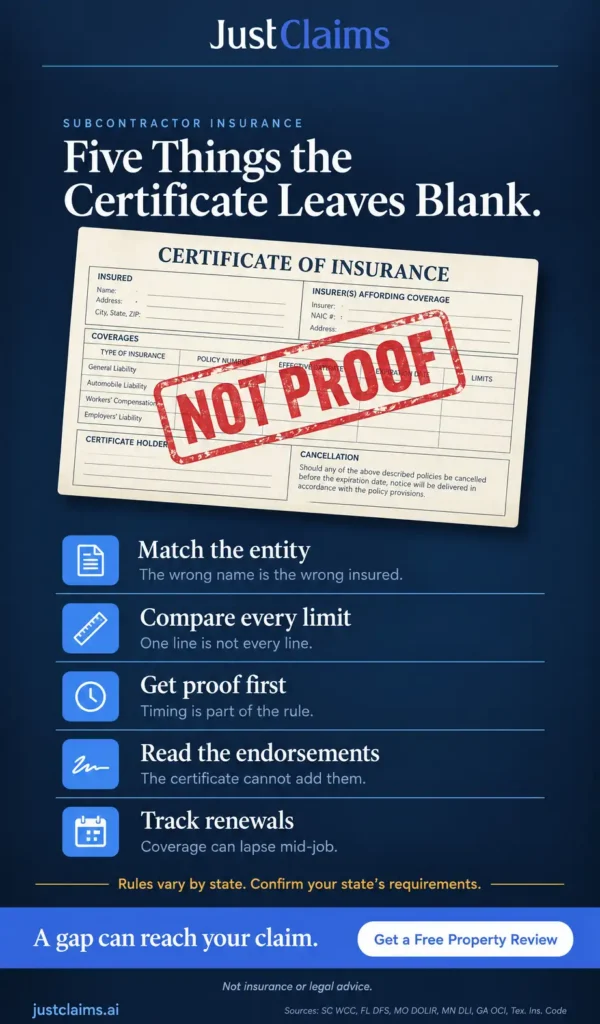
1. Match the Legal Entity Name to the Subcontract
Confirm that the legal entity named on the certificate is the same entity you hired and named in the subcontract. If the names differ — a related company, a former business name, a parent or affiliate — ask the producer for the policy declarations before work starts. A certificate only summarizes the policy it references and cannot be used to expand coverage[5], so a name mismatch is a documentation problem to resolve, not a detail to note.
2. Confirm Every Required Coverage Line and Limit
Compare every coverage line and limit on the certificate against your subcontract, one line at a time. A general liability line does not tell you whether the workers’ compensation, auto, or umbrella requirement is met. When a line is missing or a limit falls short, ask for the policy forms or endorsements that show the actual terms instead of accepting a revised certificate [5].
3. Get Proof Before the Job Begins
For workers’ compensation, Florida’s Department of Financial Services says that when a sub has its own policy, the contractor must obtain one of three proofs before the job begins: the policy’s Information Page, a printout from the Division’s Proof of Coverage database, or a Certificate of Liability Insurance with written documentation from the producer or carrier confirming coverage is in effect [2]. The timing is part of the requirement, not a formality.
4. Check Endorsements Against the Contract — Not the Certificate
A certificate cannot amend, extend, or alter coverage — Texas says so in statute [6] — and Georgia’s insurance department notes that a certificate holder may ask for copies of the actual policy forms or endorsements to verify coverage [5]. Those forms — not the certificate — are what your contract requirements should be checked against. If your subcontract requires additional insured status or a waiver of subrogation, confirm it in the forms themselves. If your team is unsure how those roles differ, review named insured vs additional insured before finalizing your contract requirements.
5. Track Renewals Centrally Across Projects
A certificate reflects coverage only as of the date it was issued, so a project that runs past the policy’s renewal date needs a fresh check[5]. Keep one register of certificates, endorsements, and renewal dates, assign one person to own it, and request updated proof before each renewal date. Otherwise the follow-up falls between project managers, and the file looks complete while the coverage is not.
Common Pain Points: Expired Coverage and Non-Compliant Subcontractors
Two failures the five steps above are built to catch are expired coverage and subcontractors who cannot show proof, and both can quietly undo a file that looks complete.
Expired or Lapsed Coverage
A certificate reflects coverage when it was issued, so a project that runs past a policy’s renewal date needs a fresh verification [5]. Tracking renewal dates in one place gives you a chance to request updated documentation before work continues under a policy that may no longer be active. When a renewal date passes without updated paperwork, treat the sub’s coverage as unverified until the carrier or producer confirms otherwise.
Subcontractors That Cannot Show Proof
Missouri’s Department of Labor notes that a general contractor may require a subcontractor to provide proof of its own coverage, and that giving that proof to the general contractor’s carrier can avoid premium charged for the uninsured sub [3]. Putting proof requirements in the subcontract, and tying payment or site access to them, gives you a documented basis for pausing work when documentation is missing. Have an attorney review the exact wording, since enforceability depends on your state and contract.
A Multi-Project Compliance Checklist
Because the same gaps recur across jobs, a standard checklist applied at fixed points keeps you from relying on memory. The checklist below applies the state requirements and verification practices described above [2][3][5].
Before mobilization
- Match the entity name on the certificate to the subcontract.
- Confirm each required coverage line and limit.
- Obtain one accepted proof of workers’ compensation before mobilization.
- Compare endorsements and waiver language with contract requirements.
During the project
- Record each policy renewal date in a central register.
- Request updated documentation before any policy renews.
- Pause new work for subs whose proof is missing.
At closeout
- Archive certificates, endorsements, and confirmations with the project file.
- Note any sub that repeatedly lapsed, for future bid decisions.
This framework covers upstream insurance requirements for your subcontractors. Rules governing contractors who assist with insurance claims are a separate subject, covered in public adjusting compliance for contractors.
Frequently Asked Questions
Is a certificate of insurance enough to prove a subcontractor is covered?
No. A certificate is a synopsis of coverage as of the date it was issued — it is not the policy and cannot amend, extend, or alter coverage[5]. For workers’ compensation, a sub that carries its own policy can prove it with any of three documents Florida accepts before the job begins: the policy’s Information Page, a Proof of Coverage database printout, or a certificate plus written confirmation from the producer or carrier [2].
Can a general contractor be responsible if a subcontractor has no workers’ comp?
It depends on the state. Minnesota says the general contractor is liable for all benefits due to an injured employee of an uninsured sub[4], and Missouri says the general contractor may become liable and its insurer may have to pay claims [3]. Check your own state’s rules, since the details differ.
What should I check first on a subcontractor’s certificate?
Start with the legal entity name, then the coverage lines and limits. A mismatch is a reason to request corrected documentation — or the policy declarations — before the sub starts work.
How can I keep track of renewals across several projects?
Because a certificate reflects coverage only as of the date it was issued [5], keep one register of certificates, endorsements, and renewal dates. Assign one person to own it so renewal follow-up does not depend on individual project managers.
How to Keep Your Subcontractors Compliant
Coverage on paper and coverage in force are not always the same thing, and the cost of that difference can land on the general contractor. You can reduce that exposure by matching entity names, confirming each line and limit, obtaining one of the accepted proofs before mobilization, and tracking renewals in one register. Applying the same checklist to every project makes compliance routine and helps protect your scope, your schedule, and your reputation.
When a covered property loss hits the project, the payout for that loss runs through the property policy — not the sub’s certificate. Get a free property policy review with Justin before you scope the repair.
This content is for informational purposes only and does not constitute legal or insurance advice. Coverage decisions depend on the specific terms, conditions, and exclusions of each policy and the laws of the applicable jurisdiction; policyholders and contractors should consult with a qualified professional for advice on their particular situation. Workers’ compensation and contractor liability rules vary by state and may change, so confirm current requirements with your state agency or an attorney. Public adjusting is a licensed activity regulated state by state; verify any public adjuster’s license with your state department of insurance before signing an agreement.
Sources
[1] Coverage and Compliance FAQs — South Carolina Workers’ Compensation Commission

Taylor Bezek

As the General Manager at JustClaims, Taylor Bezek brings over a decade of experience managing complex residential, commercial, and large-loss claims. A licensed Public Adjuster in TX (#2125659), FL (#W455048), CO (#769172), and 10 additional states, Taylor founded his own firm before joining JustClaims to scale a tech-forward solution for the insured. He is committed to combining industry expertise with AI to enhance speed, clarity, and outcomes for every policyholder. Taylor's mission is to modernize the public adjusting profession and ensure owners get exactly what they are entitled to.