Suing an Insurance Company: Property Claims & Disputes 2026
November 05, 2026
Written by Taylor Bezek
Share


In Colorado, the Division of Insurance recovered $5,764,272 on homeowners insurance complaints in fiscal year 2024–25 — part of $10.4 million recovered on property and casualty complaints overall, all through the state’s complaint process rather than a courtroom. For a commercial property owner, the gap between the carrier’s estimate and the documented loss can run into seven figures, which makes the decision to litigate a financial one as much as a legal one. This guide explains when suing an insurance company makes financial sense, what the process looks like, and how to prepare.
Key Takeaways
- Common complaint drivers: Delays, denials, and unsatisfactory settlements are among the most common reasons consumers complain to state regulators.
- Regulator recoveries: Colorado’s Division of Insurance recovered $5.8 million on homeowners complaints in fiscal year 2024–25.
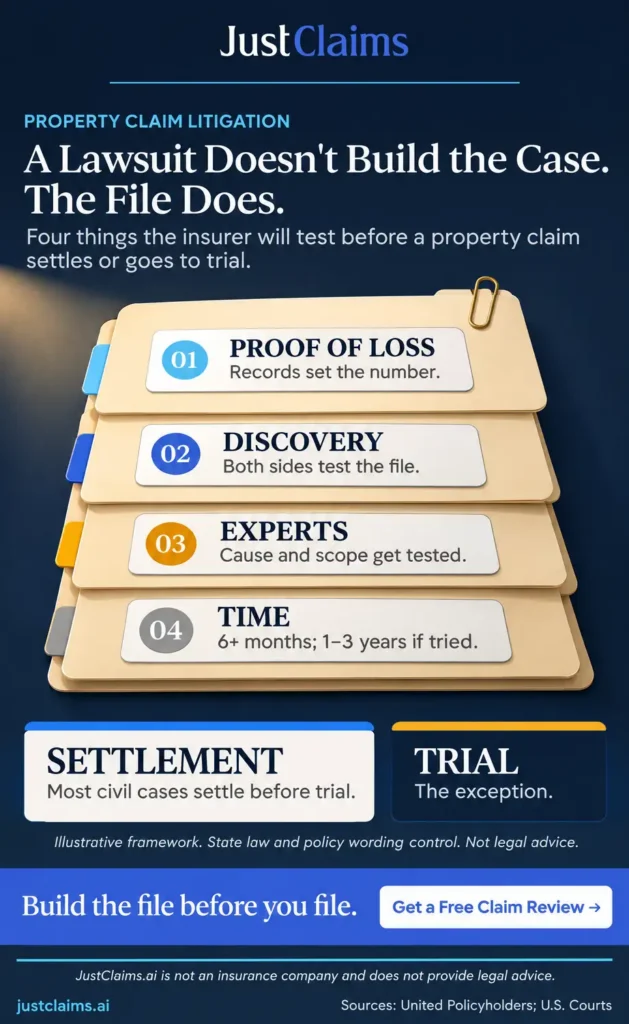
- Settlement reality: United Policyholders says a lawsuit can take six months or more, and one to three years if the case goes to trial.
- Federal answer deadline: Defendants generally have 21 days to answer a federal complaint.
- Burden of proof: A civil plaintiff must prove the case by a preponderance of the evidence — more likely than not.
- Typical contingency fee: 33% if the case settles before trial, 33–40% if it goes to trial.
Common Triggers for Property Insurance Litigation
Disputes that reach a courtroom usually start as ordinary claim problems that went unresolved. The NAIC, the association of state insurance regulators, says delays, denials, and unsatisfactory settlements are among the most common reasons consumers file complaints against carriers [1]. Regulators do more than log those complaints: in Colorado, the Division of Insurance recovered $10,430,250 on property and casualty complaints in fiscal year 2024–25, including $5,764,272 on homeowners complaints [2].
Denials and Underpayment
Many property claim disputes start with a number, not a lawsuit: the carrier’s estimate comes in below the documented cost of repair or replacement. The NAIC publishes closed, confirmed complaint data by company and insurance type [1].
For commercial property owners, underpayment can hide in the valuation.
Business interruption calculations and law and ordinance upgrade costs are two areas where a modest error in the carrier’s estimate can compound into a seven-figure shortfall. Complex claims require forensic-level analysis of both the policy language and the loss documentation.
Bad Faith Conduct
There is no single national definition of bad faith; the standard comes from state law. The NAIC’s model Unfair Claims Settlement Practices Act lists conduct that regulators treat as unfair, including failing to adopt and implement reasonable standards for the prompt investigation and settlement of claims, refusing to pay claims without a reasonable investigation, and not attempting in good faith to reach a prompt, fair, and equitable settlement once liability has become reasonably clear.
The same model law flags compelling policyholders to sue to recover amounts due by offering substantially less than the amounts ultimately recovered [3]. Whether particular conduct meets your state’s bad-faith standard, and what remedy it triggers, depends on state law, so counsel should evaluate it.
What to Try Before You File Suit
Two cheaper levers exist before a courtroom. The first is the regulatory complaint process. The NAIC says state insurance departments take complaints seriously and are prepared to help, and it publishes closed, confirmed complaint data by company and insurance type [1]. The Colorado figures above show the mechanism moves real money [2].
The second lever is your own policy. If it has an appraisal clause, review it first; our guide on appraisal vs. litigation explains where that path ends and litigation begins, and JustClaims’ insurance claim appraisal services cover what invoking the clause looks like in practice. United Policyholders is blunt about sequencing: file suit only as a last resort, after all negotiations have failed, because “a courtroom is the last place you want to be” [4].
The Litigation Process From Filing to Settlement or Trial
Because delayed payouts and disputed valuations are what push a claim toward court, it helps to know the sequence of events before you commit. The outline below follows the federal process. State-court deadlines and procedures vary by state.
| Stage | What happens |
|---|---|
| Complaint | The plaintiff files a complaint and serves a copy on the defendant [5] |
| Answer or motion | The defendant generally has 21 days to answer, or may move to dismiss first [6] |
| Pretrial conference | The judge holds a case management conference where a schedule for discovery is generally set [6] |
| Discovery | Parties exchange information and documents, and may take depositions [5] |
| Settlement talks | Judges commonly encourage settlement, and talks frequently occur in the final pretrial phase [6] |
| Trial | If no settlement is reached, the case proceeds to trial |
Filing the Complaint
A federal civil lawsuit begins when the plaintiff files a complaint with the court and serves a copy on the defendant. The complaint describes the damages, explains how the defendant caused the harm, shows the court has jurisdiction, and asks for relief. A filing fee required by statute applies [5]. Federal diversity jurisdiction requires an amount in controversy above $75,000 and parties who are citizens of different states [7]. Whether a particular property claim clears that bar is a jurisdictional question for counsel.
Discovery and Depositions
Discovery requires each side to exchange information such as witness identities and relevant documents. In a deposition, a witness answers a lawyer’s questions under oath in front of a court reporter, who produces a word-for-word transcript. Discovery exists to make each side assemble its evidence and prepare its witnesses, and either side may file motions seeking rulings on discovery or trial procedures [5]. Expect your own records, communications, and claim calculations to be examined closely.
Settlement or Trial
Judges frequently encourage litigants to settle to avoid the expense and delay of trial. Cases can settle during the final pretrial phase, and even during trial, including while a jury deliberates [6]. If a case is tried, the jury, or the judge in a bench trial, decides whether the defendant is responsible and the amount of damages.
The plaintiff must prove responsibility by a preponderance of the evidence — more likely than not [5]. United Policyholders says to expect the process to take six months or more, and one to three years if the matter goes to trial, which it describes as unusual [4].
Evidence Collection: Documentation, Expert Testimony, and Damage Assessments
Since valuation disputes drive so many of these cases, the quality of your evidence often shapes the outcome. United Policyholders says insurers generally require every claimant, even those who lost everything, to fully document their losses to get paid in full [8].
Documentation From Day One
The NAIC advises policyholders to list all damaged property, take photos and videos of the damage, explain what happened and describe the extent of the damage, keep receipts for repairs and new purchases, and review and update the inventory every year [9]. The NAIC consumer guide adds that you should jot down notes and keep track of the dates of any conversations with your agent or adjuster [10].
Avoid cleaning or repairing before the evaluation. The Arizona Department of Insurance and Financial Institutions warns that doing so could lead to a denial. If emergency repairs are unavoidable, ask the insurer which documentation it will accept and keep all receipts and photo records of the work [11].
Proof-of-loss requirements can be strict. Under the National Flood Insurance Program’s standard policy, for example, the policyholder must provide a signed and sworn proof of loss with documentation that supports the loss and dollar amount requested [12]. Check your own policy for similar sworn-statement obligations.
Expert Testimony
Federal Rule of Evidence 702 governs expert testimony in federal court. The expert must be qualified, and the testimony must help the factfinder. It must rest on sufficient facts or data and come from reliable principles and methods that are reliably applied to the case facts. The party offering the expert must show the court that these requirements are more likely than not met [13]. This gatekeeping standard applies to engineers, adjusters, and other damage experts. Choose experts whose methods you can defend under cross-examination.
Damage and Coverage Assessments
United Policyholders notes that insurers employ highly paid experts, so a policyholder in a dispute should seek legal help from someone with special expertise in the subject matter [8]. A thorough assessment compares the carrier’s estimate against the actual policy language. For commercial losses, that means testing business interruption calculations and law and ordinance provisions line by line. The NAIC also suggests having your contractor meet with you and the insurance adjuster [10]. Keep contractor scopes and adjuster estimates side by side so differences are visible.
How to Choose a Litigation Partner
If the evidence supports a dispute that outweighs the cost and time of suing, the next decision is who represents you. The insurer’s counsel will be experienced, so the quality of your representation affects both the case and the carrier’s settlement calculus.
Experience That Matters
United Policyholders advises against using a general-practice family lawyer. It says your lawyer should have experience representing policyholders in insurance coverage or bad faith litigation. Insurers usually hire very experienced defense counsel, and they weigh the risk of not settling by looking at how strong your representative is [14]. United Policyholders recommends finding counsel through referrals from friends, family, or reputable attorneys, or through its state-by-state professional help directory. It also recommends interviewing candidates about their insurance expertise and trial experience, and checking references from former clients [14].
Fees and Costs
Most lawyers who represent policyholders against insurers work on contingency, so they are paid only if the client recovers money, and many policyholders cannot afford to pay a lawyer by the hour [14]. United Policyholders says the fee is typically 33% if the case settles before trial and 33–40% if it goes to trial. Clients may still owe litigation costs even if they lose, and they can set a cost reserve with the attorney in advance [14].
Timing and Examination Under Oath
United Policyholders says the safest course is to consult an attorney at least a month before the one-year anniversary of the loss, because statutes of limitations can cut off the right to sue. You should also consult a qualified attorney before giving an examination under oath (EUO). A client can discharge an attorney at any time, but may still owe the reasonable value of the lawyer’s time [14]. Your policy and state law set the actual deadlines, so confirm them with counsel.
Frequently Asked Questions
When should a commercial property owner consider suing an insurer?
Consider litigation when a denial, delay, or underpayment persists after you have documented the loss and challenged the carrier’s position. Consult counsel early, because limitation periods can cut off your right to sue [14]. A lawyer can tell you whether the dispute justifies the cost and time.
What counts as bad faith in a property claim?
Bad faith is defined by state law, not by a single national standard. The NAIC’s model Unfair Claims Settlement Practices Act lists conduct regulators treat as unfair, including refusing to pay a claim without a reasonable investigation and failing to attempt a good-faith settlement once liability is reasonably clear [3]. Your state’s statute and your policy determine what you must prove.
How long does property insurance litigation take?
Timelines vary by court and case complexity. United Policyholders says to expect six months or more, and one to three years if the case goes to trial, which it describes as unusual [4]. Many cases settle before trial, sometimes during the final pretrial phase or even while a jury is deliberating [6].
Do I have to sue to challenge a denial?
No. Before suing an insurance company, a complaint to your state insurance department and your policy’s appraisal clause can both resolve a dispute without litigation [1]. United Policyholders recommends treating a lawsuit as a last resort after negotiations fail [4]. An attorney can tell you which path fits your policy and your state’s rules.
Do I need an expert witness?
Disputes over valuation, causation, or scope of damage often turn on expert opinion. Under the federal standard, an expert must be qualified and must use reliable methods that are reliably applied to the facts [13]. Your attorney can advise which experts fit your case.
What You Should Do Before Suing Your Insurer
Delayed payouts and dense policy language put commercial property owners under pressure, but a lawsuit is a long, costly path. Start by documenting the loss, tracking every conversation with the carrier, and avoiding repairs that could undermine your evidence. Then check your policy for an appraisal clause and any sworn proof-of-loss requirements. Consult an experienced policyholder-side attorney well before the one-year mark after the loss, and interview more than one candidate [14].
Run a free AI property insurance policy review with Justin to flag potential business interruption and law and ordinance coverage gaps before you and your counsel decide on next steps.
This content is for informational purposes only and does not constitute legal or insurance advice. Coverage decisions depend on the specific terms, conditions, and exclusions of each policy and the laws of the applicable jurisdiction; policyholders and contractors should consult with a qualified professional for advice on their particular situation. Public adjuster disclosure: this article is presented under a licensed public adjuster byline. Public adjuster licensing requirements and permitted activities vary by state, so verify any adjuster’s license with your state department of insurance. JustClaims is not a law firm and does not provide legal representation.
Sources
[4] Want to Sue Your Insurance Company? Here’s What Will Happen — United Policyholders
[5] Civil Cases — United States Courts
[6] Covering Civil Cases — Journalist’s Guide to Federal Courts — United States Courts
[8] Home Inventory and Contents Claim Tips — United Policyholders
[10] A Consumer’s Guide to Home Insurance — National Association of Insurance Commissioners
[11] Homeowners Insurance — Arizona Department of Insurance and Financial Institutions
[12] Proof of Loss Decision Upheld — Personal Property — National Flood Insurance Program (FEMA)
[13] Federal Rule of Evidence 702 — Testimony by Expert Witnesses — U.S. Government Publishing Office
[14] Hiring an Attorney for an Insurance Claim Q&A — United Policyholders

Taylor Bezek

As the General Manager at JustClaims, Taylor Bezek brings over a decade of experience managing complex residential, commercial, and large-loss claims. A licensed Public Adjuster in TX (#2125659), FL (#W455048), CO (#769172), and 10 additional states, Taylor founded his own firm before joining JustClaims to scale a tech-forward solution for the insured. He is committed to combining industry expertise with AI to enhance speed, clarity, and outcomes for every policyholder. Taylor's mission is to modernize the public adjusting profession and ensure owners get exactly what they are entitled to.