



Named Insured vs Additional Insured: Key Differences

July 08, 2026
Written by Taylor Bezek
Share


In 2022, named insureds achieved a 92% success rate for general liability claims, collecting $78 billion, while additional insureds saw only a 67% success rate due to narrower coverage terms. Being listed as the wrong type of insured on a construction project can leave property owners and general contractors entirely exposed to liability. Understanding the exact rights attached to your policy status is one effective way to protect your business when a claim occurs.
Key Takeaways
- Primary Rights: The named insured holds the primary right to file claims and negotiate settlements directly with the insurance company after a loss.
- Success Rates: In 2022, named insureds had a 92% success rate for general liability claims, compared to a 67% success rate for additional insureds.
- COI Limitations: Being listed as a certificate holder only proves that the subcontractor has active insurance on the date the COI was issued.
- Endorsement Requirement: To actually receive liability protection under a subcontractor’s policy, the general contractor or property owner must be granted ‘Additional Insured’ status through a specific policy endorsement.
- Co-Owner Status: An additional named insured is typically treated as a ‘co-owner’ of the policy, receiving broad coverages and rights similar to those of the actual named insured — though the exact scope depends on the policy’s specific definitions.
What ‘Named Insured’ Means at Claim Time
The named insured is the primary policyholder and the central figure in any insurance contract. When a loss occurs on a job site, the named insured holds the primary right to file claims and negotiate settlements directly with the insurance company after a loss [1]. This direct line of communication is vital when a project is stalled due to property damage or a liability claim, as it allows the primary policyholder to drive the recovery process without waiting on third parties.
The authority granted to the primary policyholder is absolute within the bounds of the contract. Named insureds have the undisputed right to file claims, whereas an additional insured’s right to file a claim is secondary and depends on the actions of the named party [1]. Furthermore, the named insured is legally empowered to seek compensation for damages or losses incurred during a covered incident [2]. This legal standing is what allows them to hire representatives, sign proof of loss documents, and ultimately accept settlement checks. It also determines who may invoke the appraisal clause to dispute the amount of loss — a right the carrier recognizes only from the named insured. Understanding these rights is as important as knowing what a claims adjuster is when navigating the aftermath of a site accident.
Beyond just financial payouts, the primary status dictates legal defense provisions. Being the named insured provides access to the insurer’s legal team for defense if sued, a level of protection not extended to others covered under the policy [1]. For a property owner or general contractor facing a third-party lawsuit after a workplace accident, lacking this defense provision means paying out-of-pocket for attorneys, even if they are eventually found not liable. The financial impact of this primary status is significant. In 2022, named insureds had a 92% success rate for general liability claims, collecting $78 billion, compared to a 67% success rate for additional insureds due to their narrower coverage [1].
What ‘Additional Insured’ Does (and Doesn’t) Cover
Because named insureds hold the primary power in any settlement negotiation, understanding the limitations of additional insured status is crucial for property owners and contractors relying on downstream coverage. An additional insured is typically added to a policy to protect them from liabilities arising specifically from the named insured’s operations. However, this status does not grant independent authority over the policy. Some states go further, and Colorado anti-managed repair laws limit how far a carrier can direct the repair.
The secondary nature of the additional insured status creates a structural bottleneck during the claims process. Because an additional insured’s right to file a claim is secondary and depends on the actions of the named party [1], they cannot unilaterally put the carrier on notice with the same authority. If the named insured (the subcontractor) disputes fault, breaches policy conditions, or delays reporting the incident to their carrier, the additional insured (the general contractor or property owner) is left waiting.
This lack of direct control often results in denied claims or prolonged disputes. The narrower coverage explains why additional insureds only achieved that 67% success rate during that timeframe [1]. Relying on someone else’s policy is inherently riskier than holding your own, making it essential to verify exactly what protections are extended before work begins.
The 3 COI Scenarios That Matter on Every Job Site
Since additional insured status carries strict limitations, verifying how you are listed on a subcontractor’s Certificate of Insurance (COI) serves as your primary defense against liability gaps. General contractors frequently encounter a scenario where a subcontractor provides a Certificate of Insurance (COI) listing the GC merely as a ‘Certificate Holder’ rather than an ‘Additional Insured’ as required by the contract [3]. This administrative oversight happens on job sites every day, often going unnoticed until a loss occurs.
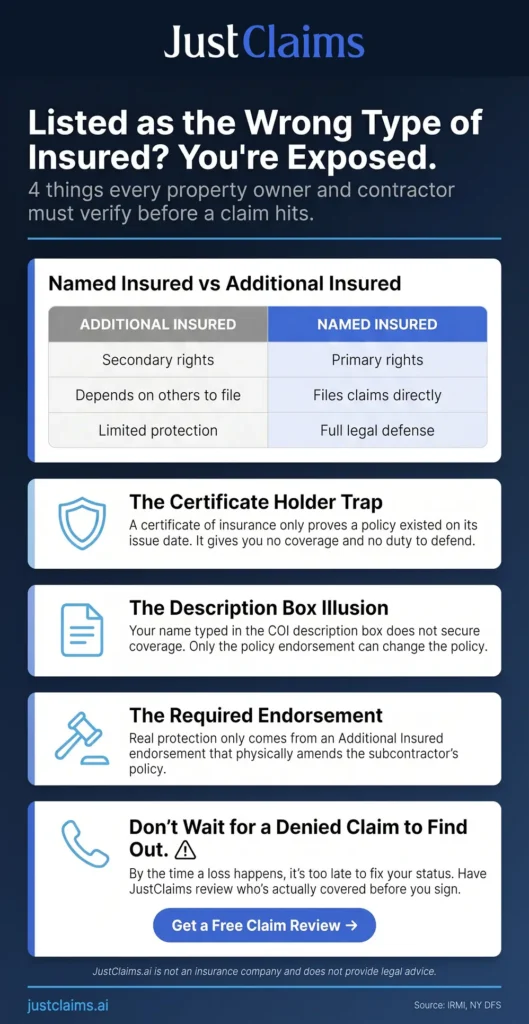
1. The ‘Certificate Holder’ Trap
Property owners and builders often file COI documents away, mistakenly believing the piece of paper protects them from site liabilities. However, being listed as a certificate holder only proves that the subcontractor has active insurance on the date the COI was issued, but it does not extend any actual coverage or duty to defend to the certificate holder [3]. It is merely an informational document. If the subcontractor cancels their policy the day after issuing the COI, the certificate holder has no recourse and no coverage. For an association, the association itself is the named insured on the HOA master policy, so the board — not a contractor’s certificate — decides what the policy defends.
2. The Description Box Illusion
Contractors often look at the bottom of the COI and see their name typed out, assuming this fulfills their contractual requirements. Even if a COI includes ‘Additional Insured’ wording in the description box, it does not secure coverage unless the actual policy endorsement is provided and verified, as COI language alone cannot change a policy [3]. The description box is essentially a clerical note; it holds no legal weight against the actual policy contract. Courts have repeatedly ruled that the COI is not the contract, and the policy itself governs the coverage.
3. The Required Policy Endorsement
To actually receive liability protection under a subcontractor’s policy, the general contractor or property owner must be granted ‘Additional Insured’ status through a specific policy endorsement [3]. This endorsement physically alters the subcontractor’s policy to extend specific, limited protections to the upstream parties. Standard construction contracts typically require subcontractors to add the general contractor as an additional insured and include indemnification language to hold the GC and property owner harmless [4]. Without verifying the endorsement itself, the indemnification clause may lack the financial backing needed to be effective.
| Document Feature | Provides Proof of Active Insurance | Extends Actual Coverage | Grants Duty to Defend |
|---|---|---|---|
| Certificate Holder Status | Yes, on date issued [3] | No [3] | No |
| COI Description Box Wording | Yes | No | No |
| Specific Policy Endorsement | Yes | Yes | Yes |
Additional Named Insured — A Third Status Most Miss
While navigating COI endorsements protects you from subcontractor liabilities, structuring your own corporate policies often requires a third classification: the additional named insured. This status bridges the gap between the primary policyholder and a standard additional insured, offering robust protection without the secondary limitations.
An additional named insured is typically treated as a ‘co-owner’ of the policy, receiving broad coverages and rights similar to those of the actual named insured — though the exact scope depends on the policy’s specific definitions [5]. This means they possess the same authority to file claims, negotiate settlements, and access the insurer’s legal defense team. Insurers often use the additional named insured status to cover related entities, such as affiliates, subsidiaries, or DBAs, providing them with broader protections than a standard additional insured [6]. For construction firms operating under multiple corporate umbrellas or joint ventures, this classification helps all related branches share the same defensive shield. Tenants sit outside that structure entirely, and the renters insurance claim process works differently.
The primary benefit of this structure lies in the separation of rights and administrative duties. While they enjoy full policy rights, additional named insureds typically do not share the primary named insured’s obligations, such as paying premiums or having the authority to cancel the policy [6]. This allows a parent company to manage the financial and administrative duties while extending full operational coverage to its subsidiaries. When dealing with complex corporate structures, knowing who holds the rights to negotiate with the carrier is just as vital as understanding what an insurance adjuster does during the field inspection.
Frequently Asked Questions
What is the main difference between a named insured and an additional insured?
The primary policyholder is the named insured, possessing the direct authority to submit claims and negotiate with the carrier [1]. Conversely, an additional insured holds secondary rights that rely on the primary policyholder’s actions, resulting in much narrower coverage and lower historical success rates [1].
Does being a certificate holder mean I have insurance coverage?
No, holding a certificate merely confirms that the subcontractor had an active insurance policy on the specific day the document was generated [3]. It does not provide the certificate holder with any legal defense or liability protection in the event of a claim [3].
How do I ensure I am actually covered under a subcontractor’s policy?
You should obtain a specific policy endorsement that officially grants you additional insured status [3]. Relying solely on text in the description box of a Certificate of Insurance is insufficient, as that document cannot alter the actual terms of the policy [3].
What are the benefits of being an additional named insured?
This status functions like a co-ownership of the policy, granting full coverage rights and protections to related businesses or subsidiaries [5][6]. However, these entities generally avoid the administrative burdens of the primary policyholder, such as paying the monthly premiums or managing cancellations [6].
How to Verify Your Policy Status Today
Reviewing your contracts and insurance documents before a loss occurs helps demonstrate your exact coverage standing. Property owners and general contractors should audit every subcontractor COI to confirm the presence of actual policy endorsements rather than relying on certificate holder status. Unsure whether you’re listed correctly on a policy? Justin can tell you exactly who’s covered, under what terms, and whether there are gaps you need to address before a claim. If your insurance claim was denied or underpaid, JustClaims‘ expert team — accelerated by our bespoke AI — reviews the policy language, compares it against your documentation, and flags likely underpayments so you can go back to the carrier with confidence.
This content is for informational purposes only and does not constitute legal or insurance advice. Coverage decisions depend on the specific terms, conditions, and exclusions of each policy and the laws of the applicable jurisdiction; policyholders and contractors should consult with a qualified professional for advice on their particular situation.
Sources
[1] https://www.irmi.com/articles/expert-commentary/who-wants-to-be-an-insured
[2] https://www.irmi.com/articles/expert-commentary/additional-insured-status-and-waivers-of-subrogation
[3] https://www.irmi.com/articles/expert-commentary/avoiding-common-insurance-certificate-errors
[4] https://www.irmi.com/articles/expert-commentary/additional-insured-status-automatic-or-wet-blanket

Taylor Bezek

As the General Manager at JustClaims, Taylor Bezek brings over a decade of experience managing complex residential, commercial, and large-loss claims. A licensed Public Adjuster in TX (#2125659), FL (#W455048), CO (#769172), and 10 additional states, Taylor founded his own firm before joining JustClaims to scale a tech-forward solution for the insured. He is committed to combining industry expertise with AI to enhance speed, clarity, and outcomes for every policyholder. Taylor's mission is to modernize the public adjusting profession and ensure owners get exactly what they are entitled to.


