



What Does an Insurance Adjuster Do? Roles & Process

June 10, 2026
Written by Taylor Bezek
Share


An insurance adjuster evaluates insurance claims to determine whether an insurance company must pay a claim and the appropriate amount to pay. Because complex claims require forensic-level analysis, minor valuation errors during this evaluation phase can cost commercial property owners millions in lost capital. Understanding who the adjuster represents and how they calculate damage is the first step in protecting your financial recovery.
Key Takeaways
- Core function: An insurance adjuster evaluates insurance claims to determine whether an insurance company must pay a claim and the appropriate amount to pay.
- Staff adjusters: Staff adjusters are full-time employees of a single insurance carrier and handle claims exclusively for that specific company.
- Independent adjusters: Independent adjusters are typically contracted by third-party firms to handle claims on behalf of multiple different insurance companies, often simultaneously.
- Public adjusters: A public adjuster is an independent professional hired directly by a policyholder to negotiate an insurance claim on their behalf, rather than working for the insurance company.
- Depreciation calculation: Adjusters calculate depreciation by evaluating an item’s Replacement Cost Value (RCV)—the current cost to repair or replace it—and its average expected life span.
Definition and Core Responsibilities
An insurance adjuster evaluates insurance claims to determine whether an insurance company must pay a claim and the appropriate amount to pay [1]. Complex claims require forensic-level analysis, and the adjuster serves as the primary investigator for the carrier. Their core responsibilities include interviewing claimants and witnesses, inspecting property damage, reviewing police reports, and consulting with experts [1].
During the evaluation phase, adjusters review factual information to prepare damage estimates, evaluate policy coverage, determine liability, and negotiate settlements [2]. Company adjusters work directly for the insurance company paying the claim, reviewing what happened to estimate the claims payment [3]. Conversely, a public adjuster is an independent professional hired directly by a policyholder to negotiate an insurance claim on their behalf, rather than working for the insurance company [4].
The Difference Between Staff, Independent, and Public Adjusters
Because minor valuation errors can have major financial consequences, property owners need to understand who the adjuster represents and how that relationship affects the claim process. The insurance industry generally uses three categories of adjusters: staff adjusters, independent adjusters, and public adjusters.
1. Staff Adjusters
Staff adjusters are full-time employees of a single insurance carrier and handle claims exclusively for that specific company [5]. When dealing with a staff adjuster, property owners should remember that the carrier behind these professionals is bound by state fair claims settlement regulations that govern how your claim must be handled [6]. Their primary objective is to align the damage assessment with the carrier’s internal guidelines and policy interpretations. That objective shapes every question in a recorded statement after a claim.
2. Independent Adjusters
Independent adjusters are typically contracted by third-party firms to handle claims on behalf of multiple different insurance companies, often simultaneously [5]. Carriers frequently deploy independent adjusters during catastrophic events when their internal staff is overwhelmed. While they represent the insurance company’s financial interests during the inspection, independent adjusters owe no direct duty of care to the policyholder [5].
3. Public Adjusters
Unlike staff or independent representatives, public adjusters are hired directly by the policyholder, work exclusively for the insured’s benefit, and are usually paid a percentage of the final settlement [5]. Property owners often retain public adjusters to level the playing field, as these professionals advocate solely for the policyholder’s financial recovery rather than the carrier’s bottom line.
What This Means for Contractors and Builders
For contractors and builders, the adjuster’s assessment directly influences the approved scope of work and the funds available for reconstruction. Knowing who is inspecting the property — and which valuation rules they are applying — is the first step in protecting your scope and your margin.
1. Verify the Valuation Method Before You Finalize the Contract
Once the insurance company sends an adjuster to evaluate the damage, the settlement is paid on either a replacement cost or an actual cash value basis, depending on the provisions in the policy [12]. If the property owner only has ACV coverage, the initial payout is final — which can leave a significant funding gap between the settlement and the real cost of construction. Confirm which rules apply before signing.
2. Walk the Property With the Adjuster
Be available during the inspection so you can point out structural issues, hidden damage, and code-upgrade requirements the adjuster might otherwise miss [7]. Providing manufacturer specifications and local building code references on the spot gives the adjuster what they need to justify a more accurate estimate to the carrier.
3. Compare the Statement of Loss Against Your Own Estimate
After the adjuster submits their report, the carrier issues a statement of loss. Compare it line by line against your own estimate. Initial adjuster estimates may omit legally required safety measures and administrative costs such as permits and fall protection. If you disagree with the estimate, tell the insurance company why and submit a detailed supplement with supporting evidence — carriers can and do adjust offers when presented with documentation [3]. When the two sides still cannot agree on the value of the loss after supplements, the policy’s appraisal clause can force a binding valuation through independent appraisers and an umpire.
4. Stay on the Right Side of Public Adjusting Laws
Contractors can discuss the scope of work, material costs, and repair methods with an adjuster during the inspection or supplement process. But negotiating policy coverage or settlement on the property owner’s behalf is reserved for licensed public adjusters and attorneys — doing it without the appropriate license is known as the unauthorized practice of public adjusting (UPPA) [13]. Some states go further: in Pennsylvania, for example, an adjuster who is also a contractor can only perform one function at a time and must hold two separate contracts with the policyholder [4]. Laws vary significantly by state; consult a licensed attorney familiar with your jurisdiction before engaging in any claims advocacy role.
Step-by-Step Breakdown of the Inspection Process
Since the adjuster’s findings dictate your financial recovery, navigating their inspection process requires strict oversight from the property owner. A claims adjuster is professionally trained to assess property damage and will typically visit the property to conduct a thorough evaluation before permanent repairs begin [6].
1. The Initial Visual Evaluation
During the primary site visit, the adjuster examines the structural damage, takes photographs, and notes the condition of the affected materials. Property owners should be available during the inspection to walk through the property and point out all areas of damage to the adjuster [7]. Pointing out hidden or secondary damage helps establish a more accurate baseline for the initial estimate.
2. The Scope of Loss Assessment
In situations involving severe or widespread destruction, a comprehensive evaluation may not be possible on the first day. If an adjuster cannot complete a full inspection immediately, they may perform a ‘scope of loss’—a brief initial inspection to assess the degree of damage and take measurements, requiring a follow-up visit [6]. This preliminary scope helps the carrier set initial reserves for the claim.
3. Property Owner Mitigation Requirements
While waiting for the adjuster to arrive, policyholders have specific duties under their insurance contract. Property owners should only make temporary repairs to secure the property and prevent further damage until the adjuster has completed their visual inspection [8]. Discarding damaged materials or initiating permanent reconstruction too early can jeopardize coverage. Understanding what an insurance claim adjuster is measuring helps you avoid that.
How Adjusters Calculate Claim Value and Depreciation
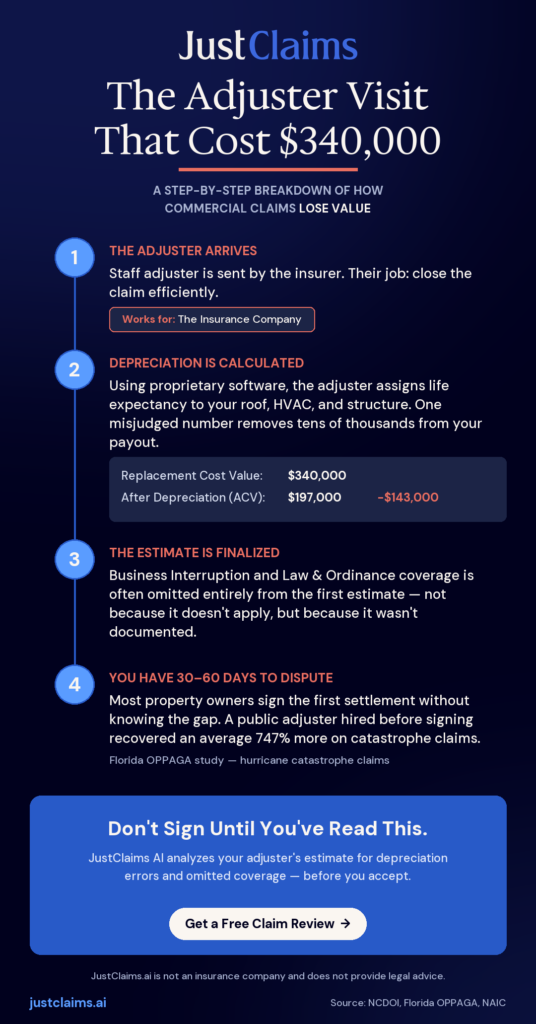
The financial impact of an adjuster’s visit culminates in their depreciation calculations, where minor valuation errors can cost millions in commercial claims. Actual Cash Value (ACV) is calculated by taking the amount needed to fix or replace property and subtracting the decrease in value due to age or use, which is known as depreciation [9].
Adjusters calculate depreciation by evaluating an item’s Replacement Cost Value (RCV)—the current cost to repair or replace it—and its average expected life span [10]. To determine the life expectancy of property, adjusters often use estimating software that relies on data from sources like the U.S. Government and the National Association of Home Builders [10].
The payout structure depends heavily on the specific policy endorsements. If a policy includes Replacement Cost Coverage, adjusters typically issue an initial payment for the Actual Cash Value, and later reimburse the ‘Recoverable Depreciation’ once the item is repaired or replaced and receipts are submitted [9].
Tips for Property Owners on How to Prepare for an Adjuster’s Visit
To prevent coverage gaps in complex areas like Business Interruption and Law & Ordinance, property owners must prepare meticulously for the adjuster’s arrival. Proactive documentation supports a more accurate initial estimate and reduces the likelihood of prolonged disputes.
1. Documenting the Damage
Visual evidence is the foundation of any successful property claim. It is important to document the damage by taking photographs and notes before the insurance adjuster arrives [11]. Capturing the immediate aftermath of a loss provides a clear record of the destruction before any temporary mitigation efforts alter the scene.
2. Gathering Documentation and Inventories
Adjusters rely on the information provided to them to verify the existence and value of affected assets. Owners who want an independent count should read what’s a public adjuster. Property owners should prepare an itemized list or property inventory of lost or damaged personal property to provide to the adjuster [11]. Additionally, policyholders should gather relevant documentation, such as their insurance policy and receipts for past repairs or maintenance, prior to the visit [11].
3. Managing Communication
Interactions with the adjuster become part of the official claim file. During the visit, property owners should avoid making statements that suggest they are to blame for the property damage, as policies do not cover losses caused by negligence [11]. Keeping a detailed log of all meetings and conversations with the adjuster, including dates and times, helps property owners stay organized during the claims process [11].
Frequently Asked Questions
What is the difference between Actual Cash Value and Replacement Cost Value?
Actual Cash Value represents the cost to repair or replace an item minus its depreciation based on age and wear. In contrast, Replacement Cost Value is the current market price required to buy a brand-new version of that same item without any deduction for depreciation.
Do independent adjusters work for the property owner?
No, independent adjusters do not represent the policyholder. They are hired by third-party firms to evaluate claims on behalf of the insurance carrier, meaning their primary function is to assess the damage according to the insurer’s guidelines.
What should I do before the insurance adjuster arrives?
Prior to the site visit, you should take extensive photographs of all damage and compile an itemized inventory of affected assets. It is also highly recommended to locate your insurance policy documents and any historical maintenance receipts to present during the inspection.
Can I start permanent repairs before the adjuster inspects the property?
You should refrain from beginning any permanent reconstruction until the carrier’s representative has fully documented the loss. However, Can a contractor negotiate directly with a claims adjuster?
Contractors can discuss the scope of work, material costs, and repair methods with an adjuster during the inspection or supplement process. However, negotiating policy coverage or acting as a public adjuster on the property owner’s behalf without the appropriate state license is the unauthorized practice of public adjusting (UPPA) [13] — and in many states, a licensed public adjuster is also prohibited from performing repair work on the same property [4]. Laws vary significantly by state; contractors should consult a licensed attorney familiar with their jurisdiction before engaging in any claims advocacy role.
How to Protect Your Commercial Claim Value
Navigating a major property loss requires strict attention to detail, as the adjuster’s initial findings set the financial trajectory for your entire recovery. By understanding how depreciation is calculated, preparing comprehensive documentation, and actively participating in the inspection process, you can better position your business for a fair settlement. Run your business interruption denial through JustClaims‘ expert team — accelerated by our bespoke AI — to identify the coverage gaps your insurer used against you.
This content is for informational purposes only and does not constitute legal or insurance advice. Coverage decisions depend on the specific terms, conditions, and exclusions of each policy and the laws of the applicable jurisdiction; policyholders and contractors should consult with a qualified professional for advice on their particular situation.
Sources
[1] U.S. Bureau of Labor Statistics — Claims Adjusters, Appraisers, Examiners, and Investigators: https://www.bls.gov/ooh/business-and-financial/claims-adjusters-appraisers-examiners-and-investigators.htm
[2] Insurance Information Institute — How to File a Homeowners Claim: https://www.iii.org/article/how-to-file-a-homeowners-claim
[3] Texas Department of Insurance — Working With an Insurance Adjuster: https://www.tdi.texas.gov/tips/working-with-adjuster.html
[4] Pennsylvania Insurance Department — Hiring a Public Adjuster: https://www.pa.gov/agencies/insurance/consumer-help-center/learn-about-insurance/homeowners/public-adjuster
[5] National Association of Insurance Commissioners — State Licensing Handbook, Chapter 18: Adjusters: https://content.naic.org/sites/default/files/inline-files/Chapter%2018%20-%20Adjuster%20Licensing.pdf
[6] California Department of Insurance — Residential Property Claims Guide: https://www.insurance.ca.gov/01-consumers/105-type/95-guides/03-res/res-prop-claim.cfm
[7] Texas Department of Insurance — Steps to Getting Your Home or Car Insurance Claim Paid: https://www.tdi.texas.gov/tips/getting-your-insurance-claim-paid.html
[8] Minnesota Department of Commerce — Filing a Residential Claim: https://mn.gov/commerce/insurance/home/residential-claim/index.jsp
[9] North Carolina Department of Insurance — Actual Cash Value vs. Replacement Cost Value: https://www.ncdoi.gov/consumers/homeowners-insurance/actual-cash-value-vs-replacement-cost-value
[10] Travelers — Understanding Depreciation: https://www.travelers.com/claims/guides/understanding-depreciation
[11] Insurance Information Institute — Settling Insurance Claims After a Disaster: https://www.iii.org/article/settling-insurance-claims-after-a-disaster
[12] Consumer Financial Protection Bureau — How Do Home Insurance Companies Pay Out Claims?: https://www.consumerfinance.gov/ask-cfpb/how-do-home-insurance-companies-pay-out-claims-en-1523/
[13] National Association of Public Insurance Adjusters — What Is a Public Adjuster: https://www.napia.com/what-is-a-public-adjuster

Taylor Bezek

As the General Manager at JustClaims, Taylor Bezek brings over a decade of experience managing complex residential, commercial, and large-loss claims. A licensed Public Adjuster in TX (#2125659), FL (#W455048), CO (#769172), and 10 additional states, Taylor founded his own firm before joining JustClaims to scale a tech-forward solution for the insured. He is committed to combining industry expertise with AI to enhance speed, clarity, and outcomes for every policyholder. Taylor's mission is to modernize the public adjusting profession and ensure owners get exactly what they are entitled to.


