



What Is an Insurance Loss Run? A Property Owner’s Guide 2026

July 17, 2026
Written by Collin Corcoran
Share


An insurance loss run report serves as a detailed claims history document covering a specific period, typically covering the previous two to five years of your claims history, detailing every claim filed under your policies during that window. Because potential insurers use this document to evaluate your risk level and determine premium rates, an inaccurate report can severely impact your coverage eligibility. Fortunately, many states require insurers to provide a requested loss run report within roughly 10 to 15 days, though the exact deadline varies by state, giving you the opportunity to review and correct your record.
Key Takeaways
- Defined-period record: An insurance loss run report documents a business’s claims history over a specific window — typically the previous two to five years — not an all-time permanent record.
- Report contents: Loss run reports typically include the insured’s name, policy number, dates of reported claims, claim descriptions, and settlement costs or reserve amounts for open claims.
- Review timeframe: When shopping for new coverage, most insurance companies will request loss run reports covering the previous two to five years of business operations.
- Risk evaluation: Potential insurers use loss run reports to evaluate a business’s risk level, which helps determine their eligibility for coverage and their premium rates.
- Statutory deadline: Many states require insurers to provide a requested loss run report within roughly 10 to 15 days, though the exact deadline varies by state.
The Anatomy of an Insurance Loss Run Report
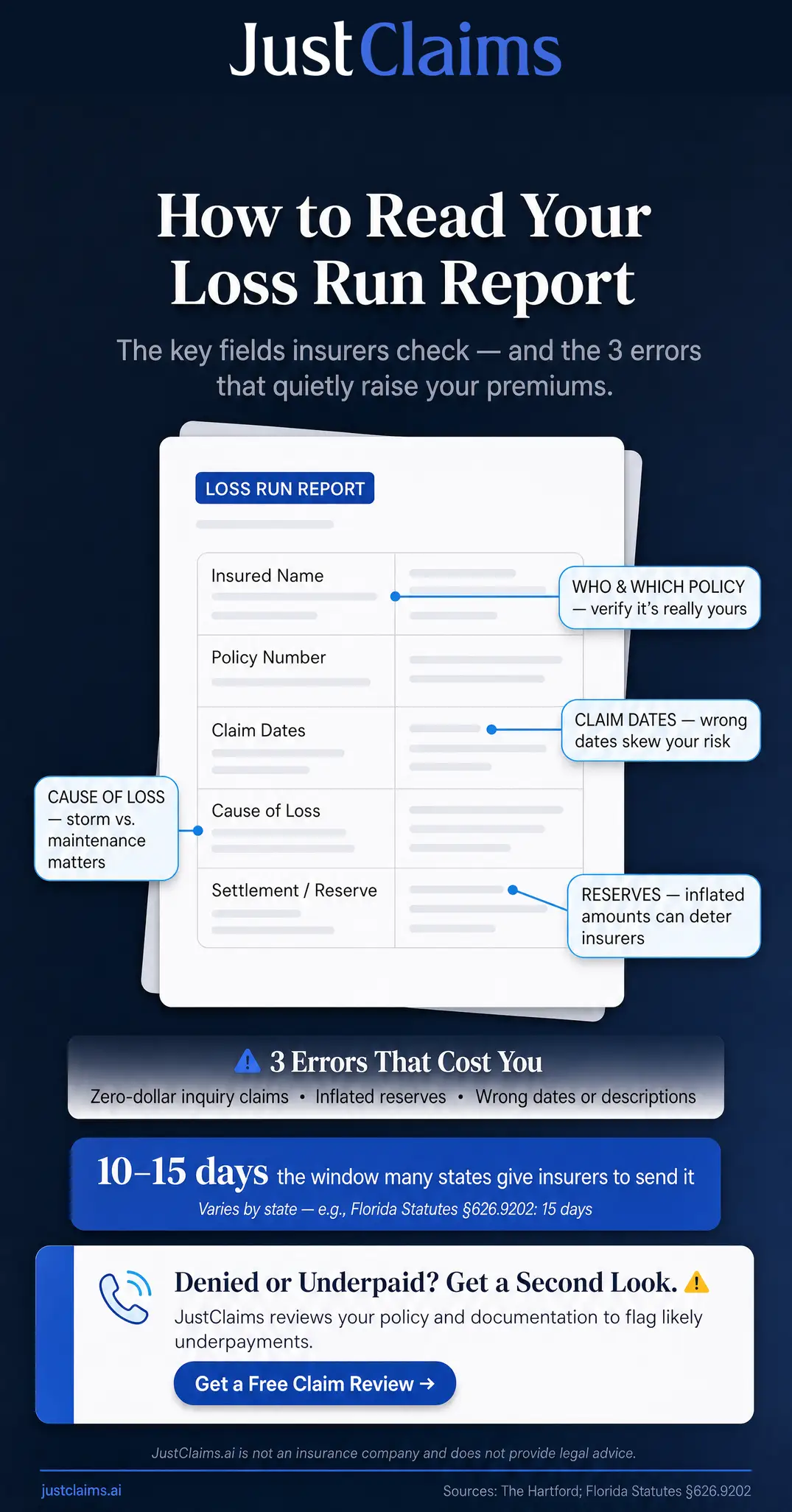
An insurance loss run report serves as a detailed claims history document covering a specific period, typically the previous two to five years of a claims history, detailing every claim filed under the applicable insurance policies [1]. While property owners rarely see this document until a dispute arises, understanding its contents can help you maintain accurate records and protect your insurability. Loss run reports typically include the insured’s name, policy number, dates of reported claims, claim descriptions, and settlement costs or reserve amounts for open claims [2].
1. Policyholder and Claim Identification
The foundational section of the report verifies your identity and the specific policy in question. It lists the named insured, the policy number, and the exact dates when claims were reported [2]. This timeline is critical because insurers track the frequency of claims over specific periods to assess future risk.
2. Incident Descriptions
Every entry includes a claim description that outlines the cause of loss [2]. Whether the damage resulted from wind, hail, fire, or water, the description categorizes the event. Accurate descriptions help future carriers distinguish between unavoidable catastrophic weather events and maintenance-related issues that might suggest higher ongoing risk.
3. Financial Settlements and Reserves
The financial columns detail the actual monetary impact of each incident. The report lists the final settlement costs for closed claims and the reserve amounts for open claims [2]. If you believe a past settlement shown on the report understated your loss, that amount of loss could have been contested — you can invoke the appraisal clause before a claim is closed. Reserve amounts represent the funds the insurance company has set aside to cover an ongoing claim, which can impact your risk profile even before a final payout is issued.
Why Insurance Carriers Review Your Claims History
Because your claims history directly influences your future insurance costs, understanding how carriers use this data is essential for any property owner. Potential insurers use loss run reports to evaluate a risk level, which helps determine eligibility for coverage and premium rates [2].
1. Evaluating Risk for New Coverage
When shopping for new coverage, most insurance companies will request loss run reports covering the previous two to five years of operations [1]. Carriers analyze this historical data to predict the likelihood of future claims. A clean record often supports more favorable underwriting decisions, while multiple recent claims may trigger additional scrutiny.
2. Determining Premium Rates
The frequency and severity of past claims play a significant role in pricing your policy. Insurers use the settlement costs and claim descriptions found in the report to calculate premium rates [2]. Property owners with a history of high-value payouts may face higher premiums to offset the perceived risk of insuring the property.
3. Assessing Eligibility and Renewals
Beyond pricing, the loss run report helps determine basic eligibility for coverage [2]. If a property owner has filed numerous claims within the standard two to five-year review window [1], a prospective carrier might decline to offer a policy altogether. Similarly, your current insurer may review this history during the renewal process to decide whether to maintain your coverage. For an HOA or condo association, that same claims history is the paper trail behind every special assessment — and the record a condo loss assessment coverage claim gets checked against.
The 3 Steps to Secure Your Loss Run Report
Since potential insurers rely on your claims history to determine your eligibility and rates, obtaining your own copy of the report allows you to verify its accuracy before shopping for coverage. Many states require insurers to provide a loss run report within 10 days, though the exact timeframe varies by state [2].
1. Contact Your Current or Former Agent
To request a loss run report, contact your insurance carrier or agent directly. If you are looking for records from a previous policy, you will need to contact the agent who managed that specific account. They have direct access to the carrier’s systems and can generate the document. If the property sits in an HOA community, the same claims history follows the association’s master insurance policy and can affect eligibility and pricing for every unit owner.
A Note for Homeowners: The CLUE Report
Loss run reports apply to commercial and business insurance policies. If you are a homeowner, the equivalent claims-history document is your CLUE report (Comprehensive Loss Underwriting Exchange), maintained by LexisNexis, which records the type, date, amount, and status of homeowners and auto claims [3]. Under the federal Fair Credit Reporting Act, you are entitled to one free copy per year, which you can request directly from LexisNexis [4].
2. Submit a Formal Written Request
To establish a clear paper trail, always submit your request in writing. Condo owners should make that request for two policies at once — the association’s master policy and the unit owner’s HO-6 policy each carry a separate claims history. Specify that you are asking for a complete loss run report covering the previous two to five years [3]. Including your policy number, the named insured, and the specific dates of coverage helps expedite the process and prevents administrative delays.
3. Track the Statutory Deadline
Once your written request is submitted, the clock starts ticking. Because many states require insurers to provide a loss run report within roughly 10 to 15 days, though the exact deadline varies by state [5], you should mark this deadline. If the carrier fails to produce the report within that window, you may need to follow up or file a formal inquiry with your state’s department of insurance.
Addressing Errors on Your Loss Run Report
Because an inaccurate claims history can lead to higher premiums or coverage denials, reviewing your loss run report for errors is a vital step in protecting your financial interests. Mistakes on this document can misrepresent your risk profile to future insurers [2].
1. Identify Zero-Dollar Claims
Sometimes, a property owner will call their agent to ask a question about potential coverage, and the carrier will open a claim file even if no formal claim is pursued. These inquiries can appear on the report as zero-dollar claims. While no settlement costs were paid [2], the mere presence of the claim can negatively impact your risk evaluation.
2. Dispute Inaccurate Reserve Amounts
For open claims, the report will list reserve amounts [2]. If a claim has been resolved or if the reserve amount is disproportionately high compared to the actual damage, this inflated figure can deter potential insurers. Property owners should verify that the reserve amounts accurately reflect the current status of any ongoing loss.
3. Request Formal Corrections from the Carrier
If you identify incorrect dates, inaccurate claim descriptions, or erroneous settlement costs [2], you should contact the issuing carrier immediately. Provide documentation proving the error and request a revised loss run report. Ensuring the detailed claims history document [1] is accurate helps secure fair premium rates and coverage eligibility.
Frequently Asked Questions
What exactly is an insurance loss run?
An insurance loss run functions as a detailed record of your claims history covering a specific period. It documents every incident filed under your policies within that window, providing future insurers with a clear picture of your past insurance activity [1].
How far back do insurance companies look at claims history?
When you apply for a new policy, carriers typically review your claims activity over the previous two to five years [3]. This historical window helps them assess your long-term risk profile before offering coverage.
How long does an insurance company have to provide a loss run?
Under most state regulations, many states require insurers to provide a loss run report within 10 to 15 days, though the exact timeframe varies by state [5]. Tracking this deadline helps you receive your records in a timely manner.
Why do potential insurers need my loss run report?
Carriers analyze your past claims to evaluate your overall risk level. The information contained in the report directly influences whether they will offer you a policy and how much they will charge for your premium rates [2].
How to Protect Your Property Coverage Eligibility
Maintaining an accurate record of your claims history is essential for securing fair insurance rates and ensuring continuous coverage. By proactively requesting your loss run report and verifying the settlement costs, reserve amounts, and claim descriptions, you can prevent administrative errors from jeopardizing your insurability. If your insurance claim was denied or underpaid, JustClaims‘ expert team — accelerated by JustIn — reviews the policy language, compares it against your documentation, and flags likely underpayments so you can go back to the carrier with confidence.
This content is for informational purposes only and does not constitute legal or insurance advice. Coverage decisions depend on the specific terms, conditions, and exclusions of each policy and the laws of the applicable jurisdiction; policyholders and contractors should consult with a qualified professional for advice on their particular situation.
Sources
[1] Insurance Information Institute — What is a loss history report? https://www.iii.org/article/what-is-a-loss-history-report
[2] The Hartford — What Are Insurance Loss Runs? https://www.thehartford.com/small-business-insurance/insurance-loss-runs
[3] LexisNexis — C.L.U.E. Property loss history reports https://risk.lexisnexis.com/products/clue-property
[4] Wisconsin Office of the Commissioner of Insurance — Frequently Asked Questions About C.L.U.E. https://oci.wi.gov/Documents/Consumers/PI-207.pdf
[5] Florida Statutes §626.9202 — Loss run statements https://www.flhouse.gov/Statutes/2025/0626.9202/

Collin Corcoran

Experienced Public Adjuster and Property Claims Specialist, Collin is licensed in New York (#1603393), New Jersey (#3003700204), and Connecticut (#19820270). With 20+ years of hands-on construction and property damage experience, he specializes in residential and commercial claims, complex loss inspections, policy review, detailed estimating, and strategic negotiation. Collin’s background in construction, asset management, emergency response, and claims documentation allows him to accurately identify damage, understand repair requirements, and advocate effectively for policyholders. He works with homeowners, business owners, contractors, and insurance professionals to move claims forward with clarity, accuracy, and confidence. Collin is committed to transparency, technical precision, strong communication, and securing fair outcomes for policyholders.


