



Restoration Company Insurance Claims: Guide for 2026

September 08, 2026
Written by Taylor Bezek
Share


If a restoration estimate can’t be compared line by line against the insurance company’s own pricing software, getting it approved becomes an uphill fight — and for property owners standing in a water-damaged kitchen or a fire-scarred attic, that single detail often decides how fast the claim check arrives. Understanding how restoration companies, public adjusters, and insurance company adjusters actually work together is the first step toward a faster, more complete settlement.
Key Takeaways
- Claim stages: Restoration insurance claims typically move through five stages, from reporting the loss to the final payment released after the work passes inspection.
- AOB is optional — and costly: You are not required to sign an Assignment of Benefits to get repairs done; once signed, the insurer communicates only with the contractor, and you can lose your right to mediation.
- Public adjuster cancellation window: Illinois law lets policyholders cancel a public adjuster contract by certified mail within 5 business days of signing.
- Public adjuster fees: Public adjusters charge a percentage of the settlement; Florida law caps it at 20%, and at 10% for claims tied to a Governor-declared state of emergency made during the first year after the declaration.
- Documentation standard: The IICRC S500 Standard for Professional Water Damage Restoration (5th Edition, 2021) treats project documentation and risk management as part of the restoration work itself.
- The Xactimate factor: Insurance company adjusters widely use Xactimate to price claims — an estimate that can’t be compared line by line with its format is harder to get paid.
The Restoration Claims Process (Step-by-Step)
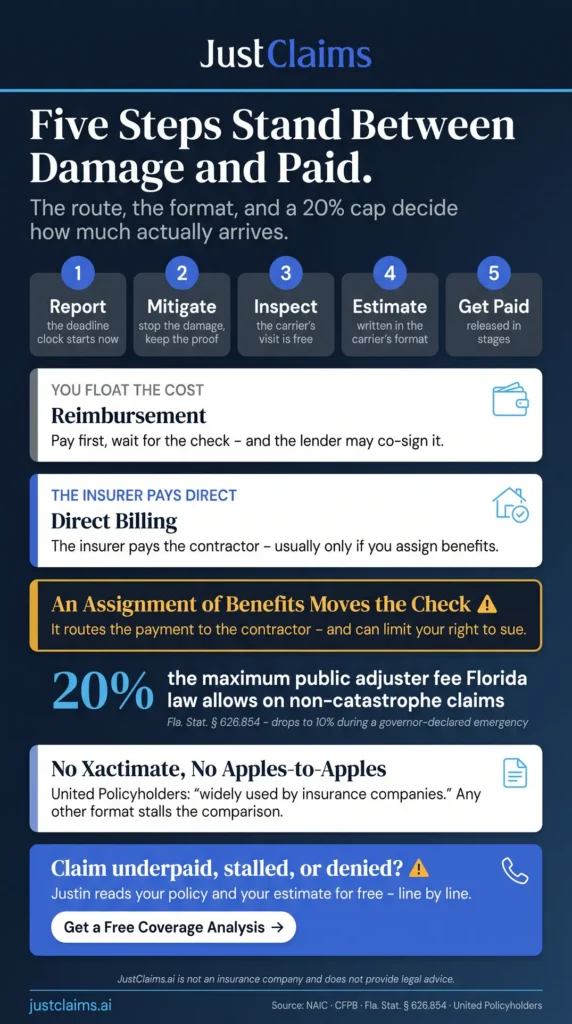
A restoration insurance claim rarely moves in a straight line, but regulators describe a predictable sequence that both contractors and property owners can track from the first phone call to final payment [1][2].
| Stage | What Happens |
|---|---|
| 1 | The loss is reported to the insurance company — most policies have a reporting time requirement |
| 2 | The damage is documented (photos, video, an itemized list) before debris is removed, and emergency mitigation begins |
| 3 | The insurer sends an adjuster to assess the damage at no cost and determines the settlement amount |
| 4 | The restoration work is completed while the settlement is released in stages |
| 5 | The final payment is released once the work is finished and passes inspection |
Where Public Adjusters Fit In
A public adjuster is not the same as the insurance company’s own adjuster — a public adjuster has no ties to the insurer, estimates the damage to your property, reviews your insurance coverage, and negotiates the settlement of the claim for you [1]. Many states require public adjusters to be licensed, and some states don’t allow them to negotiate claims at all [1]. You pay for that work yourself: Illinois regulators describe the fee as a percentage of the claim paid by your insurance company, set out in a written contract the state requires [3].
Some states cap that percentage by law — Florida, for example, caps public adjuster compensation at 20% of claim payments or settlements, dropping to 10% for claims based on a Governor-declared state of emergency made during the year after the declaration [4]. In Illinois, the signed contract is binding but can be canceled by certified mail within 5 business days after signing [3].
Property owners weighing whether to bring in a public adjuster alongside a restoration contractor should ask how the two roles will divide responsibilities so the scope of work and the settlement negotiation stay aligned rather than duplicated.
Direct Billing vs. Reimbursement: What You Need to Know
Because how a claim gets paid can matter as much as how much it pays, the choice between direct billing and reimbursement affects both the contractor’s cash flow and the property owner’s control over the claim. Before signing one, see how assignment of benefits laws by state limit what a contractor may collect. An Assignment of Benefits (AOB) is an agreement signed by a policyholder that lets a third party — such as a water extraction company or a roofer — act on the insured’s behalf and collect payment directly from the insurance company [1]. Once an AOB is signed, the insurer communicates only with that third party, which can sue the insurer without the policyholder’s involvement — and the policyholder can lose the right to mediation [1].
Property owners are not required to sign an AOB to get repairs done; filing the claim directly keeps the policyholder in control of the rights and benefits under their own policy [1]. Under a standard reimbursement arrangement, the insurer’s adjuster assesses the damage at no cost to the property owner [1], and the settlement check is typically made out jointly to the owner and the mortgage servicer or lender, who releases the money in stages as the work progresses [2]. Restoration companies and property owners should settle on the model before work begins, since it determines who sits across from the carrier if a dispute arises.
Why Documentation (Photos and Moisture Logs) Matters for Claim Approval
Because adjusters approve payment based on evidence rather than the mere presence of damage, the records a restoration company keeps often decide whether a claim gets paid in full or gets challenged. That record-keeping is the core of commercial restoration claims documentation.
The IICRC S500 Standard for Professional Water Damage Restoration (5th Edition, 2021) treats administrative procedures, project documentation, and risk management as components of the work itself, alongside inspections, pre-restoration evaluations, drying technology, and equipment [5]. In practice, that means a professional restorer documents moisture, temperature, and humidity readings and equipment placement throughout the drying process — building the baseline that later proves drying was complete [5].
State regulators give property owners the matching instruction: the California Department of Insurance advises policyholders to list every damaged item and, if possible, take photographs of the damage [6], and the NAIC tells policyholders to document all losses with photos or video before any debris is removed [1]. Property owners can ask their restoration company for these logs and photos directly and request copies for their own records before the file is closed.
How to Choose a Restoration Partner That Uses Xactimate
Because insurers evaluate scope and pricing through a specific software format, choosing a restoration partner fluent in that format can directly affect how quickly and completely a claim is paid. A contractor who writes in that format produces an Xactimate estimate the carrier can price line by line. Xactimate — Verisk’s property claims estimating software, part of its Xactware product family [7] — is, in United Policyholders’ words, “widely used by insurance companies,” whose adjusters use it to calculate building damage and repair costs and to generate loss estimates and settlement offers [8].
That dominance has a practical consequence: insurers often want estimates broken down in Xactimate’s detailed line-item format, and an estimate that can’t be compared apples-to-apples against that format is harder to get paid — that is United Policyholders’ warning to policyholders, not a sales pitch [8].
A restoration partner should also be able to work where the carriers work: XactAnalysis, Verisk’s secure network where insurers, contractors, and adjusters exchange and manage estimate data in real time [9]. When you interview a restoration company, ask whether its estimators write in Xactimate and submit through XactAnalysis — the answer tells you whether your scope will arrive in the format the adjuster is already using [8][9].
Frequently Asked Questions
What’s the difference between a public adjuster and a restoration contractor?
A restoration contractor performs the mitigation and repair work and typically prepares a cost estimate for that work, while a public adjuster works only for you — estimating the damage, reviewing your coverage, and negotiating the settlement with the insurer [1]. Illinois regulators describe the role as assisting you in the preparation, presentation, and settlement of your claim, under a written contract you sign [3].
The two roles can work on the same claim: the contractor’s estimate covers the physical work, while the public adjuster’s scope is the overall settlement.
Do I have to sign an Assignment of Benefits to get my repairs done?
No — you are not required to sign an AOB to have repairs completed. Filing the claim directly with your insurer keeps you in control of communications and of rights such as mediation access[1].
Why do adjusters ask for moisture logs and daily photos?
Because the IICRC S500 treats project documentation as part of the restoration work itself, dated readings and photos are the evidence trail showing that drying equipment ran as long as needed and that the job followed recognized procedures rather than guesswork [5]. On the owner side, regulators advise photographing the damage and listing every damaged item from day one [6] — your contractor’s logs plus your own photos leave the adjuster little to question.
What is Xactimate and why does it matter for my claim?
Xactimate is the estimating software insurance company adjusters widely use to price restoration and repair claims — the practical benchmark your contractor’s estimate will be compared against [8]. A restoration company whose estimators write in Xactimate and submit through XactAnalysis presents its scope in the same environment the adjuster already works in, which keeps the negotiation about the damage instead of the format [8][9].
How to Protect Your Scope and Reputation
A restoration claim moves faster when the paperwork trail — drying logs, dated photos, an estimate in the format adjusters use — matches what the carrier’s side expects to see [5][8]. Contractors who document consistently, and owners who choose billing arrangements deliberately, leave an adjuster fewer open questions to raise later [1][2].
Property owners, in turn, benefit when their restoration partner and any public adjuster involved are clear about who is negotiating what, under a written contract [3]. And if the claim still comes back denied or underpaid, start with the policy itself: upload it for a free AI insurance coverage analysis from Justin — built by licensed public adjusters — and find out in minutes what your policy actually says before you go back to the carrier.
This content is for informational purposes only and does not constitute legal or insurance advice. Coverage decisions depend on the specific terms, conditions, and exclusions of each policy and the laws of the applicable jurisdiction; policyholders and contractors should consult with a qualified professional for advice on their particular situation.
Sources
[1] Assignment of Benefits: Consumer Beware — NAIC (National Association of Insurance Commissioners)
[2] How do home insurance companies pay out claims? — Consumer Financial Protection Bureau
[3] Public Adjusters — Illinois Department of Insurance
[4] Florida Statutes § 626.854 — Public Adjusters; Prohibited Acts — The Florida Senate
[5] ANSI/IICRC S500 Standard for Professional Water Damage Restoration (5th Edition, 2021) — IICRC
[6] Residential Property Claims Guide — California Department of Insurance
[7] Xactimate: Property Claims Estimating Software — Verisk
[8] Xactimate Demystified — United Policyholders
[9] XactAnalysis: Property Insurance Claims Software — Verisk

Taylor Bezek

As the General Manager at JustClaims, Taylor Bezek brings over a decade of experience managing complex residential, commercial, and large-loss claims. A licensed Public Adjuster in TX (#2125659), FL (#W455048), CO (#769172), and 10 additional states, Taylor founded his own firm before joining JustClaims to scale a tech-forward solution for the insured. He is committed to combining industry expertise with AI to enhance speed, clarity, and outcomes for every policyholder. Taylor's mission is to modernize the public adjusting profession and ensure owners get exactly what they are entitled to.


