AOB Laws for Contractors: 2026 State-by-State Guide

August 14, 2026
Written by Taylor Bezek
Share


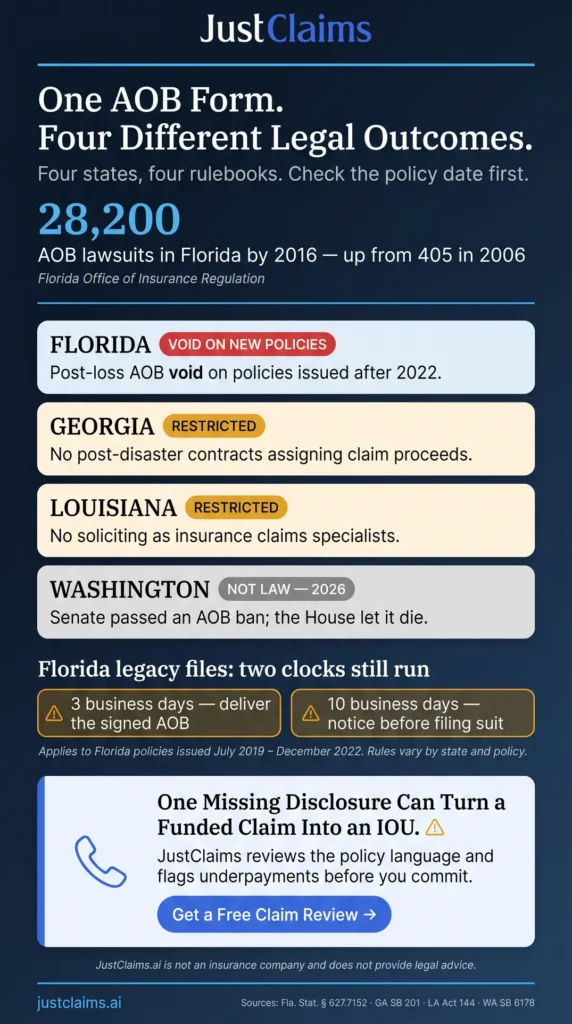
Post-loss assignment of benefits is now void, invalid, and unenforceable on every Florida residential and commercial property insurance policy issued on or after January 1, 2023. The only exceptions are transfers to a subsequent purchaser with an insurable interest, powers of attorney under chapter 709, and liability coverage. The Florida AOBs that still function are legacy agreements tied to policies issued between July 1, 2019 and the end of 2022 — and those survive only if they satisfy a strict statutory checklist. Contractors operating in multiple states now face a patchwork of bans, disclosure mandates, and pending bills that can invalidate a signed agreement after the work is already done.
Key Takeaways
- What changed: Florida law makes any attempt to assign post-loss property insurance benefits void on policies issued on or after January 1, 2023, except for transfers to a subsequent purchaser with an insurable interest, powers of attorney under chapter 709, and liability coverage.
- Legacy window: Florida’s valid-assignment framework applies only to policies issued on or after July 1, 2019 and before January 1, 2023.
- Delivery deadline: A legacy assignee must deliver the executed agreement to the insurer within 3 business days.
- Pre-suit notice: A contractor-assignee must serve written notice of intent to initiate litigation at least 10 business days before filing suit.
- Litigation driver: Florida AOB lawsuits grew from 405 in 2006 to 28,200 by 2016.
- Other states: Georgia’s Act 71 makes it an unfair or deceptive practice for a contractor to enter a post-disaster contract under which the homeowner assigns insurance proceeds, and Louisiana’s Act 144 bars contractors from advertising or soliciting as insurance claims specialists.
Why AOB Rules Look Nothing Like They Did in 2019
Florida’s statute defines an assignment agreement as any instrument by which post-loss benefits under a residential or commercial property policy are assigned, transferred, or acquired — in whole or in part — to a person providing services that include inspecting, protecting, repairing, restoring, replacing, or mitigating further damage [1]. In plain terms, the policyholder’s claim rights pass to a third party, which then stands in the shoes of the insured and seeks payment directly from the carrier [2]. For restoration and roofing contractors, that was once the cleanest path to getting paid directly instead of chasing a property owner who had already spent the check.
The volume of resulting litigation is what ended that era. Florida’s insurance regulator, citing Department of Financial Services data, reports that AOB lawsuits grew from 405 across all 67 Florida counties in 2006 to 28,200 by 2016 — the trend that drove HB 7065 in 2019 and the tighter restrictions that followed [2]. The NAIC warns consumers that once an AOB is signed, the insurer communicates only with the third party, that party can sue the insurer, and the policyholder can lose the right to mediation [3]. Regulators also emphasize a point contractors should assume every adjuster and consumer advocate will repeat: a property owner is never required to sign an AOB to have repairs completed [2] [3].
The practical consequence for a multi-state operation is that the assignment form in your standard contract packet may be enforceable in one jurisdiction, unenforceable in another, and a licensing exposure in a third.
Florida: Post-Loss Assignment Is Void on Current Policies
Because a signed but unenforceable assignment leaves a contractor with no direct claim against the carrier, Florida is the first place to audit your paperwork. Florida Statute 627.7152, as it stands in the 2025 statutes, provides that a policyholder may not assign, in whole or in part, any post-loss insurance benefit under any residential or commercial property insurance policy issued on or after January 1, 2023, and that any attempt to do so is “void, invalid, and unenforceable” [1].
1. The Legacy Policy Window
The statutory framework governing valid assignment agreements applies only to policies issued on or after July 1, 2019 and before January 1, 2023 [1]. That means the threshold question on any Florida file is not whether the property owner signed your form — it is the issue date of the policy. If the policy was written after the cutoff, the assignment carries no effect regardless of how carefully it was executed.
2. Contractor Duties on Enforceable Legacy Agreements
For the 2019–2022 policies where an AOB can still stand, the statute imposes specific obligations on the assignee [1]:
- Deliver the executed agreement to the insurer within 3 business days.
- Include a written itemized, per-unit cost estimate of the services to be performed.
- Include the required 18-point uppercase boldface consumer warning.
- Indemnify and hold the policyholder harmless from all liabilities and damages.
- Charge no rescission, cancellation, check or mortgage processing, or administrative fees.
The statutory compliance benchmarks are 14 days to rescind, 3 business days to deliver the executed agreement to the insurer, and an 18-point uppercase boldfaced notice [1].
Emergency-circumstance assignments under residential policies are capped at the greater of $3,000 or 1 percent of the Coverage A limit, and an agreement that fails to comply is invalid and unenforceable [1]. A single missing disclosure can therefore convert a funded claim into an unsecured receivable.
3. Pre-Suit Notice, EUOs, and Attorney Fees
Litigation rights under an enforceable legacy AOB are narrower than many contractors expect. A contractor-assignee must serve a written notice of intent to initiate litigation at least 10 business days before filing suit, and not before the insurer has made a coverage determination [1]. Submitting to examinations under oath and to appraisal or alternative dispute resolution are conditions precedent to suit. The insurance appraisal clause sits first on that list, and it belongs to the policyholder even where an assignment fails. [1].
Most significantly for economics: an assignee may recover attorney fees only under s. 57.105, and a court may order an assignee to pay the adverse party’s fees from a previously voluntarily dismissed action [1]. A disputed claim pursued in your own name can become a cost center rather than a recovery.
State-Level Reform Activity to Track in 2026
The same litigation-cost argument that reshaped Florida is now driving bills and regulatory alerts elsewhere, which is why a nationally standardized AOB form is a compliance risk rather than an efficiency. Kentucky HB 568 is the sharpest current example, freezing new claim-advocate licenses outright.
| State | Instrument | Effect on contractors |
|---|---|---|
| Florida | Fla. Stat. § 627.7152 | Post-loss assignment void on policies issued on or after January 1, 2023 |
| Georgia | SB 201 (Act 71, signed May 8, 2025) | Entering a post-disaster contract under which the homeowner assigns insurance proceeds to the contractor is an unfair or deceptive practice from July 1, 2025; insurers barred from selling policies allowing such assignments from January 1, 2026 |
| Louisiana | HB 121 (Act 144, effective August 1, 2025) | Contractors barred from advertising or soliciting as insurance claims specialists or policy-interpretation providers; good-faith itemized estimate required before repair authorization |
| Washington | SB 6178 (2026 session) | Post-loss AOB ban passed the Senate 48-0 but died in House committee; not current law |
Georgia’s Post-Disaster Contracting Rules
Georgia SB 201 was signed on May 8, 2025 as Act 71 [4]. It adds two layers of post-disaster contracting rules. First, effective July 1, 2025, a contractor who contracts with a homeowner within one year of a natural disaster commits an unfair or deceptive practice by — among other things — entering into a contract under which the homeowner assigns insurance proceeds to the contractor, or by refusing cancellation before midnight on the fifth business day after the homeowner receives written notice from the insurer that all or part of the claim is not a covered loss [4]. Second, effective January 1, 2026, no insurer may sell a homeowner’s insurance policy that allows the assignment of proceeds to a contractor within one year of a natural disaster that damages the insured’s residential property [4] [5]. “Natural disaster” covers flood, tornado, hurricane, earthquake, or any other occurrence for which the Governor proclaims a state of emergency [4]. Storm-response crews mobilizing across state lines should confirm which contract terms and disclosures apply before doors are knocked.
Louisiana’s Enacted Act 144: Solicitation and Estimate Rules
Louisiana’s HB 121 became Act No. 144 on June 8, 2025, effective August 1, 2025 — but the enacted Act is narrower than the bill that was filed [6]. The original proposal would have barred roofing contractors from providing, advertising, or soliciting insurance claims-handling services and regulated contingency contracts; that section was stripped by a House floor amendment before passage [7]. What was enacted instead: a public adjuster may not act as a contractor or subcontractor, nor provide construction, roofing, or repair services to an insured in connection with a claim the adjuster has processed [6]; contractors are prohibited from advertising or soliciting as insurance claims specialists, or as providing insurance claim or policy interpretation services to an insured [6]; and no repair or construction authorization may be given without a good-faith estimate of itemized, detailed costs — though a cost difference resulting from the insurer’s own adjustment is not a violation [6]. Contractors in that market should treat claims-handling language in their marketing as a compliance exposure.
Washington’s Failed AOB Ban
Scrutiny is not confined to the hurricane belt. Senate Bill 6178, introduced in January 2026 at the request of the Insurance Commissioner, would have made post-loss assignment of benefits in property insurance void and unenforceable, with carve-outs for licensed public adjusters, contingency-fee attorneys, federally insured financial institutions, mortgagees, and subsequent purchasers, and a penalty of $50,000 per violation [8]. The bill passed the Senate 48-0 on February 5, 2026, but the House Consumer Protection & Business Committee took no action, and on March 12, 2026 the bill was returned to Senate Rules by resolution — dead for the biennium [8]. The Senate Bill Report underscores the gap it aimed to fill: current Washington law does not specifically address the assignment of benefits under property insurance policies [9].
What to Watch Next
Two signals are worth tracking even where no statute has landed. The NAIC’s Public Adjuster Licensing Model Act now provides that policy rights may be assigned only to a person with legal authority to represent the named insured, or to a subsequent owner — and expressly prohibits assignment to anyone else, including a property repair contractor [10]. And Washington’s Insurance Commissioner had already urged caution in a July 2024 consumer alert, warning that AOB contracts usually include no right of rescission or cooling-off period and that homeowners are not required to enter one [11]. That regulatory posture shapes how adjusters in a state react when an assignment appears in a file, statute or no statute.
Compliant Payment Alternatives to an AOB
Because the assignment itself is the instrument under attack, the durable strategy is to secure payment through mechanisms that do not require transferring the policyholder’s claim rights at all.
Direction-to-Pay Language
A direction to pay instructs the carrier to issue payment to the contractor for work performed, while the claim and its rights remain with the policyholder. Under the Florida statute, an assignment agreement does not create authority to adjust, negotiate, or settle a claim for a person not licensed to do so, and the legal effect of a direction-to-pay form depends on state law and policy language [1]. Because it transfers less, it is less likely to be swept into an assignment prohibition, though contractors should confirm treatment under their own state’s law.
Lien and Security Rights
Construction lien and bond rights arise from the improvement to the property rather than from the insurance policy — but in Florida they are not a separate safe track for assignees. Under the legacy-agreement framework, accepting an assignment is a statutory waiver: the assignee and its subcontractors give up all claims against the named insured, including the right to sue, to claim a lien on the insured’s real property, or to report the insured to a credit reporting agency — and the waiver survives rescission or a determination that the agreement was invalid [1]. The insured then owes only the deductible, the cost of any approved betterment, and contracted work performed before rescission [1]. Outside an assignment, preserving lien rights depends on documentation discipline: a signed scope, itemized pricing consistent with the per-unit estimate standard Florida imposes on assignees [1], and timely notices under the applicable state statute. Treat lien deadlines as non-negotiable calendar items rather than fallback options.
Licensed Adjusting Support on the Policyholder’s Side
When a scope dispute is the real obstacle, the alternative to taking over the claim is supporting the policyholder who owns it. In practice that support looks like a claims partner who handles the carrier while the contractor handles the build. An assignee’s attorney-fee recovery in Florida is limited to s. 57.105 [1], and keeping the claim in the property owner’s name avoids the claims-handling conflicts Louisiana’s Act 144 was drafted to target [6]. Property owners can decline an AOB entirely and still have their repairs completed [2].
Frequently Asked Questions
Is an assignment of benefits still legal in Florida in 2026?
Not for current policies. Any attempt to assign post-loss benefits under a residential or commercial property policy issued on or after January 1, 2023 is treated as void, invalid, and unenforceable [1], except for transfers to a subsequent purchaser with an insurable interest, powers of attorney under chapter 709, and liability coverage. Only agreements tied to policies issued in the earlier statutory window can still be enforced.
Does a property owner have to sign an AOB for repairs to begin?
No. Florida’s insurance regulator states plainly that consumers are never required to sign an assignment of benefits in order to have repairs completed [2]. Contractors who present the form as mandatory invite both a consumer complaint and an enforceability challenge.
Can a contractor recover attorney fees on an assigned claim?
Rarely, and never as a matter of course. Under the Florida statute, an assignee may recover attorney fees only under s. 57.105, and a court may also order an assignee to pay the adverse party’s fees from a previously voluntarily dismissed action [1]. That allocation changes the cost-benefit analysis of litigating in the contractor’s own name.
Which states are moving next on AOB restrictions?
Georgia’s Act 71 rolled out in two stages — post-disaster contracting rules from July 1, 2025, and a ban on insurers selling homeowner policies that allow assignment of proceeds to a contractor within one year of a natural disaster from January 1, 2026 [4] [5]. Louisiana’s Act 144 has been in force since August 1, 2025, targeting claims-handling solicitations by contractors [6]. In Washington, SB 6178 passed the Senate unanimously in February 2026 but died in House committee, leaving the state without an AOB-specific statute [8] [9]. The NAIC’s model act language gives the next state a ready-made template [10].
How to Protect Your Scope and Get Paid
Start with a file audit: pull every active claim, confirm the policy issue date against the applicable state’s assignment rules, and identify which files rest on an instrument that may not hold. Replace blanket assignment forms with state-specific paperwork — direction-to-pay language where permitted, itemized per-unit estimates as a default standard, and lien notices calendared from the first day of work. Where the dispute is about scope rather than payment routing, keeping the claim in the property owner’s name preserves rights that an assignment would forfeit [1]. If your insurance claim was denied or underpaid, JustClaims’ expert team — accelerated by our bespoke AI — reviews the policy language, compares it against your documentation, and flags likely underpayments so you can go back to the carrier with confidence. Start with the JustClaims policy analyzer to see exactly what the policy says.
This content is for informational purposes only and does not constitute legal or insurance advice. Coverage decisions depend on the specific terms, conditions, and exclusions of each policy and the laws of the applicable jurisdiction; policyholders and contractors should consult with a qualified professional for advice on their particular situation.
Sources
[2] Assignment of Benefits Resources — Florida Office of Insurance Regulation
[3] Assignment of Benefits: Consumer Beware — NAIC (September 13, 2023)
[4] SB 201 (Act 71, signed May 8, 2025) — Georgia General Assembly
[5] Summary of 2025 Enacted Statutes — Georgia Office of Legislative Counsel
[6] Act No. 144 (HB 121, 2025 Regular Session) — Louisiana State Legislature
[7] HB 121 Bill History (2025 Regular Session) — Louisiana State Legislature
[8] SB 6178 Bill History — Washington State Legislature
[9] Senate Bill Report, SB 6178 (As Passed Senate) — Washington State Legislature
[10] Public Adjuster Licensing Model Act (#228) Project History — NAIC

Taylor Bezek

As the General Manager at JustClaims, Taylor Bezek brings over a decade of experience managing complex residential, commercial, and large-loss claims. A licensed Public Adjuster in TX (#2125659), FL (#W455048), CO (#769172), and 10 additional states, Taylor founded his own firm before joining JustClaims to scale a tech-forward solution for the insured. He is committed to combining industry expertise with AI to enhance speed, clarity, and outcomes for every policyholder. Taylor's mission is to modernize the public adjusting profession and ensure owners get exactly what they are entitled to.