UPPA & Contractors 2026: How to Stay Compliant on Property Claims
August 13, 2026
Written by Collin Corcoran
Share


Reviewing a customer’s insurance policy, advising them to demand appraisal, or promising on your website to “advocate” with their insurer are all activities Iowa’s insurance regulator lists as off-limits to an unlicensed contractor. Acting as an adjuster without a license in Iowa is a class “D” felony, and a residential contractor’s storm-repair contract is void if the contractor represented or negotiated the claim. In 2024, a Texas roofing company whose contracts authorized it “to negotiate on [the customer’s] behalf with [the] insurance company” carried its challenge to the state’s licensing rule all the way to the Texas Supreme Court — and had its case dismissed.
Key Takeaways
- What UPPA is: Unauthorized public adjusting is what happens when someone who is not a licensed public adjuster negotiates or settles a property insurance claim for a policyholder. About 40 states license public adjusters, and the definitions and penalties differ in every one.
- The statutory trigger: Iowa defines a public adjuster as anyone who, for compensation or any other thing of value, acts for or aids an insured in negotiating or settling a first-party property claim — or who advertises, solicits, or simply advises an insured about such claims.
- Your marketing is evidence: In Iowa, claim-advocacy language on a website or social profile is itself a violation, and the Iowa Supreme Court treated one contractor’s website promise to “ADVOCATE on YOUR behalf” as public adjusting.
- Your contract is the exposure: An Iowa residential contractor’s contract is void if the contractor represented or negotiated the claim, and Illinois voids any contract made in violation of its public adjuster licensing law.
- A license does not fix it: A contractor who becomes a licensed public adjuster still cannot be both contractor and public adjuster on the same Iowa project, and Texas bars a contractor from adjusting claims on any property it does or may work on — licensed or not.
What Unauthorized Public Adjusting Actually Means
The compliance line is drawn at the moment your work shifts from describing damage to interpreting or settling a policy.
Iowa Code §522C.2 defines a “public adjuster” as a person who, for compensation or other thing of value, acts for or aids an insured in negotiating or settling a first-party claim for loss or damage to property, advertises or solicits business as a public adjuster of first-party claims, or directly or indirectly solicits business investigating or adjusting losses — or advises an insured about first-party claims [2]. Iowa’s Insurance Division applies that definition to contractors, and it reads “contractor” broadly: roofing, siding, gutters, general construction, restoration and remodeling, storm damage repair, emergency storm repair, moving companies, tree care, “and any other business/individual in which a consumer hires to repair or oversee commercial or residential construction projects” [1]. A person may not act as, or represent that they are, a public adjuster in Iowa unless licensed [3].
Two details drive day-to-day risk. First, the trigger is “compensation or other thing of value,” so a service bundled free into a repair contract is not automatically outside the definition [2]. Second, the definition reaches advising an insured about a claim, not just negotiating one [2]. That is why a well-meaning conversation about what a policy “should” cover carries regulatory risk even when no money changes hands over it.
Iowa’s Market Regulation Bureau draws its enforcement authority from Iowa Code §§505.8, 507B and 522C [1].
Why Contractors Cross the Line Without Meaning To
Because the definition captures advice and advertising as well as negotiation, contractors rarely cross the line on purpose. The exposure builds quietly — in contract templates, sales scripts and website copy written years before anyone read the licensing statute.
The consequences are not limited to a regulatory letter. Iowa’s Insurance Division states that any person or company found to be acting as an unlicensed public adjuster may be subject to both administrative action and criminal sanctions, and that violations are an unlawful practice under Iowa’s consumer fraud statute, Iowa Code §714.16 [1]. Under Iowa Code §522C.14(2)(a), a person acting as an adjuster without proper licensure is guilty of a class “D” felony — a class “C” felony if the violation results in a loss of more than $10,000 [3].
The contract itself is also at risk. Iowa Code §103A.71(3) prohibits a residential contractor from representing or negotiating on behalf of a property owner on any insurance claim connected to roof or exterior repair work, or from offering or advertising to do so — and §103A.71(5) makes the contract void if the contractor violates that provision[4]. Iowa also requires a ten-point bold notice in the contract telling the owner the agreement is void if the contractor advertises or promises to rebate the deductible, or represents or negotiates with the carrier on the owner’s behalf [4].
The 3 Court Decisions Shaping Contractor Compliance in 2026
These rulings matter because each one turned on the same distinction between repair work and claim advocacy that governs your contracts and website today.
1. Texas Department of Insurance v. Stonewater Roofing (Texas Supreme Court, 2024)
Stonewater Roofing’s customer contracts “specifically ‘authorize’ Stonewater ‘to negotiate on [the customer’s] behalf with [the] insurance company and upon insurance approval to do the work specified'” [5]. The company sued the Texas Department of Insurance, arguing that applying the public adjuster licensing law to it violated the First and Fourteenth Amendments. The Texas Supreme Court held that Stonewater “failed to state cognizable First and Fourteenth Amendment speech and vagueness claims,” reversed the court of appeals, and rendered judgment dismissing the case The same line applies to any contractor who negotiates a water damage claim in Houston on the owner’s behalf without a public adjuster license. [5].
The court also restated the dual-role bar: a contractor, even one licensed as a public insurance adjuster, “may not act as a public adjuster or advertise to adjust claims for any property for which the contractor is providing or may provide contracting services,” so “a person may not serve in a dual role—as both contractor and adjuster—in connection with property subject to an insurance claim or falsely advertise an ability to do so” [5]. That prohibition is Texas Insurance Code §4102.163; §4102.051 requires a license to act as, or hold yourself out as, a public insurance adjuster in Texas [6].
The operative fact was contract language, not field conduct. A single verb in a template decided the case.
2. Building Permit Consultants, Inc. v. Mazur (California Court of Appeal, 2004)
California Insurance Code §15007 defines a public insurance adjuster as a person who, for compensation, “acts on behalf of or aids in any manner, an insured in negotiating for or effecting the settlement of a claim or claims for loss or damage under any policy of insurance covering real or personal property” [7]. The California Court of Appeal read that language literally. Section 15007, it held, “does not limit the definition of a public insurance adjuster to persons who only directly represent or act on behalf of the insured,” and instead “casts a broad net” reaching “all persons … whose conduct or involvement impacts the resolution of the insurance claim” [8].
Firms that think of themselves as consultants, estimators or claim coordinators rather than adjusters can still fall inside that reach.
3. 33 Carpenters Construction, Inc. v. State Farm Fire & Casualty Co. (Iowa Supreme Court, 2020)
33 Carpenters’ website told homeowners: “We will meet personally with your insurance adjuster, as an ADVOCATE on YOUR behalf, and discuss the work that needs to be completed to repair your home to its original beauty and value” [9]. Its contract contained an “Insurance Contingency” authorizing the company to “meet with and discuss hail and wind damage” with the carrier, and required the homeowners to acknowledge that “33 Carpenters Construction will act as their General Contractor to obtain appropriate property damage adjustments” [9].
The Iowa Supreme Court concluded that “33 Carpenters thereby acted on behalf of the Clausens in negotiating their claim,” that its activities showed it “was acting for and aiding the insureds … in effecting the settlement of their claim,” and that its six-step website process “exemplifies solicitation of business investigating losses and advising insureds regarding claims” [9]. The court affirmed that 33 Carpenters “acted as an unlicensed public adjuster” and held the assignment contract “void under Iowa Code section 103A.71(5)” [9].
Marketing copy was treated as evidence of the prohibited role — and the contract was the thing that got voided.
Permitted vs. Prohibited: The Day-to-Day Line in Iowa
Iowa’s Insurance Division publishes both sides of the line. Read this as Iowa guidance — the same logic runs through other states, but the exact wording and exceptions differ, so check your own state’s statute before relying on it.
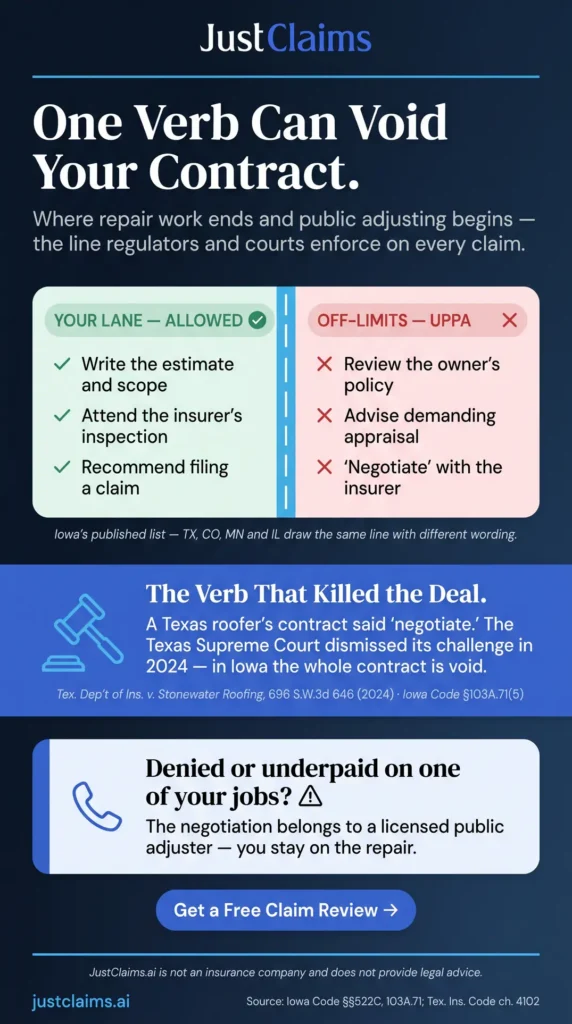
| Permitted in Iowa without a public adjuster license [1] | Prohibited in Iowa without a public adjuster license [1] |
|---|---|
| Soliciting and offering repair or reconstruction services to homeowners or business owners | Reviewing a consumer’s insurance contract |
| Offering an opinion on whether damage was possibly caused by wind, hail, storm or another incident normally covered by a policy | Giving advice on provisions of the insurance contract, including demanding appraisal |
| Preparing an estimate and scope of work for the loss | Initiating, handling, negotiating or taking any direct or indirect role in effecting settlement of a claim |
| Discussing the estimate or scope of work with the customer | Choosing an appraiser or public adjuster to handle a consumer’s claim |
| Recommending that the policyholder file a claim with their insurer | Advertising, marketing or holding out as a public adjuster — on the website or any social media profile |
| Attending any inspection of the damage by an insurer’s adjuster | “Partnering” with, contracting with, or otherwise working in concert with a public adjuster |
| Answering questions the policyholder or insurer’s adjuster has about the estimates | Acting as both contractor and public adjuster on the same project, even while licensed |
That advertising prohibition applies to any published statement on a contractor’s website and any social media profile owned or controlled by the contractor or its agents, representatives, employees and officers [1]. Iowa’s regulator publishes actual phrases it treats as violations when used by an unlicensed company — run these against your own site [1]:
- “We are insurance claim experts.”
- “We are an advocate for you against your insurance company.”
- “At (Company name) we advocate for homeowners.”
- “At (Company name) we’ll assist you with the claims process to ensure you get your full payment.”
- “Our Claim Specialists are here to take care of your insurance claim.”
- “We can interpret insurance coverage and assist with line-of-sight settlements with your insurance carrier.”
The Division also directs contractors to add a disclaimer to all solicitations, advertising, social media, contracts and agreements stating that the contractor is not a public adjuster, is not responsible for obtaining approval of the claim, will not negotiate the customer’s policy rights with the insurer, and that the insured is responsible for reviewing their own insurance policy[1].
How the Same Line Is Drawn in Texas, Colorado, Minnesota and Illinois
About 40 states license public adjusters, and more than 30 require licensure of one or more categories of adjuster[10]. The rules are not uniform, so a contract or website that passes in one state can be a violation in the next. Here is how four of the most active storm-claim states draw it. Washington draws the same line — anyone who negotiates a Washington state fire damage claim for a property owner must hold an active license from the Office of the Insurance Commissioner and file a $5,000 surety bond.
Texas (Dallas–Fort Worth)
A contractor “may not act as a public adjuster or advertise to adjust claims for any property for which the contractor is providing or may provide contracting services,” whether or not the contractor holds an adjuster license and whether or not it has a power of attorney [6]. A person who violates chapter 4102 “commits an offense,” and that offense is a Class B misdemeanor[6]. The Texas Department of Insurance states the permitted zone plainly: “Contractors may provide estimates and discuss those estimates and other technical information with an insurer or its adjuster”. Past that line, the file belongs to the policyholder and to the Texas public adjusters licensed to advocate for them [11].
Colorado (Denver)
A roofing contractor “shall not claim to be or act as a public insurance adjuster adjusting claims for losses or damages,” and may not advertise or promise to pay, waive or rebate any part of the insurance deductible[12]. Colorado then carves out an explicit safe harbor: nothing in that subsection “precludes a roofing contractor from discussing, on behalf of the property owner, the scope of repairs with a property and casualty insurer when the roofing contractor has a valid contract with the property owner”[12]. Break the deductible rule and the insurer “is not obligated to consider the estimate of costs for the roofing work prepared by the roofing contractor” [12].
Minnesota (Minneapolis–St. Paul)
A residential roofer, building contractor or remodeler may not “interpret policy provisions or advise an insured regarding coverages or duties under the insured’s policy, or adjust a property insurance claim on behalf of the insured, unless the contractor has a license as a public adjuster under chapter 72B” [13]. The same statute bars advertising or promising to pay any part of the deductible, and bars compensating an owner for allowing an inspection, for making a claim, or for referrals [13]. The Department of Labor and Industry enforces it and warns that contractors making such an offer face public enforcement action “including fines of up to $10,000 per violation”. KY HB 568 goes further still, putting a moratorium on new claim-advocate licenses altogether [14].
Illinois (Chicago)
No person may “act, advertise, solicit, or hold himself out as a public adjuster or to be in the business of adjusting insurance claims” in Illinois without a public adjuster license — and “all contracts entered into that are in violation of this Section are void and invalid” [15]. Separately, a home repair or remodeling contractor may not represent, or offer or advertise to represent, a homeowner on any insurance claim, and “shall not call in or file a claim to an insurance carrier on the insured’s behalf”[16]. Illinois preserves the same technical lane: a contractor may provide an estimate, confer with the insurer’s representative about damage, and discuss repair or replacement options [16].
The pattern across all four states is identical. Damage, scope and cost are yours. Coverage, entitlement and settlement are not.
Where the Exposure Actually Lives: Your Contract and Your Website
All three decisions above turned in part on documents rather than jobsite behavior, which makes contract and website review the highest-leverage compliance work available to you. For North Texas jobs, name the referral before you need it: a public adjuster Dallas, Texas property owners can verify through the TDI license lookup.
The verb in your contract
Stonewater’s contracts “authorize” the company “to negotiate on [the customer’s] behalf” with the carrier [5]. 33 Carpenters’ contract required homeowners to acknowledge the company would act as general contractor “to obtain appropriate property damage adjustments” [9]. Iowa Code §103A.71(3) reaches any residential contractor who represents or negotiates — or offers or advertises to represent or negotiate — on an owner’s behalf on an insurance claim, and §103A.71(5) voids the contract when that happens [4]. Read every authorization, assignment and power-of-attorney clause in your template with that verb list in hand.
What your website says
Iowa treats prohibited claim-advocacy language as a violation wherever it is published, including websites and any social media profile owned or controlled by the contractor or its agents, representatives, employees and officers [1]. In 33 Carpenters, the website was quoted back to the company by the Iowa Supreme Court[9]. Iowa’s regulator directs contractors to remove that wording from “advertising, webpages, social media accounts, flyers, postcards, handouts, vehicles, etc” [1].
What you say to the adjuster
Keep the conversation on damage, scope and cost. Texas confirms contractors “may provide estimates and discuss those estimates and other technical information with an insurer or its adjuster” [11]. Illinois preserves estimates, conferring about damage, and discussing repair or replacement options [16]. Colorado permits discussing the scope of repairs with the carrier once you hold a valid contract with the owner [12]. Iowa permits answering questions the policyholder or the insurer’s adjuster has about your estimates [1]. What none of them permit is you interpreting policy provisions or pressing for appraisal. Pressing for appraisal is the policyholder’s move — invoking appraisal clause rights belongs to them, not to the contractor. [1].
Add the disclaimer — and mean the last line of it
Iowa’s disclaimer language ends by telling the customer that they are responsible for reviewing their insurance policy [1]. Take that literally. Pointing the owner to a way to understand their own policy is compliant. Explaining it for them is not.
Frequently Asked Questions
Can a contractor tell a property owner to file an insurance claim?
Yes, in Iowa. Recommending that a policyholder file a claim with their insurer is expressly listed among permitted activities, as is offering an opinion that damage was possibly caused by wind, hail, storm or another incident normally covered by a policy [1]. Illinois draws it tighter: a home repair contractor there may not call in or file a claim to the carrier on the insured’s behalf [16]. In both states the boundary is the same — recommend the claim, do not interpret the policy behind it.
Is it legal for a contractor to attend the insurance adjuster’s inspection?
In Iowa, yes. Attending any inspection of the damage by an insurer’s adjuster is permitted, and so is answering questions the policyholder or the carrier’s adjuster has about your estimates [1]. The limit is subject matter, not attendance: discuss damage, scope and cost rather than coverage entitlement or settlement terms.
Does getting a public adjuster license solve the problem?
Not on the same job. Iowa’s regulator states that a contractor who obtains a public adjuster license cannot be the contractor and the public adjuster on the same project [1]. Texas is broader: a contractor may not act as a public adjuster or advertise to adjust claims for any property for which it is providing or may provide contracting services, regardless of licensure [6], and the Texas Supreme Court restated that a person “may not serve in a dual role—as both contractor and adjuster” [5]. Iowa separately bars a licensed public adjuster from holding a financial interest in the business responsible for repairing the damaged property [3].
What happens to my contract if a court finds UPPA violations?
It can be void. Iowa Code §103A.71(5) makes a residential contractor’s contract void if the contractor represented or negotiated on the owner’s behalf on the claim [4], and the Iowa Supreme Court applied exactly that in 33 Carpenters, holding the assignment contract void [9]. In Illinois, all contracts entered into in violation of the public adjuster licensing requirement are “void and invalid” [15]. Iowa also treats the violation as an unlawful practice under its consumer fraud statute [1][4], and unlicensed adjusting is a class “D” felony [3].
Can I include an assignment of benefits in my contract?
Look hard at what it actually assigns. In 33 Carpenters, the assignment contract was held void under Iowa Code §103A.71(5) because the company had acted as an unlicensed public adjuster [9]. An assignment that hands you control of the claim can read as acting for or aiding the insured in settling it — precisely the conduct the definition reaches [2].
Can I offer to cover my customer’s deductible?
No, in all four states covered above. Colorado prohibits a roofing contractor from advertising or promising to pay, waive or rebate any part of the deductible [12]. Minnesota prohibits the same, plus compensating an owner for allowing an inspection, for making a claim, or for referrals [13]. Illinois prohibits advertising or promising to rebate the deductible as a sales inducement [16]. Iowa requires contract notice that the agreement is void if the contractor advertises or promises to rebate any portion of the deductible [4].
How to Keep Your Claim Support Compliant
The compliant model is a division of labor. You document the damage, build the scope, price the repair, and answer technical questions about your estimate. Only a licensed public adjuster or a licensed attorney may negotiate the claim — Iowa’s licensing statute requires a license to act as a public adjuster and exempts attorneys acting within their professional capacity [3]. Iowa contractors also may not choose the appraiser or public adjuster for the customer, and may not “partner” with, contract with, or otherwise work in concert with a public adjuster [1].
Practically, that is five moves:
- Strike “negotiate,” “represent” and “obtain adjustments” from your agreement [4][5][9].
- Add the regulator’s disclaimer to your contracts, solicitations, advertising and social profiles [1].
- Scrub claim-advocacy language from your website and every social profile you control [1].
- Drop any deductible-rebate offer and any inspection or referral incentive [4][12][13][16].
- Hand policy interpretation to the owner or to a licensed professional — never do it for them [1].
Step five is where most contractors get stuck, because the customer still needs to know what their policy actually says. Give them a way to find out for themselves: have your customer upload their policy to Justin for a plain-English read on their own coverage — without you interpreting a single provision.
If a storm claim on one of your jobs comes back denied or underpaid, the negotiation has to move to a licensed professional. JustClaims is an active public adjusting firm: our licensed team, accelerated by our own AI, compares the policy language against your scope and estimate documentation and flags likely underpayments — so the claim stays with licensed professionals while you stay on the repair. See how our claim and appraisal support works.
Deeper reading for contractors: Appraisal vs. Litigation for Contractors and RCV vs. ACV: Educating Your Client.
This content is for informational purposes only and does not constitute legal or insurance advice. Coverage decisions depend on the specific terms, conditions, and exclusions of each policy and the laws of the applicable jurisdiction; policyholders and contractors should consult with a qualified professional for advice on their particular situation.
Sources
[1] Guidance for Contractors and Public Adjusters — Iowa Insurance Division, Market Regulation Bureau
[2] Iowa Code §522C.2, Definitions (2026) — Iowa Legislature
[4] Iowa Code §103A.71, Residential Contractors — Insurance Proceeds (2026) — Iowa Legislature
[14] Contractors and Insurance Deductibles — Minnesota Department of Labor and Industry
[15] 215 ILCS 5/1515, Public Adjusters Law — Licence Required — Illinois General Assembly
[16] 815 ILCS 513/18, Home Repair and Remodeling Act — Prohibited Acts — Illinois General Assembly

Collin Corcoran

Experienced Public Adjuster and Property Claims Specialist, Collin is licensed in New York (#1603393), New Jersey (#3003700204), and Connecticut (#19820270). With 20+ years of hands-on construction and property damage experience, he specializes in residential and commercial claims, complex loss inspections, policy review, detailed estimating, and strategic negotiation. Collin’s background in construction, asset management, emergency response, and claims documentation allows him to accurately identify damage, understand repair requirements, and advocate effectively for policyholders. He works with homeowners, business owners, contractors, and insurance professionals to move claims forward with clarity, accuracy, and confidence. Collin is committed to transparency, technical precision, strong communication, and securing fair outcomes for policyholders.