Texas Property Damage Statute of Limitations: 2-Year Rule
September 29, 2026
Written by Stephane Elias
Share


Texas gives property owners just two years to file a lawsuit over property damage, and for contractors managing insurance-funded repairs, that clock starts running on the date the damage occurred — not when a claim gets approved. Miss it, and an otherwise valid claim for storm damage, water intrusion, or structural failure can be barred from court entirely, leaving contractors and their clients with no legal path to recover payment. Tracking this two-year window alongside the separate deadlines insurers must follow is what keeps a repair scope — and the payment behind it — intact.
Key Takeaways
- What it is: Texas imposes a two-year statute of limitations on lawsuits for property damage, covering both real and personal property.
- When the clock starts: Generally the date the damage occurred; for hidden damage, the exact start date can be less straightforward.
- Insurer acknowledgment deadline: Insurers must acknowledge a claim, begin an investigation, and request needed items within 15 calendar days of notice (30 business days for eligible surplus lines insurers).
- Insurer decision deadline: Insurers must accept or reject a claim within 15 business days after receiving all required items, extendable by 45 days with written notice of the reason for delay.
- Late payment penalty: Insurers that delay payment beyond the statutory period owe 18% annual interest on the claim amount plus reasonable attorney’s fees under Section 542.060 (a lower, judgment-linked rate applies to weather-related claims under Chapter 542A).
- Catastrophe extension: During a declared weather-related catastrophe or major natural disaster, all claim-handling deadlines are extended by an additional 15 days.
Understanding Texas’s Two-Year Property Damage Deadline
Texas law, under Texas Civil Practice and Remedies Code Section 16.003(a), sets a two-year statute of limitations on lawsuits arising from property damage, and this window generally begins on the date the damage occurred [1].
For contractors coordinating repairs on behalf of clients, this deadline is not just a legal technicality — it defines how long a client can pursue payment through the courts if an insurer refuses to pay a fair amount. A scope of work built around an eventual insurance payout loses its financial backbone the moment that lawsuit right expires.
When that leverage matters, Texas storm damage lawyers can turn a looming filing deadline into negotiating pressure — but only while the right to sue is still alive.
When the Clock Starts on Hidden Damage
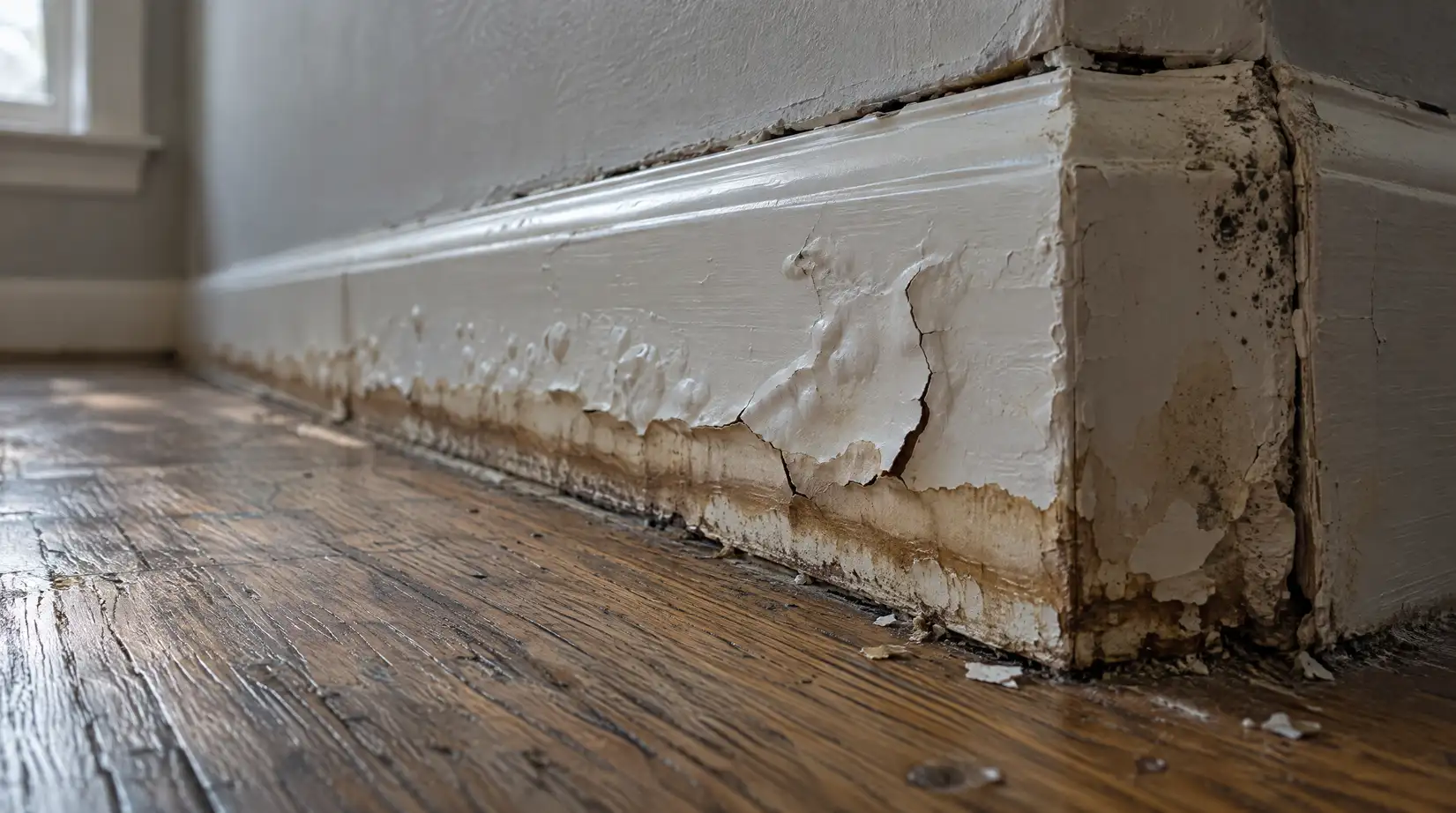
Not all property damage is visible the day it happens. The statute runs from “the day the cause of action accrues,” and for latent issues — foundation movement, hidden roof leaks, or slow water intrusion behind walls — that date is not always the day of the storm [1]. If a dispute over timing ever reaches court, when the damage was first identified versus when it occurred can matter. Documenting the date damage was first identified, not just the date of the storm or incident, preserves the record a client needs either way.
Tolling Conditions That Can Pause the Clock
Texas law also recognizes tolling for minors and persons of unsound mind under a legal disability (Section 16.001) and for a defendant’s temporary absence from the state (Section 16.063) [1]. Contractors advising clients on timing should treat the two-year window as the default assumption unless a licensed attorney has confirmed a tolling condition applies to the specific facts of the case. Waiting to see if a tolling exception might apply is a risky strategy when the alternative — filing before the deadline — costs nothing to preserve.
Real Property vs. Personal Property Claims
Because contractors often handle both structural repairs and contents replacement on the same job, distinguishing real property from personal property matters for tracking deadlines. Texas’s two-year statute of limitations applies to damage claims involving both real property — structures, foundations, roofing systems, built-in fixtures — and personal property, such as contents, appliances, and movable equipment [1][2]. Keeping a documented contents inventory gives the personal-property side of the claim the same deadline-ready footing as the structural scope.
Both categories run on the same two-year clock, but the discovery date for each can differ: structural damage may be discovered during a roof inspection, while contents damage may not surface until a client unpacks storage after a loss. Contractors documenting separate discovery dates for structural versus contents damage give clients a clearer record if a dispute over timing arises later.
Insurer Response Deadlines Contractors Should Track for 2026
Because a client’s ability to recover payment depends on more than just the lawsuit deadline, the insurer response timeline running in parallel is just as important for contractors to track. Texas Insurance Code Chapter 542 sets specific deadlines insurers must follow once a claim is filed, and missed deadlines can trigger statutory interest penalties against the insurer.[3]
| Insurer Action | Deadline | Statute Reference |
|---|---|---|
| Acknowledge claim receipt, begin investigation, request items | 15th day after notice (30 business days for eligible surplus lines insurers) | Section 542.055 |
| Accept or reject the claim | 15th business day after receiving all required items (30 days if arson is suspected), extendable by 45 additional days with written notice | Section 542.056 |
| Pay the claim once accepted | 5th business day after notice of acceptance (20 business days for eligible surplus lines insurers) | Section 542.057 |
| Weather catastrophe extension | Adds 15 additional days to all deadlines above | Section 542.059 |
The Texas Department of Insurance confirms the decision window: once an insurer has the information it needs, it generally has 15 business days to decide whether to pay a claim, with that period extendable by 45 days if the insurer gives a written reason for the delay.[4]
Insurers must also state their reasons in writing if a claim is rejected [4], giving contractors and clients a documented basis to challenge a denial that doesn’t hold up. Knowing how long an insurer can take to pay in Texas — including what triggers each extension — is worth having on hand before the first follow-up call.
Consequences of Missing Filing or Payment Deadlines
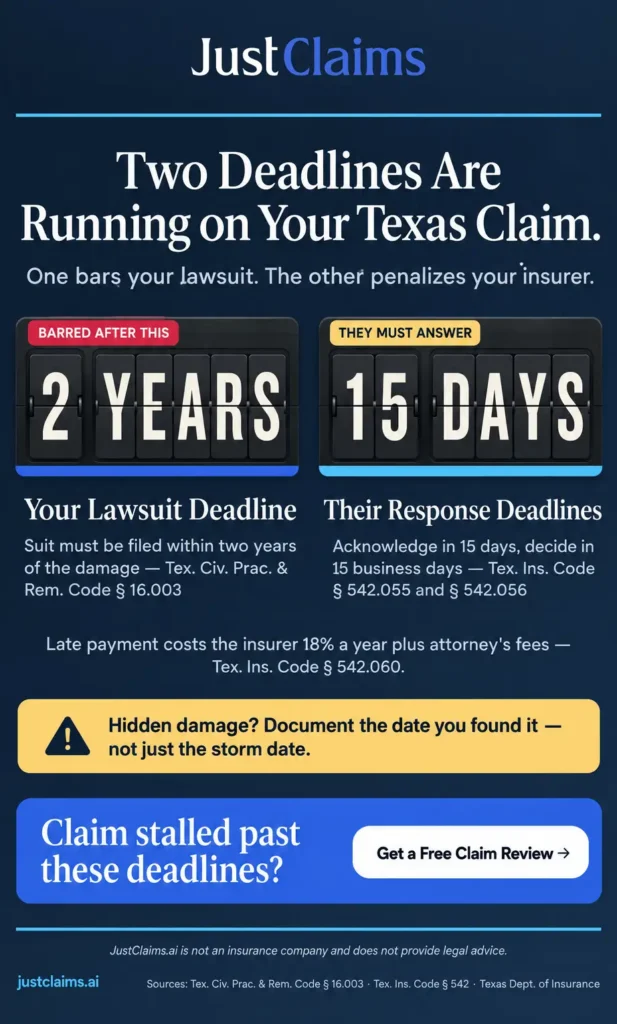
Because both the lawsuit clock and the insurer response clock are running at the same time, missing either one can cost a client — and by extension a contractor’s completed scope — real money. If a property owner misses the two-year statute of limitations, the right to sue over that damage is generally barred, regardless of how strong the underlying claim was [1].
On the insurer side, if a company delays payment beyond the period other statutes specify — or beyond 60 days if no other period is specified — after receiving all required documentation, Section 542.058 makes it liable for damages under Section 542.060: 18% annual interest on the claim amount plus reasonable attorney’s fees [3].
For weather-related claims governed by Insurance Code Chapter 542A, that interest is instead simple interest at five percent above the postjudgment interest rate, determined on the date of judgment [3].
Either way, the penalty structure gives policyholders a financial reason to hold insurers to their own deadlines rather than let a claim drift. When a weather claim does drift past those windows, the revised Texas appraisal process gives contractors and clients a second pressure point that does not depend on the lawsuit clock.
Frequently Asked Questions
Does the two-year deadline start on the date of the storm or the date repairs are estimated?
The two-year period runs from the day the cause of action accrues — generally the date the damage occurred, not the date a contractor provides an estimate or begins work [1][2]. For hidden or latent damage, pinning down that date is less straightforward, which is why documenting when the damage was first identified matters.
What happens if an insurer misses its 15-business-day decision deadline?
An insurer that fails to accept or reject a claim within that window, without properly extending it under Section 542.056, is out of compliance with Texas Insurance Code Chapter 542 [3]. This kind of delay can support a request for the statutory interest penalty and attorney’s fees available under Sections 542.058 and 542.060 [3].
Do weather catastrophes change these deadlines?
Yes. When the insurance commissioner declares a weather-related catastrophe or major natural disaster, every claim-handling deadline under this subchapter is extended by an additional 15 days [3]. Contractors working disaster-area jobs should confirm whether a formal catastrophe declaration is in effect before assuming a standard deadline applies.
Does the two-year rule apply differently to contents versus structural damage?
Both real property (structures) and personal property (contents) fall under the same two-year statute of limitations [1][2]. What can differ is the discovery date used to start that clock, since contents damage is sometimes identified later than structural damage on the same loss.
Track These Deadlines Before You File
Meeting Texas’s two-year filing deadline and the insurer response windows under Chapter 542 protects a client’s right to be paid — and protects the scope of work a contractor has already built around that payment. Missed deadlines on either side of the claim can turn a fully documented repair into an unpaid one, regardless of how sound the original assessment was.
If a claim on your job site has stalled past these statutory windows or was denied without a clear written reason, JustClaims’ licensed Texas public adjusters — accelerated by our bespoke AI — review the policy language, compare it against your documentation, and flag likely underpayments so you can go back to the carrier with confidence.
Want a faster first pass? Upload your policy for a free AI policy analysis and see which deadlines and penalties apply to your claim.
This content is for informational purposes only and does not constitute legal or insurance advice. Coverage decisions depend on the specific terms, conditions, and exclusions of each policy and the laws of the applicable jurisdiction; policyholders and contractors should consult with a qualified professional for advice on their particular situation.
Sources
[2] Statutes of Limitations in Civil Lawsuits — TexasLawHelp (Texas Legal Services Center)
[4] Insurance companies must meet deadlines to respond to Texas claims — Texas Department of Insurance

Stephane Elias

A seasoned insurance professional with nearly a decade of experience, Stephane Elias is currently serving as a Senior Claims Professional and Public Adjuster with JustClaims. Throughout his career, Stephane has represented policyholders through leading public adjusting firms and served as a loss consultant for law firms specializing in insurance litigation, giving him extensive expertise in complex property insurance claims. A licensed public adjuster in TX (#2645032), FL (#W564547), and six other states, he specializes in commercial and residential property claims, claims management, appraisals, mediation, and strategic partnerships. Stephane is passionate about helping policyholders overcome delayed, denied, and underpaid insurance claims, ensuring they receive the full recovery they’re entitled to under their policy.