Bad Faith Insurance Claims: Signs & Recovery Guide 2026
September 23, 2026
Written by Taylor Bezek
Share


Insurers now deploy AI systems in claim management, and state insurance regulators have moved fast to put those automated decisions under the same unfair-claims laws that govern human adjusters. For commercial property owners, a single overlooked valuation error in Business Interruption or Law & Ordinance coverage can turn a routine dispute into a multimillion-dollar loss. Recognizing bad faith conduct early — and responding with the same forensic rigor insurers apply against you — is now a core part of protecting commercial claim value.
Key Takeaways
- What it is: Bad faith occurs when an insurer wrongfully withholds benefits owed under a policy through conduct that is unreasonable.
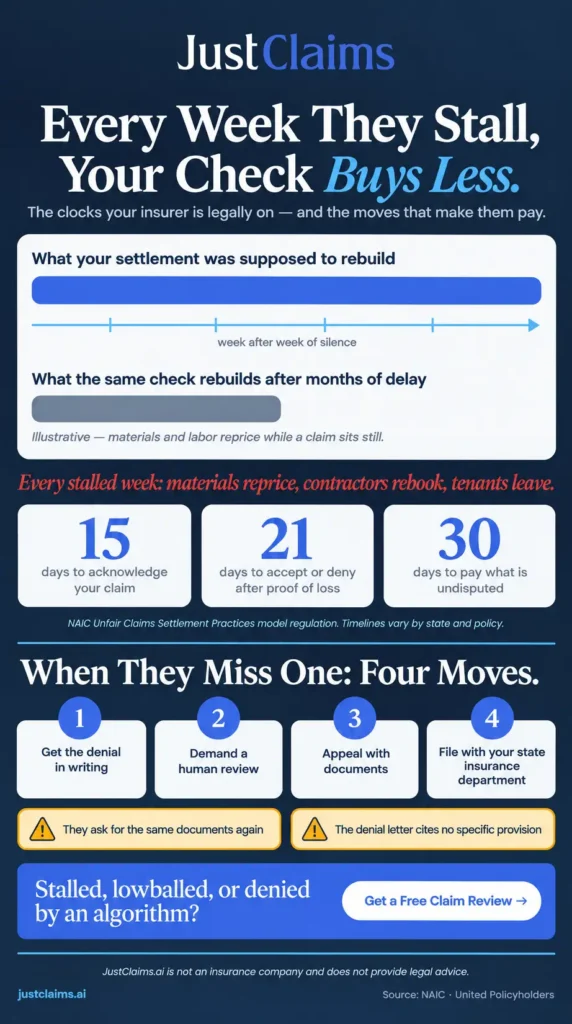
- Payment deadline: Under the NAIC model regulation, insurers must tender payment within 30 days of affirming liability once the amount owed is undisputed.
- Acknowledgment deadline: Insurers must acknowledge receipt of a first-party claim notification within 15 days.
- AI claims risk: Insurers now use AI systems in claim management, and the NAIC’s model bulletin — already adopted across multiple states — requires AI-supported decisions to comply with the same unfair-claims laws that bind human adjusters.
- Potential damages: Bad-faith recoveries can include withheld policy benefits, additional financial losses caused by the conduct, and, in egregious cases, punitive damages.
What Qualifies as Bad Faith: Delays, Lowballing, and Investigation Failures
Bad faith is a legal standard, not just a feeling of frustration with a slow-moving claim. The National Association of Insurance Commissioners’ Unfair Property/Casualty Claims Settlement Practices Model Regulation defines “investigation” broadly as all activities directly or indirectly related to determining what is owed under a policy, and it requires insurers to affirm or deny liability within a reasonable time and tender payment within 30 days once the amount owed is undisputed [1].
The same model regulation sets specific procedural clocks: insurers must acknowledge a first-party claim notification within 15 days, and must advise the claimant of acceptance or denial within 21 days after receiving a properly executed proof of loss, unless the insurer reasonably needs more time to complete a full investigation [1].
States have enacted versions of this framework as their own Unfair Claims Settlement Practices Act — enforced by state insurance commissioners with penalty and cease-and-desist authority, not by federal regulators [2].
To prevail on a bad faith claim, a policyholder generally must show two things: that benefits owed under the policy were wrongfully withheld, and that the insurer’s conduct in withholding them was unreasonable [3]. In practice, an insurer is expected to investigate, process, and pay a claim fully, promptly, and in good faith — when it handles that claim unreasonably, it is acting in bad faith [3].
For commercial property owners, the financial exposure is amplified — a valuation error buried in a Business Interruption calculation or a Law & Ordinance sublimit can silently cost far more than the original disputed amount.
Other documented forms of unfair claims handling include misrepresenting pertinent facts or policy provisions to the claimant [3], settling a claim on the basis of an application that was materially altered without the insured’s knowledge or consent, and settling for less than the amount a reasonable person would have believed they were entitled to based on the insurer’s own written or printed advertising material — a pattern commonly described as lowballing [2].
Common Tactics Insurers Use to Avoid Payment
Because these valuation errors compound whenever a carrier actively works to minimize what it pays, understanding the specific tactics insurers use is the logical next step after learning what bad faith looks like on paper.
Delay and Non-Response Tactics
The NAIC model act prohibits insurers from denying a claim solely because a claimant failed to give written notice, when that failure was not itself unreasonable, and it sets rules for how claims touching multiple coverage parts must be handled [1].
Arizona’s statutory list of unfair claim settlement practices, A.R.S. § 20-461, specifically bars carriers from failing to affirm or deny coverage within a reasonable time after proof of loss and from failing to attempt prompt, equitable settlement once liability is reasonably clear [4]. Property owners should treat silence or repeated requests for the same documentation as a warning sign worth documenting in writing.
Lowballing and Valuation Manipulation
The NAIC model act also identifies refusing to pay a claim without conducting a reasonable investigation as a recognized unfair practice [2]. Arizona law further prohibits an insurer from settling under one part of a policy specifically to pressure the claimant into accepting different, less favorable terms on another part [4] — a tactic commercial property owners should watch for when a claim spans both property damage and business interruption coverage.
Exclusion Misuse and Documentation Gaps
Unreasonable delays, duplicative demands for proof, and a failure to explain the basis for a denial or a compromise offer are each named as unfair claims practices in the NAIC model act [2]. Property owners reviewing a denial letter should ask whether the cited exclusion language actually matches the loss described in their policy, or whether it has been applied more broadly than the policy’s own definitions allow.
The Four-Step Process for Challenging an AI-Influenced Denial
Because minor valuation errors in complex coverages like Business Interruption and Law & Ordinance can cost millions, contesting a denial on a commercial claim requires forensic-level analysis rather than a quick read of the denial letter. This is especially true now that a growing share of claims decisions are shaped by automated systems rather than a human underwriter’s judgment.
AI techniques are now deployed across every stage of the insurance life cycle, including claim management [5]. The NAIC’s model bulletin on insurer AI use — adopted in December 2023 and issued by eleven state insurance jurisdictions within five months — makes one rule explicit: decisions made or supported by AI must comply with the same insurance laws that govern human adjusters, including unfair claims settlement practices acts [5] [6].
Property owners facing a denial that appears to have been generated or heavily influenced by an automated system have a structured path to challenge it.
1. Request the Denial Decision in Writing
Step 1 is to request the denial decision in writing, with the insurer citing exactly how the specific policy language does or does not apply to the loss — under the NAIC model regulation, a denial based on a specific policy provision, condition, or exclusion must reference that provision and must be given to the claimant in writing [1]. A vague or boilerplate denial letter that fails to reference specific policy provisions is itself worth flagging.
2. Request a Human Adjuster Review
Step 2 is to formally request a human adjuster review to catch nuances an automated system may have missed — the NAIC’s AI bulletin expects insurers to weigh the extent to which humans are involved in final decision-making when they govern AI-supported decisions [5]. Complex commercial losses — particularly those involving Business Interruption calculations or Law & Ordinance sub limits — often turn on judgment calls that generic algorithms are not designed to make.
3. File a Formal Written Appeal
Step 3 is filing a formal written appeal supported by documentation that directly rebuts the insurer’s stated denial reasons — reasons the insurer is required to explain with a reasonable and accurate basis under the NAIC model act [2].
4. Escalate to the State Insurance Commissioner
Step 4 is escalating the dispute to the state insurance department if the appeal remains unresolved — after an insurer rejects a claim, the NAIC model regulation requires it to notify the claimant in writing that the matter may be reviewed by the state Department of Insurance [1].
State regulators treat improper denial or delay in claim settlement as a core complaint category, and once a complaint is filed the insurer is generally required to respond to the department within twenty business days [7].
Property owners should also be cautious about relying on any AI platform’s “no coverage” conclusion without independent review: the Nevada Division of Insurance reports an increase in consumer complaints containing incorrect or misleading policy information that originated from AI tools, and cautions users to verify every detail against official sources [7].
Legal Rights and Potential Damages
When these tactics cross the line from aggressive claims handling into a breach of the duty of good faith, commercial property owners gain access to remedies that go well beyond the original disputed claim amount.
It is against the law for an insurer to unreasonably deny a claim in a way that forces the policyholder to sue to recover benefits owed [3].
When an insurer breaches its duty of good faith, a policyholder may recover damages beyond the underlying claim’s value, including the wrongfully withheld policy benefits, the additional financial losses caused by the bad-faith conduct, and in some cases damages for emotional distress and attorney fees; in particularly egregious cases, courts may also award punitive damages intended to deter insurers from repeating the misconduct [8].
State law defines the specific conduct that supports these claims. Virginia law, Va. Code § 38.2-510, enumerates unfair claim settlement practices including misrepresenting policy provisions, failing to promptly investigate or acknowledge claims, refusing arbitrarily to pay claims, and failing to affirm or deny coverage within a reasonable time after proof of loss [9].
Washington’s regulation, WAC 284-30-330, similarly defines unfair claims settlement practices to include compelling a claimant to litigate in order to recover amounts already owed, refusing to pay a claim without a reasonable investigation, and procedures which are not designed to deliver payment to the payee within fifteen business days after receipt by the insurer or its attorney of properly executed releases or other settlement documents are not acceptable [10].
Arizona Revised Statutes § 20-461 establishes as a matter of state insurance law that insurers must attempt in good faith to effectuate a prompt, fair, and equitable settlement once liability has become reasonably clear [4].
Frequently Asked Questions
What actually counts as insurance bad faith?
Bad faith generally requires two elements: benefits owed under the policy were wrongfully withheld, and the insurer’s conduct in withholding them was unreasonable [3].
Common examples include refusing to pay a claim without conducting a reasonable investigation [2], misrepresenting pertinent facts or policy provisions [3], or offering a settlement far below the amount a reasonable person would have believed they were entitled to [2].
How long does an insurer have to pay a claim once liability is confirmed?
Under the NAIC model regulation adopted in some form by most states, an insurer must tender payment within 30 days after affirming liability once the amount owed is undisputed [1]. Separate procedural clocks also apply to acknowledging the claim and responding to a completed proof of loss [1].
Can I challenge a denial that was generated or influenced by AI?
Yes — a structured path exists: request the written denial with the specific policy provisions cited, ask for human adjuster review, file a documented written appeal, and escalate to the state insurance department if the dispute remains unresolved [1] [5].
An appeal grounded in the specific policy language carries more weight than accepting an automated denial at face value — state regulators have already flagged AI tools as a source of incorrect or misleading policy information in consumer complaints [7].
What damages can I recover if my insurer acted in bad faith?
Beyond the originally owed policy benefits, a policyholder may recover additional financial losses caused by the insurer’s conduct, and in some cases damages for emotional distress and attorney fees; punitive damages are possible in especially egregious cases [8].
Does state law define what counts as an unfair claims practice?
Yes — states such as Arizona, Virginia, and Washington each maintain specific statutes or regulations listing prohibited insurer conduct, including failing to settle claims promptly once liability is clear and refusing to pay without a reasonable investigation [4] [9] [10].
These state-level rules generally mirror the NAIC’s model act, which is enforced by state insurance commissioners through penalty and cease-and-desist authority rather than by federal regulators [2].
How to Respond to a Bad Faith Denial
Recognizing bad faith conduct is only the first step — the financial exposure for commercial property owners lies in the details of the policy language itself, particularly in coverages like Business Interruption and Law & Ordinance where a single misapplied clause or valuation error can compound into a loss worth far more than the original dispute.
Documenting every delay, requesting specific policy citations for any denial, and treating vague or boilerplate rejection letters as a signal for deeper review are practical steps every commercial policyholder can take before escalating a dispute. That is the level of forensic policy analysis a public adjuster brings to a commercial dispute.
Complex claims require forensic-level analysis of the policy against the denial reason, not a surface-level reading of either document. Run your denial through our free insurance policy analyzer — Justin, built by JustClaims’ licensed adjusters — to identify the exact coverage gaps and policy language your insurer used against you.
This content is for informational purposes only and does not constitute legal or insurance advice. Coverage decisions depend on the specific terms, conditions, and exclusions of each policy and the laws of the applicable jurisdiction; policyholders and contractors should consult with a qualified professional for advice on their particular situation.
Sources
[2] Unfair Claims Settlement Practices Act (MO-900) — National Association of Insurance Commissioners
[3] Insurance Bad Faith in California — United Policyholders
[4] A.R.S. § 20-461 — Unfair Claim Settlement Practices — Arizona State Legislature
[7] File a Complaint — Nevada Division of Insurance
[9] Va. Code § 38.2-510 — Unfair Claim Settlement Practices — Virginia Legislative Information System
[10] WAC 284-30-330 — Unfair Practices — Washington State Legislature

Taylor Bezek

As the General Manager at JustClaims, Taylor Bezek brings over a decade of experience managing complex residential, commercial, and large-loss claims. A licensed Public Adjuster in TX (#2125659), FL (#W455048), CO (#769172), and 10 additional states, Taylor founded his own firm before joining JustClaims to scale a tech-forward solution for the insured. He is committed to combining industry expertise with AI to enhance speed, clarity, and outcomes for every policyholder. Taylor's mission is to modernize the public adjusting profession and ensure owners get exactly what they are entitled to.