What is a Public Adjuster? Claims Guide & Benefits 2026

June 15, 2026
Written by Taylor Bezek
Share


A public adjuster is a licensed insurance professional hired by the policyholder — not the insurance company — to prepare, present, and settle property damage claims. For commercial owners, that independent advocacy typically decides whether underpaid line items like Business Interruption and Law & Ordinance are recovered or written off.
Key Takeaways
- Primary role: A public adjuster works exclusively for the commercial property owner, not the insurance carrier.
- Fee structure: Compensation is typically based on a percentage of the final settlement rather than upfront hourly rates.
- Vulnerable coverages: Business Interruption and Law & Ordinance are the most common areas where carriers undercalculate commercial losses.
- Analysis requirement: Complex claims require forensic-level analysis to identify discrepancies in the carrier’s initial valuation.
Understanding the Role of a Public Adjuster
A public adjuster is a licensed insurance professional hired by a policyholder to manage, evaluate, and negotiate an insurance claim on their behalf. Unlike the adjusters sent by your insurance company, public adjusters have a fiduciary duty exclusively to you, the commercial property owner. A public adjuster is hired by the policyholder to prepare, present, and negotiate an insurance claim, with the goal of securing a fair and accurate settlement within the terms of the policy [1].
Commercial insurance policies are dense contracts filled with endorsements, exclusions, and conditional clauses. When a major loss occurs—whether from fire, hurricane, or severe winter weather—the burden of proving the extent of the damage falls entirely on the policyholder. A public adjuster steps in to lift this administrative and technical burden. They deploy structural estimators, inventory specialists, and forensic accountants to document every compromised asset [1], ensuring that no covered damage is overlooked during the carrier’s initial inspection.
The Three Types of Adjusters in a Commercial Claim
Understanding who represents whose financial interests is the first step in protecting your commercial asset. During a large-loss event, you will likely encounter different types of adjusters, and knowing their distinct roles helps you navigate the settlement process effectively.
1. The Company Adjuster
Also known as a staff adjuster, this individual is a direct employee of the insurance carrier. Their salary and benefits are paid by the insurance company, and their primary directive is to adjust the claim according to the carrier’s internal guidelines. While they are tasked with evaluating your loss, their underlying allegiance is to their employer, which often supports the position that damages should be calculated conservatively to protect the carrier’s bottom line. The same principle applies to the contractor side of the claim: knowing what belongs in a roofing contract for an insurance claim tells you whether the person doing the repairs can actually stand behind their work.
2. The Independent Adjuster
Despite the name, an independent adjuster does not work for the policyholder. These are freelance adjusters or contractors hired by the insurance company, typically deployed during catastrophic events when the carrier’s internal staff is overwhelmed. They operate under the exact same directives as company adjusters and report directly to the insurance carrier. Their fees are paid by the insurer [2], meaning their financial interests remain tied to the company issuing your settlement check.
3. The Public Adjuster
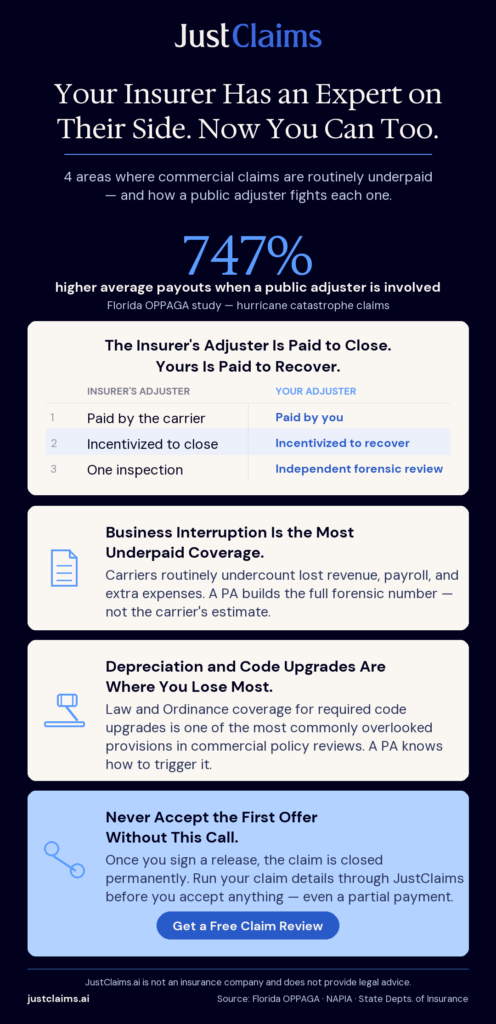
The public adjuster is a claims professional who works exclusively for the property owner, not the insurance company. They are hired directly by you and are compensated based on the success of your financial recovery. This structure aligns their goals entirely with yours. The harder question is when to hire a public adjuster, and the answer usually comes down to three deadlines. Public adjusters conduct independent inspections, scope and estimate losses, review insurer estimates, and negotiate on the policyholder’s behalf [1] — including disputing valuation methods such as depreciation calculations — to secure a fair settlement.
When to Hire Independent Representation
Since complex claims require forensic-level analysis, bringing in a public adjuster early in the process often prevents initial low-ball settlements from becoming permanent financial losses. Commercial property owners should strongly consider hiring representation when facing large-scale structural damage, as the sheer volume of documentation required can easily overwhelm internal management teams. Whether that means an adjuster or a lawyer is covered in public adjuster vs attorney.
Certain types of coverage — such as business interruption — can be difficult to calculate and may lead to disputes with the carrier. Business Interruption claims, for example, require projecting lost revenue, ongoing payroll, and extra expenses incurred to keep the business operational. Carriers frequently apply aggressive formulas to minimize these payouts. Similarly, Law & Ordinance coverage—which pays for the required code upgrades during a rebuild—is often ignored or severely undervalued by company adjusters. An independent expert knows how to trigger these specific policy provisions and document the exact costs required to bring the property up to modern municipal codes.
When Carriers Use AI to Value Your Claim
Insurance companies increasingly use AI property damage assessment software to evaluate photographs of damaged property and calculate estimated claim amounts, a shift driven by the need to manage surge capacity after catastrophes and to reduce claims-handling expenses [4] [5]. Regulators are responding: the NAIC’s model bulletin on insurers’ use of AI systems has now been adopted across a growing number of jurisdictions, signaling that automated claims decisions face active regulatory scrutiny [6].
For a commercial property owner, the risk is an automated valuation trained on historical pricing that no longer reflects post-disaster labor and material reality. A public adjuster counters this by presenting real-world pricing data, line-item evidence, and a forensic estimate — and by formally challenging AI-generated valuations that omit documented damage [5]. This is one reason the goal of a public adjuster — securing the highest accurate payout for the policyholder — matters more, not less, as carrier automation increases [1].
How Fee Structures Work
While the prospect of paying out of pocket deters some property owners, public adjusters operate on a model designed to align their financial interests directly with your recovery. Public adjusters in the United States operate under three primary compensation models: contingency fees (a percentage of the settlement), flat fees, and hourly rates [2]. Contingency fees are the most common model in most states, but fee structures and any applicable caps are governed by each state’s statutes.
Public adjuster contingency fees commonly range from 5% to 20% of the settlement, depending on claim size, complexity, and state regulations, though rates vary by state, claim size, and complexity. Many states do not impose a statutory fee cap. Because they do not charge upfront hourly rates under the contingency model, under the contingency model, public adjusters take on the financial risk of the investigation. If they do not secure a payout for the property owner, they do not get paid. This performance-based compensation model incentivizes them to uncover every legitimate dollar owed under the policy, from hidden structural damage to complex business income losses.
How to Choose a Licensed Public Adjuster
Nearly all states require public adjusters to hold a license issued by the state insurance commissioner, pass an examination, and complete continuing education — Alabama, Alaska, Arkansas, and South Dakota are the current exceptions, so verify requirements in your state [3]. Before signing, confirm the license with your state department of insurance, and get the fee agreement in writing: fees are negotiable, are typically charged as a percentage of the settlement, and must be set out in a contract [2]. Finally, be wary of any contractor who offers to negotiate your claim for you — in most states that crosses into the unauthorized practice of public adjusting (see our UPPA compliance guide).
Frequently Asked Questions
Can my insurance company cancel my policy if I hire a public adjuster?
No, hiring professional representation is a legally protected right for policyholders in most states. Insurance carriers cannot drop your coverage, refuse to renew your policy, or raise your premiums specifically because you chose to bring in your own claim advocate to review the damages.
How long does the public adjusting process take?
The timeline varies significantly based on the severity of the commercial damage and the complexity of the policy language. While bringing in an independent expert adds a layer of detailed forensic review, it often prevents prolonged disputes over underpaid items later in the process, ultimately leading to a more accurate final resolution.
Are public adjusters licensed professionals?
Most states require these advocates to pass rigorous examinations, submit to background checks, and maintain active licenses through the state’s Department of Insurance [3]. However, a handful of states — including Alabama and Alaska — do not currently license or regulate public adjusters, so consumers should verify local requirements before engaging one. This strict regulatory oversight provides a necessary layer of protection for commercial property owners seeking qualified, ethical help.
What happens if the carrier already issued a partial payment?
You can still hire independent representation even after receiving an initial check, provided you have not signed a final release of claims or a settlement agreement. A qualified expert can reopen the file, review the carrier’s initial estimates, and pursue supplemental payments for missed damages or undervalued business interruption losses.
How to Protect Your Commercial Claim
Securing a fair settlement requires proactive documentation, a deep understanding of your policy limits, and the ability to challenge the carrier’s initial valuation with hard data. Do not accept the insurance company’s first offer as the final word on your property’s damage. Run your business interruption denial through JustClaims‘ expert team — accelerated by our bespoke AI — to identify the coverage gaps your insurer used against you.
This content is for informational purposes only and does not constitute legal or insurance advice. Coverage decisions depend on the specific terms, conditions, and exclusions of each policy and the laws of the applicable jurisdiction; policyholders and contractors should consult with a qualified professional for advice on their particular situation.
Sources
[1] National Association of Public Insurance Adjusters — What Is a Public Adjuster: https://www.napia.com/what-is-a-public-adjuster
[2] Illinois Department of Insurance — Public Adjusters (Commercial Property): https://idoi.illinois.gov/consumers/consumerinsurance/commercial/commercial-property-public-adjusters.html
[3] Federation of Regulatory Counsel — Compliance Requirements and Updates Relating to Public Adjusting: https://forc.org/Public/Public/Journals/2024/Articles/Fall/Vol35Ed3Article2.aspx
[4] U.S. Bureau of Labor Statistics — Claims Adjusters, Appraisers, Examiners, and Investigators: https://www.bls.gov/ooh/business-and-financial/claims-adjusters-appraisers-examiners-and-investigators.htm
[5] National Claims Adjuster Authority — AI and Automation in Claims Adjustment: https://nationalclaimsadjusterauthority.com/ai-and-automation-in-claims-adjustment/
[6] National Association of Insurance Commissioners — Model Bulletin: Use of Artificial Intelligence Systems by Insurers (adoption status, April 2024): https://content.naic.org/sites/default/files/inline-files/AI%20Model%20Bulletin%20-%20April%202024.pdf

Taylor Bezek

As the General Manager at JustClaims, Taylor Bezek brings over a decade of experience managing complex residential, commercial, and large-loss claims. A licensed Public Adjuster in TX (#2125659), FL (#W455048), CO (#769172), and 10 additional states, Taylor founded his own firm before joining JustClaims to scale a tech-forward solution for the insured. He is committed to combining industry expertise with AI to enhance speed, clarity, and outcomes for every policyholder. Taylor's mission is to modernize the public adjusting profession and ensure owners get exactly what they are entitled to.