Soft Costs in Builders Risk: Coverage & Claims Guide
September 28, 2026
Written by Stephane Elias
Share


A single unresolved definition in a builder’s risk policy can leave a contractor absorbing months of loan interest, property taxes, and lost rental income out of pocket — even after the insurer pays for the physical damage. Courts have ruled that an all-risk builder’s risk policy’s general coverage grant pays only for direct physical loss — financial losses like soft costs are recoverable only to the extent the policy explicitly extends coverage to them, turning a routine delay into a solvency threat for the project.
Key Takeaways
- What it is: Soft costs coverage is generally not included in standard builder’s risk policies and must be added through a specific endorsement, with its own sub-limits, deductibles, and waiting periods.
- Coverage window: Soft cost provisions typically cover expenses incurred from the date construction would have been completed absent the loss until the date it is actually completed.
- Recoverable categories: Common recoverable soft costs include construction loan interest, real estate taxes, architect and engineer fees, insurance premiums, legal and accounting fees, and lease renegotiation commissions.
- Legal precedent — Vision One: In Vision One, LLC v. Philadelphia Indemnity Insurance Co. (174 Wn.2d 501), the Washington Supreme Court held that an all-risk builder’s risk policy’s general grant covers only direct physical loss — financial delay losses were recoverable solely under the policy’s extra-expense endorsement, capped at its $1 million limit.
- Legal precedent — Hall Arts: In Hall Arts Center Office, LLC v. Hanover Insurance Co. (327 F. Supp. 3d 979, N.D. Tex.), the court enforced a policy definition that limited soft costs to four listed categories — interest payments, realty taxes, lease expenses, and insurance premiums — and granted the insurer’s summary judgment motion in part.
Hard Costs vs. Soft Costs: What Builder’s Risk Actually Pays For
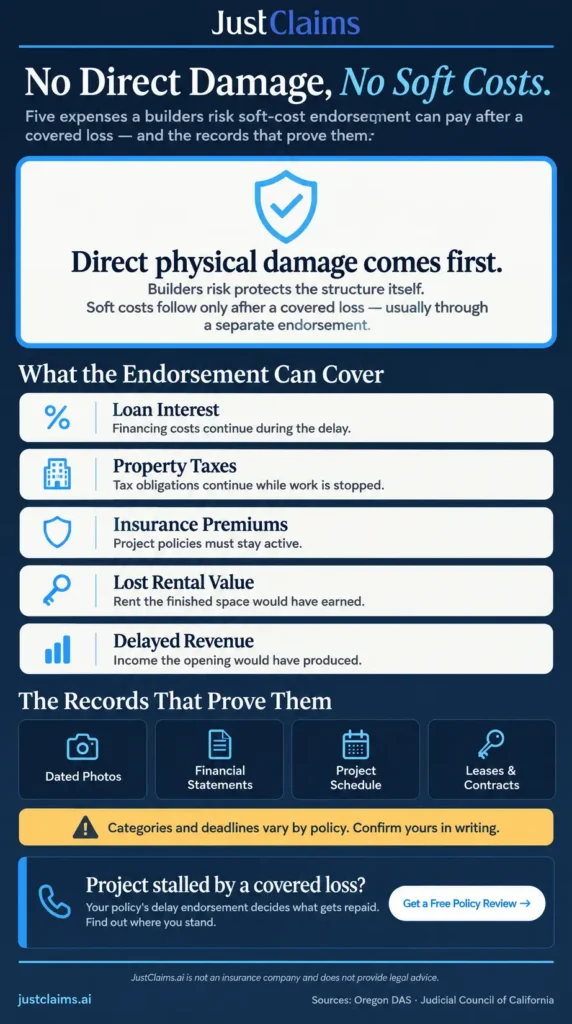
Every builder’s risk claim starts with hard costs — the price of rebuilding the physical structure after a covered event like fire, wind, or vandalism. But the financial damage from a construction delay rarely stops at the studs and drywall. Soft costs are the continuing financial obligations that keep accruing while a project sits idle: loan interest, taxes, professional fees, and lost income that a contractor or developer would not have paid had the loss never occurred. The business income side of the same exposure — loss-of-rents coverage for owners and extra expense for operations that keep running — follows the same endorsement-driven logic.
Standard builder’s risk policies are not written to absorb these costs automatically. Coverage for soft costs generally must be added through a specific endorsement, and that endorsement typically comes with its own sub-limits, deductibles, and waiting periods before payments begin [1][2]. Contractors should not assume that a broad “all-risk” builder’s risk policy extends to financial losses just because it covers most types of physical damage.
Common recoverable soft cost categories include construction loan interest, real estate taxes, architect and engineer fees, insurance premiums, legal and accounting fees, advertising and promotional expenses tied to the project, license and permit fees, and commissions paid to renegotiate leases delayed by the loss [1][2]. Contractors and developers should review their endorsement language line by line to confirm which of these categories are actually listed — not assumed.
How the Delay-in-Completion Trigger Works
Because the gap between hard cost payouts and soft cost reimbursement can create cash flow trouble, understanding the delay-in-completion trigger is essential to protecting a project’s financial position. Soft cost coverage does not activate the moment damage occurs — it activates based on the length of the resulting delay.
Typical soft cost provisions provide coverage for costs incurred from the date construction would have been completed, had no loss occurred, until the date construction is actually completed [2]. This means the contractor or developer must be able to document both the original projected completion date and the revised completion timeline caused by the covered loss.
Without a clear paper trail connecting the two dates, insurers may dispute how much of the delay is attributable to the covered peril versus other factors like labor shortages or supply delays. That same two-timeline paper trail anchors the documentation burden of a large-loss claim on the physical-damage side of any major commercial loss.
It is also worth noting that even itemized soft costs are only payable when they result directly from a covered loss, such as fire or vandalism — not from general project mismanagement or unrelated scheduling issues [1][2]. And if soft costs are not specified anywhere in the builder’s risk policy, those expenses will not be covered at all, even when they clearly arise from a covered event [3].
Contractors should ask their broker directly whether the delay-in-completion language is present and how the waiting period is calculated before a loss occurs, not after.
Common Exclusions That Erase Soft Cost Coverage
Because courts have consistently interpreted soft cost language narrowly, exclusions in this area of a policy deserve as much scrutiny as the delay trigger itself. Two decisions illustrate how easily a contractor can lose an otherwise reasonable claim.
In Vision One, LLC v. Philadelphia Indemnity Insurance Co. (174 Wn.2d 501), the Washington Supreme Court examined an all-risk builder’s risk policy whose general grant covered “direct physical loss” to covered property.
The contractor argued that the financial losses listed in its extra-expense endorsement — construction loan interest, real estate and property taxes, and legal and accounting fees — were also covered under that general grant. The court disagreed: the policy did not cover financial losses “in the first instance,” and the endorsement’s delay-related financial coverage applied only up to its $1 million limit [3]. The ruling underscores that “all-risk” language describes the causes of physical loss covered — not automatically the categories of financial loss covered.
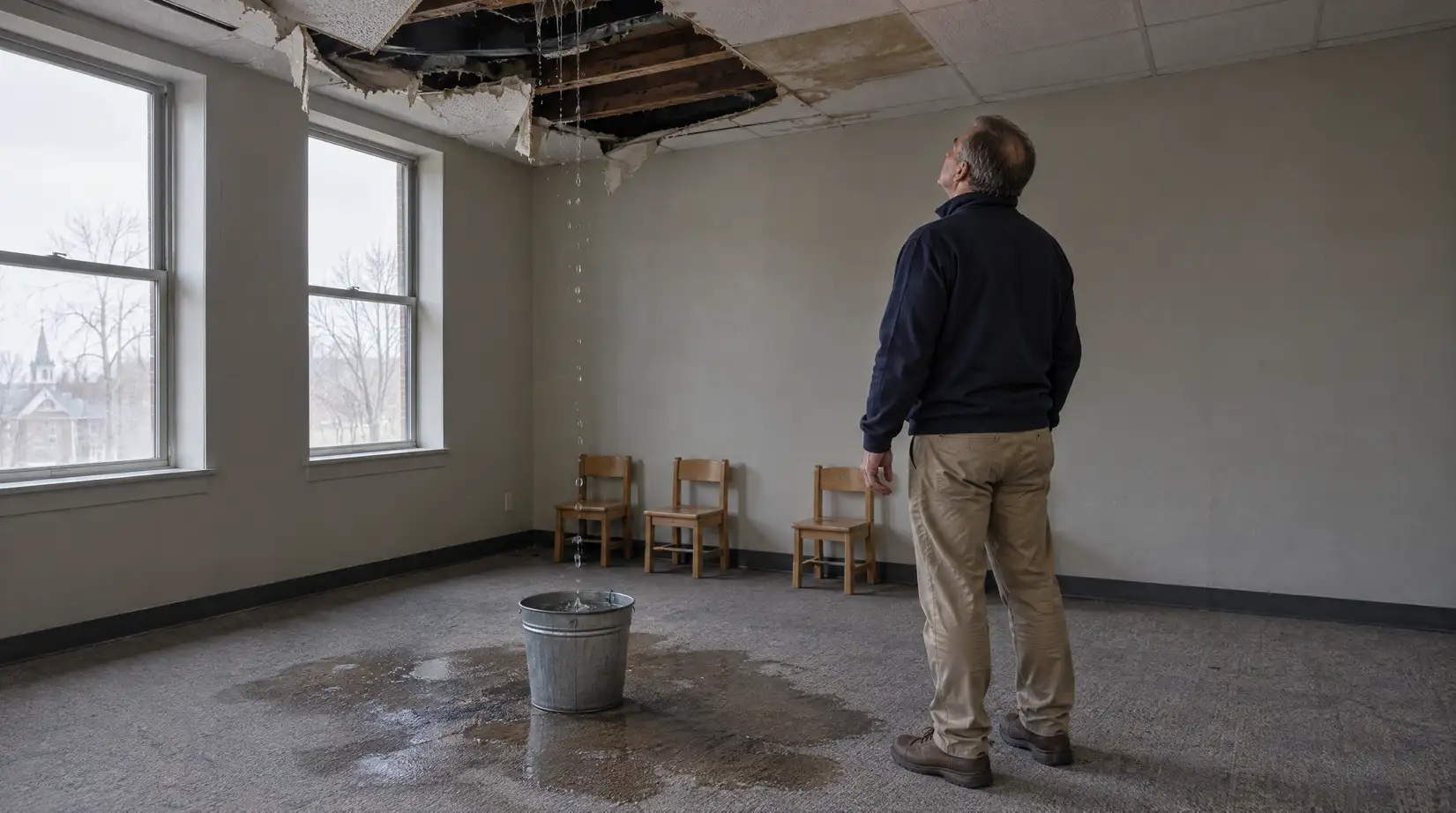
In Hall Arts Center Office, LLC v. Hanover Insurance Co. (327 F. Supp. 3d 979, N.D. Tex.), a case arising from rainwater that leaked through a temporary roof and damaged electrical equipment during construction, the court granted the insurer’s summary judgment motion in part and dismissed the developer’s bad-faith claim. The policy’s own definition limited soft costs to four listed categories — interest payments, realty taxes, lease expenses, and insurance premiums — and the developer’s broader lost-rental-income claim could not be resolved at summary judgment because of genuinely disputed facts about the length of the delay [4].
Contractors should watch for policy definitions that use closed lists (“means the following”) rather than open, illustrative language (“includes but is not limited to”), since closed lists are what courts have enforced against policyholders in both of these cases. Courts read protective safeguard language the same way — a closed list of required systems operates as a condition of coverage, not a starting point for negotiation.
Documenting and Quantifying Soft Cost Losses
Given how narrowly courts have read soft cost definitions, the strength of a claim often comes down to documentation quality rather than the size of the loss itself. Contractors can strengthen a soft cost claim by assembling loan statements showing accruing interest, property tax bills covering the delay period, invoices from architects and engineers for extended service, and correspondence establishing the original versus revised completion dates.
Because soft cost coverage is typically capped by sub-limits and confined to specifically listed categories, contractors should map each expense against the exact wording of their endorsement before submitting a claim [1][2]. An expense that seems reasonable in isolation — such as a marketing cost to re-lease delayed units — may not qualify unless the endorsement explicitly names that category.
Contractors preparing a soft cost claim should also flag ambiguous definitions early and ask the carrier in writing how each line item will be evaluated, rather than waiting for a denial to surface the disagreement. And if that denial arrives after the carrier has already closed the file, reopening a closed claim is still on the table when the disagreement was documented in writing before closure.
Frequently Asked Questions
What is the difference between hard costs and soft costs in a builder’s risk claim?
Hard costs are the direct expenses of repairing or rebuilding the physical structure after a covered loss. Soft costs are the ongoing financial obligations — like loan interest, taxes, and professional fees — that keep accumulating while the project is delayed, and they require a separate endorsement to be covered [1].
Does a standard builder’s risk policy automatically cover lost rental income from a delay?
No, lost income and other soft costs are not automatically included in a standard policy and must be added through a specific endorsement with its own limits and waiting periods [1]. Even a broad all-risk policy’s general grant does not extend to financial losses unless the policy separately extends coverage — the rule confirmed in the Vision One ruling [3].
When does soft cost coverage start and stop paying?
Coverage generally applies from the date the project would have been completed absent the loss until the date it is actually completed [2]. Contractors need clear documentation of both dates to establish the length of the compensable delay.
Can an insurer deny a soft cost expense that isn’t specifically listed in the endorsement?
Yes, courts have upheld insurers’ right to limit soft cost coverage strictly to the categories named in the policy’s definition, as seen in the Hall Arts case [4]. Expenses outside those listed categories do not qualify as soft costs under that policy’s definition.
Protect Your Project’s Financial Recovery
The distance between a covered physical loss and full financial recovery is where many construction projects lose their footing — not because the damage wasn’t covered, but because the resulting delay costs were never mapped against the policy’s actual language. Contractors who treat the soft cost endorsement as a checklist item rather than a negotiated set of definitions risk seeing interest, taxes, and lost income go unreimbursed. Reviewing the endorsement’s listed categories, the delay-in-completion window, and any closed-list exclusions before a loss occurs gives a project team the clearest path to recovering what the policy actually promised.
If your builder’s risk or property claim was denied or underpaid, get a free commercial property policy review — JustClaims’ expert team, accelerated by our bespoke AI, reviews the policy language, compares it against your documentation, and flags likely underpayments so you can go back to the carrier with confidence.
This content is for informational purposes only and does not constitute legal or insurance advice. Coverage decisions depend on the specific terms, conditions, and exclusions of each policy and the laws of the applicable jurisdiction; policyholders and contractors should consult with a qualified professional for advice on their particular situation.
Sources

Stephane Elias

A seasoned insurance professional with nearly a decade of experience, Stephane Elias is currently serving as a Senior Claims Professional and Public Adjuster with JustClaims. Throughout his career, Stephane has represented policyholders through leading public adjusting firms and served as a loss consultant for law firms specializing in insurance litigation, giving him extensive expertise in complex property insurance claims. A licensed public adjuster in TX (#2645032), FL (#W564547), and six other states, he specializes in commercial and residential property claims, claims management, appraisals, mediation, and strategic partnerships. Stephane is passionate about helping policyholders overcome delayed, denied, and underpaid insurance claims, ensuring they receive the full recovery they’re entitled to under their policy.