Protective Safeguards Endorsement (CP 04 11) Guide

July 01, 2026
Written by Taylor Bezek
Share


The CP 04 11 Protective Safeguards endorsement requires commercial property owners to maintain specific fire and security systems as a strict condition of their insurance coverage. If a required safeguard is non-functional during a fire or break-in, the insurer can completely suspend coverage and deny the claim. Understanding these compliance requirements is essential to protecting your commercial property investment before a loss occurs.
Key Takeaways
- What it is: The CP 04 11 Protective Safeguards endorsement requires the insured to maintain specific protective systems, such as fire alarms or sprinklers, in good working order as a condition of coverage.
- Why it applies: Carriers typically attach this endorsement when they have provided a premium credit or favorable policy terms based on the existence and maintenance of these protective features.
- How it is tracked: The specific safety systems required by the endorsement are identified using a ‘P’ code symbol system, such as P-1 for sprinklers or P-2 for alarms.
- When exceptions apply: The standard endorsement includes a 48-hour safe harbor exception, which waives the notification requirement if an automatic sprinkler is shut off due to breakage, leakage, or freezing, provided full protection is restored within 48 hours.
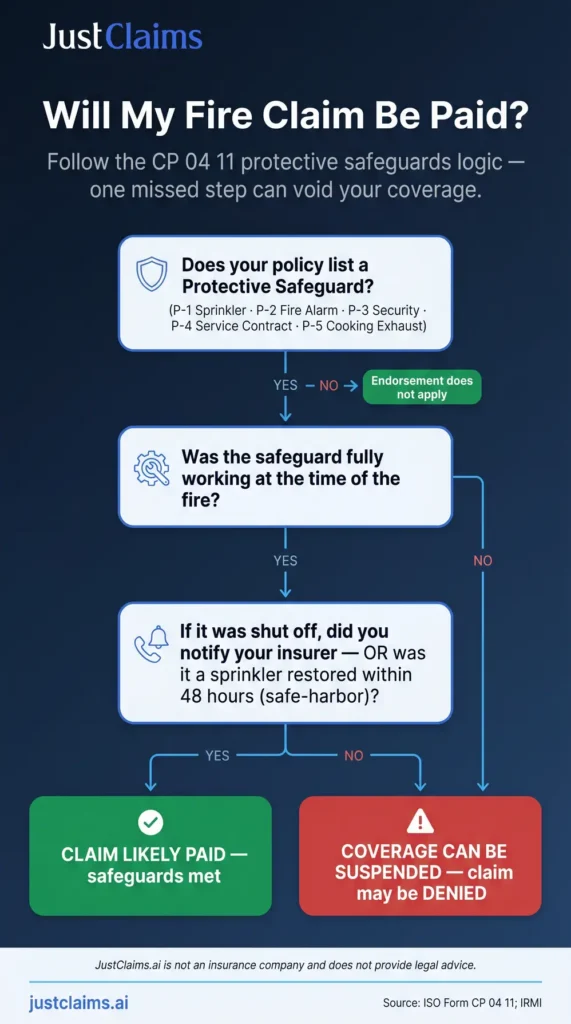
- What voids coverage: Even if a protective safeguard is temporarily suspended for routine maintenance, the insured must notify the insurer; failing to do so can result in a denied claim.
What CP 04 11 Is and Why Carriers Attach It
Commercial property policies are complex contracts, and the CP 04 11 Protective Safeguards endorsement is a critical component that dictates whether a fire or theft claim will be paid. This endorsement is a commercial property policy component that requires the insured to maintain specific protective systems, such as fire alarms or sprinklers, in good working order as a condition of coverage [2]. For property owners, this transforms routine building maintenance into a strict insurance obligation.
Carriers typically attach this endorsement when they have provided a premium credit or favorable policy terms based on the existence and maintenance of these protective features [2]. By agreeing to keep these systems operational, the property owner assumes a portion of the risk management burden in exchange for lower insurance costs. However, the presence of this endorsement is not always a choice. In some cases, insurers require the existence of a protective safeguard, such as an automatic sprinkler system, as a mandatory condition to even offer coverage for certain building occupancies [3].
The stakes for maintaining these systems are incredibly high. Failure to comply with the endorsement’s requirements can result in severe consequences, including the suspension of coverage or the denial of a claim, especially for fire-related losses [2]. If a fire destroys a commercial building and the required sprinkler system was turned off, the carrier often has the contractual right to walk away from the claim entirely, leaving the property owner to bear the full financial loss. Even when a fire claim is fully approved, owners are often surprised that debris removal insurance covers only a fraction of the cost to clear the burned structure from the site.
The Protective Safeguard Classifications You Need to Know
Because failing to maintain these systems can trigger a claim denial, property owners must understand exactly which safeguards their policy mandates. The endorsement categorizes required systems using specific alphanumeric codes, which correspond to different types of physical infrastructure or vendor services.
Understanding these classifications helps property owners coordinate with their facility managers and maintenance vendors to ensure continuous compliance. The standard designations include:
| Classification Code | Required Protective System |
|---|---|
| P-1 | Automatic Sprinkler System [1] |
| P-2 | Automatic Fire Alarm system [1] |
| P-3 | Security Service [1] |
| P-4 | Service Contract [1] |
| P-9 | Another described protective system (catch-all for any protective system specifically described in the endorsement’s Schedule) [1] |
Each of these codes represents a distinct operational requirement. For example, a property owner with a P-4 designation must ensure their service contract remains active and paid; allowing the contract to lapse could jeopardize their coverage just as easily as a broken pipe would for a P-1 designation.
How to Find This Endorsement in Your Policy
Since the presence of a P-code dictates your daily maintenance responsibilities, locating this endorsement within your commercial policy documents is a necessary first step. Many property owners mistakenly assume that all coverage limitations are listed in the main body of their policy, but protective safeguards are often added separately.
The Protective Safeguards Endorsement is typically located in the endorsement stack of a commercial property policy, rather than in the standard Exclusions or Perils Insured Against sections [1]. This means you should review the supplementary pages attached to the end of your primary contract. While auditing these endorsement pages, owners should also confirm their statement of values insurance schedule is current, since that document sets the coverage limits a paid fire claim will draw against. [1].
In some policies, the required safeguard symbols are printed directly on the policy’s Declarations page or or, if not shown there, in the policy’s Declarations [1]. This makes it easier to spot at a glance, but you still need to read the full endorsement text to understand the specific notification rules. Policyholders should look for the standard ISO form number CP 04 11, though older policies may use IL 04 15 and some carriers use their own proprietary forms [3]. Identifying the exact form number helps clarify the precise legal obligations you should meet to keep your coverage active.
What to Do If Your Safeguard Is Out of Service
Even with diligent maintenance, protective systems can fail or require temporary shutdowns, making it vital to know how to handle these lapses without jeopardizing your coverage. The rules governing system outages are strict, and a simple communication failure can lead to a devastating claim denial.
Policyholders have a strict duty to immediately notify their insurance company if they know of any suspension or impairment of a required protective safeguard [1]. This is not a flexible guideline; it is a hard contractual requirement. Even if a protective safeguard is temporarily suspended for routine maintenance, the insured must notify the insurer; failing to do so can result in a denied claim if a loss occurs during that maintenance window [4]. Property owners should establish clear protocols with their maintenance staff to ensure the broker or carrier is alerted before any system is taken offline.
However, the insurance industry recognizes that sudden, accidental breakdowns happen. The standard ISO CP 04 11 endorsement includes a 48-hour ‘safe harbor’ exception, which waives the notification requirement if an automatic sprinkler or commercial cooking exhaust system is shut off due to breakage, leakage, or freezing, provided full protection is restored within 48 hours [1]. If the repair takes longer than that timeframe, immediate notification becomes mandatory.
Finally, there are situations where the system fails due to the event causing the damage. Courts have generally ruled that an insured’s coverage cannot be suspended if the protective safeguard was rendered inoperable by the covered cause of loss itself, such as an arsonist disabling a sprinkler system or a burglar bypassing an alarm [3]. In these scenarios, the property owner is generally protected, provided the system was fully operational right up until the moment the perpetrator disabled it.
Frequently Asked Questions
What happens if I forget to turn my alarm system on before a fire?
If your commercial policy includes a requirement for an active fire alarm and it is not engaged or functioning during an incident, the insurance carrier may refuse to pay for the resulting damage. The endorsement makes the operational status of these systems a strict prerequisite for financial recovery, meaning human error in arming the system can lead to a complete denial of the claim [2].
Do I need to tell my insurance company if my sprinkler system is being repaired?
Yes, property owners are obligated to alert their carrier right away when a mandated safety system is offline, even for standard upkeep. Neglecting to report this temporary shutdown can lead to a rejected claim if a fire breaks out while the system is down for maintenance [4].
Where can I check if my commercial property policy has these requirements?
You will generally find these stipulations in the endorsement pages rather than the main exclusions section of your contract. You can also check your Declarations page or schedule for specific codes like P-1 or P-2, or look for the ISO document labeled CP 04 11 to confirm your exact obligations [1].
Is my coverage voided if a burglar destroys my security cameras before stealing property?
In most legal interpretations, your protection remains intact if the peril itself—such as an intruder or an arsonist—is what disabled the required safety equipment. The carrier generally cannot use the intentional destruction of the safeguard by the perpetrator as grounds for denial, provided the system was working properly beforehand [3].
How to Protect Your Commercial Claim
Managing a commercial property requires strict attention to the operational status of your fire and security systems. Failing to maintain these safeguards or notify your carrier of an outage can leave you entirely responsible for catastrophic damages. If your commercial property claim was denied or underpaid, JustClaims‘ expert team — accelerated by our bespoke AI — reviews the policy language, compares it against your documentation, and flags likely underpayments so you can go back to the carrier with confidence.
This content is for informational purposes only and does not constitute legal or insurance advice. Coverage decisions depend on the specific terms, conditions, and exclusions of each policy and the laws of the applicable jurisdiction; policyholders and contractors should consult with a qualified professional for advice on their particular situation.
Sources
[1] https://www.propertyinsurancecoveragelaw.com/wp-content/uploads/2023/12/CP-04-11-09-17-Protective-Safeguards.pdf
[2] https://www.irmi.com/term/insurance-definitions/protective-safeguards-endorsement
[3] https://www.irmi.com/articles/expert-commentary/protective-safeguards-endorsements-need-a-warning-label
[4] https://natlawreview.com/article/failure-to-comply-protective-safeguards-endorsement-results-loss-coverage

Taylor Bezek

As the General Manager at JustClaims, Taylor Bezek brings over a decade of experience managing complex residential, commercial, and large-loss claims. A licensed Public Adjuster in TX (#2125659), FL (#W455048), CO (#769172), and 10 additional states, Taylor founded his own firm before joining JustClaims to scale a tech-forward solution for the insured. He is committed to combining industry expertise with AI to enhance speed, clarity, and outcomes for every policyholder. Taylor's mission is to modernize the public adjusting profession and ensure owners get exactly what they are entitled to.