Insurance Claim Supplement Delays: A Contractor’s 2026 Guide to Faster Approvals

August 17, 2026
Written by Taylor Bezek
Share


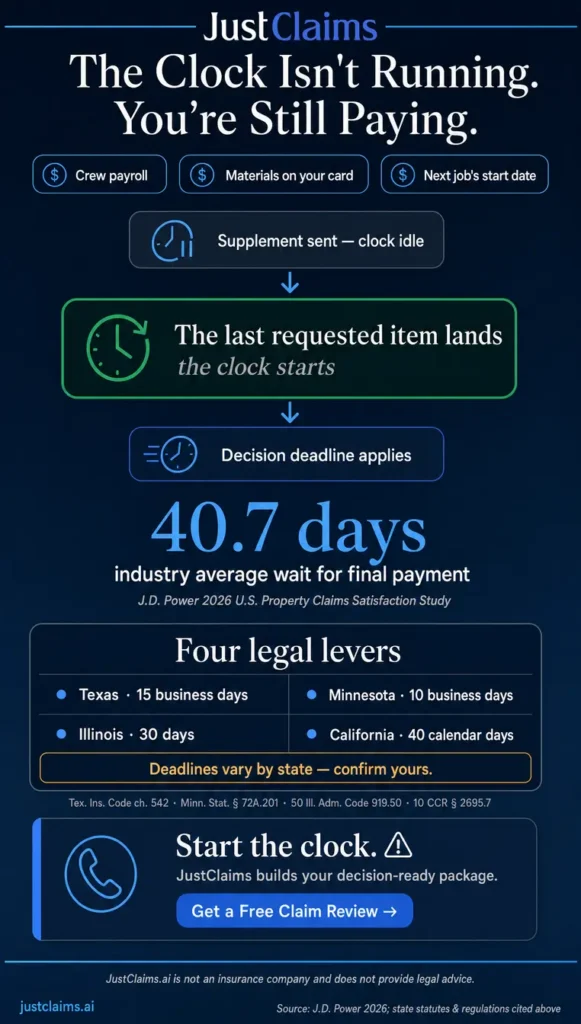
Homeowners now wait an average of 40.7 days from filing a property claim to receiving final payment. That is 3.4 days faster than a year ago — and it still means the industry measures payment in weeks, not days. For the restoration contractor whose insurance claim supplement is sitting somewhere in a desk adjuster’s queue inside that window, every one of those days is labor already performed and material already installed, financed out of your own pocket.
Key Takeaways
- 2026 payout timeline: Final payment now averages 40.7 days from filing — 3.4 days faster than the prior year.
- Repairs sped up too: Average repair time fell to 29.6 days, down 2.8 days year over year.
- The 2025 baseline: Time from first notice of loss to final payment topped 44 days — the longest span since the study began in 2008.
- Pre-verified paths move fastest: Among the 41% of customers using insurer-connected direct repair programs, higher-severity repairs finished more than two weeks sooner.
- Your paperwork starts the clock: In Texas, the insurer’s 15-business-day window to accept or reject only begins once it has received every item, statement and form it required to secure final proof of loss.
- Silence has a deadline too: Minnesota gives insurers ten business days to reply to a claim communication; California requires a written status update every 30 calendar days while a decision is pending.
What the 2026 Claim Cycle Data Actually Shows
Supplement turnaround is not a problem any single carrier invented — it tracks the broader claim cycle that contractors feel through delayed draws and idle crews. Handing the follow-up loop to the claims partner takes it off the contractor’s desk entirely. The JD Power 2026 U.S. Property Claims Satisfaction Study reports that the average time before customers receive final payment is 40.7 days, down 3.4 days from the prior year, and that the average time required to complete a repair is 29.6 days, down 2.8 days [1]. The prior-year picture was worse: the 2025 study put average claim cycle time — filing to finished repairs — at 32.4 days, with time from first notice of loss to final payment exceeding 44 days, both the longest spans since the study began in 2008 [2].
The more useful figure for contractors is buried in the repair data. Among the 41% of customers using insurer-connected direct repair programs, higher-severity claims finished repairs more than two weeks faster than claims outside those programs [1]. Carriers can move quickly, and they do it routinely — when the claim path is structured, pre-verified and predictable. The same pre-assembled file is what buys appraisal speed for contractors when the dispute gets that far. A supplement that arrives with the scope justified line by line and the photo evidence already matched to it is asking the adjuster to approve something, not to go investigate it.
What Actually Slows a Supplement Down
Here is the part most contractors underestimate: in much of the country, the statutory clock on a claim decision does not start when you hit send. Under the Texas Insurance Code, the insurer must acknowledge the claim, begin investigating, and request all items, statements and forms it reasonably believes will be required — and its 15-business-day window to accept or reject the claim only begins after it receives all of those items, statements and forms required to secure final proof of loss [3]. An incomplete supplement does not merely risk a kickback. It can keep the deadline from ever starting to run. For a look at the other side of that queue, see what a desk adjuster actually reviews.
Incomplete Line-Item Justification
Desk adjusters cannot approve a cost they cannot verify against the estimate line. When a supplement lists an added cost with no corresponding code reference, measurement, or material specification attached to it, the file has a ready-made reason to sit — and in Texas the insurer is expressly entitled to request the items it believes it needs before the decision window opens [3]. Writing each line with an explicit “why” — code requirement, manufacturer specification, or documented damage extent — removes that reason. For the valuation language behind the numbers, see our contractor guide to replacement cost versus actual cash value.
Missing or Disorganized Photo Evidence
Illinois regulation is unusually direct about supplements: when it is apparent that additional benefits would be payable upon receipt of additional proofs of loss, the insurer is required to communicate and cooperate with the insured in determining the extent of that additional liability [4]. Cooperation still runs on evidence. Photos that are dated, labeled, grouped by scope section and cross-referenced to the specific estimate line they support give the adjuster something to act on. A folder of unlabeled images invites another information request instead.
Delayed or Inconsistent Follow-Up
Follow-up is not nagging — in several states it triggers an obligation. Minnesota treats it as a prohibited claims practice to fail to reply within ten business days to communications about a claim that reasonably indicate a response is requested or needed, and requires the insurer to give its reasons and an expected completion date when an investigation runs past 30 business days [5]. California requires the insurer to accept or deny within 40 calendar days of receiving proof of claim and, if it needs longer, to send written notice specifying the additional information it requires — then repeat that notice every 30 calendar days until it decides [6]. It also has 15 calendar days to give a complete response to any claim communication that reasonably suggests a response is expected [7].
The practical translation: put every follow-up in writing, date it, and keep the thread. A written follow-up starts a clock in states that have one, and it builds the record you will need if the file has to be escalated to the department of insurance.
Statutory Deadlines Contractors Should Track
Because state law sets the floor for how long a carrier can sit on a decision, knowing your state’s numbers turns a frustrated phone call into a specific, documented request. Every one of those numbers comes from the state payment deadlines written into insurance code. The deadlines differ by state and by claim type, so confirm the rule that applies to your file — the NAIC publishes a state-by-state chart of claims settlement provisions as a starting point, and your state department of insurance is the authority for your own market [9].
In Texas, the Department of Insurance states it plainly: the insurer has 15 business days to tell you it received your claim, and 15 business days after getting what it needs from you to decide whether it will pay — extendable by 45 days if it tells you why it needs more time [8]. The statute adds teeth. An insurer that delays payment more than 60 days after receiving the items it reasonably requested can owe 18% annual interest on the claim amount as damages, plus reasonable and necessary attorney’s fees [3].
| Jurisdiction | Milestone | Deadline |
|---|---|---|
| Texas | Acknowledge claim, begin investigation, request required items | Not later than the 15th day after notice of claim [3] |
| Texas | Written acceptance or rejection | 15th business day after receiving all items required for final proof of loss; extendable 45 days with written reasons [3] |
| Texas | Payment-delay exposure | Beyond 60 days: 18% annual interest as damages plus attorney’s fees [3] |
| Minnesota | Acknowledge claim notification | 10 business days [5] |
| Minnesota | Reply to other claim communications | 10 business days [5] |
| Minnesota | Advise acceptance or denial after properly executed proof of loss | 60 business days [5] |
| Illinois | Offer payment after affirming liability (amount determined, not in dispute) | 30 days [4] |
| Illinois | Written explanation of a lower offer or a denial | 30 days after investigation and determination completed [4] |
| California | Accept or deny after receiving proof of claim | 40 calendar days [6] |
| California | Written status notice while a decision is pending | Every 30 calendar days [6] |
| California | Complete response to a claim communication | 15 calendar days [7] |
A Workflow Checklist for Faster Supplement Review
Adjusters request the same handful of things over and over. Build the supplement so those requests are already answered:
- Tie every added cost to a code reference, manufacturer specification, or field measurement on the estimate line itself.
- Attach dated, labeled photos for each disputed line, grouped by scope section.
- Cross-reference each photo to the specific estimate line it supports.
- Confirm you have sent every item, statement and form the carrier requested — in Texas the decision window does not open until it has all of them [3].
- Log the submission date, then follow up in writing and keep the thread; several states set a deadline for the insurer’s reply [5][7].
- Diary the carrier’s acknowledgment and decision dates against your state’s deadline, and record any written extension and the reason given [3][8].
- Keep a running record of adjuster communications — names, dates, what was requested — in case the file has to go to the department of insurance.
Frequently Asked Questions
Why do insurance supplements take so long to approve?
Often because the decision clock has not started yet. In Texas, the insurer’s 15-business-day window to accept or reject only opens once it has received all items, statements and forms it required to secure final proof of loss [3]. A supplement submitted with each line item justified and the photo evidence already matched to it gives the carrier less to request — and less reason to pause the file.
What is the average time to receive final payment on a claim?
The JD Power 2026 U.S. Property Claims Satisfaction Study puts the average at 40.7 days from filing to final payment, 3.4 days faster than the prior year, with average repair time at 29.6 days [1]. Individual timelines vary by claim severity, carrier, state, and how quickly complete documentation is submitted and verified.
Are there legal deadlines carriers must follow?
Yes, and they vary by state. Texas requires acknowledgment within 15 days of notice of the claim and a written acceptance or rejection within 15 business days of receiving complete proof of loss, extendable by 45 days with written reasons [3]. Minnesota sets ten business days both to acknowledge a claim and to reply to claim communications [5]. California requires a decision within 40 calendar days of proof of claim, then written status updates every 30 calendar days [6]. Confirm the rule for your own state before relying on any single figure [9].
How often should a contractor follow up on a pending supplement?
Anchor it to the deadlines instead of guessing at an interval. Put each follow-up in writing, date it, and diary it against the response deadline that applies in your state — ten business days for a reply in Minnesota [5], 15 calendar days in California [7] — and against the carrier’s own decision deadline and any written extension it has claimed [3]. Written, dated follow-up keeps the file moving and builds the record you need if you have to escalate.
What can a contractor do if the adjuster stops responding?
Escalate in writing, then to the regulator. Minnesota treats failure to reply within ten business days to a claim communication that reasonably indicates a response is needed as a prohibited claims practice [5], and California requires a complete response within 15 calendar days[7]. Once that deadline passes, your state department of insurance accepts complaints — Texas, for example, publishes both the response deadlines and a consumer help line for exactly this situation [8].
How to Speed Up Your Next Supplement Review
Slow supplements are usually files that left the adjuster with unanswered questions — and in states like Texas, the questions the carrier has formally requested keep the statutory clock from starting at all [3]. Line-item justification, photo evidence matched to scope, and dated written follow-up move a file from “still under investigation” to “ready to decide.” That discipline decides a Houston water damage insurance claim faster than almost anything else, because the flood-versus-water question already hands the carrier its easiest reason to wait.
Not sure what the policy actually obligates the carrier to cover before you build the supplement? Upload the policy to Justin — JustClaims’ free AI policy review — and get the coverage, limits and conditions back in plain English in minutes. Then send us the supplement documentation and our licensed team will organize the line items and photo evidence into a package built for a faster desk-adjuster decision. If a supplement still stalls after escalation, our deeper comparison of when appraisal beats litigation walks through the next rung on the ladder.
This content is for informational purposes only and does not constitute legal or insurance advice. Coverage decisions depend on the specific terms, conditions, and exclusions of each policy and the laws of the applicable jurisdiction; policyholders and contractors should consult with a qualified professional for advice on their particular situation.
Sources
[1] 2026 U.S. Property Claims Satisfaction Study — JD Power, 17 March 2026
[2] 2025 U.S. Property Claims Satisfaction Study — JD Power, 18 March 2025
[8] Insurance companies must meet deadlines to respond to Texas claims — Texas Department of Insurance

Taylor Bezek

As the General Manager at JustClaims, Taylor Bezek brings over a decade of experience managing complex residential, commercial, and large-loss claims. A licensed Public Adjuster in TX (#2125659), FL (#W455048), CO (#769172), and 10 additional states, Taylor founded his own firm before joining JustClaims to scale a tech-forward solution for the insured. He is committed to combining industry expertise with AI to enhance speed, clarity, and outcomes for every policyholder. Taylor's mission is to modernize the public adjusting profession and ensure owners get exactly what they are entitled to.