



Houston Water Damage Insurance Claims 2026

September 02, 2026
Written by Stephane Elias
Share


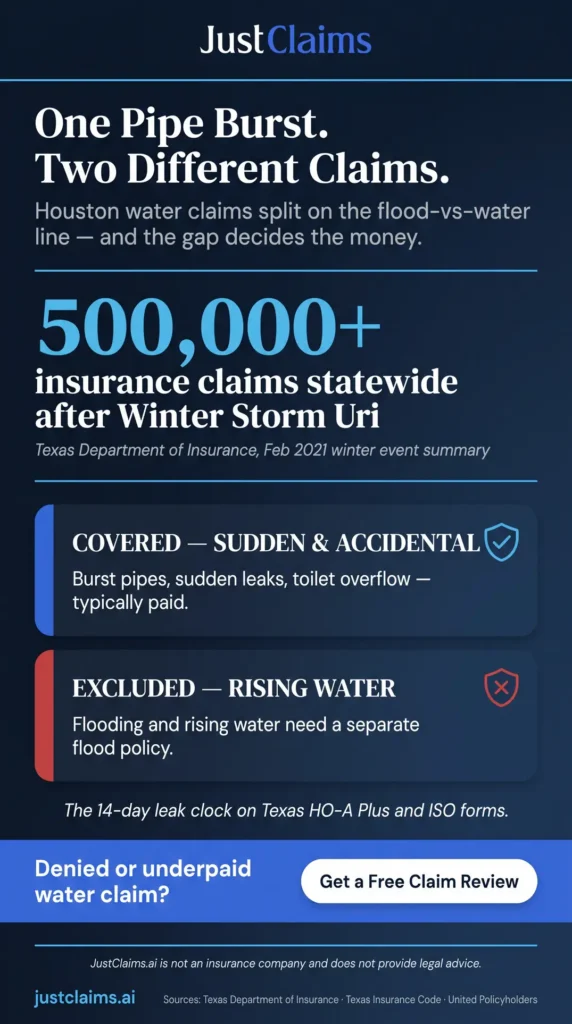
Winter Storm Uri, which struck Texas in February 2021, was one of the most damaging storms in Texas history — more than 500,000 insurance claims were filed statewide following Winter Storm Uri — with Greater Houston homes losing pipes in attics, exterior walls, and under slabs by the thousands. That same storm also exposed a pattern Gulf Coast property owners still run into today: carriers processing Houston water claims as if they were routine, when the region’s flood exposure, freeze risk, and slab-on-grade construction make them anything but.
Key Takeaways
- Coverage trigger: Standard policies generally cover “sudden and accidental” water damage — a burst pipe, toilet overflow, or broken washer hose — while damage from gradual leaks is typically excluded.
- Flood exclusion: Flooding and rising water are not covered by a standard homeowners policy and require a separate flood policy.
- Slab leak nuance: On Texas HO-A Plus and ISO policy forms, seepage or leakage continuing for 14 or more days is excluded — a key issue for Houston’s slab-on-grade, clay-soil homes.
- Historic event: After Winter Storm Uri (February 2021), more than 500,000 insurance claims were filed statewide.
- Insurer deadline: Under Texas Insurance Code §542.056, insurers must accept or reject a claim in writing within 15 business days of receiving all required information.
- Public adjuster fee cap: Public adjusters are capped at 10% of the total claim settlement under Texas Insurance Code §4102.104.
Why Houston Water Claims Are Different
Houston’s combination of flood exposure, periodic hard freezes, and expansive clay soils means water damage claims here rarely fit the tidy “burst pipe” scenario carriers are set up to process quickly. That mismatch between how claims actually happen on the Gulf Coast and how policies are written is a major reason property owners end up underpaid or denied.
Storm Surge
Storm surge and flooding are treated as a separate risk category entirely. TDI’s flood guidance is blunt: “Most home policies don’t cover floods,” and flood insurance exists to cover “damage from rising water” — which is why homeowners need a separate flood policy [2]. Property owners who assume their homeowners policy handles any water event that reaches their home are often surprised to learn rising-water damage falls outside that coverage.
Burst Pipes and Freeze Events
Burst pipes are more likely to be covered, but not without limits. TDI notes that many policies pay for damage caused by a frozen pipe that bursts, though coverage “may have some limitations,” and property owners should confirm those limitations with their agent or company [3]. Houston’s periodic hard-freeze events, including Winter Storm Uri, have shown how quickly this coverage can be tested at scale when thousands of pipes fail within the same window [4].
Slab Leaks
Slab leaks sit in a gray area that depends heavily on the specific policy form. TDI’s comparison of Texas homeowners policies shows the seepage-and-leakage exclusion window varies by form — on Texas HO-A Plus and ISO policy forms, it excludes water or steam seepage occurring “over a period of 14 or more days,” while other forms use different windows such as weeks, months, or years [5]. That form-by-form distinction matters in Houston, where slab-on-grade construction over expansive clay soil is prone to slow, hard-to-detect leaks rather than sudden failures.
What the Policy Actually Covers — and the Flood-vs-Water Distinction Carriers Exploit
Because Houston’s water risk spans flood, freeze, and slab exposure, the exact wording of what counts as “water damage” versus “flood damage” often determines whether a claim gets paid at all. This distinction is where many disputes originate.
Most homeowner and renters policies cover sudden and accidental water damage — a burst pipe, toilet overflow, or broken washer hose — and if mold develops on a damaged item as a result, that is typically covered too [1]. But mold resulting from flood damage is not covered, because standard home policies don’t cover floods in the first place; that protection requires a separate flood policy [1].
Sewer backups fall into their own category. Whether a home flooded by a backed-up sewer line is covered under a standard homeowners policy “depends on your policy” — some policies cover water or sewage that enters from outside sewers or drains, while many do not without an added endorsement [3]. Property owners should check their declarations page for this specific coverage rather than assume it is included.
For those who do experience flood damage, TDI advises that a denial letter from the insurance company — confirming the damage isn’t covered under the homeowners policy — may be needed to apply for federal disaster assistance through FEMA [6]. TDI also separates homeowners, flood, and wind coverage explicitly: most home policies don’t cover floods, and flood policies exist for damage from rising water [2]. That single sentence is often the difference between an approved and a denied Houston claim.
The Documentation That Wins Houston Claims
Because the flood-vs-water line is so easy for carriers to draw in their own favor, documentation becomes the property owner’s main tool for pushing back on a low or denied offer. What gets recorded in the first hours and days after damage occurs can shape the entire outcome.
TDI advises making a list of damaged property and, if possible, taking pictures or video of the damage before making any repairs, and not throwing away damaged items until the adjuster has seen them [1]. Property owners should also act quickly: TDI states that water damage hidden from view usually must be reported within days of first noticing it, making prompt notification part of the required claim record [1].
Temporary protective measures matter too. TDI recommends only temporary repairs — such as a tarp on the roof or covering a broken window — to protect the property, while holding off on permanent repairs until the insurer has inspected the damage, and keeping receipts for any materials purchased along the way [1]. For claims involving mold, TDI recommends confirming the remediation professional holds a state license, obtaining an inspection confirming the mold was removed and its underlying cause fixed, and requiring a certificate confirming the removal [1].
For flood-specific claims, TDI’s guidance is similar — photograph or video the damage as soon as it’s safe and avoid discarding items until speaking with the adjuster — with one added deadline: NFIP flood policyholders must file a claim within 60 days of the flood [6].
Why the First Offer Is Rarely What’s Owed
Because documentation gaps and the flood-vs-water distinction give carriers room to interpret damage narrowly, the first settlement offer on a Houston water claim often reflects the carrier’s minimum defensible position rather than the full cost of repair. Recognizing this pattern is the first step toward a fair recovery. When that gap shows up, structured insurance claim assistance is what turns the file from an argument into evidence.
Texas Insurance Code §542.056 requires insurers to accept or reject a claim in writing within 15 business days of receiving all required items and statements; if more time is needed, they must explain that in writing and then have an additional 45 days to decide [7]. Under Texas Insurance Code Chapter 541, failing to attempt in good faith a prompt, fair, and equitable settlement once liability is reasonably clear is an unfair settlement practice; a policyholder who proves a knowing violation may recover up to three times actual damages [8].
| Signal of a Possible Underpayment | Why It Matters |
|---|---|
| Settlement doesn’t cover a licensed contractor’s repair estimate | United Policyholders lists “lowball” estimates below contractor bids as a known underpayment pattern [9] |
| Adjuster spent minimal time inspecting the damage | United Policyholders warns that rushed adjusting is a routine underpayment signal [9] |
| Documented damaged areas excluded from the estimate | A gap between documented damage and the paid scope is exactly what United Policyholders tells property owners to watch for [9] |
| Pressure to sign a full release before repairs are complete | United Policyholders warns that rushed signatures lock in a low number before full damage is known [9] |
| Unusually fast offer with no thorough investigation | United Policyholders notes that settling fast usually means underestimating what was lost [9] |
If a property owner disagrees with the payout, TDI recommends telling the company why and submitting supporting documentation, such as a contractor’s estimate, since the adjuster’s original estimate may have overlooked damage [10]. If disagreement continues, many policies allow an appraisal process: each side hires an appraiser, and if their estimates differ, a jointly selected umpire makes a final, binding decision For Texas owners, the insurance appraisal route changed recently in ways worth understanding before a dispute starts. [10].
When to Bring in a Public Adjuster
Given how often first offers undercount real repair costs, hiring a public adjuster is one option available to Texas property owners whose claim was denied or who believe the insurer should pay more for repairs [11]. A public adjuster works independently of the insurance company and can help build the documentation case described above.
Public adjusters must be licensed by TDI and may charge up to 10% of the total amount the insurer pays on the claim — a fee that applies to the full settlement, not just the disputed portion [11]. Texas law separates these roles clearly: a public adjuster working on a claim cannot also act as the property owner’s contractor, and contractors are barred from advertising that they will handle a homeowner’s insurance claim [11]. Consumers who sign a public adjuster contract have 72 hours to cancel it; after that window, the contract cannot be canceled [11]. These protections come from Texas Insurance Code Chapter 4102, which requires state licensing to act as a public adjuster (§4102.051) and caps the commission at 10 percent of the insurance settlement (§4102.104) For Gulf-Coast losses specifically, a public adjuster in Houston who works flood-versus-water disputes every week knows where carriers shave the estimate. [12].
Frequently Asked Questions
Does homeowners insurance cover flood damage in Houston?
No — a standard homeowners policy does not cover flooding, and protection from rising water requires a separate flood policy [2]. If a property owner’s claim is denied for this reason, they may still be able to use the denial letter to apply for federal disaster assistance [6].
What’s the difference between a denied claim and an underpaid claim?
A denied claim means the insurer refuses to pay anything, while an underpaid claim means the insurer pays less than what repairs actually cost, often because the estimate missed documented damage or relied on a rushed inspection [9]. Both situations can be challenged by submitting a contractor’s estimate and requesting the insurer explain the discrepancy [10].
How long do I have to file a water damage claim after a Texas storm?
Timelines vary by policy type; for example, NFIP flood policyholders must file within 60 days of the flood [6]. Because reporting deadlines and required documentation differ between flood and standard water damage policies, property owners should confirm the specific window that applies to their coverage as soon as damage is discovered [6].
Should I hire a public adjuster for a Houston water damage claim?
Hiring a licensed public adjuster is one option available when a claim is denied or a property owner believes the insurer should pay more, and the adjuster’s fee is capped at 10% of the settlement amount [11][12]. Because this fee applies to the entire settlement and the adjuster cannot also serve as the repair contractor, property owners should review the contract terms — including the 72-hour cancellation window — before signing [11].
Are slab leaks covered by homeowners insurance in Texas?
It depends on the specific policy form and any endorsements; TDI’s comparison shows the seepage-exclusion window differs by form, with the 14-day version applying to Texas HO-A Plus and ISO forms [5]. That distinction is why Houston’s slab-on-grade homes on clay soil often face disputes over whether a leak was sudden or gradual.
How to Protect Your Water Damage Payout
Houston’s flood-vs-water policy language, freeze-related pipe failures, and slab leak exclusions all create room for carriers to underpay claims that look straightforward on the surface. Property owners who document damage immediately, keep receipts, report hidden damage promptly, and push back with a contractor’s estimate when an offer looks low put themselves in a stronger position under Texas’s claim-handling deadlines and appraisal rights. Upload your claim documents to Justin to see in minutes if your insurer missed coverage you’re owed.
This content is for informational purposes only and does not constitute legal or insurance advice. Coverage decisions depend on the specific terms, conditions, and exclusions of each policy and the laws of the applicable jurisdiction; policyholders and contractors should consult with a qualified professional for advice on their particular situation.
Sources
[1] When are water damage and mold covered by insurance? — Texas Department of Insurance
[2] Home, flood, wind: Which policies do you need? — Texas Department of Insurance
[3] FAQ: Homeowners insurance and disaster claims — Texas Department of Insurance
[4] February 2021 Texas Winter Weather Event summary — Texas Department of Insurance
[5] Texas Homeowners Policies comparison handout — Texas Department of Insurance
[6] Insurance claim tips for Texas flood victims — Texas Department of Insurance
[7] Texas Insurance Code Chapter 542 (§542.056 claim deadlines) — Texas Statutes
[8] Texas Insurance Code Chapter 541 (unfair settlement practices) — Texas Statutes
[9] FAQ’s about Property Damage Insurance Claims — United Policyholders
[10] What if my insurance isn’t paying enough? — Texas Department of Insurance
[11] Public adjusters: What to know before you hire one — Texas Department of Insurance
[12] Texas Insurance Code Chapter 4102 (public adjusters) — Texas Statutes

Stephane Elias

A seasoned insurance professional with nearly a decade of experience, Stephane Elias is currently serving as a Senior Claims Professional and Public Adjuster with JustClaims. Throughout his career, Stephane has represented policyholders through leading public adjusting firms and served as a loss consultant for law firms specializing in insurance litigation, giving him extensive expertise in complex property insurance claims. A licensed public adjuster in TX (#2645032), FL (#W564547), and six other states, he specializes in commercial and residential property claims, claims management, appraisals, mediation, and strategic partnerships. Stephane is passionate about helping policyholders overcome delayed, denied, and underpaid insurance claims, ensuring they receive the full recovery they’re entitled to under their policy.


