Underpaid Insurance Claim? 5 Steps to Get Paid in 2026

June 22, 2026
Written by Taylor Bezek
Share


Because scope omissions and errors are a leading cause of underpayment disputes, the first step to protecting your scope and reputation is dissecting the carrier’s initial estimate against the policy’s actual limits. In jurisdictions like Massachusetts, carriers that fail to respond to a formal 30-day demand letter can face triple damages and attorney’s fees. Protecting your scope and reputation requires a systematic approach to documenting hidden damage and challenging lowball offers.
Key Takeaways
- Standard contents limit: Basic contents limits are generally established by insurance companies as a percentage of the dwelling coverage limit, with 50% to 70% being the standard industry rate.
- Common estimate errors: The most common problems with insurance loss estimates are related to scope omissions or errors.
- Demand letter deadlines: Massachusetts state law requires policyholders to send a 30-day demand letter before filing a claim in court.
- Public adjuster fees: Public adjusters typically charge a contingency fee ranging from 5% to 20% of the final claim settlement amount.
- Appraisal clause purpose: An appraisal clause is a provision in property insurance policies designed to resolve disputes specifically regarding the value or amount of a covered loss.
Reviewing Policy Limits and Line Items
Because scope omissions and errors are a leading cause of underpayment disputes, the first step to protecting your scope and reputation is dissecting the carrier’s initial estimate against the policy’s actual limits. Property owners and contractors must understand exactly what the policy covers before challenging a low settlement offer.
Locating Primary and Additional Coverages
The policy’s declarations page outlines the primary coverage limits, but additional limits for specific items like valuable papers or computers are often detailed in other sections of the document [1]. When evaluating personal property, basic contents limits are generally established by insurance companies as a percentage of the dwelling coverage limit, with 50% to 70% being the standard industry rate [1]. Owners should also confirm the dwelling limit itself reflects proper insurance to value, since an understated Coverage A figure can cap the entire settlement long before any line-item dispute is resolved. Identifying these specific caps helps demonstrate whether the carrier has prematurely capped a payout.
Structuring Estimates for Comparison
Requesting contractor estimates that match the insurance company’s line-item structure makes it straightforward to compare assessments and identify missing scope of work [2]. Insurers may omit code upgrade costs in their initial line-item estimates, which can result in underpayment if the policyholder has ordinance or law coverage [4]. Aligning the formatting of your estimates puts the carrier on notice regarding exactly which line items were undervalued or ignored.
Documenting Missed Damage With Photos and Pro Estimates
Once you understand the policy limits, proving that the carrier’s initial offer falls short requires concrete evidence of the property’s actual condition. Common problems with insurance loss estimates include scope omissions and errors, highlighting the need for detailed documentation of all property features. Many of those omissions trace back to mistakes before the adjuster arrives.
Capturing Hidden and Overlooked Damage
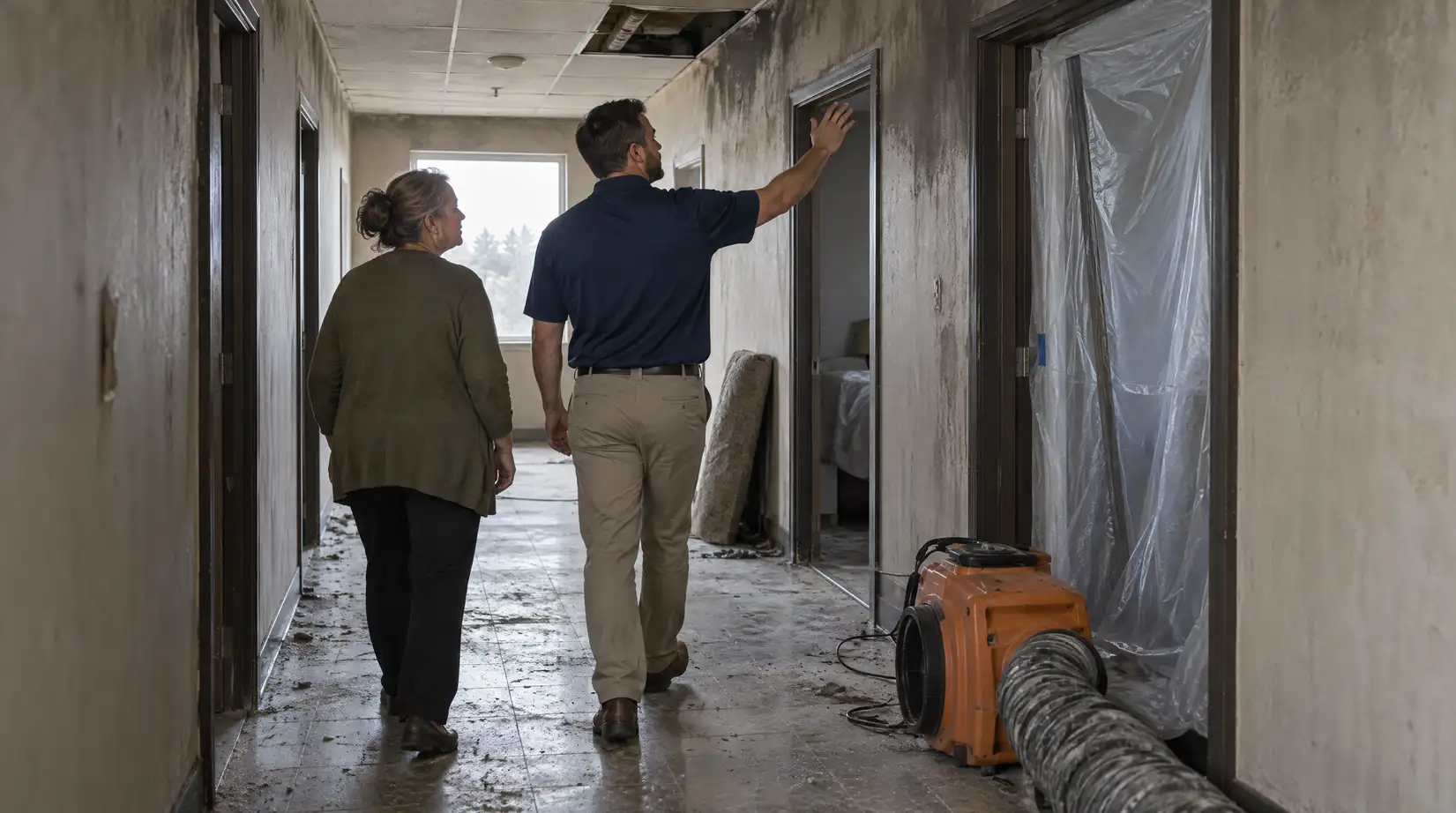
Adjusters often miss hidden damage that is not visible at first glance, such as water behind walls or underlying roof issues, making thorough contractor inspections essential [3]. Gathering comprehensive documentation, including photos of the damage, detailed contractor estimates, and invoices, is the strongest tool for demonstrating where an insurer’s settlement falls short [3].
Submitting the Supplement Request
Submitting a supplement request with updated documentation, contractor estimates, and evidence of overlooked damage is typically the first step in resolving an underpaid claim [3]. This package serves as the factual foundation for the dispute, allowing the property owner to formally request additional funds based on verified contractor findings rather than preliminary adjuster assumptions.
Writing Formal Demand Letters
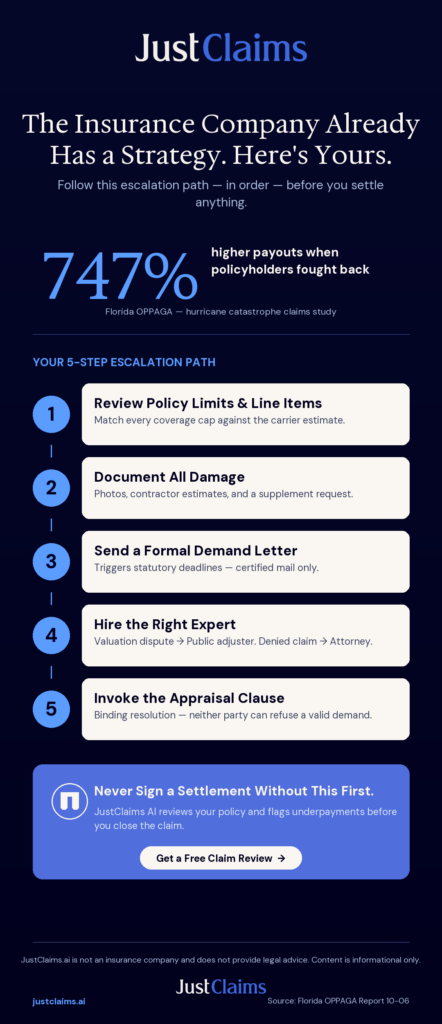
If a supplement request does not close the gap, the next escalation is often a formal written demand that clearly states the policyholder’s position. This step signals that the claim is moving from routine adjustment into a documented legal dispute.
Structuring the Demand
A formal demand letter should clearly explain the facts of the claim, including how the loss occurred, the resulting damage, the amount you are seeking, and the key documents supporting that number (photos, contractor estimates, invoices, expert reports). A concise, organized narrative makes it easier for the carrier’s internal review teams and counsel to see exactly why the current offer is inadequate and what evidence supports your valuation.
Meeting Statutory Deadlines and Delivery Requirements
In states like Massachusetts, a special consumer protection law (Chapter 93A) requires a written 30‑day demand letter before you can sue for unfair or deceptive claim handling and seek enhanced remedies under that statute. The demand must describe the alleged wrongful conduct, the harm suffered, and the relief requested, and it starts a 30‑day period for the business to make a written settlement offer.
Because these letters are often a prerequisite to pursuing Chapter 93A claims, policyholders are typically advised to send them by certified mail with return receipt requested or another trackable method, so they can prove the insurer actually received the notice. If an insurer’s conduct is ultimately found to be willful or knowing under Chapter 93A, courts may award multiple damages and attorney’s fees, but the availability and scope of these remedies vary significantly by state and depend on the specific facts and statutes involved. A more common obstacle is simpler: the mortgagee clause on your check.
When to Hire Public Adjusters vs. Attorneys
When formal demands do not yield a fair settlement, property owners and their contractors must decide whether the claim needs stronger documentation and valuation support, legal representation, or both. Public adjusters can assist with underpaid claims and certain denied claims involving disputed damage, scope, valuation, or missing documentation. Attorneys are generally better suited for disputes that require legal advice, policy interpretation, bad-faith claims, or litigation.
| Professional | Best Used For | Services / Limitations |
|---|---|---|
| Public Adjuster | Underpaid claims and denied claims involving disputed damage, scope, valuation, or documentation | Documents the loss, prepares the claim, and negotiates with the carrier; cannot provide legal advice or litigate |
| Insurance Attorney | Coverage disputes, policy exclusions, alleged bad faith, and litigation | Provides legal advice, interprets policy language, and handles lawsuits |
Leveraging Public Adjusters for Valuation Disputes
Public adjusters can assist when an insurance company acknowledges coverage but disputes the claim’s value. They may also help with denied claims involving disputed damage, scope, valuation, or missing documentation, subject to applicable state law [7]. Public adjusters specialize in assessing property damage and negotiating settlements with insurance companies [8]. For their services, public adjusters typically charge a contingency fee ranging from 5% to 20% of the final claim settlement amount [8].
Engaging Attorneys for Bad Faith and Legal Issues
Unlike attorneys, public adjusters cannot provide legal advice, resolve complex legal disputes, or file a lawsuit [8]. An insurance attorney may be appropriate when a denied, underpaid, or delayed claim turns on policy interpretation, disputed coverage, an exclusion, alleged bad faith, or another legal issue [8]. A denied claim or low offer does not automatically make the dispute exclusively legal: a public adjuster may still document the loss and negotiate with the carrier [7]. When legal rights must be interpreted or enforced, however, the policyholder should consult an experienced insurance attorney [8].
Invoking Appraisal Clauses
If the disagreement remains strictly about the cost of repairs rather than policy interpretation, the appraisal process offers an alternative dispute resolution path. This mechanism is found in many standard property insurance policies to keep valuation arguments out of the courtroom, though its inclusion and enforceability vary by policy and jurisdiction. If appraisal is not open to you, our insurance claim help team can look at the file directly.
Understanding the Appraisal Scope
An appraisal clause is a provision in property insurance policies designed to resolve disputes specifically regarding the value or amount of a covered loss, rather than legal questions about coverage or causation [9]. The appraisal process is most effective for underpaid claims involving competing estimates, scope disagreements, or valuation gaps after partial payments have been made [9].
Navigating the Appraiser and Umpire Process
Courts generally hold that a valid dispute for appraisal exists only after both sides have had a good faith opportunity to investigate the claim and failed to reach a consensus [10]. During an appraisal, both the policyholder and the insurer select an independent appraiser; if they cannot agree, an impartial umpire is brought in to help issue a binding appraisal award [9]. If an appraisal demand is valid, neither party can refuse to participate, and an improper refusal by the insurer can be considered a breach of contract entitling the policyholder to damages [10].
Frequently Asked Questions
What is the standard limit for basic contents coverage?
Insurance companies generally set personal property limits as a fraction of the main dwelling coverage. The industry norm for this allocation is 50% to 70%, though specific high-value items may have separate caps detailed elsewhere in the policy [1].
How should contractors format their repair estimates?
Builders and roofers should align their pricing breakdowns to mirror the carrier’s line-item structure. This direct comparison helps highlight missing scope and omitted code upgrades that the adjuster may have overlooked [2].
What happens if an insurer ignores a formal demand letter?
In specific states like Massachusetts, carriers have a strict window to reply to a statutory demand. Failing to respond in good faith within that timeframe can expose the insurer to attorney’s fees and triple damages [6].
Can a public adjuster file a lawsuit against an insurance company?
No, these professionals are restricted to negotiating claim values and assessing property damage. If the carrier acts in bad faith or invokes a policy exclusion, the property owner must hire an attorney to pursue legal action [8].
How to Protect Your Scope and Recover Full Value
Navigating an underpaid claim requires diligence, clear documentation, and a firm understanding of policy rights. By systematically addressing valuation gaps, property owners and their contractors can protect their scope and reputation while pushing back against lowball offers. You deserve to get paid without the chase, and we don’t replace you—we back you and get you paid. If your insurance claim was denied or underpaid, JustClaims‘ expert team — accelerated by our bespoke AI — reviews the policy language, compares it against your documentation, and flags likely underpayments so you can go back to the carrier with confidence, knowing we back your assessment.
This content is for informational purposes only and does not constitute legal or insurance advice. Coverage decisions depend on the specific terms, conditions, and exclusions of each policy and the laws of the applicable jurisdiction; policyholders and contractors should consult with a qualified professional for advice on their particular situation.
Sources
[1] https://www.iii.org/article/how-much-homeowners-insurance-do-you-need
[2] https://peopleslawteam.com/property-damage-resources/underpaid-claims/
[3] https://www.claimsupplementpro.com/blog/what-to-do-if-your-insurance-claim-was-underpaid/
[6] https://www.mass.gov/info-details/30-day-demand-letter
[7] https://www.tdi.texas.gov/tips/public-adjusters.html
[9] https://www.kkpfirm.com/claim-process/insurance-appraisal-clause-and-appraisals/

Taylor Bezek

As the General Manager at JustClaims, Taylor Bezek brings over a decade of experience managing complex residential, commercial, and large-loss claims. A licensed Public Adjuster in TX (#2125659), FL (#W455048), CO (#769172), and 10 additional states, Taylor founded his own firm before joining JustClaims to scale a tech-forward solution for the insured. He is committed to combining industry expertise with AI to enhance speed, clarity, and outcomes for every policyholder. Taylor's mission is to modernize the public adjusting profession and ensure owners get exactly what they are entitled to.