Property Damage Lawyers vs Public Adjusters: 2026 Guide

June 18, 2026
Written by Taylor Bezek
Share


When an insurance carrier disputes a property damage assessment, contractors and property owners must choose the right professional to advance the claim. While public adjusters are licensed to negotiate claim values, they are legally prohibited from providing legal advice or practicing law. Understanding when to leverage an adjuster for valuation disputes versus an attorney for bad faith denials can significantly impact project timelines and financial recovery. Most public adjuster disputes fall into one of three buckets — scope, value, or cause of damage — and each one has a different right tool.
Key Takeaways
- Role limitation: Public adjusters are licensed professionals who can prepare, document, and negotiate claims, but they are legally prohibited from practicing law or providing legal advice.
- Contractor restrictions: In states like Texas, public adjusters are legally prohibited from acting as a contractor on the same claim, and contractors cannot advertise that they will handle an insurance claim.
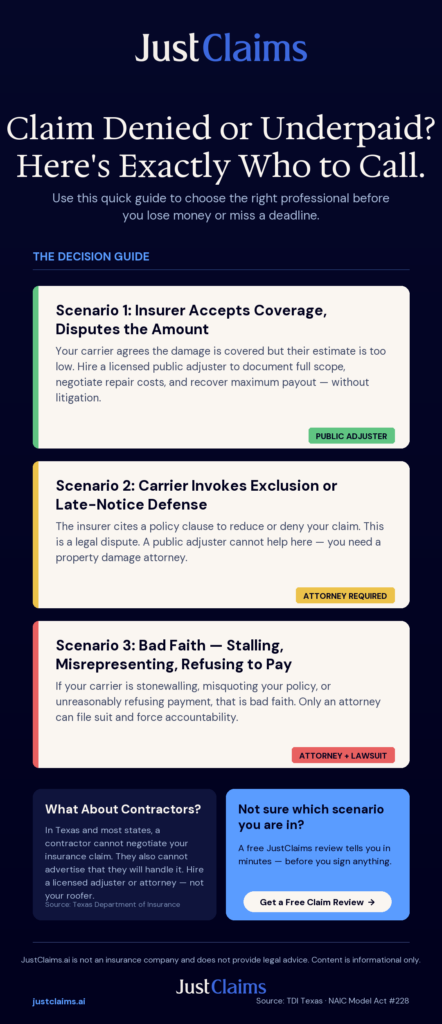
- Legal necessity: Property damage lawyers are necessary when a claim involves legal questions, such as policy exclusions, late-notice defenses, or allegations of bad faith by the insurance carrier.
- Litigation power: Attorneys have the ability to file lawsuits against insurance companies that engage in predatory tactics, such as stalling, misrepresenting policy provisions, or unreasonably refusing to pay claims.
- Best use cases: A public adjuster is generally best suited for cases where the insurer acknowledges coverage but disputes the value of the claim, whereas an attorney is needed when coverage is denied or conditioned on questionable policy interpretations.
The 3 Distinctions That Matter for Claim Resolution
Because choosing the wrong professional can delay project funding and complicate recovery, understanding the strict boundaries between adjusters and attorneys is essential for contractors and property owners.
1. Scope of Negotiation and Valuation
Public adjusters specialize in the financial and physical assessment of property damage. They are licensed professionals who can prepare, document, and negotiate claims on behalf of the policyholder [3]. A public adjuster is generally best suited for cases where the insurer acknowledges coverage but disputes the value of the claim [3]. They focus on proving the scope of work, material costs, and labor requirements necessary to restore the property to its pre-loss condition. When the disagreement is purely about the amount of the loss, invoking the policy’s right to appraisal clause can resolve the valuation dispute through independent appraisers without escalating to a lawsuit.
2. Legal Authority and Restrictions
Public adjusters can assist with documenting and negotiating the valuation of a claim, but face statutory limitations regarding policy interpretation. Wondering are public adjusters worth it? The deciding factor is often how much time is left on the claim. Public adjusters are prohibited from engaging in the unauthorized practice of law — a standard codified in the NAPIA Code of Professional Conduct [2], Florida statute (Fla. Stat. § 626.854) [4], and the licensing laws of most states where public adjusters are licensed, though the specific restrictions vary by jurisdiction. If a carrier denies a claim based on complex policy interpretations, late-notice defenses, or specific exclusions, public adjusters lack the authority to resolve these legal questions [3]. At this stage, property damage lawyers become necessary to interpret case law and challenge the carrier’s legal standing [3].
3. Litigation and Bad Faith Actions
A key distinction between public adjusters and property damage attorneys is the attorney’s ability to file lawsuits and pursue bad faith claims against an insurance carrier.
Public adjusters are not licensed to file lawsuits or pursue legal action — a restriction codified in Virginia (Va. Code Ann. § 38.2-1845.12) and consistent with public adjuster licensing laws across most states — meaning cases involving severe bad faith require an attorney’s intervention.
Public adjusters are not licensed to file lawsuits or pursue legal action — their statutory scope is limited to negotiating and settling first-party property claims [3]. Cases involving severe bad faith require an attorney’s intervention to pursue the claim through the court system.
Navigating Contractor and Adjuster Boundaries
Because choosing the right professional dictates how a claim progresses, contractors must also recognize their own regulatory limitations when assisting property owners. State departments of insurance strictly regulate who can negotiate a claim to protect consumers from conflicts of interest. That regulation is the starting point for understanding what a public adjuster does.
In states like Texas, public adjusters are legally prohibited from acting as a contractor on the same claim, and contractors cannot advertise that they will handle an insurance claim [1]. This separation requires contractors to collaborate effectively with independent adjusters or legal counsel rather than attempting to negotiate directly with the carrier’s desk adjuster. By maintaining clear boundaries, contractors can focus on providing accurate damage assessments and repair estimates, which licensed adjusters then use to negotiate the final claim value [1].
Identifying When Legal Representation Becomes Necessary
Because valuation disputes often escalate into contractual conflicts, recognizing the shift from a scope disagreement to a legal battle helps property owners pivot their strategy. An attorney is needed when coverage is denied or conditioned on questionable policy interpretations [3].
If an adjuster has exhausted their negotiation capabilities and the carrier continues to issue late-notice defenses or cite obscure policy exclusions, the dispute has moved into the legal realm — as recognized by courts across multiple states [2]. Property damage lawyers step in to address allegations of bad faith by the insurance carrier, utilizing the court system to hold insurers accountable for conduct prohibited under the NAIC Unfair Claims Settlement Practices Act [5]. Property owners should monitor carrier correspondence closely; repeated delays or sudden shifts in the carrier’s reasoning for denial often signal that legal intervention is required to advance the claim. Remember that suing for bad faith is the last resort, and it only makes sense after the negotiation record is built.
Frequently Asked Questions
Can a roofing contractor negotiate my insurance claim?
No, contractors are generally not permitted to act as claim negotiators on behalf of property owners. In jurisdictions like Texas, contractors cannot advertise that they will handle an insurance claim, and public adjusters cannot perform the repair work on the same property [1]. Property owners must hire a licensed adjuster or attorney to handle the actual negotiation with the carrier.
When should I hire a public adjuster instead of a lawyer?
A public adjuster is the appropriate choice when the insurance company agrees that your policy covers the damage but disagrees on the repair costs [2]. They are experts at documenting the physical damage, estimating material costs, and negotiating the financial value of the claim [1].
What happens if the insurance company acts in bad faith?
If an insurer engages in predatory behavior, such as intentionally stalling the process or misrepresenting what the policy covers, legal intervention is required [2]. Attorneys possess the authority to file lawsuits against carriers for these bad faith tactics — conduct that the NAIC’s Unfair Claims Settlement Practices Act defines as prohibited insurer behavior, including stalling, misrepresentation of policy provisions, and unreasonable refusal to pay [5].
Are public adjusters allowed to give legal advice on policy exclusions?
No, Public adjusters are prohibited from engaging in the unauthorized practice of law, as codified in NAPIA’s Code of Professional Conduct [2] and statutes like Florida’s § 626.854 [4]. If your claim is denied based on a complex legal interpretation or a specific policy exclusion, you will need a property damage lawyer to resolve the issue.
How to Protect Your Project Timeline
Navigating the boundaries between contractors, adjusters, and attorneys requires clear documentation and a strategic approach to policy interpretation. Whether you are dealing with a straightforward valuation dispute or a complex legal denial, having the right professional handle the negotiation keeps the restoration process moving forward. If your insurance claim was denied or underpaid, JustClaims‘ expert team — accelerated by our bespoke AI — reviews the policy language, compares it against your documentation, and flags likely underpayments so you can go back to the carrier with confidence.
This content is for informational purposes only and does not constitute legal or insurance advice. Coverage decisions depend on the specific terms, conditions, and exclusions of each policy and the laws of the applicable jurisdiction; policyholders and contractors should consult with a qualified professional for advice on their particular situation.
Sources
[1] https://www.tdi.texas.gov/tips/public-adjusters.html
[2] https://www.napia.com/code-of-conduct
[3] https://content.naic.org/sites/default/files/model-law-228.pdf
[5] https://content.naic.org/sites/default/files/model-law-900.pdf

Taylor Bezek

As the General Manager at JustClaims, Taylor Bezek brings over a decade of experience managing complex residential, commercial, and large-loss claims. A licensed Public Adjuster in TX (#2125659), FL (#W455048), CO (#769172), and 10 additional states, Taylor founded his own firm before joining JustClaims to scale a tech-forward solution for the insured. He is committed to combining industry expertise with AI to enhance speed, clarity, and outcomes for every policyholder. Taylor's mission is to modernize the public adjusting profession and ensure owners get exactly what they are entitled to.