Texas Storm Damage Lawyers: Best Way to Win Claims?
June 08, 2026
Written by Taylor Bezek
Share


When severe weather strikes Texas, property owners often assume traditional litigation is the only path to resolving disputed insurance payouts. However, alternative dispute resolution methods and binding appraisal clauses offer an opportunity to expeditiously settle first-party property damage claims without the protracted time and expense of a lawsuit. Understanding these out-of-court options helps policyholders navigate the recovery process more efficiently.
Key Takeaways
- Alternative Dispute Resolution: Alternative dispute resolution (ADR) methods, such as mediation, allow policyholders to settle disputes with a neutral third party outside of court.
- The Appraisal Process: The appraisal process allows both the policyholder and the insurance company to hire independent appraisers who then select a neutral umpire to make a binding decision on the amount of damage.
- Mediation Benefits: Mediation offers an opportunity to expeditiously settle first-party property damage claims without the protracted time and expense of traditional litigation.
- Arbitration: Arbitration can provide a faster and cheaper alternative to litigation, though it involves a neutral arbitrator issuing a decision rather than a jury.
The 3 Dispute Resolution Methods That Matter
Because traditional litigation often involves protracted timelines, understanding alternative dispute resolution methods can help property owners recover losses more efficiently. When an insurance carrier disputes the severity of hail, wind, or hurricane damage, policyholders have several structured options to challenge the decision without immediately filing a lawsuit.
1. The Binding Appraisal Process
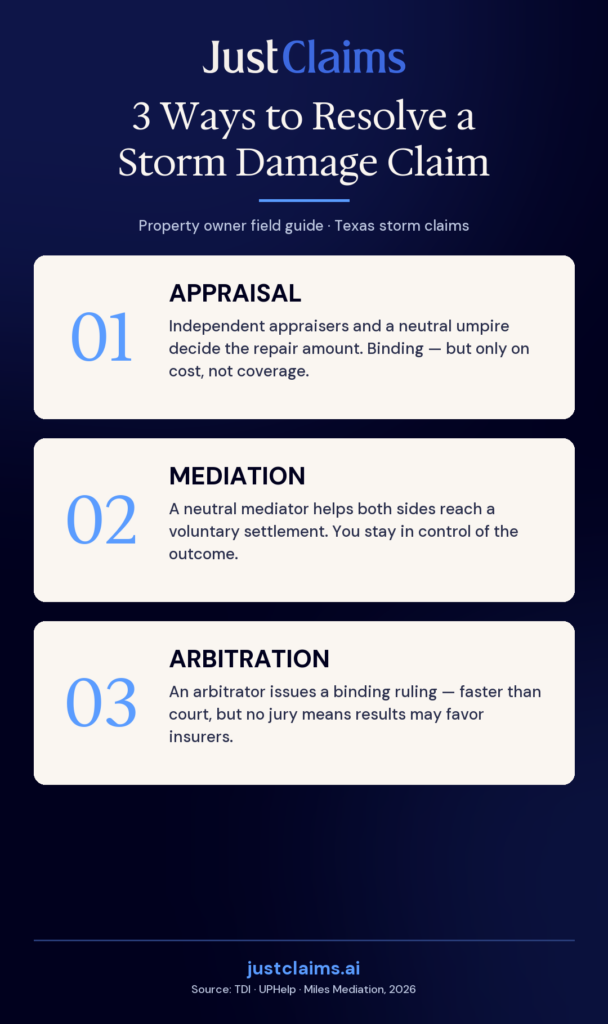
When the dispute centers specifically on the cost to repair or the extent of the damage, the appraisal clause found in many Texas property policies becomes a powerful tool. The appraisal process resolves disputes over the amount of a covered loss only. The appraisal process allows both the policyholder and the insurance company to hire independent appraisers who then select a neutral umpire to make a binding decision on the amount of damage [1]. This method focuses strictly on the financial valuation of the loss rather than legal interpretations of policy coverage. By relying on construction and adjusting professionals rather than the court system, property owners can often reach a final settlement figure much faster than they would through a formal legal battle.
2. Mediation for First-Party Claims
If the disagreement involves broader claim handling issues, mediation serves as a highly effective intervention step. Alternative dispute resolution (ADR) methods, such as mediation, allow policyholders to settle disputes with a neutral third party outside of court [1]. During this process, a trained mediator facilitates negotiations between the property owner and the insurance carrier’s representatives to help them find common ground. Mediation offers an opportunity to expeditiously settle first-party property damage claims without the protracted time and expense of traditional litigation [2]. Because the mediator does not force a decision, both parties maintain control over the final agreement.
3. Arbitration Decisions
For disputes that require a definitive ruling but need to bypass the backlogged court system, arbitration provides a middle ground. Arbitration can be faster and cheaper than litigation, but because it does not involve a jury, outcomes may favor insurance companies over policyholders. Unlike mediation, the arbitrator reviews the evidence presented by both the property owner and the insurance company and issues a ruling that is typically binding. This process mimics a streamlined trial, allowing policyholders to present their documentation and arguments in a formal setting while avoiding the extensive discovery phases and procedural delays associated with traditional lawsuits.
Comparing Traditional Legal Action and Modern Claim Adjusting
While alternative dispute resolution methods provide structured paths to settlement, property owners must also weigh the differences between hiring legal representation and utilizing modern adjusting resources. The choice between a Texas storm damage lawyer and a technology-driven public adjuster often depends on the specific nature of the dispute and the desired timeline for recovery.
The Role of Traditional Litigation
Attorneys specialize in navigating complex legal frameworks, particularly when an insurance company engages in bad faith practices. If a carrier violates state insurance codes, misrepresents policy language, or wrongfully denies coverage entirely, legal representation supports the position that the carrier must be held accountable. Lawyers handle the formal filing of lawsuits, manage extensive discovery processes, and prepare cases for trial. However, this route often involves contingency fee structures that take a significant portion of the final settlement, and the timeline for a jury trial can stretch across several years.
The Impact of AI-Assisted Public Adjusting
For claims where the primary issue is underpayment or missed damage rather than a fundamental legal breach, modern public adjusters utilizing artificial intelligence offer a different approach. These professionals focus on the technical documentation of the physical damage and the precise costing of repairs. By leveraging AI tools to analyze policy language and cross-reference local material costs, tech-driven adjusters can rapidly compile comprehensive damage reports. This detailed documentation puts the carrier on notice regarding specific line-item discrepancies. Because this approach aims to resolve the claim through negotiation or the appraisal process rather than the courts, this approach can result in faster payouts and may involve lower fee structures than traditional legal contingency models.
Frequently Asked Questions
What is the appraisal process for property damage?
The appraisal provision is a mechanism used to resolve disagreements over the cost of repairs. Both the insurance company and the property owner select their own independent appraisers, who then agree on a neutral umpire to evaluate the loss and issue a binding financial decision [1].
How does mediation differ from a lawsuit?
Mediation is a collaborative process where a neutral third party helps the policyholder and the insurer negotiate a settlement out of court [1]. It is designed to resolve first-party property disputes quickly, avoiding the high costs and lengthy timelines associated with formal litigation [2].
Is arbitration faster than going to court?
Arbitration generally moves more quickly than a traditional trial, but because it does not involve a jury, outcomes may favor insurance companies over policyholders. The disputing parties present their evidence to a neutral arbitrator who makes a final ruling on the matter [3].
Do I always need an attorney for a denied claim?
Not necessarily. While lawyers are essential for bad faith lawsuits or complex legal disputes, many disagreements over damage scope or repair costs can be resolved through alternative dispute resolution, appraisal, or by working with a public adjuster to improve claim documentation.
How to Advance Your Storm Damage Claim
Navigating a disputed property loss requires understanding all available avenues for recovery, from binding appraisal to formal mediation. By evaluating the specific nature of your disagreement with the carrier, you can choose the most efficient path to secure the funds needed for repairs. If your insurance claim was denied or underpaid, JustClaims‘ expert team — accelerated by our bespoke AI — reviews the policy language, compares it against your documentation, and flags likely underpayments so you can go back to the carrier with confidence.
This content is for informational purposes only and does not constitute legal or insurance advice. Coverage decisions depend on the specific terms, conditions, and exclusions of each policy and the laws of the applicable jurisdiction; policyholders and contractors should consult with a qualified professional for advice on their particular situation.
Sources
[1] https://www.tdi.texas.gov/tips/disagree.html
[3] https://uphelp.org/claim-guidance-publications/resolving-claim-disputes/

Taylor Bezek

As the General Manager at JustClaims, Taylor Bezek brings over a decade of experience managing complex residential, commercial, and large-loss claims. A licensed Public Adjuster in TX (#2125659), FL (#W455048), CO (#769172), and 10 additional states, Taylor founded his own firm before joining JustClaims to scale a tech-forward solution for the insured. He is committed to combining industry expertise with AI to enhance speed, clarity, and outcomes for every policyholder. Taylor's mission is to modernize the public adjusting profession and ensure owners get exactly what they are entitled to.