



Additional Living Expenses (ALE) Coverage Explained 2026

July 21, 2026
Written by Taylor Bezek
Share


When a covered disaster forces you out of your property, Additional Living Expenses (ALE) coverage pays for temporary housing costs like a hotel or apartment while repairs are underway. However, this coverage does not pay for all living costs—it only covers the difference between your normal expenses and your new temporary burdens. Understanding how to track and claim these specific differences is your primary tool for surviving displacement without severe financial strain.
Key Takeaways
- Core Purpose: Additional Living Expenses (ALE) coverage pays for temporary housing costs, such as a hotel or apartment, while a property is being repaired or rebuilt following a covered disaster.
- Payment Scope: ALE does not cover all living expenses; it only pays the difference between normal living expenses and new temporary expenses.
- Covered Items: Typical expenses covered include hotel bills, reasonable restaurant meals if the temporary housing lacks a kitchen, and other costs that exceed normal housing expenses.
- Policy Constraints: ALE coverage often has limits, which may include a maximum dollar amount or a specific time limitation, separate from the coverage for rebuilding the structure or replacing belongings.
The 3 Covered Expenses That Matter While Your Property Is Unlivable
Because ALE only pays the difference between your normal expenses and your new temporary burdens, knowing exactly which costs qualify is essential for displaced property owners. When a property becomes uninhabitable, the immediate financial shock can be overwhelming, making it necessary to identify which specific categories of spending your policy will reimburse. For a fuller walkthrough, read our guide to renters insurance claims.
1. Temporary Housing and Lodging
Temporary housing is typically the largest single ALE expense during displacement Additional Living Expenses (ALE) coverage pays for temporary housing costs, such as a hotel or apartment, while a property is being repaired or rebuilt following a covered disaster [1]. Property owners should look for accommodations that maintain their standard of living without exceeding the reasonable boundaries of their policy. Whether you require a short-term hotel stay immediately after the event or a longer-term apartment lease during extensive structural repairs, this coverage is designed to bridge the housing gap.
2. Increased Food and Dining Costs
Displacement often disrupts normal meal preparation, especially in the early days of a claim. Typical expenses covered by ALE include reasonable restaurant meals if the temporary housing lacks a kitchen. It is important to note that the policy will not pay for your entire food budget. Because ALE does not cover all living expenses, it only pays the difference between your normal living expenses and your new temporary expenses [1]. If you normally spend a set amount on groceries, the insurance carrier will deduct that baseline amount from your restaurant receipts when calculating your reimbursement [2].
3. Other Qualifying Out-of-Pocket Expenses
Beyond rent and food, ALE covers other costs that exceed normal housing expenses [1]. This can include increased commuting costs if your temporary apartment is further from your workplace, or additional laundry expenses if your hotel does not have accessible facilities. Property owners must carefully evaluate their daily routines to identify any new financial burdens directly caused by their displacement, as these incremental costs can quickly add up over months of living away from the property.
The Two Common ALE Limit Structures
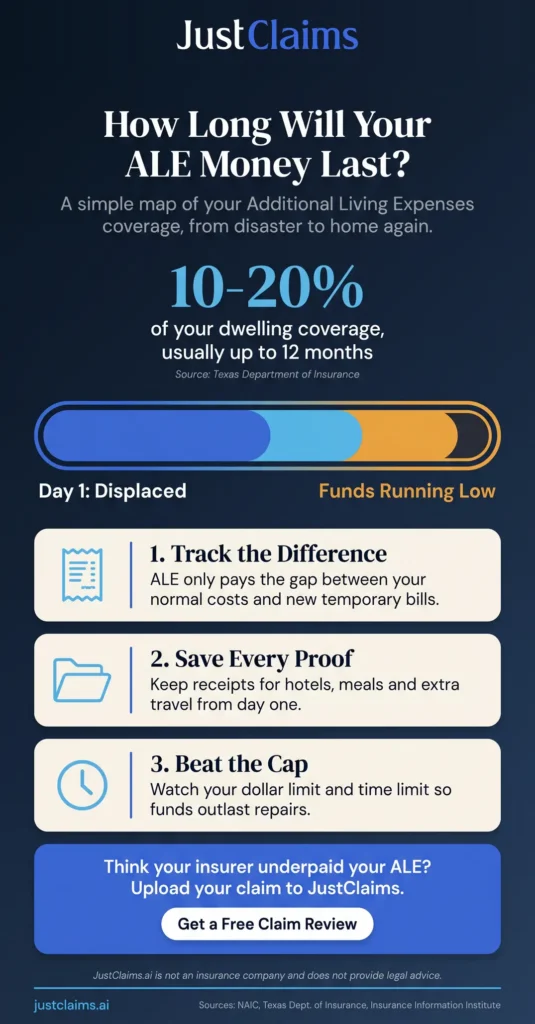
Because miscalculating your available funds can leave you stranded mid-repair, property owners must identify how their specific policy restricts ALE payouts. Insurance policies do not provide unlimited funds for temporary living. For condo owners, that ceiling sits inside the unit owner’s own HO-6 condo insurance — the association’s master policy never pays a resident’s living costs. ALE coverage often has limits, which may include a maximum dollar amount or a specific time limitation, separate from the coverage for rebuilding the property or replacing belongings [1][3].
Maximum Dollar Amount Caps
Many policies restrict temporary housing benefits to a strict financial ceiling. This maximum dollar amount acts as a hard cap on what the carrier will pay for your hotel bills, reasonable restaurant meals, and other costs that exceed normal housing expenses. Property owners must pace their spending to ensure this pool of money lasts through the entire construction phase. Because this limit is separate from the coverage for rebuilding the property or replacing belongings, utilizing your ALE funds will not reduce the amount available to repair your physical structure [1].
Specific Time Limitations
Instead of, or in addition to, a financial cap, policies frequently impose a specific time limitation [1]. This means the carrier will only pay for temporary housing costs, such as a hotel or apartment, for a set number of months following the covered disaster. If construction delays push the repair timeline past this specific time limitation, property owners may be left paying for their temporary housing out of pocket, regardless of whether they have reached their maximum dollar amount.
The 3 Documentation Steps That Apply to Your Reimbursement
Since ALE only pays the difference between normal living expenses and new temporary expenses, meticulous documentation supports the position that your claimed costs are valid. Insurance adjusters require clear proof of both your historical spending and your current burdens before issuing reimbursement checks.
1. Establishing Your Baseline Expenses
Before you can claim the difference, you should establish what your normal life costs. Because ALE does not cover all living expenses, property owners should gather past bank statements and grocery receipts to prove their standard monthly food and utility budgets [1]. This baseline serves as the foundation for all future reimbursement requests. If you rent rather than own, the renters insurance claims process covers the same ground from a tenant’s side.
2. Tracking the New Temporary Expenses
Once displaced, property owners must save every receipt related to their temporary living situation. Typical expenses covered by ALE include hotel bills, reasonable restaurant meals if the temporary housing lacks a kitchen, and other costs that exceed normal housing expenses [1]. Without clear, itemized receipts, adjusters may dispute whether the restaurant meals were reasonable or whether the costs genuinely exceeded your normal baseline.
3. Maintaining a Reimbursement Log
To clearly present the difference between normal living expenses and new temporary expenses, property owners should maintain a running log of all transactions. A structured approach helps demonstrate the exact financial impact of the displacement. Your tracking log should include:
- The date of the transaction
- A description of the temporary housing cost or restaurant meal
- The total cost of the new temporary expense
- The normal expected cost for that category (your baseline)
- The calculated difference claimed under ALE
The 3 Steps You Need to Know When ALE Runs Out
Because ALE coverage often has limits, such as a specific time limitation, property owners may face the risk of exhausting their benefits before the property is livable again. Managing this transition requires proactive planning and clear communication with your adjuster.
1. Reviewing the Specific Time Limitation
Property owners should regularly check their policy documents to confirm their specific time limitation. Knowing exactly when the temporary housing benefits expire allows you to pressure contractors to meet deadlines or begin searching for alternative living arrangements before the funding abruptly stops.
2. Monitoring the Maximum Dollar Amount
In addition to watching the calendar, property owners must track their spending against the maximum dollar amount. If hotel bills and reasonable restaurant meals are draining the available funds faster than anticipated, you may need to adjust your living situation to stretch the remaining balance.
3. Adjusting Temporary Housing Costs
If the maximum dollar amount is depleting rapidly, property owners may need to transition from expensive hotel bills to a more cost-effective apartment. Because ALE pays for temporary housing costs, such as a hotel or apartment, while a property is being repaired, securing a longer-term lease can often lower the monthly burn rate and help the coverage last until the rebuilding process is complete [1].
Frequently Asked Questions
Does ALE cover my regular mortgage payments?
No, ALE does not cover all living expenses or replace your standard mortgage obligations. It only pays the difference between your normal living expenses and your new temporary expenses. Property owners must continue paying their standard mortgage while displaced, as the insurance coverage is designed only to handle the new, overlapping costs of temporary housing.
Will my insurance pay for all my meals while I am displaced?
Your policy will not cover your entire food budget. Typical expenses covered by ALE include reasonable restaurant meals only if the temporary housing lacks a kitchen, and it only covers the portion that exceeds your normal food expenses. The carrier will deduct your standard grocery budget from your dining receipts to calculate the final reimbursement.
Does using ALE reduce the payout for rebuilding my property?
No, the funds used for temporary housing do not deduct from your structural repair budget. ALE coverage often has limits that are entirely separate from the coverage for rebuilding the property or replacing belongings. You can utilize your full temporary housing benefits without compromising the funds needed to restore your physical structure.
How long can I stay in temporary housing under ALE?
The duration depends entirely on your specific policy language. ALE coverage often has limits, which may include a specific time limitation or a maximum dollar amount that dictates how long you can receive reimbursement for a hotel or apartment. Property owners must review their declarations page to understand exactly when these benefits will expire.
How to Secure Your Full ALE Reimbursement
When a covered disaster forces you into temporary housing, tracking the difference between your normal living expenses and your new temporary expenses is your primary responsibility. The same discipline decides the repair claim itself: a water damage insurance claim rises or falls on clear proof of what happened and when. Because ALE coverage often has limits, including a maximum dollar amount or a specific time limitation, careful documentation helps demonstrate your ongoing financial needs to the carrier. Upload your claim documents to Justin to see in minutes if your insurer missed coverage you’re owed.
Sources
[1] National Association of Insurance Commissioners (NAIC) — What are Additional Living Expenses and How Can Insurance Help? https://content.naic.org/article/what-are-additional-living-expenses-and-how-can-insurance-help
[2] Texas Department of Insurance (TDI) — When do policies pay for additional living expenses? https://www.tdi.texas.gov/tips/additional-living-expenses.html
[3] Insurance Information Institute (Triple-I) — What is covered by standard homeowners insurance? https://www.iii.org/article/what-covered-standard-homeowners-policy

Taylor Bezek

As the General Manager at JustClaims, Taylor Bezek brings over a decade of experience managing complex residential, commercial, and large-loss claims. A licensed Public Adjuster in TX (#2125659), FL (#W455048), CO (#769172), and 10 additional states, Taylor founded his own firm before joining JustClaims to scale a tech-forward solution for the insured. He is committed to combining industry expertise with AI to enhance speed, clarity, and outcomes for every policyholder. Taylor's mission is to modernize the public adjusting profession and ensure owners get exactly what they are entitled to.


