



New York Water Damage Insurance Claims 2026

September 07, 2026
Written by Collin Corcoran
Share


New York property owners carry two water damage exposures at once: storm surge along the city’s 520 miles of waterfront, and aging plumbing in its older housing stock. After Superstorm Sandy, FEMA’s remapping put roughly 400,000 New York City residents inside the mapped floodplain, and the National Flood Insurance Program paid out more than $8.1 billion on Sandy claims. Yet many water damage claims still turn on a single insurer argument: that a sudden pipe failure was really the result of slow, poorly maintained plumbing.
Key Takeaways
- Storm surge exposure: New York City has 520 miles of waterfront exposed to storm surge, rainfall flooding, nor’easters, and chronic high-tide flooding.
- Floodplain expansion: FEMA’s post-Sandy preliminary flood maps put roughly 400,000 New York City residents inside the mapped 1% annual-chance floodplain.
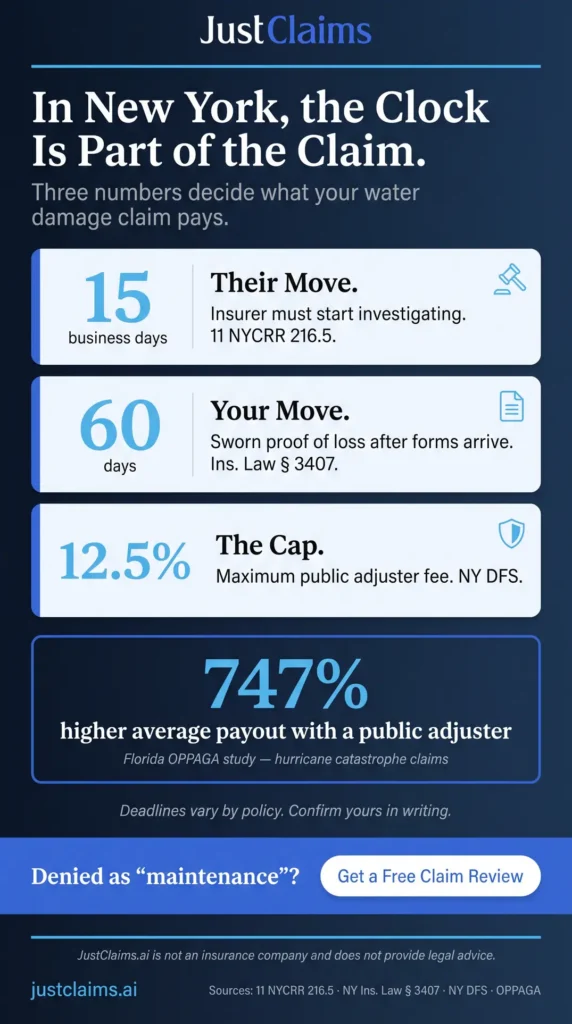
- Proof of loss deadline: Under New York Insurance Law § 3407, once an insurer sends written notice and blank forms, a proof of loss furnished within 60 days satisfies the policy’s timing requirement.
- Claim response window: Under 11 CRR-NY 216.5–216.6, insurers must begin investigating a claim within 15 business days of notice.
- Public adjuster fee cap: New York caps public adjuster fees at 12.5% of the claim recovery under 11 NYCRR Part 25.
- Sandy NFIP claims: New York State NFIP claims from Sandy totaled 57,000, with an average payment near $61,000.
NYC’s Water Damage Reality — Aging Pipes, Freeze Bursts and Storm Surge
New York property owners face two distinct water damage exposures: catastrophic storm surge along the city’s 520 miles of waterfront [1], and the slower, freeze-driven failure of plumbing systems that run through much of the city’s older housing stock. Superstorm Sandy demonstrated the scale of the first risk, damaging hundreds of thousands of homes across the city and knocking out power to roughly two million homes and facilities [2].
FEMA’s 2015 preliminary Flood Insurance Rate Maps, issued after Sandy, put roughly 400,000 New York City residents inside the mapped 1% annual-chance floodplain — more people than the entire population of Cleveland, Tampa, or St. Louis [3]. That means many property owners who never considered themselves flood-exposed now carry that risk on paper, whether or not their coverage has caught up. The city notes the 2007 maps still govern flood-insurance purchase requirements while the newer maps drive building code, zoning, and planning decisions [3].
The financial scale of Sandy’s water losses shows why documentation and causation arguments matter so much today. Knowing when to hire a public adjuster matters most in exactly this window, before causation hardens into the carrier’s version. FEMA told Congress that 57,000 Sandy flood-insurance claims were filed in New York, that the average Sandy claim payment was $61,000, and that the NFIP paid out more than $8.1 billion on Sandy claims overall [4]. That program exists separately for a reason: standard homeowners and tenants policies sold in New York generally exclude flood damage, and DFS notes the only way to buy flood coverage is through federal insurance programs [5].
Storm surge is not the only exposure property owners should watch for. State insurance regulators describe water damage as one of the most common reasons people file home insurance claims [6], and for New York’s older housing stock, the freeze-driven failure of aging pipes is the quieter exposure. Regulators describe coverage for a burst frozen pipe as generally available when the discharge is “sudden and accidental” — but warn it can be lost when an owner neglects basic safeguards, like keeping heat on in a vacant unit [7].
What Carriers Argue — Maintenance vs. Sudden Damage — and How to Counter It
Because so many New York water losses trace back to decades-old plumbing or storm-driven flooding, the first fight in many claims is over timing: whether the damage developed gradually — usually excluded — or happened suddenly — usually covered.
Standard property insurance policies sold in New York generally cover water damage only when it results from a sudden event — DFS lists “damage resulting from an accidental discharge or overflow of water or steam from within a plumbing, heating, air conditioning or automatic fire sprinkler system” and “freezing of plumbing systems” among the perils a standard policy covers [5].
Damage attributed to an ongoing leak or seepage is treated differently: homeowner insurance “usually covers sudden leaks, but may not cover gradual leaks,” and mold, rust and rot are generally the owner’s responsibility unless they stem from covered water damage [6].
When a pipe fails, the entire claim can turn on when the damage happened — regulators stress that “when and why water damage happens is important to getting your claim approved,” because sudden leaks are usually covered and gradual ones usually are not [6]. Owners who delay repairs risk losing coverage altogether, and policies generally require that heat be maintained to prevent freezing [6][7].
Property owners are not without recourse. New York claim rules require insurers to do a timely, thorough, and unbiased investigation of a loss and to pay what they owe in full compliance with the policy and applicable law [8]. DFS also tells policyholders they may ask to see the specific contract language behind a denial, request a sit-down with the contractor and adjuster to go over the estimate line by line, and get a second opinion from an independent contractor [9].
New York’s claim-handling regulation, 11 CRR-NY 216.5–216.6, requires insurers to begin investigating a claim within 15 business days of notice and, after receiving a properly executed proof of loss, to accept or deny the claim in writing within 15 business days [8][10]. If more time is needed, the insurer must explain why and follow up with status letters every 90 days [10]. A missed deadline or a vague denial letter can give a policyholder grounds to push back or file a complaint with the Department of Financial Services [8].
New York’s Unfair Claim Settlement Practices standard — Insurance Law § 2601 — prohibits insurers from knowingly misrepresenting policy provisions relevant to coverage, failing to adopt reasonable standards for prompt investigation, or failing to attempt in good faith to settle claims once liability has become reasonably clear [8]. Property owners disputing a maintenance-based denial can cite these provisions directly and file a complaint with DFS if they believe the carrier violated them [8].
Documentation Standards for New York Claims
Because carriers can reframe sudden pipe failures as long-term maintenance problems, the paperwork a property owner assembles in the days after a loss often decides which version of events prevails. These insurance claim management tips cover the proof-of-loss and deadline habits that keep a claim from dying on a technicality.
Under 11 NYCRR 216.6(c), once an insurer receives a properly executed proof of loss, it must advise the policyholder of acceptance or denial in writing within 15 business days [10]. That clock does not start until the proof of loss has been properly filed, which makes the filing deadline one of the most consequential dates in a New York water damage claim.
New York Insurance Law § 3407 frames the deadline this way: an insurer cannot void or reduce a claim over a missing proof of loss unless it first sends written notice and blank proof-of-loss forms — and a policyholder who furnishes the proof within 60 days after receiving that notice is deemed to have met the policy’s timing requirement [11]. The deadline still has teeth: New York’s Court of Appeals has noted that failing to furnish proofs within the required period after being put on notice is an absolute defense to a claim [12], regardless of how strong the underlying damage evidence is.
Timing technicalities can also work in a policyholder’s favor. New York’s highest court, in Ball v. Allstate Ins. Co., 81 N.Y.2d 22 (1993), held that a proof of loss is considered “furnished” as of the date it is mailed, not the date the insurer receives it [12]. Mailing the form on the final day of that 60-day window still satisfies the deadline even if the insurer receives it several days later.
| Requirement | Deadline | Source |
|---|---|---|
| Insurer begins investigating a claim | 15 business days after notice | 11 CRR-NY 216.5–216.6 [8] |
| Insurer affirms or denies after a complete proof of loss | 15 business days | 11 NYCRR 216.6(c) [10] |
| Policyholder furnishes proof of loss | 60 days after receiving insurer’s written notice and forms | NY Ins. Law § 3407 [11] |
| Public adjuster fee cap | 12.5% of recovery | 11 NYCRR Part 25 (Reg. 10) [13] |
United Policyholders’ New York guidance recommends keeping a daily claim journal that logs every phone call, email, and document exchanged with the insurer, and notes that carriers typically require receipts before reimbursing additional living expenses tied to loss of use of the property [8]. Photographs, moisture readings, contractor estimates, and dated repair invoices all strengthen the record a property owner can point to if a carrier later argues the damage was gradual rather than sudden. A room-by-room personal property inventory is what turns that record into a documented contents figure.
Co-op and Condo Complications — Who Claims What
Because multi-unit buildings layer a master policy on top of an individual unit policy, New York’s co-op and condo owners face a second version of the sudden-versus-gradual dispute — this time over which policy is even responsible for paying.
Two policies layer on top of each other in a multi-unit building. New York DFS describes the split this way: condominium (HO-6) policies generally cover contents plus alterations, appliances, fixtures, improvements and interior walls within the unit, while the building and its common areas are typically insured through the association’s policy; for co-ops, insuring the building itself is typically the building owner’s responsibility [5]. Where one policy stops and the other starts in your building is set by its governing documents — the proprietary lease, bylaws, or declaration — read against both policies’ terms.
Before accepting a board’s or association’s damage allocation at face value, pull three documents: the master policy’s declarations page, the governing documents, and any alteration agreement signed before past renovations. That paper trail tells you whether the damaged component — a riser, a relocated pipe, a replaced fixture — belongs to the building’s claim or the unit owner’s. Our guide to master policy vs. HO-6 coverage walks through that boundary in detail.
If the association passes part of a master policy deductible down to owners after a covered loss, the unit owner’s own policy may include loss assessment coverage — we break down what loss assessment coverage pays for in a separate guide. Allocation disputes like these are one reason New York caps the fee a public adjuster can charge at 12.5% of the claim recovery [13] — a detail worth knowing before bringing in outside help.
When a Public Adjuster Pays for Itself
Because causation disputes and master-policy allocation fights can drag on for months, many New York property owners eventually weigh whether a public adjuster’s fee is worth the potential increase in what the carrier ultimately pays.
New York regulation — 11 NYCRR Part 25, Regulation 10, Section 25.7 — caps public adjuster fees at 12.5 percent of the recovery for services rendered [13]. That maximum applies only to monies paid to the policyholder after the public adjuster is retained, not to any amount the insurer already offered or paid beforehand [13].
A compensation agreement can lawfully pay the adjuster 50% of the amount by which a pending settlement offer is subsequently increased, as long as total compensation stays within that cap, according to a New York State Insurance Department (now DFS) opinion [13].
Whether that fee is worth paying depends on how much a public adjuster’s involvement changes the outcome. The most-cited government data on that question comes from the Florida Legislature’s research office: analyzing Citizens Property Insurance claims from 2008–2009, it found policyholders represented by public adjusters received typical settlements of $17,187 on 2005-hurricane catastrophe claims versus $2,029 without representation — 747% higher — and $9,379 versus $1,391 on non-catastrophe claims, a 574% difference [14]. That is one state’s hurricane data, not a promise for a New York water damage claim — but it shows what documented, professional claim presentation can change. Because water damage claims so often turn on the sudden-versus-gradual argument described earlier, a public adjuster’s ability to marshal contractor estimates, moisture documentation, and expert opinion can matter most where causation — not just the dollar amount — is disputed.
United Policyholders advises hiring only a public adjuster with strong references who is likely to recover more than you could on your own [8]. For a disputed New York claim, you can hire a licensed public adjuster in New York who works under that 12.5% cap.
Frequently Asked Questions
How long do I have to file a proof of loss on a New York water damage claim?
Once the insurer sends written notice and blank forms, New York property owners generally have 60 days from receipt to furnish a proof of loss, under Insurance Law § 3407 [11]. Because New York’s Court of Appeals treats the mailing date as the furnishing date, sending the form by the deadline satisfies the law even if the insurer receives it later [12].
Why do insurers deny burst pipe claims as “maintenance issues”?
Claims handlers separate sudden leaks from gradual ones, and regulators note that mold, rust and rot are generally treated as the owner’s responsibility unless they stem from covered water damage — so a leak pattern suggesting weeks of seepage points a claim toward exclusion [6]. Requesting the specific contract language behind the denial and obtaining an independent contractor opinion are two ways to challenge that determination [9].
Who pays for water damage inside a co-op apartment — the shareholder or the building?
It depends on the building’s governing documents and both policies’ terms: DFS notes that condo (HO-6) policies generally cover the unit’s interior, alterations, fixtures and belongings, while the building and common areas are typically insured through the association’s policy [5]. Review the proprietary lease or declaration — and any alteration agreement from past renovations — before accepting a damage allocation.
What can New York property owners do if an insurer misses a claim deadline?
Under 11 CRR-NY 216.5–216.6, insurers must begin investigating within 15 business days of notice and respond to a complete proof of loss within a set window; missing those deadlines without proper notice can support a complaint filed with the Department of Financial Services [8]. Keeping a dated log of every communication with the carrier makes it easier to show exactly when those deadlines were missed [8].
How much does a public adjuster cost in New York?
State regulation limits public adjuster fees to 12.5% of the claim recovery, calculated only on money paid after the adjuster is retained [13]. A fee agreement that pays a higher share of any increase over a pending offer is allowed as long as total compensation stays within the cap [13].
How to Protect Your Water Damage Settlement
New York’s water damage claims sit at the intersection of aging infrastructure, strict statutory deadlines, and a causation argument insurers raise more often than most property owners expect. Missing a proof-of-loss deadline, accepting a co-op board’s damage allocation without reviewing the alteration agreement, or failing to document a leak’s onset can all reduce what a policyholder ultimately recovers.
Property owners who track every regulatory deadline, request the specific policy language behind a denial, and gather contractor and moisture evidence early put themselves in a stronger position when a carrier tries to reclassify sudden damage as gradual wear. For claims where causation or co-op/condo allocation is disputed, a public adjuster’s fee — capped at 12.5% of the recovery under New York regulation — can be worth weighing against the potential increase in settlement.
Upload your claim documents to Justin — our free AI insurance policy analyzer — and see in minutes whether your insurer’s maintenance-based denial or co-op allocation determination missed coverage you’re owed.
This content is for informational purposes only and does not constitute legal or insurance advice. Coverage decisions depend on the specific terms, conditions, and exclusions of each policy and the laws of the applicable jurisdiction; policyholders and contractors should consult with a qualified professional for advice on their particular situation.
Sources
[1] NYC Comprehensive Waterfront Plan — NYC Department of City Planning
[3] Flood Risk in NYC: Information Brief — NYC Department of City Planning
[5] Homeowners Insurance: Choosing a Policy — New York State Department of Financial Services
[6] Leaks, Water Damage and Mold — Washington State Office of the Insurance Commissioner
[8] Insurance Consumer Rights in New York — United Policyholders
[9] Managing and Mitigating Losses — New York State Department of Financial Services
[10] 11 NYCRR § 216.6 — Unfair Claims Settlement Practices (Regulation 64), official NYCRR text
[11] New York Insurance Law § 3407 — Property Insurance; Proofs of Loss; Notice of Loss — NY State Senate

Collin Corcoran

Experienced Public Adjuster and Property Claims Specialist, Collin is licensed in New York (#1603393), New Jersey (#3003700204), and Connecticut (#19820270). With 20+ years of hands-on construction and property damage experience, he specializes in residential and commercial claims, complex loss inspections, policy review, detailed estimating, and strategic negotiation. Collin’s background in construction, asset management, emergency response, and claims documentation allows him to accurately identify damage, understand repair requirements, and advocate effectively for policyholders. He works with homeowners, business owners, contractors, and insurance professionals to move claims forward with clarity, accuracy, and confidence. Collin is committed to transparency, technical precision, strong communication, and securing fair outcomes for policyholders.


