



Personal Property Inventory Checklist for Insurance 2026

July 27, 2026
Written by Collin Corcoran
Share


More than half of U.S. homeowners told a 2023 Triple-I and Munich Re US consumer survey that they do not have an inventory of their possessions in the event of a loss or claim. That gap matters, because most insurance companies want a record of lost or damaged items before they will pay a personal property claim, and reconstructing an entire household’s contents from memory after a fire or storm is difficult. Building a documented list before a catastrophe is one of the most practical ways to substantiate a loss and check whether your coverage limits are adequate.
Key Takeaways
- Inventory completion rate: 53% of U.S. homeowners said they do not have an inventory of their possessions (2023 Triple-I / Munich Re US consumer survey, 1,103 homeowners).
- Core definition: A home inventory is a list of your personal possessions along with their estimated financial value.
- Why insurers ask for it: Most insurance companies want a record of your lost or damaged items before they will pay a personal property claim, and not having one could delay payment.
- Primary benefit: Documenting belongings helps property owners purchase the correct amount and type of insurance coverage.
- Post-disaster utility: A well-organized inventory substantiates financial losses for tax purposes or when applying for disaster assistance.
- Memory limitations: Most people cannot recall the contents of an attic, kitchen cabinet or closet after a fire or storm, which is what makes a pre-documented record valuable.
Why Insurers Require an Itemized List for Personal Property Claims
When a total loss occurs, the policyholder is generally the party who has to document what was inside the structure. Most insurance companies want a record of your lost or damaged items before they will pay a personal property claim, and not having a home inventory could delay your claims payment [4]. In a 2023 Triple-I and Munich Re US consumer survey of 1,103 homeowners, more than half said they did not have an inventory of their possessions in the event of a loss or claim [1]. Documentation also affects timing and amount, because most carriers pay homeowners claims in two parts: a first payment for the estimated cost of repairs minus depreciation and your deductible, with the balance released once work is complete [5]. Requirements vary by state — Colorado, for example, requires insurers to pay 65% of contents coverage without a personal property inventory on qualifying total losses, and requires them to accept bulk listings such as the number of t-shirts lost [6].
A home inventory is a list of your personal possessions along with their estimated financial value, and having an accurate list helps property owners buy the right amount and type of insurance coverage before a loss occurs [2]. By establishing this baseline, policyholders can identify whether their current limits are sufficient to replace their belongings at today’s market prices. An up-to-date home inventory makes filing a claim as simple as possible by providing a pre-documented record of belongings — most people cannot recall the contents of an attic, kitchen cabinet or downstairs closet after a fire, storm or other catastrophe [2]. Presenting an organized list immediately after a loss puts the carrier on notice that the policyholder has the evidence required to support their personal property claim.
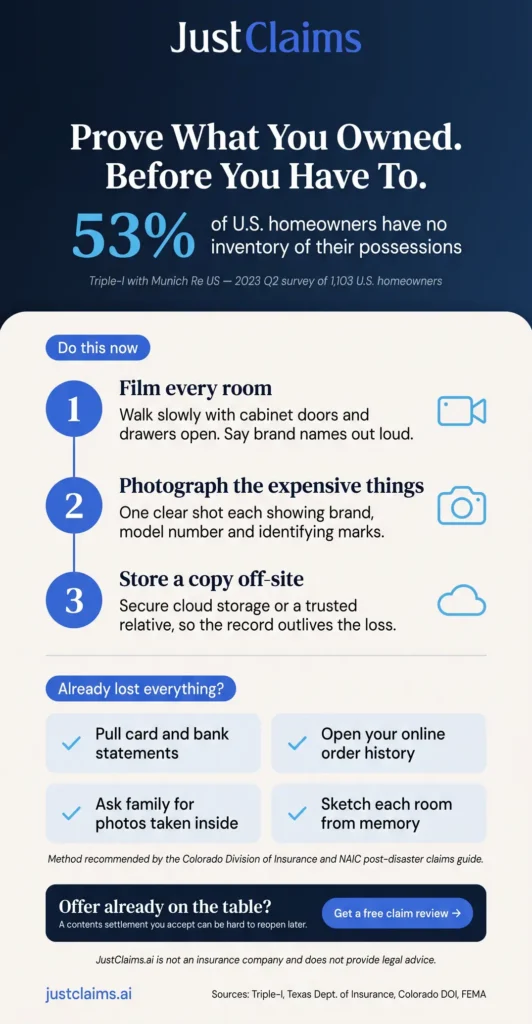
The 3 Steps That Matter for a Room-by-Room Inventory
Because it is hard to recall the contents of a home after a fire, storm or other catastrophe, a systematic room-by-room approach helps capture insurable items you would otherwise forget [2]. State regulators recommend the same method: go through each room of your house and list every piece of furniture and fixture within it [11]. Breaking the process down into specific documentation methods allows policyholders to build a robust file that adjusters can easily process. A Denver public adjuster can review the file before it reaches the carrier.
1. Record a Continuous Video Walkthrough
A continuous video walkthrough establishes the physical presence of items within the property. The Texas Department of Insurance suggests using a smartphone to take pictures or video of each room, opening closets and drawers, recording serial numbers on appliances and electronics, and not forgetting the garage or shed where tools, lawn equipment and sporting goods are stored [4]. New York’s Department of Financial Services adds that all drawers and furniture doors should be open so you have a record of what is stored inside, and that it helps to verbally describe major items as you record [11]. Narrating brand names and purchase locations gives an adjuster context to work from, and captures the everyday clothing and kitchenware that is easiest to forget later.
2. Photograph High-Value Items Individually
While video captures the bulk of household goods, high-value items are worth individual still photographs. The Colorado Division of Insurance advises keeping a comprehensive list of all possessions including purchase prices, model numbers and serial numbers, with pictures of your belongings and especially any high-end valuables [6]. Jewelry, art and collectibles may also have increased in value and may need special coverage separate from a standard homeowners policy, so it is worth checking those limits with your agent before a loss [3]. Capturing these details helps demonstrate the quality and specific tier of the item, which may support a like-kind replacement and give you stronger grounds to dispute a lower-quality generic valuation.
3. Log Serial Numbers and Purchase Receipts
The final step is creating a paper trail for expensive possessions. Store sales receipts, purchase contracts and appraisals with your list, and record serial numbers, which are usually found on the back or bottom of major appliances and electronic equipment [3]. FEMA’s guidance is to write down descriptions including year, make and model numbers alongside any photos or video, and to consider a formal appraisal for valuable items [8]. If you ever need to claim a casualty or disaster loss on a tax return, the IRS publishes a room-by-room workbook — Publication 584 — with schedules for the contents of a main home, which is far easier to complete from an existing inventory than from memory [10].
How to Rebuild a Property List After a Total Loss
Because more than half of homeowners lack a pre-documented record when disaster strikes [1], many policyholders have to reconstruct their personal property lists from memory — which regulators treat as a normal starting point rather than a dead end: work from memory if your property was destroyed and you have no records [7]. This retroactive process requires patience and a strategic approach to gathering secondary evidence.
Reconstructing a list from memory is hard, but policyholders can use secondary evidence to substantiate their financial losses [2]. The Colorado Division of Insurance and NAIC post-disaster claims guide recommends reviewing photos taken inside your home — on your own phone or from family and friends — and searching online retailers to help estimate replacement costs [7]. Past credit card statements and online order histories can fill remaining gaps. Ask your adjuster how much time you have to submit the inventory list, and whether items can be grouped by category rather than itemised one by one [7]. Having a well-organized home inventory is essential following a catastrophe to substantiate financial losses for tax purposes or when applying for disaster assistance [2]. If the original list was never made, property owners should mentally walk through each room, sketching the layout and listing items found in specific drawers or closets to slowly rebuild the record.
Where to Store Your Inventory Documentation
Documenting your belongings only helps if the record itself survives the event. The same record supports your claim for living expenses after a loss. Storing the inventory securely is as important as creating it, which is why III advises keeping a copy of a paper inventory outside the home and making at least one separate backup copy [3].
Keep a copy of a paper inventory outside the home — in a safe deposit box, at a friend’s or relative’s home, or at your workplace [3][11]. FEMA recommends storing paper copies in a fireproof and waterproof box or safe, keeping electronic copies password-protected on a flash or external hard drive, and considering a secure cloud-based service [9]. The Texas Department of Insurance similarly suggests storing your inventory away from home with a family member or close friend, or keeping it online in cloud storage or email [4]. Using more than one of these methods, rather than relying on any single one, is what keeps the record available when you need it — including when applying for disaster assistance [2].
Frequently Asked Questions
Why is a personal property inventory important for insurance?
Creating a list of your possessions and their estimated financial value helps you buy the right amount and type of coverage [2]. It also matters at claim time: most insurance companies want a record of your lost or damaged items before they will pay a personal property claim, and not having one could delay your payment [4].
How many homeowners actually have a home inventory?
A 2023 consumer survey by Triple-I and Munich Re US, covering 1,103 U.S. homeowners, found that 53% did not have an inventory of their possessions in the event of a loss or claim [1]. The rate varied by region: 39% of Northeast homeowners had one, compared with 52% in the South.
Can an inventory help with disaster relief outside of insurance?
Yes. A well-organized home inventory helps substantiate financial losses for tax purposes or when applying for financial assistance following a catastrophe [2]. FEMA notes an inventory provides documentation for tax deductions you may be able to claim for your losses [8], and the IRS publishes a room-by-room workbook, Publication 584, for figuring a casualty, disaster or theft loss on personal-use property [10]. Whether a particular loss is deductible depends on your circumstances and current tax law, so confirm the treatment with a qualified tax professional.
What should I do if I lose my home but never made an inventory?
Recalling the contents of an entire residence is hard, but reconstructing a list is expected rather than exceptional. State regulator and NAIC guidance says to work from memory if your property was destroyed and you have no records, to review photos taken inside your home — including any your family or friends have — and to search online retailers to help estimate costs [7]. Old bank statements and online order histories can fill the remaining gaps.
My insurer is asking for an itemized contents list — do I have to list every single item?
That depends on your policy and your state. Most insurance companies want a record of lost or damaged items before they will pay a personal property claim [4]. Some states set explicit limits on what an insurer can require: Colorado requires insurers to pay 65% of contents coverage without a personal property inventory on qualifying total losses, and requires them to accept bulk listings such as the number of t-shirts lost [6]. Ask your adjuster in writing how long you have to submit the list and whether grouping by category is acceptable [7].
What is the difference between actual cash value and replacement cost on a contents claim?
Actual cash value reimburses the current value of your belongings including depreciation — a five-year-old television is valued as a five-year-old television. Replacement cost is what it costs to replace those belongings at current market rates [8]. Many carriers pay actual cash value first and release the withheld depreciation once items are actually repaired or replaced [5][6]. That is why an inventory with ages, model numbers and receipts matters: the same document drives both figures.
How to Protect Your Personal Property Settlement
Taking the time to document your belongings establishes a clear baseline for your personal property claim. By maintaining an updated list, capturing video evidence, and storing your records off-site, you put yourself in a stronger position to show what you owned and what it was worth. Where everything is gone, that inventory becomes the basis of the total loss settlement. If your insurance claim was denied or underpaid, JustClaims‘ licensed public adjusters — supported by our bespoke AI — review the policy language, compare it against your documentation, and flag potential underpayments so you can go back to the carrier with evidence. Outcomes depend on your policy terms and the facts of your loss.
This content is for informational purposes only and does not constitute legal, tax, or insurance advice. Coverage decisions depend on the specific terms, conditions, and exclusions of each policy and the laws of the applicable jurisdiction, and the tax treatment of casualty and disaster losses depends on your circumstances and current law. Policyholders and contractors should consult a qualified professional for advice on their particular situation. State-specific rules referenced here (Texas, Colorado, New York) may not apply in your state.
Sources
[1] Insurance Information Institute (Triple-I) and Munich Re US, “Homeowners Perception of Weather Risks — 2023 Q2 Consumer Survey” (PDF). https://www.iii.org/sites/default/files/docs/pdf/2023_q2_ho_perception_of_weather_risks.pdf
[2] Insurance Information Institute, “Three reasons to take a home inventory.” https://www.iii.org/article/three-reasons-to-take-a-home-inventory
[3] Insurance Information Institute, “How to create a home inventory.” https://www.iii.org/article/how-to-create-a-home-inventory
[4] Texas Department of Insurance, “A home inventory: Why you need it and how to do it.” https://www.tdi.texas.gov/tips/home-inventory.html
[5] Texas Department of Insurance, “How do I file a homeowners insurance claim?” (PDF). https://www.tdi.texas.gov/tips/documents/filing-home-claim.pdf
[6] Colorado Division of Insurance (DORA), “Are You Disaster Ready?” https://doi.colorado.gov/types-of-insurance/homeowners/renters-insurance/being-prepared/are-you-disaster-ready
[7] Colorado Division of Insurance and National Association of Insurance Commissioners, “Post-Disaster Claims Guide” (PDF). https://doi.colorado.gov/sites/doi/files/documents/Claims Disaster Guide – from DOI and NAIC (2).pdf
[8] FEMA / Ready.gov, “Document and Insure Your Property” (FEMA P-1097, PDF). https://www.ready.gov/sites/default/files/2020-03/ready_document-and-insure-your-property.pdf
[9] FEMA / Ready.gov, “Safeguard Critical Documents and Valuables” (FEMA P-1096, PDF). https://www.ready.gov/sites/default/files/2020-03/fema_safeguard-critical-documents-and-valuables.pdf
[10] Internal Revenue Service, “Publication 584, Casualty, Disaster, and Theft Loss Workbook (Personal-Use Property),” rev. December 2025. https://www.irs.gov/publications/p584
[11] New York State Department of Financial Services, “Home Inventory Checklist” (PDF, 21 pp). https://www.dfs.ny.gov/system/files/documents/2020/04/home_invchklst.pdf

Collin Corcoran

Experienced Public Adjuster and Property Claims Specialist, Collin is licensed in New York (#1603393), New Jersey (#3003700204), and Connecticut (#19820270). With 20+ years of hands-on construction and property damage experience, he specializes in residential and commercial claims, complex loss inspections, policy review, detailed estimating, and strategic negotiation. Collin’s background in construction, asset management, emergency response, and claims documentation allows him to accurately identify damage, understand repair requirements, and advocate effectively for policyholders. He works with homeowners, business owners, contractors, and insurance professionals to move claims forward with clarity, accuracy, and confidence. Collin is committed to transparency, technical precision, strong communication, and securing fair outcomes for policyholders.


