2026 Colorado Wildfire Total Loss Settlement Tips
May 26, 2026
Written by Taylor Bezek
Share


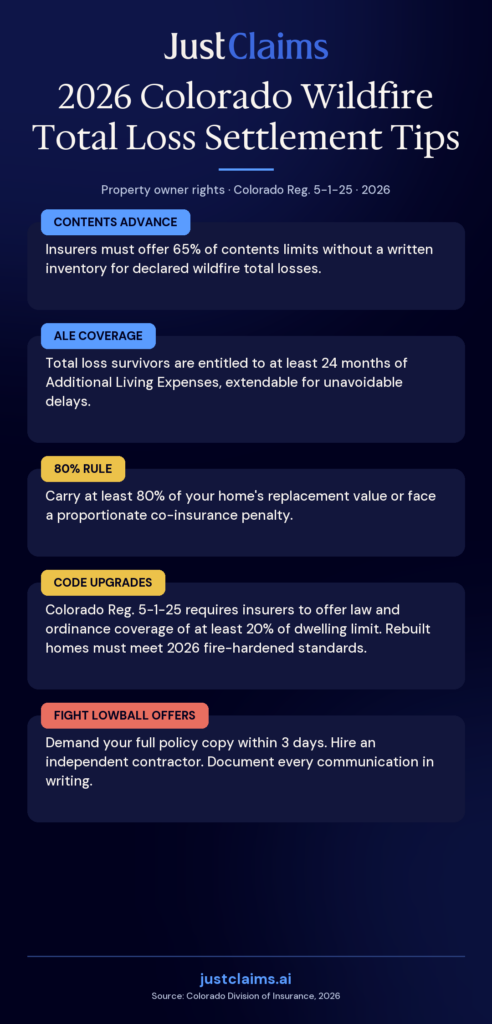
When a declared wildfire destroys a Colorado residence, state law mandates that insurers offer at least 65% of the contents coverage limit without requiring a written inventory from the property owner. Because the first offer is rarely what is owed, understanding these statutory thresholds is critical to securing the funds required to rebuild. Navigating a total loss claim requires strict attention to building code upgrades, living expense timelines, and replacement cost rules.
Key Takeaways
- Contents Advance: Insurers must offer 65% of contents limits without an inventory for declared wildfire total losses.
- ALE Duration: Total loss survivors are entitled to at least 24 months of Additional Living Expenses.
- Coverage Minimums: Policies must offer extended replacement cost coverage of at least 50% of the dwelling limit.
- Code Upgrades: Insurers must offer law and ordinance coverage of at least 20% for replacement-cost policies.
What is Colorado’s total loss threshold and how it triggers
Under Colorado law, enhanced total loss benefits are triggered when an owner-occupied residence is completely destroyed by a wildfire disaster declared by the governor [1]. When a total loss is triggered by a declared wildfire, Colorado insurers must offer at least 65% of the contents coverage limit without requiring a written inventory from the property owner [1]. A total loss from a declared wildfire triggers a requirement that insurers provide at least 24 months of additional living expense (ALE) coverage, which can be extended for unavoidable delays [2]. In the event of a total loss, Colorado policyholders are not required to rebuild on the same lot; the policy must cover the replacement cost even if the property owner chooses to rebuild or purchase a home in a new location [2].
The 80% Rule: most policies require insuring at least 80% of home value to receive full replacement cost
Because underinsurance gaps commonly trigger adjuster disputes, understanding how your coverage limits interact with state law is your primary financial recovery tool. The 80% rule requires property owners to carry insurance coverage equal to at least that threshold of their home’s total replacement value to receive full compensation for damages [3]. If a property owner’s coverage falls below the 80% threshold, the insurance company will only pay a proportionate amount of the claim, leaving the property owner to cover the remaining costs out-of-pocket [3]. This proportional shortfall is why maintaining adequate insurance to value on your dwelling is essential long before a wildfire ever threatens your home. In response to underinsurance issues highlighted by the 2021 Marshall Fire, Colorado passed HB 1174, requiring insurers to offer extended replacement-cost coverage of at least 50% of the dwelling limit, an increase from the previous 20% [4]. Effective July 30, 2024, Colorado Regulation 5-1-25 mandates that insurers issuing replacement-cost policies must offer Extended Replacement Cost coverage of at least that floor and law and ordinance coverage of at least the statutory floor [5].
Ordinance and Law Coverage: critical for older Colorado homes that must be rebuilt to 2026 building codes
Since rebuilding a destroyed property often exposes severe underinsurance, securing adequate funds for modern building code compliance is essential for a complete recovery. Effective July 30, 2024, Colorado Regulation 5-1-25 requires insurers to offer law and ordinance coverage of at least that threshold of the dwelling limit for replacement-cost policies [5]. The 2025 Colorado Wildfire Resiliency Code establishes mandatory fire-hardened building standards, such as Class A roof coverings and ignition-resistant exterior walls, for homes rebuilt in wildland-urban interface areas [6]. Following the devastating Marshall Fire, the Colorado Division of Insurance adopted Regulation 5-1-21 to protect policyholders by identifying specific acts regarding law and ordinance coverage that constitute unfair claim settlement practices [7].
Personal Property (Content) Claims: strategies for listing thousands of items without missing value
While structural rebuilding consumes the largest portion of a settlement, accurately documenting your personal property claim is equally vital to avoiding out-of-pocket losses. Under Colorado law (HB 22-1111), insurers are required to offer policyholders a minimum of that threshold of their personal property coverage limits for total losses in a declared wildfire disaster without requiring a written contents inventory [8]. For policyholders claiming more than that floor, Colorado law mandates an extended period to replace destroyed personal property and recover depreciation, lasting up to 365 days after the alternate living expense period expires or 36 months after the first actual cash value payment [8]. To effectively list thousands of items, property owners should use spreadsheet templates grouped by room or category, and utilize home photos, videos, and electronic purchase records to establish the actual cash value and replacement costs of destroyed items [8].
ALE (Additional Living Expenses) for temporary housing in Colorado
Because rebuilding a total loss property takes years, securing long-term temporary housing funds is a critical component of your overall settlement strategy. ALE coverage, also referred to as ‘Coverage D’ or ‘Loss of Use,’ provides funds for the necessary living expenses policyholders incur when their home is a total loss or rendered uninhabitable due to a catastrophic event like a wildfire [11]. Under Colorado Emergency Regulation 23-E-03, insurers are required to waive any waiting periods for Additional Living Expenses (ALE) benefits for policyholders whose homes require repair or replacement following a catastrophic disaster [9]. Following the devastating Marshall Fire, the Colorado Division of Insurance successfully secured agreements from insurance companies to extend ALE coverage up to that timeframe for total loss survivors who initially only had 12 months of coverage [10]. If an insurance company causes an unreasonable delay in settling a claim after a catastrophic disaster, Colorado regulations mandate that they toll the ALE time limits for the duration required to repair or replace the damaged property [9].
How to Fight a Lowball Total Loss Offer
1. Demand a Complete Copy of Your Policy
Before accepting any settlement figures, Under Colorado law, insurers must provide an uncertified copy of the policy within 3 business days of a request, and a certified copy within 30 days of a request. Adjusters often base initial offers on standard policy language without accounting for extended replacement cost riders or specific ordinance and law upgrades you have purchased.
2. Hire Independent Experts for Rebuilding Estimates
Insurance company adjusters utilize standardized software that frequently underestimates local labor rates and specialized material costs following a regional disaster. Securing an independent estimate from a licensed local contractor ensures your demand reflects the true cost of rebuilding in your specific market.
3. Document Every Communication in Writing
Verbal promises from field adjusters hold no legal weight during a settlement dispute. Property owners must follow up every phone call with an email summarizing the conversation, creating a verifiable paper trail that can be used if a formal complaint to the state insurance division becomes necessary.
Frequently Asked Questions
What qualifies as a total loss in a Colorado wildfire?
A property is generally considered a total loss when it is completely destroyed or damaged beyond economical repair. Under Colorado law, specific enhanced benefits trigger when an owner-occupied residence is destroyed by a wildfire disaster officially declared by the governor.
Do I have to rebuild on the exact same lot?
No, Colorado law provides flexibility for property owners recovering from a total loss. Your insurance policy must cover the replacement cost even if you choose to rebuild your home in a new location or purchase an existing home elsewhere.
How long do I have to replace my personal property?
The timeline for replacing personal property and recovering depreciation is strictly regulated. Colorado law mandates an extended period lasting up to 365 days after your alternate living expense period expires, or 36 months after the first actual cash value payment.
What happens if my coverage falls below the 80% rule?
If your dwelling coverage is less than that threshold of your home’s total replacement value, you will face a co-insurance penalty. The insurance company will only pay a proportionate amount of the claim, leaving you responsible for the remaining out-of-pocket costs.
How to Protect Your Settlement Rights
Recovering from a catastrophic wildfire requires meticulous documentation and a thorough understanding of state insurance regulations. Property owners must proactively manage their claims by tracking living expenses, securing independent rebuilding estimates, and demanding all statutory coverage minimums. Upload your claim documents to JustClaims to see in minutes if your insurer missed coverage you’re owed.
This content is for informational purposes only and does not constitute legal or insurance advice.
Sources
[3] https://www.investopedia.com/ask/answers/06/80percentrule.asp
[6] https://dfpc.colorado.gov/colorado-wildfire-resiliency-code
[8] https://cl.cobar.org/features/proving-covered-personal-property-loss-under-a-homeowners-policy/
[11] https://doi.colorado.gov/announcements/marshall-fire-response-faqs-on-additional-living-expenses-ale

Taylor Bezek

As the General Manager at JustClaims, Taylor Bezek brings over a decade of experience managing complex residential, commercial, and large-loss claims. A licensed Public Adjuster in TX (#2125659), FL (#W455048), CO (#769172), and 10 additional states, Taylor founded his own firm before joining JustClaims to scale a tech-forward solution for the insured. He is committed to combining industry expertise with AI to enhance speed, clarity, and outcomes for every policyholder. Taylor's mission is to modernize the public adjusting profession and ensure owners get exactly what they are entitled to.