Why Your Insurance Check Lists Your Mortgage Lender 2026

July 29, 2026
Written by Taylor Bezek
Share


When a mortgaged property suffers substantial damage, the insurance payout is tied to your lender’s financial interest in the building. Because most mortgage agreements require it, the carrier generally issues the settlement as a check made out to both you and your mortgage servicer — which is why so many property owners are caught off guard when a dual-payee check arrives. Understanding the mortgagee clause behind that requirement clarifies why your servicer holds the repair funds and how the release process works.
Key Takeaways
- Primary function: A mortgagee clause is a property insurance provision that protects the lender’s interest in the mortgaged property, in effect creating a separate contract between the insurer and the lender.
- Payment priority: Because most mortgage agreements require it, the carrier generally issues the settlement as a check payable to both the property owner and the mortgage servicer.
- How funds are released: The servicer typically releases part of the money before work begins, more as repairs progress, and the balance once the job is finished and the property passes inspection.
- Not the same as a loss payee clause: A mortgagee clause gives the lender stronger, real-estate-specific protections. For one- to four-unit properties, Fannie Mae does not accept a loss payable clause in place of one.
- Notification rules: Property insurance policies must provide written notice to the named insured and the mortgagee before the insurer can cancel coverage.
Understanding the Mortgagee Clause and Lender Interests
A mortgagee clause is a property insurance provision that grants special protection to the interest of a mortgagee — the lender named in the policy — in effect setting up a separate contract between the insurer and the lender [5]. It establishes that loss to the mortgaged property is payable to the mortgagee named in the policy, promises advance written notice of cancellation, and can keep coverage in force for the lender’s benefit even if the policy is voided by an act of the insured, such as arson [5]. Mortgagee clauses are sometimes loosely called ‘loss payee clauses,’ but the two are not interchangeable: for one- to four-unit properties, Fannie Mae requires a standard or union mortgagee clause and states that a loss payable clause in lieu of a mortgagee clause is not acceptable [4].
When a covered event damages the structure, the carrier generally pays the settlement with a check made out to both you and your mortgage servicer or lender, because most mortgage agreements require it [1]. The servicer then controls the release of those funds: it typically releases a portion before work begins so you can hire a contractor, more as the work progresses, and the balance once the job is finished and the property passes inspection [1]. Property insurance policies on one- to four-unit properties must also provide written notice to the named insured and the mortgagee before the insurer can cancel the policy [4].
The Loss-Draft Department Process
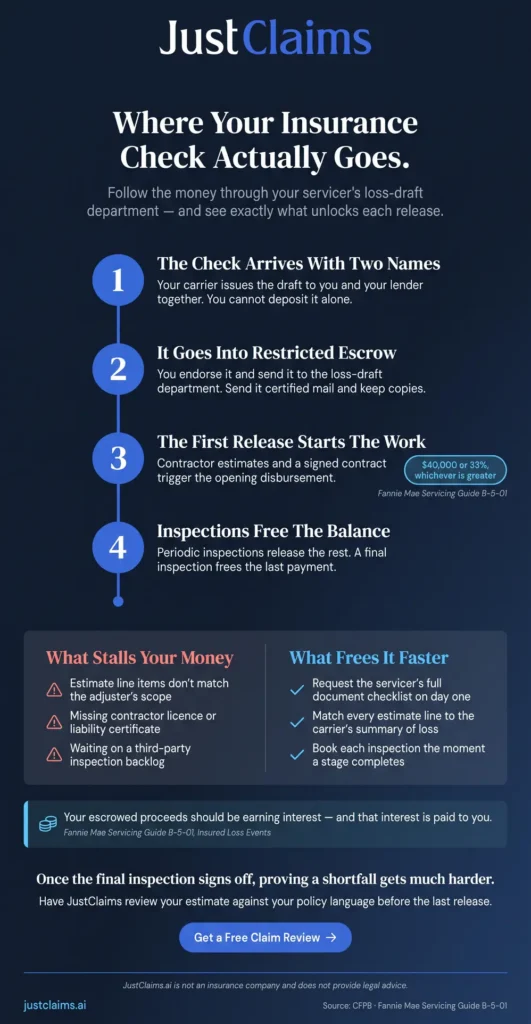
Because the settlement check is generally made payable to both you and your servicer, navigating the servicer’s loss-draft department can become a significant administrative step after the check arrives [1]. The loss-draft department is the specific division within your mortgage company responsible for managing insurance payouts and releasing funds for property repairs.
1. Submitting the Initial Check
When the settlement draft arrives with both your name and the lender’s name on it, you cannot simply deposit it into a personal checking account. Property owners must endorse the document and forward it to the mortgage company’s loss-draft department. The servicer then deposits any proceeds it does not disburse into an interest-bearing account held for your benefit, and under Fannie Mae’s servicing rules the accumulated interest is paid to the borrower once repairs are complete [3]. You should always send these endorsed documents via certified mail with tracking to maintain a clear chain of custody. Keeping copies of every endorsed check and tracking receipt helps protect your timeline if the bank misplaces the physical document. Condo owners should add one more document to that habit — the association’s building policy — and our walkthrough on how to get a copy of the HOA master insurance policy covers every channel, from the board’s records to the lender’s own loan file.
2. Providing Contractor Estimates
Before the bank releases any initial funds from the escrow account, they typically require documentation proving that legitimate repairs are underway. Property owners are generally asked to submit detailed contractor estimates and a signed repair contract. Where multiple disbursements are required, the servicer must review and approve the final repair plan, including obtaining the necessary bids to repair the property [3]. Some servicers also request the contractor’s license and liability insurance, though this is not a universal requirement. The loss-draft department reviews these documents to verify that the scope of work aligns with the insurance adjuster’s summary of loss. If your contractor’s estimate lacks specific line items that match the carrier’s assessment, the bank may pause the disbursement until you provide a revised, matching document. Knowing what a roofing supplement needs to include is what prevents that mismatch.
3. Confirming Repair Completion
Servicers generally hold the final portion of the settlement until the work is verified, and Fannie Mae requires the servicer to conduct a final inspection to ensure all repairs are completed [3]. For loans that are current or less than 31 days delinquent, Fannie Mae also permits the servicer to document repair progress using borrower-submitted photos, video, or a servicer-directed video call, which is often faster than scheduling an on-site visit [3]. Once the inspector confirms that the contractor has completed the work according to the submitted estimates, the loss-draft department releases the final payment to cover the remaining balance. Scheduling these inspections promptly is critical, as third-party vendors often have backlogs that can stall your final contractor payment.
Navigating Common Delays and Escrow Holds
Because servicers must verify repair progress before releasing each portion of the funds, that oversight can slow the restoration timeline [3]. Property owners must proactively manage the documentation requirements to prevent the loss-draft department from stalling the release of funds.
Managing Large Claim Escrow Holds
For substantial losses, banks typically place the entire insurance payout into a restricted escrow account rather than releasing it as a lump sum. Property owners should request a clear schedule of requirements from the loss-draft department immediately after the claim is approved. Some states also set deadlines: in Texas, the mortgage company must contact you within 10 days of receiving the check from your insurer, and once you have met its requirements it has 10 days to send you the funds — you may be entitled to interest if it takes longer [2]. By understanding exactly which documents trigger the next release of funds, you can prepare your contractor to submit the necessary paperwork without delay. Maintaining a dedicated communication log with your loss-draft representative helps you track which documents have been approved and which are still pending review.
Handling Staged Disbursements
Mortgage companies generally disburse funds in stages rather than as a lump sum. Under Fannie Mae’s servicing rules, when a loan is current or less than 31 days delinquent, the servicer is authorized to release an initial disbursement of up to the greater of $40,000 or 33% of the insurance loss proceeds, then release the remaining funds based on periodic inspections of the progress of the repair work [3]. Property owners must communicate this disbursement schedule to their chosen contractors before signing any agreements. If a contractor demands full payment upfront, you may need to negotiate a payment plan that aligns with the bank’s staged release schedule to avoid out-of-pocket expenses. Reputable restoration contractors are highly familiar with loss-draft procedures and will typically agree to payment terms that mirror the lender’s inspection and release milestones. If the release amount itself is wrong, an insurance claim appraiser can challenge the valuation.
Mortgage Payoffs and Refinancing During a Claim
Because the servicer controls the undisbursed settlement funds, changing your mortgage status during an active claim requires careful coordination [3]. Property owners who plan to pay off their loan or refinance must understand how these actions impact the loss-draft process.
Paying Off the Mortgage
If you pay off the remaining balance of your loan before the repairs are complete, the bank no longer holds a financial interest in the property. Property owners in this situation should request a formal lien release or payoff letter from the servicer. On an association-owned building, the same disbursement logic flows through the master policy before any individual unit owner’s coverage is tapped. Federal rules also require the servicer to return any amounts remaining in an escrow account within its control within 20 days — excluding weekends and legal public holidays — of your paying the mortgage loan in full [7]. Send proof of the payoff to the carrier’s adjusting team proactively, because carriers generally keep naming the lender on checks until they receive official notice that the lien has been released.
Refinancing Before Repairs Conclude
Refinancing while a claim is open adds moving parts. The original servicer holds the undisbursed settlement funds, and a refinance changes who must be named in the mortgagee clause: Fannie Mae requires the lender’s name, followed by the phrase “its successors and/or assigns”, and mailing address to be shown as the mortgagee, with all correspondence, policies, and bills sent to the servicer [4]. Because of that handoff, many property owners choose to wait until repairs are finished and the final funds are disbursed before initiating a refinance. If you do refinance mid-claim, confirm in writing with both servicers and your carrier how the remaining proceeds will be handled and how the mortgagee clause will be updated.
Frequently Asked Questions
What is a mortgagee clause?
A mortgagee clause is a property insurance provision that grants special protection to the lender’s interest in the mortgaged property, in effect setting up a separate contract between the insurer and the lender [5]. It establishes that loss to the mortgaged property is payable to the mortgagee named in the policy and promises the lender advance written notice if the policy is cancelled [5].
Why is my insurance check made out to my lender?
Your insurer generally pays the settlement with a check made out to both you and your mortgage servicer or lender, because most mortgage agreements require it to protect the lender’s interest [1]. The dual-payee arrangement keeps the money tied to restoring the property that secures the loan.
How does my lender release the claim payout?
Your servicer typically releases a portion of the settlement before work begins so you can hire a contractor, releases more as the work progresses, and releases the remainder once the job is finished and the home passes inspection [1]. Any proceeds not yet disbursed are held in an interest-bearing account for your benefit [3].
What happens if my policy is canceled?
Property insurance policies on one- to four-unit properties must provide written notice to both the named insured and the mortgagee before the insurer can cancel coverage [4]. If coverage does lapse, your servicer may purchase force-placed insurance and charge you for it, but only after mailing you a written notice at least 45 days beforehand and a reminder notice at least 15 days before assessing the charge [6]. The servicer must cancel that policy and refund premiums for any period of overlapping coverage within 15 days of receiving evidence that you had compliant insurance in place [6].
How to Release Your Repair Funds Faster
Managing a property damage claim is complex enough without the added administrative burden of a loss-draft department holding your settlement funds. To keep your restoration project moving, endorse your checks promptly, maintain open communication with your mortgage company, and make sure your contractor understands the staged disbursement schedule. If your insurance claim was denied or underpaid, JustClaims‘ expert team — accelerated by our bespoke AI — reviews the policy language, compares it against your documentation, and flags likely underpayments so you can go back to the carrier with confidence.
This content is for informational purposes only and does not constitute legal or insurance advice. Coverage decisions depend on the specific terms, conditions, and exclusions of each policy and the laws of the applicable jurisdiction; policyholders and contractors should consult with a qualified professional for advice on their particular situation.
Sources
[1] Consumer Financial Protection Bureau. How do home insurance companies pay out claims? consumerfinance.gov
[2] Texas Department of Insurance. FAQ: Homeowners insurance and disaster claims. tdi.texas.gov
[3] Fannie Mae. Servicing Guide B-5-01, Insured Loss Events. servicing-guide.fanniemae.com
[4] Fannie Mae. Selling Guide B7-3-08, Mortgagee Clause, Named Insured, and Notice of Cancellation Requirements. selling-guide.fanniemae.com
[5] International Risk Management Institute (IRMI). Mortgagee clause — insurance glossary. irmi.com
[6] Consumer Financial Protection Bureau. 12 CFR § 1024.37 — Force-placed insurance (Regulation X). consumerfinance.gov
[7] Consumer Financial Protection Bureau. 12 CFR § 1024.34(b) — Timely escrow payments and treatment of escrow balances (Regulation X). consumerfinance.gov

Taylor Bezek

As the General Manager at JustClaims, Taylor Bezek brings over a decade of experience managing complex residential, commercial, and large-loss claims. A licensed Public Adjuster in TX (#2125659), FL (#W455048), CO (#769172), and 10 additional states, Taylor founded his own firm before joining JustClaims to scale a tech-forward solution for the insured. He is committed to combining industry expertise with AI to enhance speed, clarity, and outcomes for every policyholder. Taylor's mission is to modernize the public adjusting profession and ensure owners get exactly what they are entitled to.