Colorado Hail Damage Insurance Claims 2026: From Filing to Full Settlement
September 18, 2026
Written by Taylor Bezek
Share


Colorado sits inside “Hail Alley” — the junction of Nebraska, Colorado, and Wyoming that NOAA’s National Severe Storms Laboratory says usually records the most hailstorms in the country, averaging seven to nine hail days per year. In an NICB analysis of 2016–2018 claims data, Colorado ranked second nationally for hail loss claims with 395,025 filed, behind only Texas — and NOAA estimates the May 2024 Colorado hailstorms and associated severe weather caused another $3 billion in damage. Knowing exactly what a Colorado hail policy is obligated to pay — and where insurers commonly underpay — can significantly change the size of a final claim settlement.
Key Takeaways
- Hail season window: Colorado’s hail season runs from April 15 through September 15, with storms most frequent — and most destructive — in June; parts of southeastern Colorado, including Pueblo, peak in August instead.
- Statewide claim ranking: Colorado ranked #2 nationally for hail loss claims in an NICB analysis of 2016–2018 data, with 395,025 claims filed over that three-year window — behind only Texas.
- Cosmetic damage exclusion: Many policies now exclude hail impacts that mar a roof’s appearance but don’t compromise its waterproofing function — check whether yours carries one before you file.
- Ice barrier code requirement: IRC Section R905.1.2 requires an ice-and-water shield from the eave edge to at least 24 inches inside the exterior wall line — and at least 36 inches up-slope from the eave on roofs sloped greater than 8:12.
- Public adjuster fee cap: Colorado law caps public adjuster fees at 10% of a catastrophic-disaster claim settlement and bans any fee, retainer, or deposit before the claim settles (§10-2-417, C.R.S.).
Colorado’s Hail Corridor: Why June Is the Costliest Month
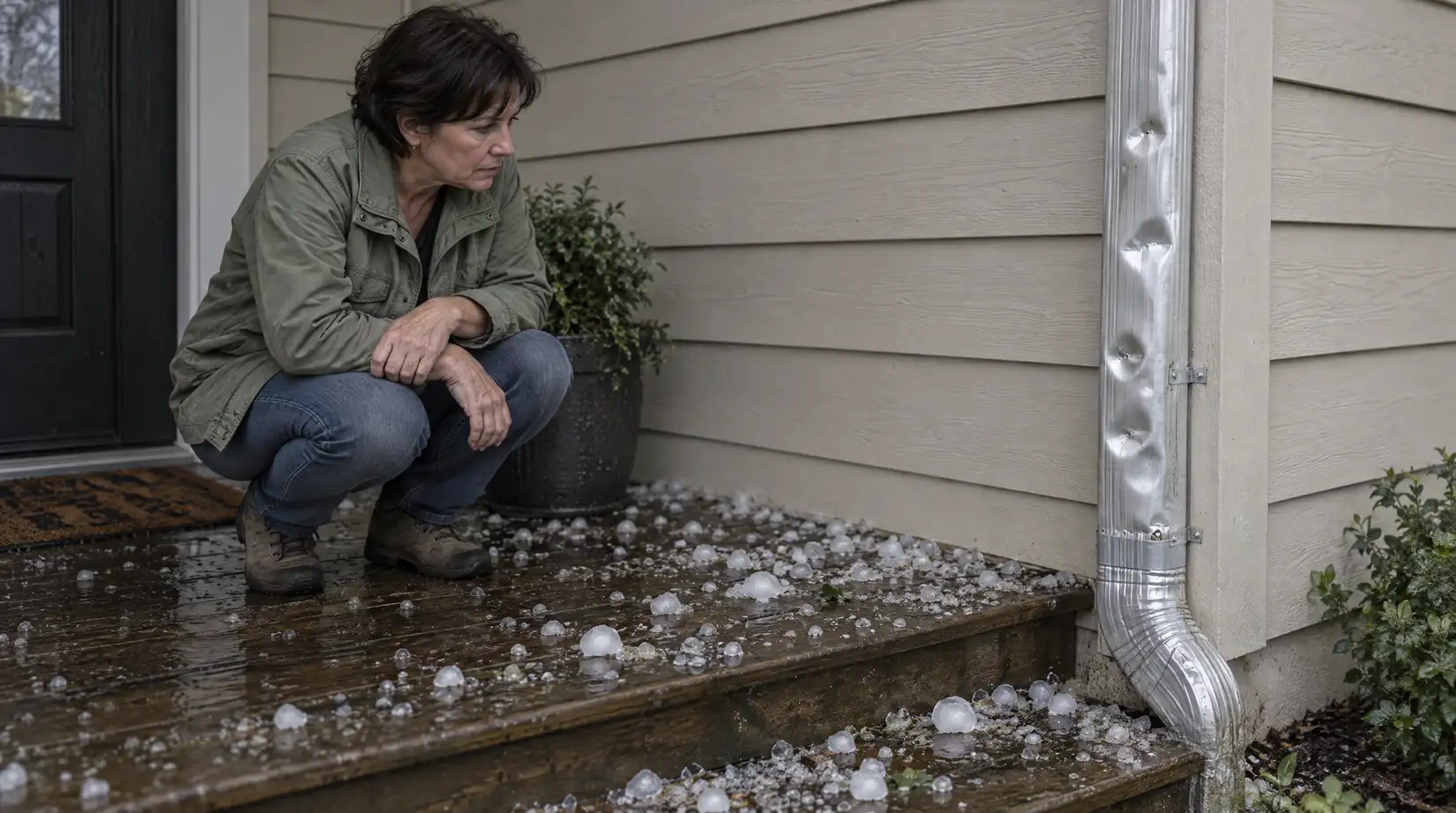
Colorado’s Front Range lies at the heart of “Hail Alley” — the area where Nebraska, Colorado, and Wyoming meet that averages seven to nine hail days per year and usually records the most hailstorms in the United States [1]. According to the Colorado Climate Center at Colorado State University, the state’s hail season runs from April 15 through September 15, with storms occurring most frequently in June and tending to be most destructive in mid-June; parts of southeastern Colorado, including the Pueblo area, see their worst hail activity in August instead [2].
An NICB analysis of ISO ClaimSearch data for 2016–2018 found Colorado ranked #2 nationally for hail loss claims, with 395,025 claims filed over that three-year window — behind only Texas. Colorado Springs and Denver both ranked among the top five U.S. cities for hail claims, and nationally May produced the highest monthly average (203,296 claims), followed by June (178,881) [3]:
| Month | National Average Hail Claims (2016–2018) |
|---|---|
| May | 203,296 |
| June | 178,881 |
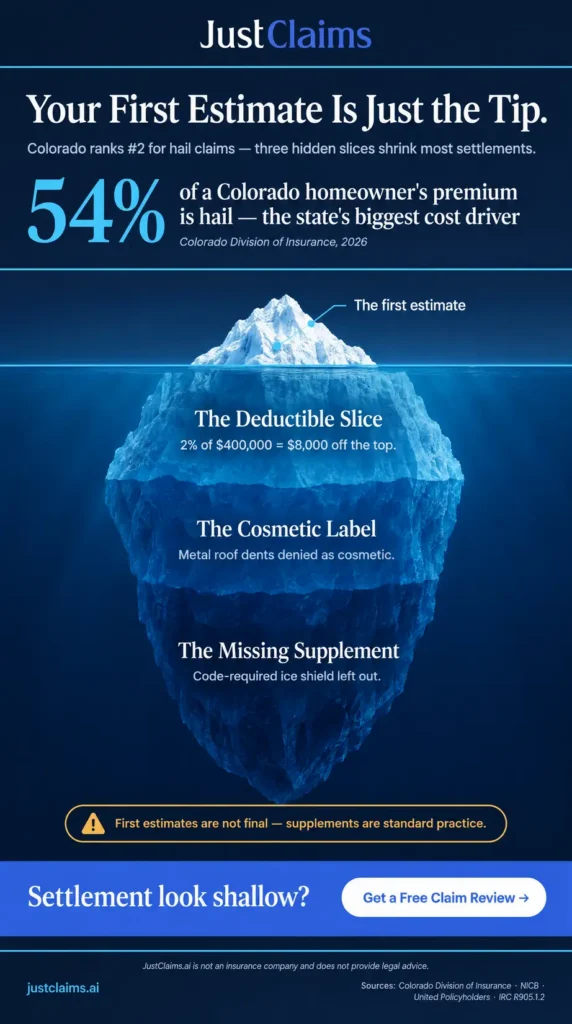
The exposure shows up directly in premiums: data released by the Colorado Division of Insurance in February 2026 — drawn from 20 carriers representing 80% of the market — found hail accounts for an average of 26% to 54% of a Colorado homeowner’s total premium depending on the county, making hail the state’s largest homeowners-insurance cost driver [4].
The May 8, 2017 Denver metro hailstorm remains the costliest insured catastrophe in state history at $2.3 billion in insured losses, generating roughly 167,000 auto claims and 100,600 homeowners claims [5] — and NOAA’s billion-dollar disaster database shows the losses keep coming, estimating the May 2024 Colorado hailstorms and associated severe weather at $3 billion in damage [6].
Property owners in the Denver metro who need immediate guidance after a fast-moving storm can also see our Denver hail damage contractor guide for time-sensitive response steps.
What a Colorado Hail Claim Should Cover
Because Colorado generates hail claims at this volume every season, understanding what a policy is actually required to pay after a covered hail event is the first step toward a full settlement rather than a partial one.
Matching Requirements for Siding and Roofing
The Colorado Division of Insurance confirms there is no law requiring an insurer to “match” siding or paint on areas of the house that were not damaged — the company is only required to repair or replace the actual damage caused by the covered hail event [7].
Auto Total-Loss and Salvage-Title Rules
For vehicle hail claims, Colorado’s motor vehicle salvage-title statute (§ 42-6-102(17)(a), C.R.S.) specifically exempts a total loss resulting from hail from the “salvage vehicle” definition — so an insurer cannot require a salvage title before releasing a hail total-loss payment on that basis alone [7] [8].
If a second hailstorm damages an already-claimed vehicle before repairs are completed, the insurer assesses the new damage and issues payment for the additional loss minus the initial hail payment, and the comprehensive deductible applies to both events [7].
There is also no statewide Colorado law setting a fixed total-loss threshold percentage for hail-damaged vehicles — each insurer sets its own valuation methodology, and the Division of Insurance verifies that the company follows its own published guidelines [7].
How Wind/Hail Deductibles Are Calculated
Colorado property insurance policies commonly use wind/hail deductibles structured as a percentage of dwelling (Coverage A) value rather than a flat dollar amount — typically between 1% and 5% — which directly affects how much of a hail settlement a policyholder actually receives [9].
The Colorado Division of Insurance gives the same range in its consumer guidance, citing wind/hail deductibles of 1%, 2%, or 5% of coverage: on a $400,000 dwelling limit, a 2% deductible means the first $8,000 of a hail claim comes out of the property owner’s pocket [10].
| Deductible Tier | Percentage of Dwelling Coverage |
|---|---|
| Lower tier | 1% |
| Mid tier | 2% |
| Upper tier | 5% |
Reviewing the declarations page before filing helps a property owner anticipate how much of a payout the deductible structure will absorb.
The Cosmetic-Damage Fight on Colorado Roofs
That same gap between “damage” and “matching” is where Colorado’s biggest roofing disputes originate: the fight over whether hail impacts are cosmetic or functional. Because the Division of Insurance confirms no state law requires matching of undamaged areas, the insurer is only obligated to repair or replace the actual damage caused by the covered event — and this becomes contested whenever hail strikes only one slope of a roof [7].
Insurers in a growing number of states have added cosmetic damage exclusions to residential policies: hail or wind impacts that mar the appearance of exterior surfaces — including roofs, walls, doors, and windows — but do not affect their function are excluded from coverage when the policy carries the endorsement. United Policyholders strongly advises consumers to avoid policies carrying this exclusion, noting that it has spurred disputes and litigation [11].
A common misconception is that any visible hail impact automatically qualifies a roof for replacement — under a cosmetic damage endorsement, dents on a metal roof or impact-resistant shingles can be classified as cosmetic and denied, which is why United Policyholders tells property owners to check whether their policy includes the exclusion and whether it can be removed [12].
The functional-versus-cosmetic fight has also reached the courts: in a case where United Policyholders filed an amicus brief, the Seventh Circuit ruled that purely cosmetic hail damage is a covered direct physical loss when the policy does not contain a cosmetic exclusion. Our breakdown of functional vs. cosmetic hail damage shows how carriers frame the exclusion and what documentation counters it [13]. Property owners facing a cosmetic-damage denial can contest it through re-inspection requests, a formal Division of Insurance complaint, engagement of a public adjuster, or, in some cases, bad-faith litigation.
Supplements and Code Upgrades: Ice-and-Water Shield
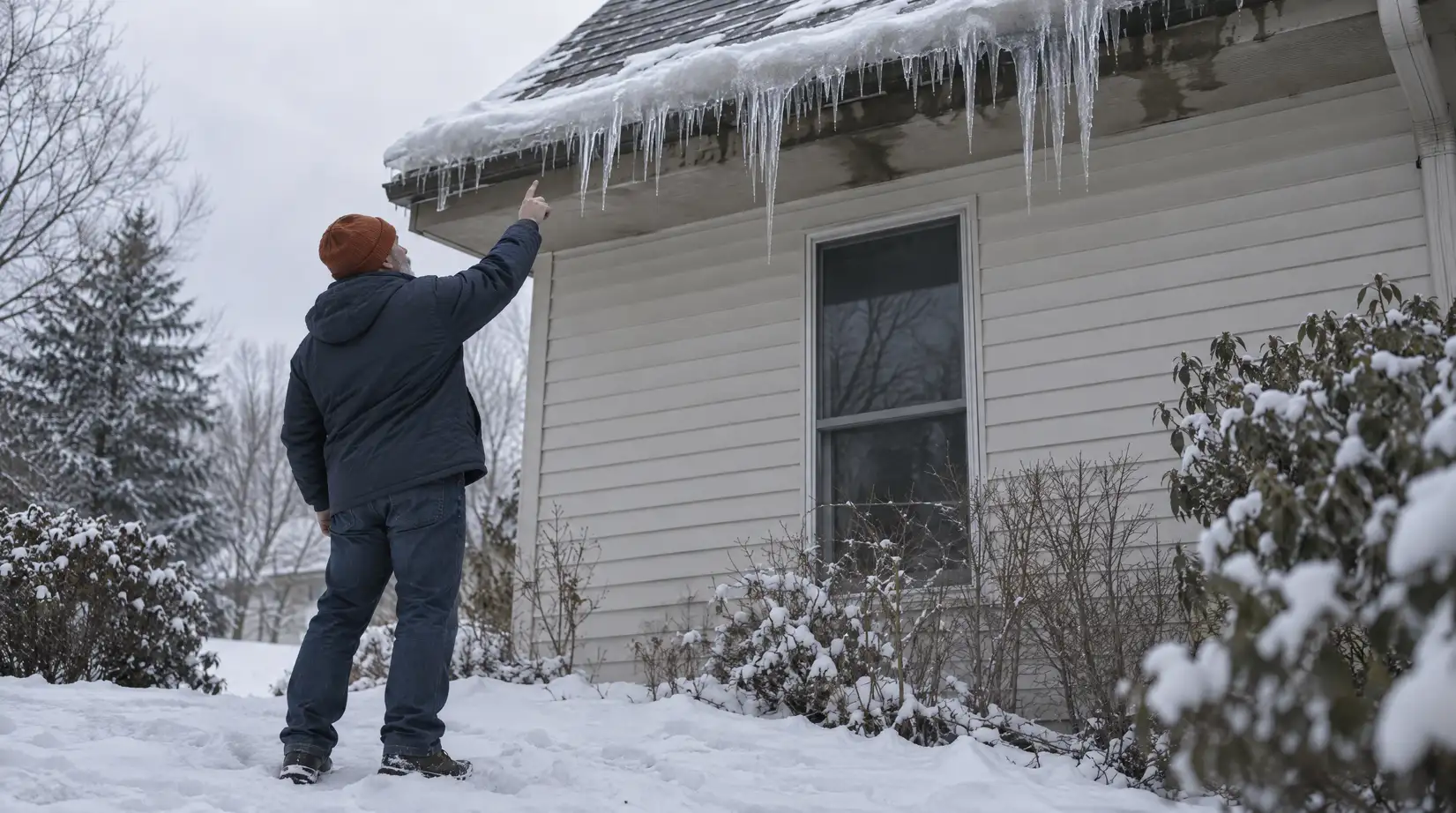
Because cosmetic-damage disputes often dominate the conversation, property owners can lose sight of a second, equally common underpayment source: code-required items missing from the original adjuster estimate. Under International Residential Code Section R905.1.2 — the model code adopted by Colorado jurisdictions including the Town of Superior — an ice barrier (ice-and-water shield) must be installed for asphalt shingles and other roof coverings in areas with a history of ice forming along the eaves, extending from the lowest edges of the roof to a point not less than 24 inches inside the exterior wall line; on roofs sloped greater than 8:12, the barrier must also extend at least 36 inches up the roof slope from the eave edge [14].
Local requirements often go further. The Town of Superior’s building department requires ice-and-water shield on all eaves for roof replacements — a minimum of one 3-foot-wide strip — plus drip edge on eaves and rakes and new step flashing at sloped roof-to-wall intersections, items adjusters may initially omit from a hail claim estimate [15].
When an original roof installation lacked this membrane, the ice-and-water shield becomes a supplement item added to the insurer’s scope when a hail-damaged roof is replaced to current code — and the Division of Insurance notes that the first estimate is not always the final one, with insurers reviewing and issuing supplements when additional damage or information is documented [10]. Property owners can ask their contractor to check the original scope against current code line by line before signing off on repairs.
When to Bring In a Public Adjuster
When a cosmetic-damage denial or a missing code supplement leaves a settlement short, some property owners consider bringing in a public adjuster to press the claim further. Our plain-English guide to what a public adjuster does covers how they charge and what to verify before signing a contract. A public adjuster assists policyholders with their insurance company and submits estimates on their behalf, but cannot perform repairs or rebuilds; the Division of Insurance directs consumers to verify the adjuster’s licensing and bonding under Insurance Regulation 1-2-19 before hiring one [16].
For catastrophic disasters, Colorado law caps public adjuster fees at 10% of the claim settlement and prohibits a public adjuster from requiring any fee, retainer, or deposit before a claim settles. The same statute (§10-2-417, C.R.S.) requires public adjusters to serve with objectivity and loyalty to the client alone, bars them from holding a financial interest in repair or reconstruction work tied to the claim they adjust, and gives the insured a 72-hour right to rescind a representation contract in writing [17]. Public adjusters must be licensed by the Division of Insurance and carry a $20,000 surety bond under §10-2-417(2), C.R.S. and Regulation 1-2-19 [18].
The Division of Insurance also advises that after a severe hailstorm, consumers may be contacted by public adjusters offering to work on their behalf for a percentage-based fee. Hiring one is not required, but a consumer who does should verify the adjuster’s license, check references, and preferably choose a Colorado-based adjuster [10]. If your hail claim was underpaid, denied, or stalled, a licensed Colorado public adjuster can re-document the full loss and negotiate the settlement on your behalf.
Frequently Asked Questions
What is a cosmetic damage exclusion, and does it apply to metal roofs?
A cosmetic damage exclusion allows an insurer to deny coverage for hail impacts that change a roof’s appearance without affecting its ability to function as a moisture barrier — and yes, it can apply to metal roofs and impact-resistant shingles, which is why United Policyholders recommends checking whether your policy carries the exclusion and whether it can be removed [12].
Can code upgrades like ice-and-water shield be added to a hail claim after the initial estimate?
Yes. When a hail-damaged roof is replaced, current code — IRC Section R905.1.2 — requires ice barrier installation in areas with a history of ice damming at the eaves, and local jurisdictions can require more; the Division of Insurance notes first estimates are not always final and insurers can issue supplements when additional items are documented [14] [10].
How much can a public adjuster charge in Colorado?
State law caps public adjuster fees at up to 10% of the claim settlement for catastrophic disasters, and the adjuster cannot demand a retainer or deposit before the claim actually settles [17]. Public adjusters must also carry a $20,000 surety bond and be licensed through the Division of Insurance [18].
Is a total vehicle loss from hail treated differently than other total losses in Colorado?
Yes. Colorado’s salvage-title statute specifically exempts a hail-caused total loss from the “salvage vehicle” definition, so an insurer cannot require a salvage title before releasing payment on that basis [7] [8]. There is also no statewide fixed percentage threshold for what qualifies as a total loss — each insurer applies its own valuation methodology under Division of Insurance oversight [7].
How to Strengthen Your Hail Claim Before You Settle
Colorado’s hail corridor produces enough claim volume every season that insurers have standardized ways of narrowing what they pay — from cosmetic exclusions to missing code supplements to deductible structures that quietly reduce a payout. A detailed storm report is one of the strongest counters — see the hail report your carrier doesn’t want you to have for how to document the storm behind a claim.
Property owners who understand these mechanisms before filing, or before accepting a first settlement offer, are in a stronger position to identify where a scope of repair fell short of what the policy and current building code actually require. Reviewing the adjuster’s written estimate line by line against code requirements, and knowing when a public adjuster’s licensing and fee structure make sense for a given claim, are both concrete steps that can affect the final number.
Upload your Colorado hail claim documents and adjuster estimate to Justin — the free policy analyzer built by JustClaims — to see whether cosmetic-damage exclusions, missing ice-and-water shield supplements, or deductible miscalculations affected your settlement.
This content is for informational purposes only and does not constitute legal or insurance advice. Coverage decisions depend on the specific terms, conditions, and exclusions of each policy and the laws of the applicable jurisdiction; policyholders and contractors should consult with a qualified professional for advice on their particular situation.
Sources
[1] Severe Weather 101: Hail Basics — NOAA National Severe Storms Laboratory
[3] Top 5 States for Hail Claims — National Insurance Crime Bureau
[5] Insurance News: Colorado’s Most Costly Catastrophe One Year Later — National Insurance Crime Bureau
[7] After a Hail Storm — Insurance FAQs — Colorado Division of Insurance
[8] Colorado Revised Statutes § 42-6-102 (2025): Definitions (Salvage Vehicle) — Justia
[9] Homeowners: How to Understand a Wind/Hail Deductible — United Policyholders
[11] Bach Talk: The “Purely Cosmetic Damage” Exclusion’s Gonna Be Ugly — United Policyholders
[12] For the 11th Straight Year, Texas Is the Hail Damage Capital of the US — United Policyholders
[13] Advance Cable, Inc. v. Cincinnati Ins. Co. (Amicus Brief) — United Policyholders
[14] 2021 IRC Chapter 9: Roof Assemblies (Section R905.1.2, Ice Barriers) — UpCodes, Colorado
[15] Supplemental Roof Information — Town of Superior, Colorado
[16] Are You Disaster Ready? — Colorado Division of Insurance
[17] Colorado Revised Statutes § 10-2-417 (2025): Public Insurance Adjusters — Justia
[18] For Producers / Agents (Public Adjuster License Applicants) — Colorado Division of Insurance

Taylor Bezek

As the General Manager at JustClaims, Taylor Bezek brings over a decade of experience managing complex residential, commercial, and large-loss claims. A licensed Public Adjuster in TX (#2125659), FL (#W455048), CO (#769172), and 10 additional states, Taylor founded his own firm before joining JustClaims to scale a tech-forward solution for the insured. He is committed to combining industry expertise with AI to enhance speed, clarity, and outcomes for every policyholder. Taylor's mission is to modernize the public adjusting profession and ensure owners get exactly what they are entitled to.