Flood Damage Insurance Claim Assistance 2026
September 17, 2026
Written by Taylor Bezek
Share


Flood-damaged property owners who miss the NFIP’s Proof of Loss deadline can forfeit their right to any further payment, no matter how strong the underlying damage documentation is. The National Flood Insurance Program collects over $4.6 billion in premiums annually while providing nearly $1.3 trillion in coverage nationwide, yet claims routinely get underpaid on scope, depreciation, and contents valuation long before a lawsuit deadline ever comes into play. Knowing who pays what, which deadlines apply, and when appraisal or a public adjuster changes the math is what separates a fair flood settlement from a forfeited one.
Key Takeaways
- NFIP program scale: The NFIP collects over $4.6 billion in premiums, fees, and surcharges and provides nearly $1.3 trillion in coverage across more than five million residential policies.
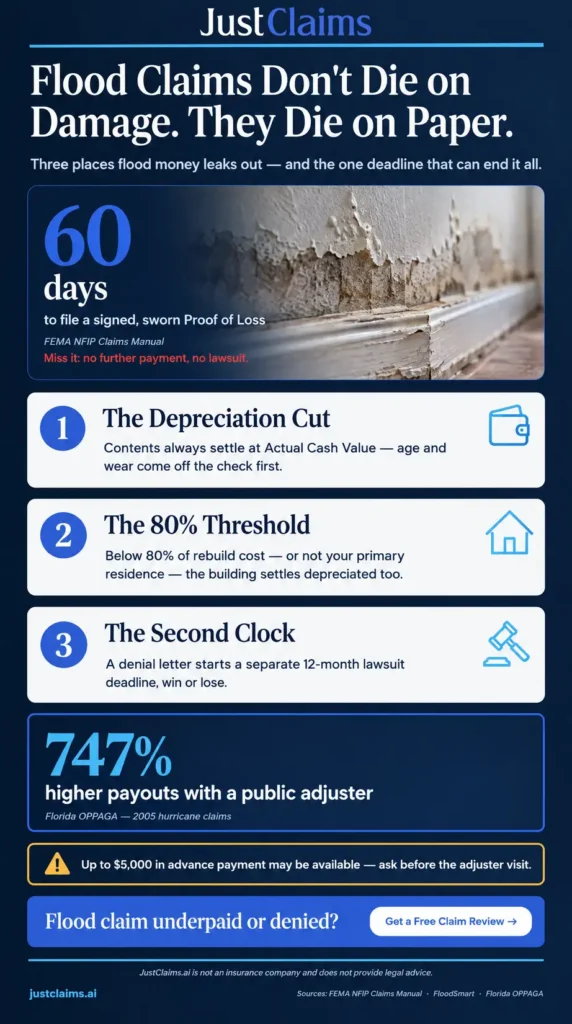
- Proof of Loss deadline: NFIP policyholders must submit a signed, sworn Proof of Loss within 60 days of the date of loss unless FEMA issues a waiver.
- Lawsuit deadline: The statute of limitations to sue over a denied or underpaid flood claim is 12 months from the mailing date of the denial notice.
- Contents valuation: NFIP personal property claims are always settled at Actual Cash Value, never full replacement cost.
- Dwelling coverage threshold: Replacement Cost Value on the building applies only when it is the primary residence and coverage equals 80% or more of the building’s replacement cost.
- Public adjuster outcome data: Non-catastrophe claims settled with a public adjuster averaged 574% higher payouts per a Florida OPPAGA review of 61,324 claims.
NFIP vs Private Flood vs Property Insurance — Who Pays What
Most standard property insurance policies exclude flood damage entirely, which is why the National Flood Insurance Program (NFIP) exists as the primary source of flood coverage for property owners, renters, and businesses nationwide [1]. Properties in high-risk flood zones with government-backed mortgages are required to carry flood insurance, while everyone else has to decide separately whether the exposure is worth the premium [1].
What an NFIP Policy Pays For
An NFIP policy covers direct physical flood damage to a structure and its contents, a scope that most standard property insurance policies do not touch at all [2]. It remains the dominant source of primary flood coverage in the country, collecting more than $4.6 billion in premiums, fees, and surcharges and providing nearly $1.3 trillion in coverage across more than five million residential flood policies [3].
Where Private Flood Insurance Fits
Private flood insurance exists, but under the Biggert-Waters Act (42 U.S.C. §4012a(b)), it can satisfy a lender’s mandatory flood-purchase requirement only if it offers coverage at least as broad as what the NFIP provides [3]. Few private insurers compete directly with the NFIP for primary residential coverage today — private flood policies show up most often on commercial properties, as a layer above NFIP policy limits, or in force-placed lender situations [3].
The Gap in Standard Property Insurance
A standard property policy — the kind covering fire, wind, and theft — typically treats flood as an excluded peril, and that gap tends to surprise property owners only after water has already entered the structure. Condo and HOA owners face a second gap on top of that one, and loss assessment coverage is what determines whether association billings for shared flood damage ever get paid. Property owners recovering from flood damage in Houston, New York, and New Jersey run into this exact coverage gap, which is why region-specific claim guidance for Houston water damage claims, New York water damage claims, and New Jersey water damage claims covers state-specific insurer practices in more depth, alongside the general property damage claim guide for non-flood losses.
The 60-Day Proof-of-Loss Deadline That Kills Flood Claims
Because the fight over a flood claim often turns on paperwork rather than the underlying damage, the Proof of Loss deadline is one of the most consequential dates on a flood claim timeline. Under the Standard Flood Insurance Policy (SFIP), NFIP policyholders must submit a signed and sworn Proof of Loss within 60 days of the date of loss unless FEMA issues a waiver extending that window [4].
| Milestone | Timeframe |
|---|---|
| Proof of Loss submission | 60 days from date of loss (absent a FEMA waiver) |
| Lawsuit filing deadline | 12 months from the denial notice’s mailing date |
| Past disaster waiver example (Hurricane Sandy) | Extended to 24 months after the date of loss |
| Typical claim payout timeline | 4–8 weeks after a claim is started |
If complete, signed Proof of Loss forms and supporting documentation — an itemized scope of loss, contractor estimates, receipts, photos, and expert reports — are not submitted by the deadline, policyholders can lose their right to full or further compensation and their right to sue for additional money [5]. Separately, the statute of limitations to file a lawsuit over a denied claim runs 12 months from the mailing date of the denial notice, a distinct clock that keeps running even after Proof of Loss is submitted on time [5].
FEMA has, in past major disasters such as Hurricane Sandy, used waiver authority to push that window out to 24 months after the loss date [6], though property owners should never assume a waiver will apply to their event. Once a claim is started, FEMA notes payment can typically take 4–8 weeks, and advance payments of up to $5,000 may be available without an adjuster visit or full documentation in some cases [7].
Why Flood Claims Get Underpaid
Even when Proof of Loss is filed on time, many flood settlements still fall short because of how scope, depreciation, and contents valuation get calculated on the back end. When the numbers come back short, these underpaid insurance claim steps walk through how to document the gap and push the settlement toward the policy limit.
Contents Are Settled at Actual Cash Value
Personal property under an NFIP policy is always paid at Actual Cash Value — the cost to repair or replace an item minus depreciation based on its age and condition immediately before the flood — and never at full replacement cost [8]. This means a five-year-old sofa or appliance is paid out well below its purchase price, regardless of how thoroughly it was damaged.
The Dwelling Replacement Cost Threshold
Replacement Cost Value, which pays without a depreciation deduction, applies to the building itself only when it is the policyholder’s primary residence and the coverage amount equals 80% or more of the building’s full replacement cost [8]. Below that threshold — or on any dwelling that is not a primary residence, such as a rental or vacation property — the building is settled at depreciated Actual Cash Value instead [9], a distinction that catches landlords and secondary-home owners especially often.
Exclusions Adjusters Point To
NFIP flood policies exclude coverage for basements (defined as any area with its floor below ground level on all sides), decks, pools, walkways, trees, shrubs, and additional living expenses [9]. Adjusters can point to these exclusions to reduce or deny portions of a claim even when related flood damage occurred.
The Appeal Path and When Appraisal Applies
When underpayment stems from a scope or valuation dispute rather than a missed deadline, two different remedy paths open up — and choosing the wrong one can close off the other permanently. Under 44 CFR 62.20, an NFIP policyholder, whether insured through a Write-Your-Own company or directly by FEMA, may appeal a decision on a claim, proof of loss, or loss estimate, but disputes already subject to appraisal cannot also be appealed under this section [10].
| Path | What It Resolves | Key Rule |
|---|---|---|
| FEMA Appeal (44 CFR 62.20) | Disputes over a decision on a claim, proof of loss, or loss estimate | Cannot be used once appraisal has been invoked on that same issue |
| Appraisal | Disagreement over the dollar amount owed for a covered item | Requires a timely, sufficient Proof of Loss on the disputed portion; does not resolve coverage disputes |
Once a policyholder files a FEMA appeal on an issue, that issue is no longer eligible for resolution by appraisal or other pre-litigation remedies, meaning the two tracks run on mutually exclusive paths for the same disputed item [10]. A claim cannot be partially resolved through appraisal and partially resolved through a FEMA appeal — the property owner has to pick one path per disputed issue [11].
Appraisal itself only applies when the dispute is about the price or amount owed for a covered item, not whether the item is covered at all, and it requires a timely, sufficient Proof of Loss covering the disputed portion before it can proceed [11].
FEMA’s guidance also addresses what happens when a Proof of Loss decision is upheld and the policyholder is still seeking additional payment, routing the request through the NFIP Claims Manual’s additional-payment process rather than a fresh claim [12].
When a Public Adjuster Changes the Outcome
Because scope disputes and depreciation fights often require documentation most property owners don’t have time to compile on their own, many turn to a public adjuster once settlement talks stall. Understanding what a public adjuster does before talks stall makes that decision faster and keeps the documentation window from closing.
Documented Settlement Differences
A Florida OPPAGA review of Citizens Property Insurance claims found that for claims related to the 2005 hurricanes, policyholders who used a public adjuster received payments 747% higher than those who did not [13]. The same review of 61,324 non-catastrophe claims found policyholders with a public adjuster received an estimated $9,379 per claim, versus $1,391 without one — a 574% difference [13]. United Policyholders, a national nonprofit that assists disaster survivors, cites the same report and cautions that the final amount a policyholder receives is reduced by the adjuster’s fee [14].
How Public Adjusters Get Paid
Public adjusters are state-credentialed professionals who work exclusively for the policyholder, unlike company or independent adjusters, and are typically paid on a contingency basis of roughly 5% to 20% of the final settlement, with some states capping the allowable percentage [14].
What They Catch That Others Miss
United Policyholders notes public adjusters can identify additional coverages embedded in a policy, such as separate debris-removal limits distinct from the dwelling rebuild limit, that unrepresented property owners often miss when filing after a disaster [14]. For flood claims specifically, this often means catching contents depreciation applied too aggressively or a disputed water line that shrank the scope of a payout.
Frequently Asked Questions
What is the deadline to file a flood insurance Proof of Loss?
NFIP policyholders generally have 60 days from the date of loss to submit a signed and sworn Proof of Loss unless FEMA grants a disaster-specific waiver. Missing that window can mean losing the right to any further payment on the claim, even if the underlying damage documentation is solid.
Does property insurance cover flood damage?
A standard property insurance policy covering fire, wind, and theft typically excludes flood as a peril, which is why the NFIP or a private flood policy is needed separately. Property owners in high-risk zones with government-backed mortgages are required to carry flood coverage precisely because standard policies leave this gap.
Can I appeal a denied or underpaid flood claim?
Yes, NFIP policyholders can appeal a decision on a claim, proof of loss, or loss estimate under federal regulation, but that option is not available once the same issue has gone through appraisal. The two remedy paths cannot be pursued on the same disputed item, so the choice between them matters before either process starts.
Is it worth hiring a public adjuster for a flood claim?
Data from a Florida state review found non-catastrophe claims settled with a public adjuster averaged notably higher payouts than claims without one, though the adjuster’s contingency fee reduces the net amount to the policyholder. Whether it’s worth it typically depends on the size and complexity of the scope dispute and how much documentation the property owner can gather independently.
Why was my flood claim paid less than expected?
Underpayment commonly comes from contents being settled at depreciated Actual Cash Value rather than replacement cost, a dwelling falling below the coverage threshold needed for Replacement Cost Value, or exclusions like basements and additional living expenses being applied to reduce the scope. Reviewing the itemized settlement against the policy’s actual valuation rules is the first step in spotting which of these applied to a specific claim.
How to Protect Your Flood Claim Payout
Flood claims rarely fail because the damage wasn’t real — they fail because a deadline was missed, contents were depreciated more than the policy allows, or a scope dispute went down the wrong resolution path. Property owners who track the Proof of Loss window, understand whether their dwelling qualifies for Replacement Cost Value, and know the difference between an appeal and appraisal are in a far stronger position when a settlement comes in low. Cross-checking a settlement letter against the actual policy language, rather than trusting the adjuster’s summary, often surfaces the gap between what was paid and what the policy allows.
Upload your flood claim documents to Justin — our free AI insurance policy analyzer — and see in minutes whether your insurer’s scope, depreciation, or contents valuation left coverage on the table.
This content is for informational purposes only and does not constitute legal or insurance advice. Coverage decisions depend on the specific terms, conditions, and exclusions of each policy and the laws of the applicable jurisdiction; policyholders and contractors should consult with a qualified professional for advice on their particular situation.
Sources
[2] Buy a Flood Insurance Policy — National Flood Insurance Program (FloodSmart)
[4] NFIP Claims Manual (June 2023) — FEMA
[5] Flood Insurance Claim Deadlines — United Policyholders
[6] Flood Insurance Lessons Learned — FEMA Administrator Testimony (July 30, 2014)
[7] Start a Claim — National Flood Insurance Program (FloodSmart)
[8] NFIP Summary of Coverage (December 2023) — FEMA
[9] Flood Insurance Claim Basics — United Policyholders
[10] 44 CFR § 62.20 — Claims Appeals — eCFR
[11] NFIP Bulletin W-13029: Appraisal — FEMA
[12] Proof of Loss Decision Upheld: Additional Payment — National Flood Insurance Program (FloodSmart)

Taylor Bezek

As the General Manager at JustClaims, Taylor Bezek brings over a decade of experience managing complex residential, commercial, and large-loss claims. A licensed Public Adjuster in TX (#2125659), FL (#W455048), CO (#769172), and 10 additional states, Taylor founded his own firm before joining JustClaims to scale a tech-forward solution for the insured. He is committed to combining industry expertise with AI to enhance speed, clarity, and outcomes for every policyholder. Taylor's mission is to modernize the public adjusting profession and ensure owners get exactly what they are entitled to.