Reopen a Closed Commercial Claim: Underpayment Guide 2026
September 15, 2026
Written by Taylor Bezek
Share


A closed commercial insurance claim is not automatically a final one. Whether a closed claim can be reopened without a signed release depends on state-specific insurance law and the specific policy’s terms.
Key Takeaways
- What it is: Reopening a claim without a signed release depends on state-specific insurance law and policy terms.
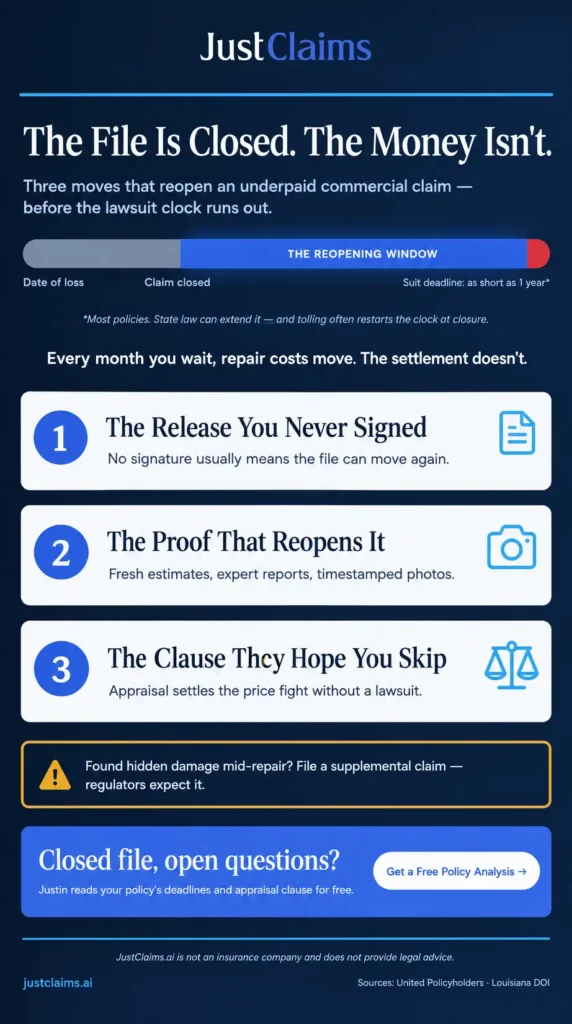
- Lawsuit deadline: Most commercial property policies contain a “Suit Against Us” provision requiring any lawsuit tied to the claim to be filed within one year of the date of loss.
- Deadline exception: State law can override the one-year policy deadline, and case law in many states pauses (“tolls”) the clock while the claim is actively being adjusted.
- What’s required to reopen: A formal written request referencing the original claim number, paired with new itemized contractor estimates, expert reports, and timestamped photo/video evidence.
- Dispute tool: An appraisal clause can resolve disagreements over the dollar amount of loss; whether it remains available on a closed claim depends on the policy and state law.
Why Commercial Claims Get Reopened After Closing
Underpaid commercial claims can occur when a file is closed before the full scope or cost of damage is accounted for, among other causes. A closed claim is not the same thing as a settled claim. Whether a closed claim can be reopened without a signed release depends on state-specific insurance law and the specific policy’s terms, not a universal rule.
For commercial property owners, the decision to challenge a closed file should start with a simple check: locate the settlement paperwork and confirm whether a release was signed. If it was not, the strength of a reopening request depends on the quality of the new documentation you bring to the carrier — and how that documentation is weighed varies by insurer and state.
Deadlines: How Long You Have to Reopen a Commercial Claim
Because underpayment disputes on a closed file are ultimately a race against contractual deadlines, understanding the lawsuit-filing clock matters as much as building your evidence package. Most commercial and property insurance policies contain a “Suit Against Us” provision that requires any lawsuit connected to the claim to be filed within one year of the date of loss [1]. That one-year window is a policy term, not a law, and state statutes can extend or override it depending on jurisdiction [1].
There is also an important nuance that changes how the clock actually runs. In many states, case law tolls — or pauses — that lawsuit-filing deadline while the claim is actively being adjusted, meaning the countdown often restarts from the date the claim was closed or denied rather than the original date of loss [1]. This tolling doctrine can meaningfully expand the practical window a contractor or commercial property owner has to challenge a low settlement, but how it applies varies by state, so confirming the specifics with an attorney before assuming you’re within (or outside) that window is a necessary step [1].
| Deadline Type | Governs | Starting Point |
|---|---|---|
| Policy “Suit Against Us” clause | Lawsuit filing | Date of loss (one year, per policy) [1] |
| State tolling doctrine | Same lawsuit deadline | Often restarts at claim closure or denial [1] |
What Changed Since Your Claim Closed: Cost Inflation & Hidden Damage
Because the original settlement was calculated using pricing and scope information available at the time of loss, a closed claim can become underpaid simply by the passage of time — before any new damage is even considered. Material costs, labor rates, and equipment availability shift, and a scope written months or years ago frequently no longer reflects what it actually costs to complete the repair today. Contractors preparing a reopening request should re-price the job against current market conditions rather than relying on the original estimate.
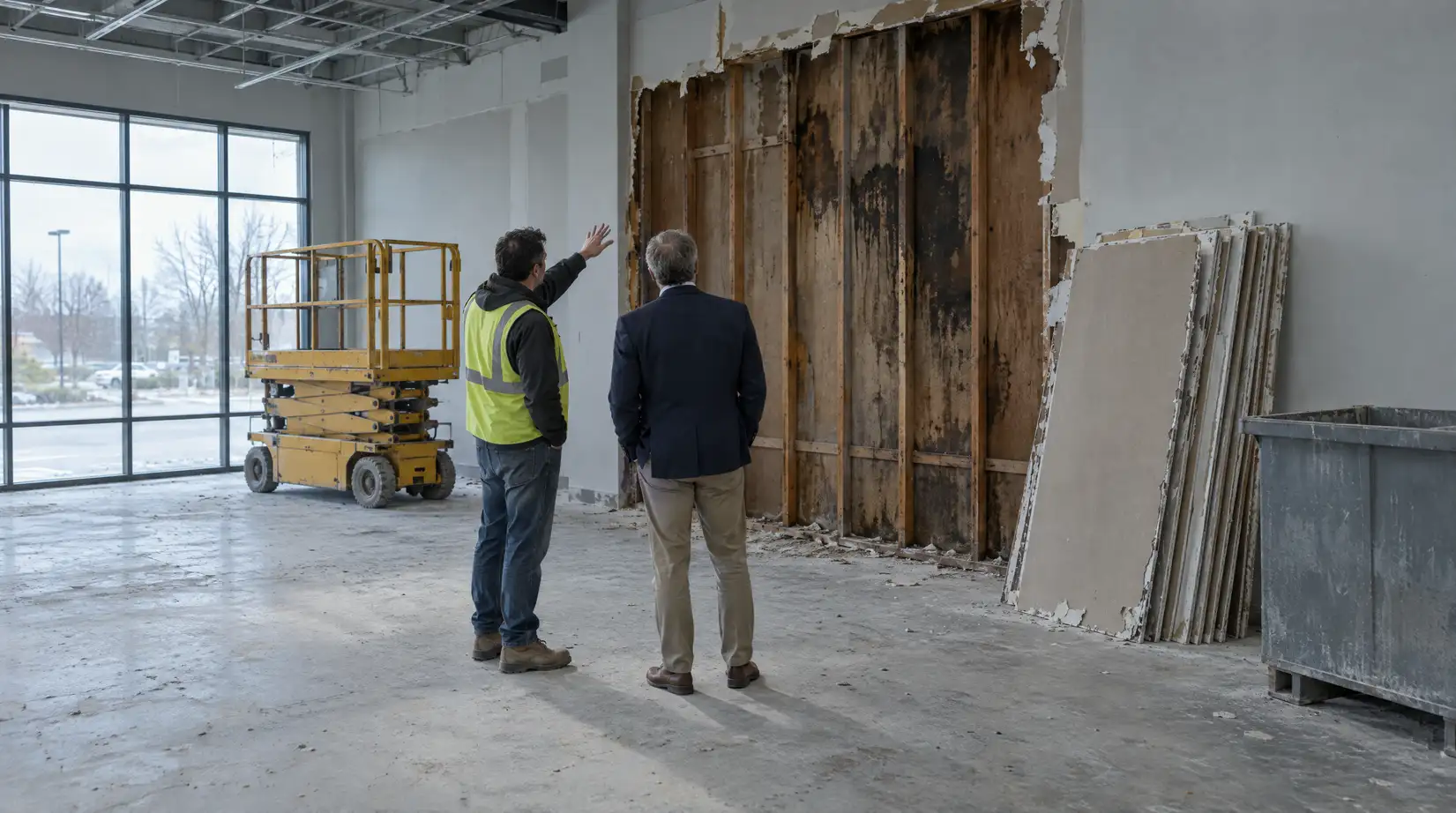
Hidden structural damage is the second driver worth flagging separately. Moisture intrusion, framing issues, or mechanical damage that was not visible during the initial inspection can surface once demolition or repair work begins — and state regulator guidance is explicit that a policyholder can file a supplemental claim when additional damage is discovered or when repairs cost more than anticipated [2].
For commercial properties carrying business interruption coverage, a longer-than-anticipated repair timeline driven by this hidden damage can also justify recalculating the interruption period itself, since the original claim closure may have assumed a shorter downtime than what actually occurred.
Building the Documentation Package to Reopen Your Claim
Successfully reopening an underpaid claim generally starts with a formal written request that references the original claim number — state regulator guidance and United Policyholders’ sample claim letters both point to the same package [2] [3]:
- New, itemized contractor repair estimates reflecting current scope and material costs [2]
- Independent appraisals or expert reports addressing newly discovered damage, such as structural or moisture issues [2]
- Timestamped photo and video evidence documenting the condition of the property [2]
Commercial property owners should treat the expert report and photo documentation as equally essential — a reopening request built on contractor pricing alone, without independent evidence of what changed, gives the carrier less reason to revisit its original decision.
Using the Appraisal Clause When the Carrier Won’t Reopen
If the carrier declines to reopen the file despite a complete documentation package, the dispute at that point is almost always about the dollar amount of loss rather than whether coverage exists at all — which is precisely the scenario an appraisal clause is built to resolve.
Most property insurance policies contain wording that allows disputes over the amount or value of a loss to be resolved through appraisal — an alternative dispute resolution process built for valuation disagreements. Whether the loss is covered is a separate issue that appraisal generally does not decide [4].
A prior payment or a closed file does not by itself convert an amount-of-loss disagreement into a coverage dispute — but whether appraisal remains available and timely on a closed claim depends on the policy’s appraisal language and governing state law [4].
For contractors and commercial property owners who have already built a strong documentation package, appraisal can offer a faster path to resolution than litigation, since it keeps the dispute focused narrowly on valuation [4].
Frequently Asked Questions
Can a commercial insurance claim be reopened after it’s closed?
Whether a claim can be reopened depends on state-specific insurance law and the specific policy’s terms, not a universal ‘most cases’ rule [2]. New evidence of underpayment or previously undiscovered damage typically strengthens a reopening request.
How long do I have to reopen an underpaid commercial claim?
Most policies set a one-year lawsuit-filing deadline measured from the date of loss, but this is a contractual term that state law can extend [1]. In many states, that clock is also paused while the claim is being actively adjusted and may restart from the date of closure or denial, so confirming your specific timeline with an attorney is strongly advised [1].
What documentation do I need to reopen a closed commercial claim?
You’ll need a formal written request citing the original claim number, along with updated itemized contractor estimates, expert reports on any newly discovered damage, and timestamped photo or video evidence [2]. Assembling this package before contacting the carrier gives the reopening request a stronger foundation.
What if the insurer refuses to reopen my claim?
If the carrier won’t reopen the file but the disagreement is purely about the dollar value of the loss, the appraisal clause in most property policies allows either party to invoke a formal valuation dispute process [4]. Whether it remains available on a claim the insurer treats as closed depends on the policy language and state law — the threshold question is whether the dispute is over the amount of loss, not coverage [4].
Protect Your Scope Before the Deadline Passes
If you’re a contractor or commercial property owner staring at a closed file that paid less than the actual repair cost, the path forward starts with two questions: did anyone sign a release, and how much time is left on the lawsuit clock in your state. From there, the documentation package — updated pricing, expert findings on hidden damage, and dated visual evidence — is what turns a reopening request into a serious challenge the carrier has to engage with. We don’t replace your assessment of the job; we back it, so you can protect your scope and your reputation while getting paid without the chase.
Not sure whether your policy’s appraisal clause or lawsuit deadline still leaves room to challenge the settlement? Upload your policy to Justin for a free analysis — we’ll find the clauses that matter, explain what they mean, and tell you exactly what to do next.
This content is for informational purposes only and does not constitute legal or insurance advice. Coverage decisions depend on the specific terms, conditions, and exclusions of each policy and the laws of the applicable jurisdiction; policyholders and contractors should consult with a qualified professional for advice on their particular situation.
Sources
[1] Lawsuit Limitations in Insurance Policies — United Policyholders
[3] Sample Letters and Claim Documents — United Policyholders

Taylor Bezek

As the General Manager at JustClaims, Taylor Bezek brings over a decade of experience managing complex residential, commercial, and large-loss claims. A licensed Public Adjuster in TX (#2125659), FL (#W455048), CO (#769172), and 10 additional states, Taylor founded his own firm before joining JustClaims to scale a tech-forward solution for the insured. He is committed to combining industry expertise with AI to enhance speed, clarity, and outcomes for every policyholder. Taylor's mission is to modernize the public adjusting profession and ensure owners get exactly what they are entitled to.