Roofing Supplements: Maximize Insurance Claims in 2026

August 19, 2026
Written by Collin Corcoran
Share


When an insurer’s first estimate misses part of the job, the missing cost doesn’t disappear — it just goes unbilled. A roofing supplement is how contractors and property owners put those costs back on the record: additional line items, backed by photos, measurements, and code references, submitted after the initial scope of loss. For a contractor, that gap is frequently the line between an unprofitable job and a fairly compensated one. For a property owner, it can be the difference between a code-correct rebuild and paying the shortfall out of pocket.
Key Takeaways
- What isn’t listed isn’t paid: United Policyholders warns that if an item is not listed in the estimate, the cost for it will not be in the final estimate total — which is exactly what makes the supplement step matter.
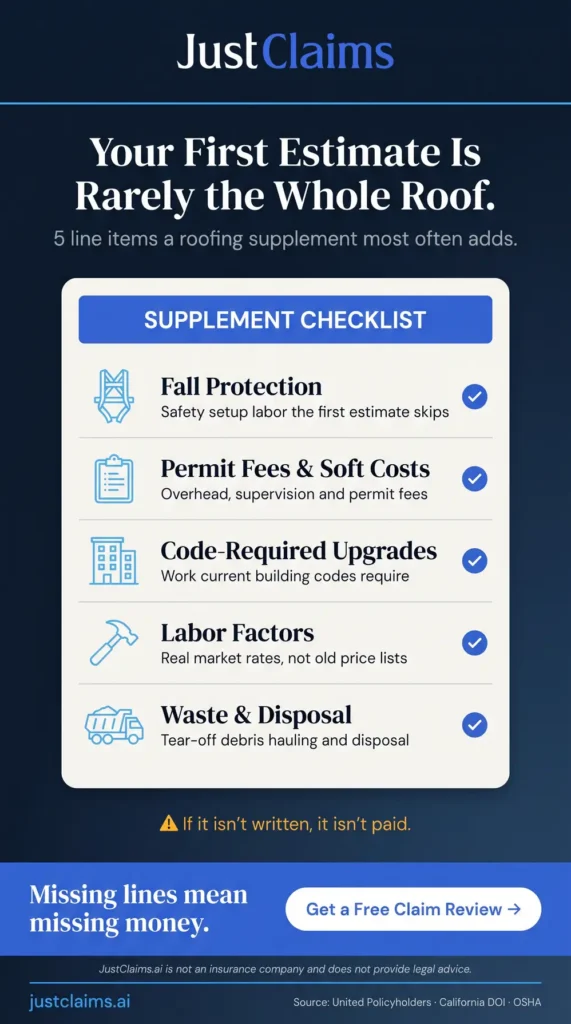
- Commonly missed items: Fall protection, permit fees and soft costs, code-required upgrades, labor pricing factors, and waste allowances are among the items worth checking before a claim closes.
- Regulator-backed basics: The California Department of Insurance advises getting written, line-by-line bids from licensed contractors — and notes that if additional damage is discovered later, a claim can generally be reopened and additional compensation requested.
What Are Roofing Insurance Supplements?
A roofing supplement is an additional line item — or set of line items — submitted after an insurer’s initial estimate to account for materials, labor, or code requirements that were not captured in the first scope of loss. Supplements are not a renegotiation of the claim itself; they are a correction to an estimate that missed something the carrier’s adjuster did not see, measure, or account for during the initial inspection. That correction step matters because of a simple rule of the claims process: if an item is not listed in the estimate, the cost for it will not be in the final estimate total [1]. And first estimates do miss things — the California Department of Insurance notes that when an adjuster cannot complete a thorough inspection due to time constraints, they may have to “scope the loss”: a brief inspection of the damage, with a second visit necessary to complete it [2]. For contractors, filing a well-supported supplement is less about disputing the carrier’s judgment and more about closing the distance between what was written down and what the job actually requires.
Documentation That Supports a Supplement Request
Adjusters and carriers respond to specifics — clear photos, measurements, and material references tied to a defined location on the roof — not general assertions that “more was needed.” That documentation-first approach is exactly what regulators and consumer advocates recommend: the NAIC tells homeowners filing a claim to make a list of all damaged property, take photos and videos of the damage, and keep receipts as proof [3], and United Policyholders’ guidance on supplemental claim packages calls for a line-by-line itemized report showing unit prices, measurements, quantities, and qualities — supported by contractor estimates, receipts, and photographs [4]. A supplement package that pairs each requested line item with a photo, a measurement, and a code or manufacturer reference gives the adjuster a defensible basis for approving the added cost.
Strong supplement documentation typically includes:
- Dated photos of the specific area or component being supplemented, taken during tear-off or inspection
- Measurements or quantities tied to the roof plan, not estimated totals
- Manufacturer specifications or local code citations supporting the requirement
- A clear line-item breakdown showing material, labor, and any applicable factors separately
Timing matters: the California Department of Insurance notes that under most circumstances, if additional damage is discovered later, you can “reopen” the claim and request additional compensation — but you must notify your insurer immediately upon the discovery of the additional damage. If the reopened claim still stalls, the insurance policy appraisal clause is the escalation sitting inside the policy. [2].
The 5 Line Items Contractors Should Check Before Closing a Claim
United Policyholders reports that the most common problems with estimates of loss are scope omissions or scope errors — and anything left out of the estimate stays out of the final total [1]. Contractors regularly flag items like drip edge and ice-and-water shield during tear-off when the original scope did not account for code-driven materials, and the five categories below are the ones that most often justify a second look before a claim closes.
1. Fall Protection and Safety Setup
Fall protection is not an optional add-on — it is a federal safety requirement with a real cost. OSHA requires that each employee engaged in residential construction activities 6 feet or more above lower levels be protected by guardrail systems, safety net systems, or personal fall arrest systems, and that each employee on a steep roof be protected by guardrail systems with toeboards, safety net systems, or personal fall arrest systems [5]. The equipment, setup time, and labor those systems require are a legitimate cost of performing the work safely — and because none of it shows up in a roof measurement report, safety setup is one of the easiest items for a first-pass estimate to leave out.
2. Permit Fees and Soft Costs
Building permits, city fees, and other project “soft costs” are real costs that an initial estimate can omit entirely. United Policyholders’ guidance on reviewing adjuster estimates lists soft costs such as building permits and city fees among the items to look for — and advises asking the adjuster about them if they are not listed [1]. Where the local jurisdiction requires a permit for the work, the fee is a legitimate item to include in the supplement documentation.
3. Code-Required Upgrades
Building codes change over time, and repairs generally have to meet the code in force today — not the code in force when the roof was built. The California Department of Insurance cautions that unless a policy includes “ordinance or law” coverage, an owner can face non-reimbursable expenses to rebuild in compliance with present codes. When the rebuild does trigger code compliance upgrades, the difference between covered and uncovered belongs in the supplement. [2]. United Policyholders notes that commonly required upgrades can include roofs themselves — and that breaking out and separately documenting code upgrades is often required to reach agreement with an insurance company adjuster [6]. That makes code-required items a legitimate supplement category when they are specifically cited and documented.
4. Labor Factors
The estimating program most commonly used by adjusters runs off a cost database of unit labor and material prices — so the labor side of an estimate is only as accurate as the price list and market assumptions behind it. Knowing how Xactimate estimating builds that database tells you which line items to challenge. United Policyholders recommends checking which regional price list the adjuster used, making sure it is not based on old cost data, and asking whether the estimate accounts for abnormal market conditions, such as the price pressure that follows a major loss event [1]. Steep-slope work, multi-layer tear-off, and complex roof geometry all change the labor a job actually requires; when the first estimate doesn’t reflect them, that difference is a legitimate supplement item.
5. Waste and Disposal Costs
Removing and disposing of old roofing material carries a real cost that scales with tear-off volume. Waste allowances are a documented pressure point: United Policyholders notes that waste factors for materials including roofing should be evident in an estimate’s quantities, warns that waste factors can be hidden inside other line items, and advises asking the adjuster how much waste is included in all quantities [1]. If the estimate’s waste and disposal assumptions don’t match the actual tear-off, that difference belongs in a supplement.
Submitting Supplement Requests to Adjusters
The California Department of Insurance advises homeowners to get written bids from reliable, licensed contractors — with materials detailed and prices listed line by line — so a supplement submission should be built to withstand that same level of scrutiny [2]. A supplement request is generally strongest when it is itemized clearly, references the specific code or manufacturer standard behind each added cost, and is submitted promptly — ideally during tear-off, when the missing scope is discovered. That timing isn’t just practical: if additional damage is discovered later, a claim can generally be reopened and additional compensation requested, but the insurer must be notified immediately upon discovery [2]. Adjusters are more likely to engage with a request that reads as a correction supported by evidence than one that reads as a broad request for more money. Framing each line item around a defined cause — a code requirement, a safety requirement, or a measured quantity — gives the adjuster a clear basis for approval and reduces back-and-forth requests for clarification.
Frequently Asked Questions
What is a roofing insurance supplement?
A roofing insurance supplement is an additional line item submitted to an insurance carrier after the initial claim estimate, correcting for materials, labor, or code requirements that were left out of the first scope of loss. It is typically supported by photos, measurements, and code or manufacturer references tied to the specific item being added.
Why do adjusters often miss line items like fall protection or waste disposal?
Time constraints are part of it: the California Department of Insurance describes how an adjuster who cannot complete a thorough inspection may have to “scope the loss” — a brief inspection, with a second visit needed to finish it [2]. United Policyholders adds that the most common problems with estimates of loss are scope omissions or scope errors — job-specific costs like safety setup or waste disposal that only become fully visible once tear-off begins [1].
When should a contractor submit a supplement request?
As soon as the missing item is discovered — ideally during tear-off, not after the job is complete or the claim has closed. The California Department of Insurance notes that when additional damage is discovered later, a claim can generally be reopened and additional compensation requested, but the insurer must be notified immediately upon discovery [2]. United Policyholders similarly recommends getting supplemental documentation organized and submitted as soon as practical [4]. Submitting early, with clear photo and measurement support, gives the adjuster a defined basis to approve the added cost before the file is finalized.
Do property owners need to review contractor-submitted supplements?
Yes. The California Department of Insurance advises homeowners to get written bids from reliable, licensed contractors — with bids that detail materials and list prices line by line — and to beware of contractors who encourage heavy spending on temporary repairs [2]. The NAIC’s guidance is similar: don’t feel rushed or pushed to agree with something you aren’t comfortable with when it comes to repairs [3]. Clear, itemized documentation benefits both the property owner and the contractor by keeping the request grounded in verifiable facts rather than assumptions.
How to Strengthen Your Next Supplement Claim
Building a documentation habit around photos, measurements, and code references at the time of tear-off, rather than after the job closes, gives every supplement request a stronger foundation with the adjuster. If your insurance claim was denied or underpaid, JustClaims’ expert team — accelerated by our policy AI reviewer — reviews the policy language, compares it against your documentation, and flags likely underpayments so you can go back to the carrier with confidence.
This content is for informational purposes only and does not constitute legal or insurance advice. Coverage decisions depend on the specific terms, conditions, and exclusions of each policy and the laws of the applicable jurisdiction; policyholders and contractors should consult with a qualified professional for advice on their particular situation.
Sources
[1] Guidelines For Reviewing Adjusters’ And Contractors’ Estimates — United Policyholders
[2] Residential Property Claims Guide — California Department of Insurance
[4] NFIP Proof of Loss, Damage Estimates and Supplemental Claims — United Policyholders
[5] 29 CFR 1926.501 — Duty to Have Fall Protection — Occupational Safety and Health Administration
[6] Building Code, Ordinance or Law Compliance — United Policyholders

Collin Corcoran

Experienced Public Adjuster and Property Claims Specialist, Collin is licensed in New York (#1603393), New Jersey (#3003700204), and Connecticut (#19820270). With 20+ years of hands-on construction and property damage experience, he specializes in residential and commercial claims, complex loss inspections, policy review, detailed estimating, and strategic negotiation. Collin’s background in construction, asset management, emergency response, and claims documentation allows him to accurately identify damage, understand repair requirements, and advocate effectively for policyholders. He works with homeowners, business owners, contractors, and insurance professionals to move claims forward with clarity, accuracy, and confidence. Collin is committed to transparency, technical precision, strong communication, and securing fair outcomes for policyholders.