Actual Cash Value Formula: Calculate ACV & Depreciation
October 07, 2026
Written by Stephane Elias
Share


An insurer’s actual cash value payment is the cost to replace damaged property minus depreciation, and that gap can leave a property owner short of what repairs actually cost. The NAIC notes that ACV coverage “often does not pay enough to fully replace your property or repair the damage.” Knowing the formula helps you read an estimate line by line.
Key Takeaways
- ACV formula: Actual cash value is the cost to repair or replace the property, minus depreciation.
- Regulator definition: The North Carolina Department of Insurance defines ACV as the money needed to fix your home, minus the decrease in value from age or use.
- What drives depreciation: The NAIC says ACV accounts for the age and wear and tear of the property.
- Payout risk: The NAIC says ACV coverage often does not pay enough to fully replace your property or repair the damage.
- RCV standard: Replacement cost value coverage pays to repair or replace damaged property with materials of like kind and quality.
- Recoverable depreciation: The NAIC says insurers pay withheld depreciation — the difference between replacement cost and ACV — once you show evidence repairs are complete, usually within a 6-month to 1-year window.
The Actual Cash Value Formula Explained
Actual cash value is the number that often determines whether a claim payment covers the real cost of repairs. The calculation is short, but each input can be disputed.
The Core Formula
The Louisiana Department of Insurance states the formula directly: “Actual Cash Value (ACV) is the cost to repair or replace your damaged or destroyed property, minus the depreciation” [1]. The NAIC describes the same calculation: ACV coverage pays the cost to repair or replace your property based on its value, considering its age and wear and tear — the depreciation [2].
In plain terms:
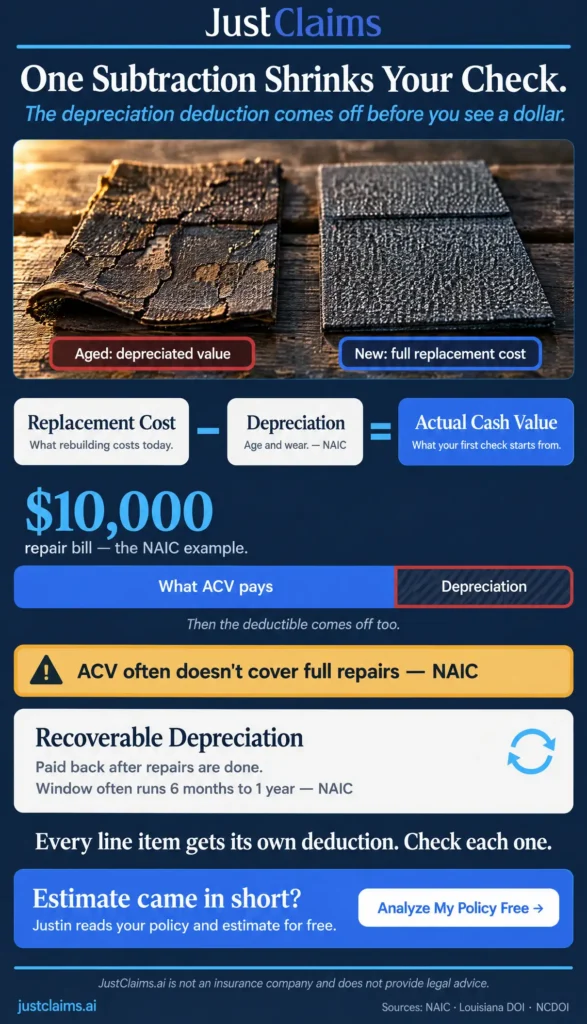
ACV = Replacement Cost Value − Depreciation
How Regulators Define It
The North Carolina Department of Insurance defines ACV as the amount of money needed to fix your home, minus the decrease in value of your property because of age or use [3].
The NAIC, the standard-setting body for state insurance regulators, says ACV coverage pays to repair or replace property based on its value after accounting for age and wear and tear [2]. Both definitions point to the same two inputs: a replacement cost figure and a depreciation deduction. Either one can be too low or too high.
How Adjusters Determine Depreciation
Because depreciation is the main adjustment applied to replacement cost, it is one place where an ACV payment can shrink. The NAIC identifies age and wear and tear as the factors insurers consider when setting ACV [2], and the NAIC says the insurer considers the age and condition of the home when paying under ACV [2].
Whether any of that withheld depreciation comes back after repairs is a big part of whether you get your full payout.
In practice, property owners can expect an estimate to reflect questions like these:
- Age: How old was the damaged item or building component when the loss occurred?
- Condition: Was the item well maintained, or already showing wear?
- Use: The North Carolina Department of Insurance explicitly cites decreased value from age or use [3].
Depreciation is applied item by item in many estimates. Check whether each line shows its own age, condition, and deduction. A blanket deduction with no explanation is a reasonable thing to question.
A Step-by-Step ACV Calculation
The NAIC uses a $10,000 home damage example to show how the two coverage types differ [2]. The steps below follow that same figure without inventing a depreciation amount, so you can substitute the numbers from your own estimate.
1. Find the replacement cost. In the NAIC example, the damage costs $10,000 to repair or replace [2].
2. Identify the depreciation. Locate the deduction the insurer applied for age and condition. This is the number to scrutinize.
3. Subtract depreciation from replacement cost. That result is the actual cash value [1].
4. Subtract your deductible. The NAIC notes that payment under both coverage types is figured minus the deductible [2].
5. Compare the result to your repair bids. If the payment cannot cover the work, the depreciation figure or the replacement cost estimate may need review.
Under RCV coverage in the same example, the payment is the full $10,000 repair cost minus the deductible [2]. Under ACV, the payment starts lower because of the depreciation step.
ACV vs. Replacement Cost Value
Because the depreciation step is what separates a full repair budget from a shortfall, the type of coverage on your policy matters. The NAIC contrasts the two this way [2]:
| Feature | Actual Cash Value (ACV) | Replacement Cost Value (RCV) |
|---|---|---|
| Basis of payment | Value after accounting for age and wear and tear | Cost to repair or replace with like kind and quality |
| Role of age and condition | Considered when determining payment | Not the basis of the payment |
| Deductible | Subtracted from payment | Subtracted from payment |
| Adequacy for full repair | Often does not pay enough to fully replace or repair | Designed to pay for like kind and quality materials |
Review your declarations page and policy language to see which valuation method applies to your dwelling and to your personal property. The two can differ.
It is also worth checking whether your coverage limits still match your property’s value, since rising rebuild costs change both numbers over time.
Recoverable Depreciation and Low Valuations
Since an ACV figure is only as accurate as its inputs, a low estimate is not necessarily the final word. Two issues deserve attention: whether withheld depreciation can be paid later, and how to question a valuation.
Recoverable Depreciation
The NAIC defines recoverable depreciation as the difference between an item’s replacement cost and its actual cash value [4]. When you present evidence that the damaged property has been repaired or replaced, the insurer will pay that difference, up to the replacement cost [4]. There is usually a time limit: the NAIC says it can range from 6 months to up to one year, depending on your state’s laws and your policy [4].
Which rules apply depends on your policy terms, so read the loss settlement provisions and ask your insurer in writing how depreciation is treated, what documents it requires, and any deadline for claiming it. Keep invoices and receipts — proof of completed repairs is what supports a request for withheld funds.
Challenging a Low Valuation
Treat the first estimate as a starting point rather than a final figure. Property owners can take these steps:
- Request the full estimate: Ask for an itemized breakdown showing replacement cost and depreciation for each line.
- Check the inputs: Compare the age and condition the insurer assumed against your own records and photographs.
- Get independent bids: Contractor estimates can help show whether the replacement cost figure matches local repair pricing.
- Put your dispute in writing: Identify specific line items, explain why the depreciation seems too high, and attach supporting documents.
The NAIC’s warning that ACV often falls short of full repair cost [2] is a reason to compare any payment against actual bids before accepting it. If the gap persists after that comparison, invoking the appraisal clause puts the valuation in front of independent appraisers.
Frequently Asked Questions
What is the formula for actual cash value?
Actual cash value is calculated by taking the replacement cost of the damaged property and subtracting depreciation [1]. The NAIC describes the same approach: payment based on the property’s value after age and wear and tear are taken into account [2].
How is ACV different from replacement cost value?
Replacement cost value coverage pays to repair or replace damaged property with materials of like kind and quality. ACV coverage instead looks at the age and condition of the property, which usually produces a smaller payment [2].
What factors reduce the value of my property under ACV?
Insurers account for age and wear and tear when setting the ACV amount [2]. The North Carolina Department of Insurance also points to decreases in value from use [3], so older or heavily used items typically see larger deductions.
Can an ACV payment fall short of my repair costs?
Yes. The NAIC says ACV coverage often does not pay enough to fully replace your property or repair the damage [2]. Comparing the payment to contractor bids shows whether a gap exists.
How to Verify What You Are Owed
Because the ACV formula has only two inputs, you can check an estimate by confirming the replacement cost, examining each depreciation deduction, and subtracting the deductible. Ask your insurer for an itemized breakdown, gather records of age and condition, and compare the payment to independent repair bids before you accept it.
Upload your estimate and policy to Justin — the free insurance policy analyzer built by the public adjusters at JustClaims — to review how depreciation was applied and flag line items that may be undervalued.
This content is for informational purposes only and does not constitute legal or insurance advice. Coverage decisions depend on the specific terms, conditions, and exclusions of each policy and the laws of the applicable jurisdiction; policyholders and contractors should consult with a qualified professional for advice on their particular situation.
Sources
[1] Catastrophe Claims Process Disclosure Guide — Louisiana Department of Insurance
[2] What’s the Difference Between Actual Cash Value Coverage and Replacement Cost Coverage? — NAIC
[3] Actual Cash Value vs. Replacement Cost Value — North Carolina Department of Insurance

Stephane Elias

A seasoned insurance professional with nearly a decade of experience, Stephane Elias is currently serving as a Senior Claims Professional and Public Adjuster with JustClaims. Throughout his career, Stephane has represented policyholders through leading public adjusting firms and served as a loss consultant for law firms specializing in insurance litigation, giving him extensive expertise in complex property insurance claims. A licensed public adjuster in TX (#2645032), FL (#W564547), and six other states, he specializes in commercial and residential property claims, claims management, appraisals, mediation, and strategic partnerships. Stephane is passionate about helping policyholders overcome delayed, denied, and underpaid insurance claims, ensuring they receive the full recovery they’re entitled to under their policy.