Actual Loss Sustained: Business Income Coverage 2026

September 28, 2026
Written by Collin Corcoran
Share


Because commercial property policies pay only the actual loss of income a business can prove — not a pre-agreed value — a single overlooked expense or misclassified cost can strip significant recovery from a legitimate business interruption claim. Actual Loss Sustained (ALS) coverage shifts the entire burden of proof onto the policyholder, and complex claims require forensic-level analysis to reconstruct what would have happened absent the loss. Property owners who treat this calculation as a formality routinely leave money on the table.
Key Takeaways
- What it is: Actual Loss Sustained is the standard valuation basis in the ISO Business Income (and Extra Expense) Coverage Form CP 00 30.
- What it pays: The net income that would have been earned had no loss occurred, plus continuing normal operating expenses such as payroll.
- Who bears the burden: Courts place the burden of proving the amount of loss actually sustained on the insured, not the insurer.
- How it’s calculated: Revenue the business did not make, minus expenses that did not continue, plus extra expenses — or built the other way: forecast net income, plus continuing expenses, plus extra expenses.
- Recovery window: Coverage is limited to the “period of restoration.”
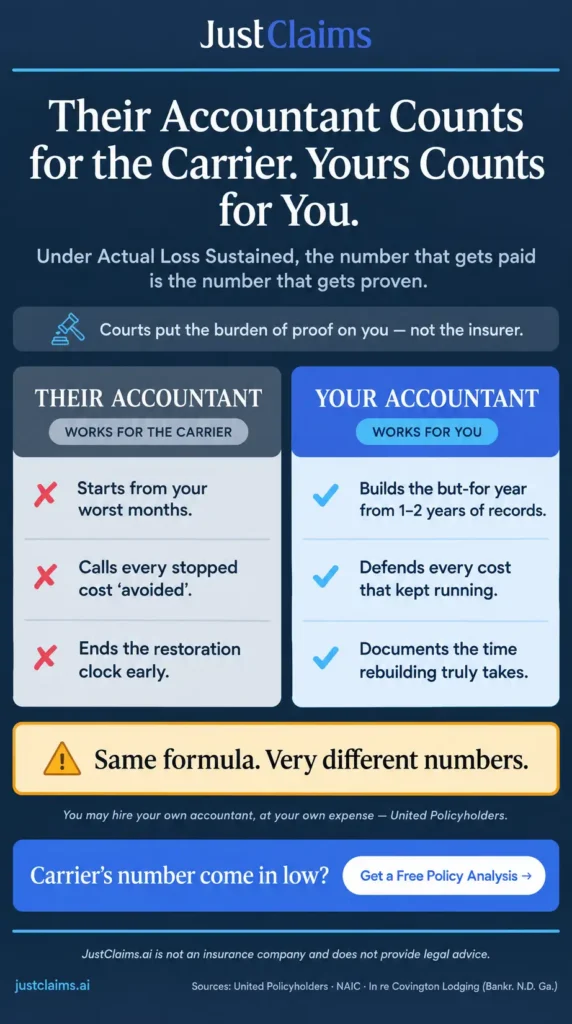
- Who calculates it: Policyholders have the right to hire their own accountant — including a forensic accountant — independent of the carrier’s accountant.
What Actual Loss Sustained Means for Business Income Claims
Actual Loss Sustained is the valuation method built into the ISO Business Income (and Extra Expense) Coverage Form CP 00 30 — the standard business income form used in commercial property policies — and it pays out only after a covered suspension of operations [1][3].
Under this basis, the carrier pays the net income — net profit or loss before income taxes — that would have been earned had no loss occurred, along with continuing normal operating expenses such as payroll, but only for the period of restoration [1][2]. The companion extra expense coverage form is what pays for the costs of keeping that interruption short — temporary space, expedited repairs, overtime labor.
Unlike a flat payout, this figure has to be reconstructed after the fact — and courts place the burden of proving both coverage and the amount of the loss on the policyholder, not the insurer [2]. That single distinction is why the calculation deserves as much attention as the underlying property damage claim itself.
Actual Loss Sustained vs. Valued Policy Provisions
Because ALS ties recovery to proof rather than a pre-set number, understanding how it differs from a valued policy matters directly to how much a business owner can ultimately recover. Valued policy laws fix the payout in advance: after a covered total loss, the insurer owes the amount stated in the policy — the value the parties agreed on when the policy was written [4][5].
An open policy works the other way — the measure of indemnity is what replacing the lost property actually costs the insured, established after the loss [6]. Business income coverage itself can be written on that predetermined basis — an agreed value option — but the default is actual loss sustained [1].
Under ALS, the policyholder must demonstrate, through financial data, what net income and continuing operating expenses — including payroll and other costs that kept accruing while revenue stopped — would have looked like without the interruption [1][7].
Property owners who assume their business income coverage works like a valued policy often underestimate how much documentation the claim actually demands. A current statement of values gives that documentation its fixed starting point — agreed building values the income calculation can anchor to before any dispute over numbers begins.
The Business Interruption Loss Calculation Formula
Because minor valuation errors compound quickly under ALS, the formula forensic accountants use to build the loss figure deserves close scrutiny from property owners before any number is finalized. Forensic accountants generally follow a three-part sequence to arrive at the recoverable amount [1].
1. Establish Projected (But-For) Revenue
The first step estimates what revenue the business would have generated had the loss never occurred, using historical financial performance — typically one to two years of pre-loss results — as the baseline [1][7].
2. Subtract Actual Revenue to Find Lost Revenue
That projected figure is then compared against what the business actually earned during the interruption, with the difference representing lost revenue [1].
3. Subtract Avoided Expenses to Find Lost Profit
Finally, expenses the business avoided because it was not operating normally are subtracted from lost revenue to produce the lost profit — and after adding any extra expenses, the result is the total business interruption loss [1]. Each step in this chain is a place where a disputed assumption — about growth trends, seasonality, or which costs truly continued — can swing the final number substantially.
Period of Restoration and Recovery Limits
Because coverage under ALS is capped by time rather than a fixed dollar figure, the period of restoration determines how much of the reconstructed loss a policyholder can actually collect. Recovery is limited to the actual loss of business income sustained during the necessary suspension of operations, measured against that restoration window [1][2].
If the reconstructed loss period runs longer than the carrier’s assessment of the restoration period, or if the two sides disagree on when normal operations should have resumed, the dollar gap between projected and actual recovery can be significant. Determining a reasonable period to rebuild is a frequent source of dispute between policyholders and insurers — rebuilding, like any construction project, often takes longer than expected for reasons outside the policyholder’s control [7].
When the carrier treats its own restoration estimate as final and closes the file anyway, that documented disagreement is exactly what supports a request to reopen a closed commercial insurance claim.
Financial Record-Keeping That Supports Your Claim
Policyholders have the right to engage their own accountant — including a forensic accountant, at their own expense — to calculate the loss and to work with the adjuster and the carrier’s accountant, but that independent calculation is only as strong as the underlying data supporting it [7].
Detailed profit-and-loss statements, payroll records, and sales records covering at least one to two years before the loss — plus expense ledgers for the interruption period — give an accountant the material needed to defend projected revenue assumptions and continuing expense classifications [7].
Businesses that maintain organized, granular financial records before a loss occurs are far better positioned to support a defensible ALS calculation than those reconstructing records after the fact. The same discipline drives the physical side of the file — the large-loss documentation requirements that commercial fire claims impose track the financial chain line for line.
Frequently Asked Questions
What is Actual Loss Sustained in a business income policy?
Actual Loss Sustained is the valuation approach used in standard ISO business income forms, under which the insurer pays the net income and continuing operating expenses the business would have realized absent the loss, limited to the period of restoration [1][2]. It requires financial reconstruction rather than a pre-agreed payout figure.
How does Actual Loss Sustained differ from a valued policy?
A valued policy pays a stated amount agreed when the policy is written [4][5], while ALS coverage requires the policyholder to establish the specific dollar amount of income and expenses lost using financial data [1][6]. This means the recoverable amount under ALS is not fixed until it is calculated and supported with documentation.
Who is responsible for calculating the business interruption loss?
The insured bears the burden of proving the amount of the loss, and courts have upheld that responsibility falls on the policyholder rather than the carrier [2]. Many businesses engage a forensic accountant to build the calculation using projected revenue, actual revenue, and avoided expense data [1][7].
What is the period of restoration and why does it limit recovery?
The period of restoration is the timeframe during which the business income loss is measured, and recovery under ALS is confined to that window [1]. Disagreements over when this period should end are a common source of dispute between policyholders and carriers [7].
Can I hire my own accountant to calculate the loss?
Yes — policyholders have the right to retain their own accountant, at their own expense, to calculate the business interruption loss and to work with the adjuster and the insurer’s accountant [7]. Having an independent calculation can help identify assumptions or expense classifications the carrier’s figures may have missed.
Does Actual Loss Sustained have a limit?
Yes — the most the insurer will pay in any one occurrence is the Limit of Insurance shown in the policy’s Declarations, and payment is confined to the period of restoration [1]. The limit is a ceiling on recovery, not a guaranteed payout amount.
Build a Defensible Business Income Claim
Actual Loss Sustained coverage puts the reconstruction burden squarely on the policyholder, and every assumption in that reconstruction — from projected revenue trends to which expenses actually continued — can move the final recovery figure by a meaningful margin. Property owners who understand the calculation formula, track the period of restoration closely, and maintain detailed financial records going into a loss are far better equipped to support a defensible number when the carrier’s adjuster pushes back.
Before you accept the carrier’s number, get a free AI policy analysis from Justin — it reads your actual business income language and shows how the payout formula applies to your policy. Then let JustClaims’ expert team — accelerated by our bespoke AI — turn that into a defensible loss figure the carrier has to answer to.
This content is for informational purposes only and does not constitute legal or insurance advice. Coverage decisions depend on the specific terms, conditions, and exclusions of each policy and the laws of the applicable jurisdiction; policyholders and contractors should consult with a qualified professional for advice on their particular situation.
Sources
[4] Florida Statutes § 627.702 — Valued Policy Law — The Florida Senate
[7] Getting (Back To) Business Interruption Insurance — United Policyholders

Collin Corcoran

Experienced Public Adjuster and Property Claims Specialist, Collin is licensed in New York (#1603393), New Jersey (#3003700204), and Connecticut (#19820270). With 20+ years of hands-on construction and property damage experience, he specializes in residential and commercial claims, complex loss inspections, policy review, detailed estimating, and strategic negotiation. Collin’s background in construction, asset management, emergency response, and claims documentation allows him to accurately identify damage, understand repair requirements, and advocate effectively for policyholders. He works with homeowners, business owners, contractors, and insurance professionals to move claims forward with clarity, accuracy, and confidence. Collin is committed to transparency, technical precision, strong communication, and securing fair outcomes for policyholders.