Best Public Adjusters for Fire Damage Claims: 2026 Guide
October 05, 2026
Written by Taylor Bezek
Share


Valuation errors on large commercial losses can add up to significant amounts, and complex claims often benefit from detailed technical analysis. A public adjuster is hired by the policyholder, not the insurer, and the strongest candidates combine a verified license, transparent fees, and the ability to document smoke damage and coverage gaps.
Key Takeaways
- Who a public adjuster works for: A public adjuster is hired by the policyholder to negotiate with the insurance company.
- License verification (Texas): The Texas Department of Insurance Help Line, 800-252-3439, can confirm whether an adjuster is licensed.
- Fee negotiability: The Illinois Department of Insurance says all public adjuster fees can and should be negotiated.
- Fee format option: The Texas Department of Insurance says you can ask for the fee as a dollar amount in the contract instead of a percentage.
- Typical fee structure: Public adjusters typically charge a percentage of the claim proceeds.
- Insurer-side adjusters: An independent adjuster is hired by the insurance company and represents the insurer’s interests.
Why Fire Claims Require Specialized Expertise
The visible char is rarely the full loss. Smoke, soot, water from suppression, and code-driven rebuild requirements all feed into the final number. The carrier’s adjuster is hired and paid by the insurer and represents the insurer’s interests, so the policyholder’s own advocate matters from the start [1].
Structural Damage Versus Cosmetic Damage
The line between structural and cosmetic damage often decides how large a settlement becomes. Structural damage involves load-bearing elements, framing, roof assemblies, electrical systems, HVAC equipment, and fire protection systems. Cosmetic damage is limited to surface finishes such as paint, flooring, and ceiling tiles.
A scope that labels heat-exposed components as cosmetic may support cleaning or repainting where replacement is warranted. A qualified adjuster pushes for the evidence that separates the two, such as engineering assessments and component-level inspection, rather than accepting a visual walk-through.
Hidden Smoke and Soot Damage
Smoke does not stay where the fire burned. Residue can travel through wall cavities, ductwork, ceiling plenums, insulation, and electronic equipment in areas that look untouched. Some residues can also corrode metals and electronics over time, so damage may surface well after the first inspection [2].
Property owners should ask any adjuster they consider how they document hidden smoke damage. Look for a plan that includes testing, qualified specialists, and a written scope covering spaces the carrier’s initial estimate overlooked.
On a large commercial fire, the documentation requirements for a large-loss fire claim are more demanding still, so ask to see that scope in writing before the carrier’s version becomes the baseline.
Displacement and Business Interruption Costs
For a commercial owner, displacement and lost income can be a significant financial exposure. Lost revenue, extra expense to operate from temporary space, and delays tied to permitting and reconstruction all depend on how the policy’s Business Interruption provisions are read and how the restoration timeline is estimated.
Law & Ordinance coverage is another common gap. When local codes require upgrades during reconstruction, the policy’s ordinance or law provisions determine whether those costs are paid. An adjuster who understands these provisions can help you see whether the claim reflects the real cost to restore operations, not just the cost to repair what burned.
The 5 Traits That Separate Top Fire Claim Adjusters
Because small errors in scope and valuation compound on a large fire loss, the traits below are the practical filters for choosing who handles your claim. Each one can be checked before you sign anything.
1. An Active License in Good Standing
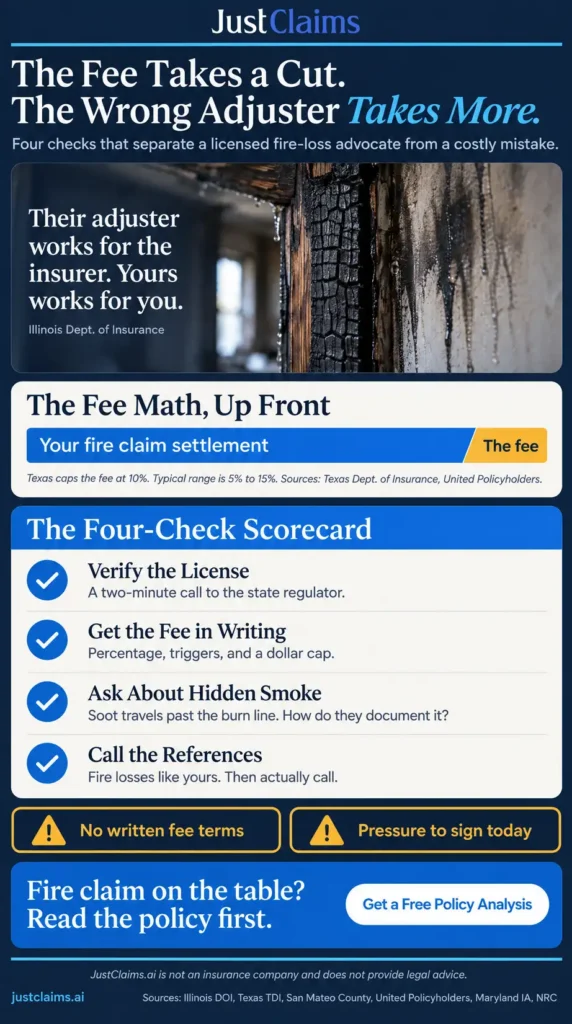
Licensing is the baseline. In Texas, public adjusters are licensed by the Texas Department of Insurance, and its Help Line at 800-252-3439 can tell you whether an adjuster is licensed, how many complaints have been filed against them, and whether the department has taken disciplinary action [3].
The Illinois Department of Insurance likewise requires public adjusters to be licensed and advises consumers to verify that the license is in good standing before signing [1].
California applies its own rules to public adjusters, so confirm the requirements of the state where your property is located [4].
2. Verifiable References From Commercial Fire Losses
Ask for references from property owners with fire losses comparable to yours in occupancy type, building complexity, and business interruption exposure. Then call them [5].
Useful questions include whether the adjuster communicated clearly, whether the scope was supported with documentation, and whether the final fee matched what was discussed. Experience with residential claims does not necessarily translate to a multi-tenant or industrial loss.
3. Transparent, Negotiable Fees
A public adjuster typically charges a percentage of the claim proceeds [4]. Since the adjuster is paid under a contract with the policyholder, often as a percentage of the settlement or through another form of compensation, the fee terms deserve the same scrutiny as any vendor agreement [1].
Regulators encourage negotiation. The Illinois Department of Insurance says all fees can and should be negotiated [1].
The Texas Department of Insurance advises policyholders to ask what an adjuster charges, try to negotiate a lower fee, and consider asking for the fee as a dollar amount in the contract instead of a percentage [3]. Owners in Texas can verify that fee structure with a Texas-licensed public adjuster before signing anything.
A top adjuster explains the fee structure plainly and puts it in writing. What that percentage looks like depends on your state. Texas caps public adjuster fees at 10% of the claim payment [3], California guidance describes a typical range of 2% to 25% or more depending on the size and complexity of the loss [4], and United Policyholders reports most public adjusters work on contingency fees of 5% to 15% — capped in some states and negotiable in all of them [5].
4. Command of Commercial Policy Language
Fire claims on commercial policies turn on specific provisions: the valuation basis for the building and contents, Business Interruption and extra expense coverage, Law & Ordinance coverage, and any sublimits or conditions. Ask a candidate to explain how each applies to your loss. If the answers are generic, the adjuster may not have handled claims of your complexity.
5. Forensic Documentation Capability
The best adjusters build claims on evidence. That means a line-item scope of loss, photographs and records of both visible and concealed damage, input from engineers, industrial hygienists, or restoration contractors where appropriate, and a clear financial model for interruption losses [6].
Ask to see a redacted sample of a prior scope and supporting package so you can judge the depth of their work.
Red Flags to Avoid During the Hiring Process
If the central risk is a valuation error that goes uncorrected, the hiring stage is where many property owners create that risk. The warning signs below suggest an adjuster may not protect your claim.
- License cannot be confirmed. If an adjuster is slow to provide a license number or the regulator cannot confirm good standing, treat that as disqualifying. Regulators such as the Texas Department of Insurance can also tell you about complaint history and disciplinary action [3].
- No written fee terms. An adjuster who avoids discussing fees, resists a written contract, or treats the percentage as non-negotiable is out of step with regulator guidance that fees can be negotiated [3][1].
- Promises of a specific outcome. No one can responsibly state a settlement figure before reviewing your policy, the loss, and the documentation.
- Pressure to sign immediately. A professional gives you time to compare candidates and review the contract [5].
- Little commercial experience. If an adjuster cannot discuss Business Interruption, extra expense, or Law & Ordinance in specific terms, they may be unprepared for your loss.
- Discouraging you from reading your policy. A trustworthy adjuster works from the policy language and welcomes your questions about it.
- Vague scope of services. The contract should state what the adjuster will do, including inspection, documentation, estimating, and negotiation, and how the fee is calculated.
How Public Adjusters Compare With Insurance Company Adjusters
Because the core risk is an undetected valuation error, it helps to understand whose interests each adjuster serves. The table below summarizes the structural differences described by the Illinois Department of Insurance [1].
| Factor | Public Adjuster | Insurance Company (Independent) Adjuster |
|---|---|---|
| Hired by | The policyholder | The insurance company, on a contract basis |
| Paid by | The policyholder, under a contract | The insurer |
| Interests represented | The policyholder | The insurer |
| Fee charged to policyholder | Yes, typically a percentage of the settlement or another form of compensation | No |
The trade-off is cost against representation. The insurer-side adjuster costs you nothing directly, but that adjuster represents the insurer’s interests [1]. A public adjuster charges a fee, typically a percentage of the claim proceeds, but works for you [1][4].
In practice, an independent estimate gives you something to measure the carrier’s scope against. A public adjuster can document hidden smoke damage, challenge scope and valuation gaps, and build the financial support for displacement and interruption losses. That work can help demonstrate the full extent of the loss, though outcomes depend on the policy, the evidence, and the carrier’s response. If you are new to the role, the full scope of what a public adjuster handles goes well beyond writing an estimate.
Weigh the fee against the size and complexity of the loss. On a large commercial fire, the cost of a missed coverage item can far exceed the fee.
Frequently Asked Questions
What does a public adjuster do on a commercial fire claim?
A public adjuster represents the policyholder in dealing with the insurance company. For a fire loss, that generally means inspecting the damage, documenting it, preparing an estimate, and negotiating with the carrier on your behalf [3]. The role differs from the insurer’s adjuster, who represents the insurance company [1].
How do I verify a public adjuster’s license?
Contact your state’s insurance regulator before signing. In Texas, the Department of Insurance Help Line at 800-252-3439 can confirm licensure, report complaints filed against the adjuster, and tell you whether disciplinary action has been taken [3]. Illinois advises consumers to confirm that a license is in good standing before they sign a contract [1].
How are public adjuster fees structured, and can I negotiate them?
Fees are usually a percentage of the claim proceeds [4]. Regulators say they are open to negotiation, and Texas notes that you can ask for a flat dollar amount written into the contract [3]. Illinois goes further and says fees can and should be negotiated [1].
What is the downside of hiring a public adjuster?
The fee reduces your net recovery. Insurance policies do not cover a public adjuster’s fee [1], and the fee is deducted from your settlement [6]. Texas notes you may still owe the fee even if the carrier does not raise its offer, and your deductible still applies [3]. On a large or disputed commercial fire loss, representation can still be worth the cost — but weigh the fee against the size and complexity of your claim before you sign.
What is the difference between a public adjuster and the adjuster my insurer sent?
The adjuster your insurer sent is hired on a contract basis by the insurance company, is paid by the insurer, and represents the insurer’s interests [1]. A public adjuster is retained and paid by you, so their role is to advocate for your side of the claim [1].
Can an adjuster help with hidden smoke damage and business interruption losses?
An experienced commercial adjuster should be able to document smoke and soot damage in concealed areas and tie it to the policy’s coverage terms. They should also be able to support interruption and extra expense losses with financial records. [6] Ask any candidate to walk you through how they handle both before you hire them.
How to Choose Your Fire Claim Adjuster
Choosing a public adjuster comes down to a short, checkable list. Confirm the license with your state regulator, negotiate the fee and get it in writing, and ask for references from similar fire losses. If the loss is large or the scope is disputed, the right moment to bring in a public adjuster is before the carrier’s number becomes the baseline.
Before you sign with anyone, get a free commercial property policy analysis from Justin — upload your fire claim documents and policy, and its AI will flag potential coverage gaps in Business Interruption and Law & Ordinance before they cost you.
This content is for informational purposes only and does not constitute legal or insurance advice. Coverage decisions depend on the specific terms, conditions, and exclusions of each policy and the laws of the applicable jurisdiction; policyholders and contractors should consult with a qualified professional for advice on their particular situation.
Sources
[1] Commercial Property Insurance Public Adjusters — Illinois Department of Insurance
[2] A Literature Review of the Effects of Smoke from a Fire on Electrical Equipment — U.S. Nuclear Regulatory Commission (NUREG)
[3] Public adjusters: What to know before you hire one to help with your claim — Texas Department of Insurance
[4] Public Insurance Adjusters — County of San Mateo, Department of Emergency Management
[5] Questions to Ask Before Hiring a Public Adjuster — United Policyholders

Taylor Bezek

As the General Manager at JustClaims, Taylor Bezek brings over a decade of experience managing complex residential, commercial, and large-loss claims. A licensed Public Adjuster in TX (#2125659), FL (#W455048), CO (#769172), and 10 additional states, Taylor founded his own firm before joining JustClaims to scale a tech-forward solution for the insured. He is committed to combining industry expertise with AI to enhance speed, clarity, and outcomes for every policyholder. Taylor's mission is to modernize the public adjusting profession and ensure owners get exactly what they are entitled to.