Religious Institution Property Damage Claims (2026)
October 01, 2026
Written by Taylor Bezek
Share


Houses of worship became eligible for FEMA Public Assistance under the Bipartisan Budget Act of 2018, but that aid is reduced by insurance proceeds and other credits. For a diocese or multi-site organization, one storm or fire can open claims across many buildings at once. How each loss is reported and documented often shapes the outcome.
Key Takeaways
- FEMA eligibility: Private nonprofit houses of worship are eligible for FEMA Public Assistance after a declared disaster.
- Request window: FEMA accepts a Request for Public Assistance up to 30 days from the date the area was designated in the declaration.
- Self-insurance example: The Diocese of Scranton’s self-insurance program covers all parish- and diocesan-owned buildings and contents.
- Reporting example: A parish in the Diocese of Arlington must immediately submit a one-page Property Damage Report to the Office of Risk Management.
- Adjuster licensing: Public adjusters usually need a license in each state where they work.
- Settlement control: Virginia law bars a public adjuster from settling a claim unless the policyholder approves the terms in writing.
What Facilities and Risk Managers Need to Know First
FEMA Public Assistance Eligibility
Private nonprofit houses of worship are eligible for FEMA Public Assistance after a declared disaster. The Bipartisan Budget Act of 2018 amended the Stafford Act to add them as eligible facilities, without regard to their secular or religious nature [1].
A qualifying applicant needs an IRS ruling letter granting 501(c), (d) or (e) tax exemption that was in effect on the declaration date. State documentation showing it is a non-revenue producing nonprofit can substitute. The applicant must also own or operate a facility that provides an eligible service [1].
Timing and cost matter. FEMA accepts a Request for Public Assistance up to 30 days from the designation date, submitted through the FEMA Grants Portal. The federal cost share is no less than 75 percent, and eligible costs are reduced by credits such as insurance proceeds and salvage values [1].
Houses of worship fall under noncritical essential social services. For those facilities, FEMA funds only the eligible permanent work costs that an SBA loan will not cover. It may assist if the organization is denied a loan or the loan is insufficient [1].
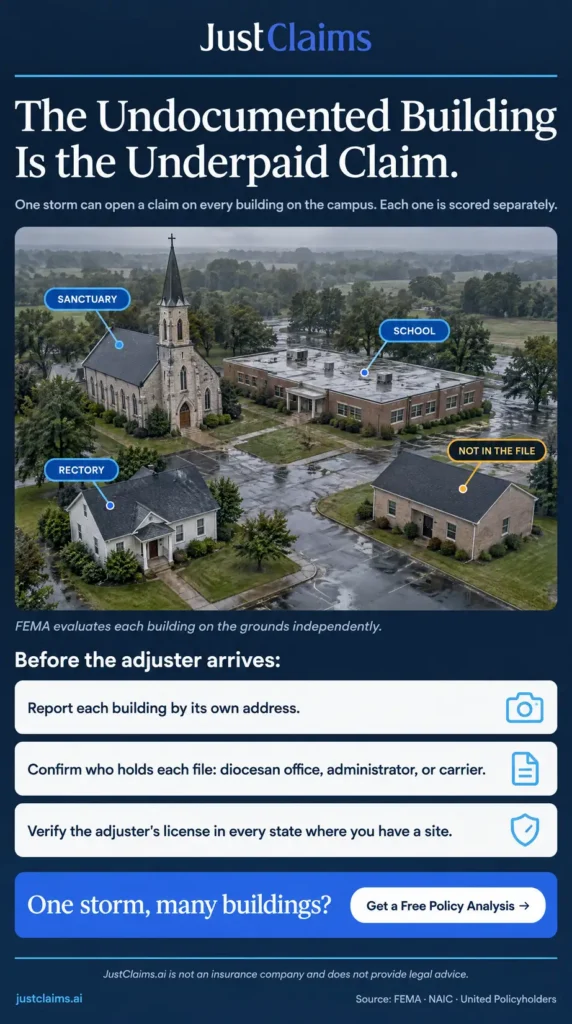
Mixed-use buildings are judged by primary use, meaning more than 50 percent of operating time in the shared space. FEMA evaluates each building on the grounds independently [1].
First Steps After a Loss
United Policyholders, a nonprofit consumer advocacy organization, publishes first-step guidance for property damage claims. The fundamentals below track that guidance [2]. For a single-site loss, the first steps of a property damage claim follow the same sequence.
- Secure safety first, then take reasonable steps to prevent further damage.
- Photograph and document the damage before widespread cleanup, and keep records of damaged items.
- Notify the insurer promptly, and keep a diary of every claim conversation.
- Ask for any denial, coverage limit, or minimal-repair position in writing.
How Institutional Claims Differ From Single-Congregation Claims
Because a portfolio loss is rarely limited to one building, the way an institution is insured determines who handles the claim and how much of it the institution carries itself.
Self-Insured Diocesan Programs
Under the Diocese of Scranton’s program, the Diocese assumes responsibility for all claims, and every parish or agency shares in paying them through its premiums. The program covers parish- and diocesan-owned buildings and contents, sacred vessels, asbestos, fungi (mold), and seepage. Newly acquired properties are insured automatically [3].
The Diocese states that it maintains “very high levels of Self-Insurance Retention.” Its Property & Risk Management Department runs the program, so a diocesan office handles the loss rather than a commercial carrier. This is one diocese’s model, not a rule for all of them [3].
Pooling is also a recognized state-level idea. Texas HB 3320 (89th Legislature) proposed a property and casualty self-insurance pool for certain religious institutions; it passed the Texas House and was reported favorably by a Senate committee in May 2025, but the session ended without enactment [4].
Louisiana went further: Act 259 of 2023 created the Louisiana Churches and Nonprofit Religious Organizations Self-Insured Fund so churches and religious organizations can band together to increase the availability of property insurance for local churches [5].
Retention Layers
A 1986 article in The Catholic Lawyer (St. John’s University) on the Archdiocese of Philadelphia describes a layered structure. Property and similar losses carried a $50,000 self-insured retention on most property risks, with a $500,000 annual stop-loss after which the retention drops to $1,000.
The pattern is that the program retains the first layer of loss and buys excess protection above it. The figures come from an older, single-archdiocese source, so treat them as historical illustration [6].
Denomination-Level Claims Offices
Church Pension Group, which provides property and casualty insurance to Episcopal churches, dioceses, and institutions, runs a centralized claims intake line [7].
Claims are reported by phone at 800-223-5705 (press 1 for claims intake staff) or by email at claims@cpg.org [8].
Multi-Building Campuses
The Insurance Board’s property policy covers the main church building plus attached or detached buildings on church property. Its online claim form asks the church to confirm it has discussed the claim with its agent and whether the loss occurred at the address on file [9]. FEMA likewise evaluates each building on the grounds independently, so a record organized building by building supports both processes [1].
Property Types in a Religious Institution Claim
Because one institutional loss can touch very different kinds of buildings, each property type calls for its own documentation and its own coverage questions. For a multi-site insured, that documentation starts upstream — a current statement of values listing every building keeps those coverage questions answerable at claim time.
Sanctuaries and Worship Spaces
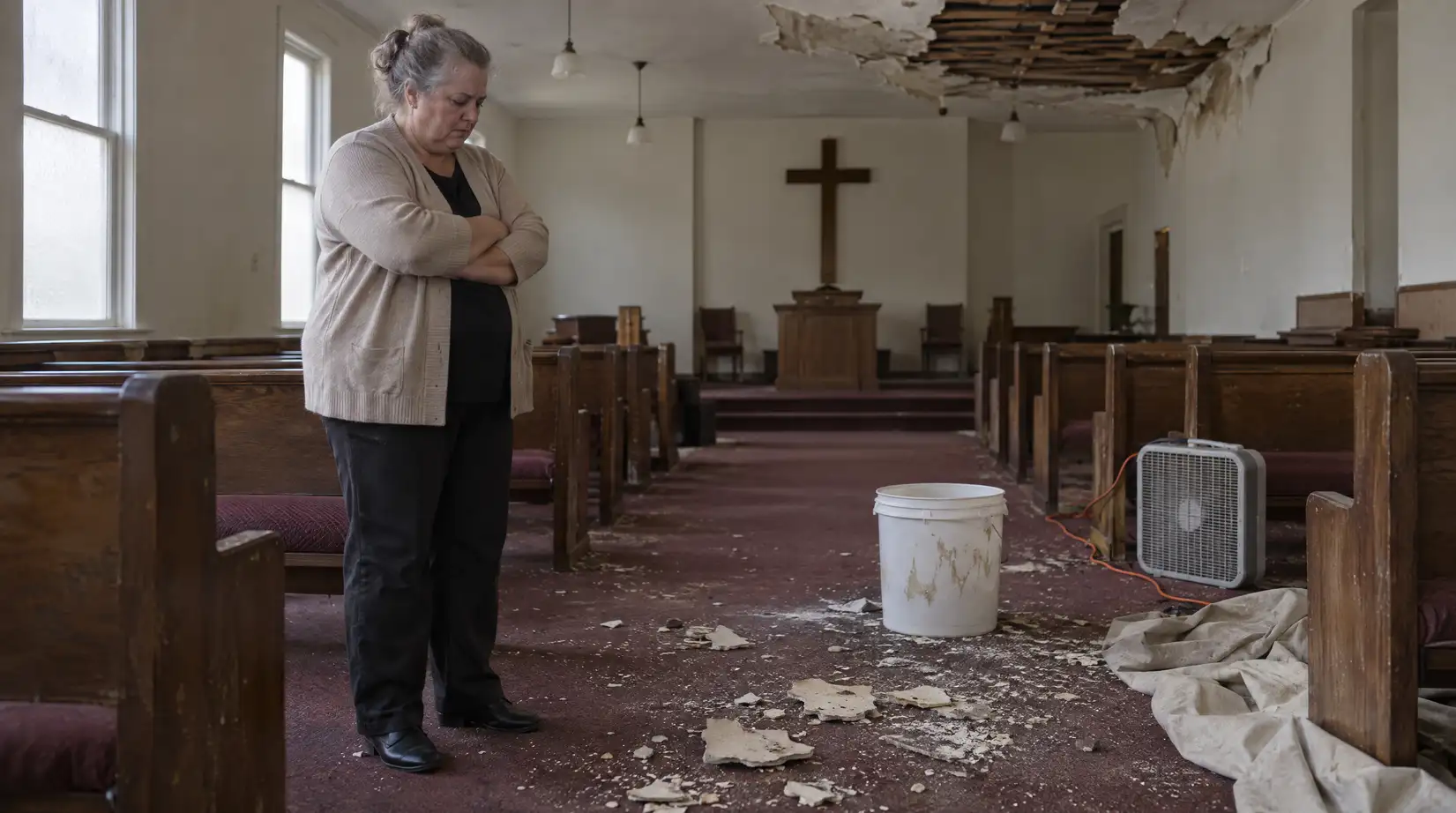
Church buildings often combine features of assembly halls, classrooms, offices, kitchens, daycare centers, and community centers. Sanctuaries are large-volume spaces with high ceilings, exposed beams, decorative finishes, and specialized lighting and sound systems.
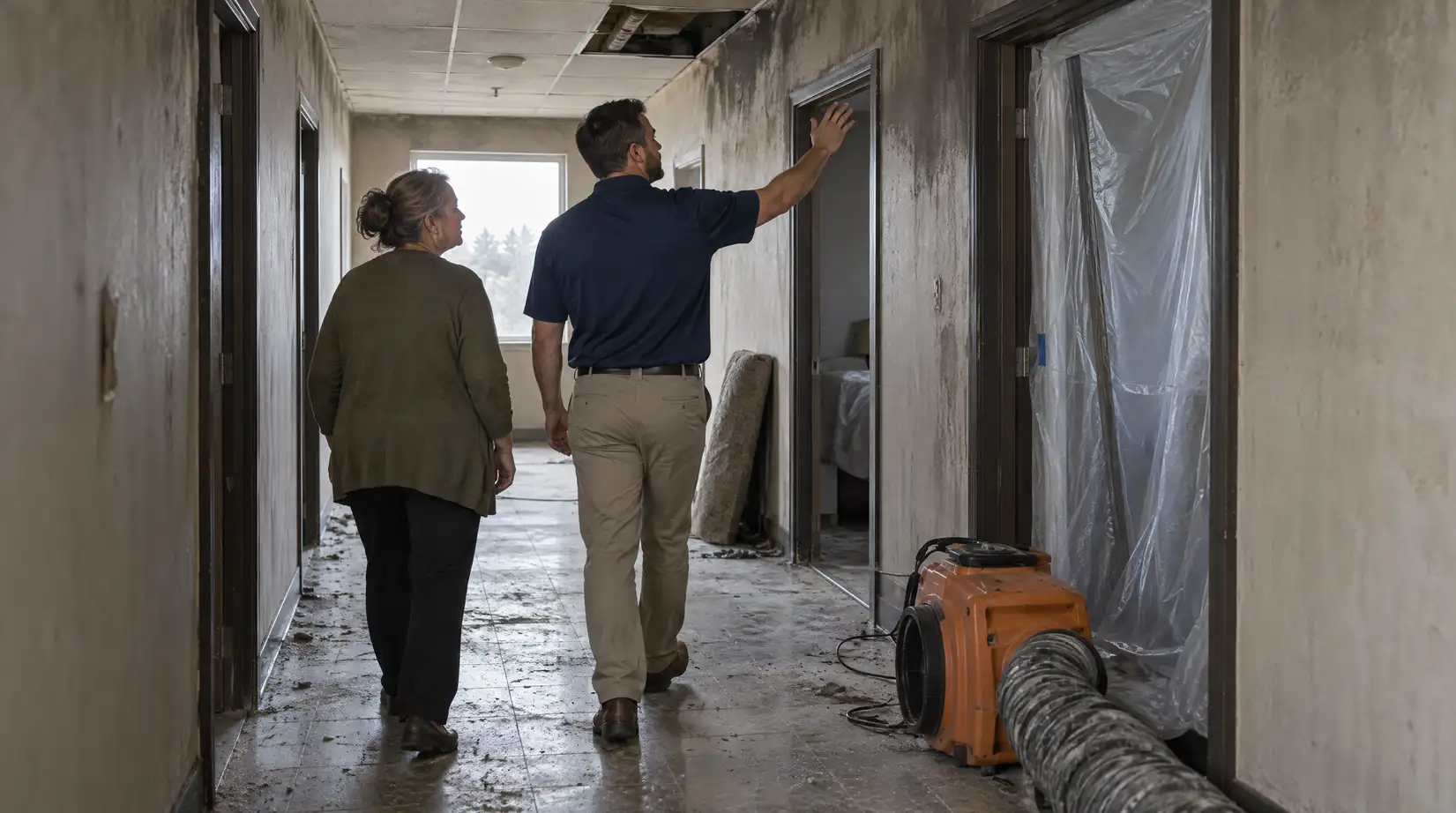
A walk-through should look beyond what is visibly burned or wet: record odors, staining, and finish condition room by room so nothing is left out of the scope.
Schools, Nurseries, and Child Care
Sunday school rooms, nurseries, and children’s wings can be unsuitable for children until water, mold, smoke, or vandalism damage is remediated. If repairs trigger current building codes, ordinance or law coverage is the part of a property policy designed to fund code-required upgrades [10].
The Insurance Board’s liability program covers church-operated daycares, preschools, and faith-based schools that belong to one of its participating denominations.[11].
Rectories, Camps, and Chapels
A denominational property program can extend well beyond the sanctuary: the Insurance Board’s program covers attached or detached buildings such as schools, sheds, parsonages, and event centers. Confirm the schedule of covered locations in your own policy [9].
Administrative Offices and Exterior Property
Church offices and administrative spaces often house key records, servers, audio archives, and donated equipment. Steeples, parking surfaces, and playground structures can also be damaged by hail, wind, lightning, falling trees, and vandalism. The Insurance Board’s property program covers main church buildings and attached or detached buildings such as schools, sheds, parsonages, and event centers, along with office equipment and ground improvements [9].
Claim Workflow When a Diocesan Office Manages Member Parish Claims
Because diocesan programs often route losses through a central office, a parish’s first call can determine whether documentation for the whole portfolio stays consistent. The examples below show how differently dioceses handle it.
Whatever the reporting chain, consistent claim management habits — one file, one log, one photo set per building — keep a portfolio loss from splintering into separate claims.
| Diocese | First point of contact | Notable feature |
|---|---|---|
| Belleville (IL) | Office of Facilities & Risk Management, by telephone [12] | Parish then submits a Property Damage Report [12] |
| Arlington | Office of Risk Management [13] | One-page Property Damage Report with photos, emailed [13] |
| Pensacola-Tallahassee | Gallagher Bassett, the third-party administrator [14] | Parish also completes the claim reporting form [14] |
| Richmond | Office of Risk Management [15] | Administers a self-insurance program covering property, casualty, auto, and workers’ compensation [15] |
Each row is a single-diocese example, not a universal rule.
Report to the Diocesan Office First
In Belleville, property, liability, and equipment breakdown claims are first reported by phone to the diocesan office. For property and equipment losses, the parish must then protect the property from further damage, arrange temporary repairs if needed, and submit the Property Damage Report. [12]
Know Where a Third-Party Administrator Fits
Some dioceses, such as Pensacola-Tallahassee, use a third-party claims administrator alongside the diocesan risk office. A parish should confirm which entity holds the file. [14] In a self-insured diocese such as Richmond, the diocesan office rather than a commercial carrier handles the claim. [15]
Separate the Claim Types
Belleville’s workflow sends auto and workers’ compensation claims directly to its carrier, Church Mutual, while property claims go through the diocesan office.
Burglary and theft must be reported promptly to the police or sheriff. Lawsuit papers or attorney letters must be phoned in to the risk office the day they arrive, then forwarded by registered mail [12].
Public Adjusters for Religious Organizations: Licensing and Multi-Site Estimating
Because a portfolio claim spans many buildings and sometimes many states, the licensing and structure of the adjuster you retain matter as much as the estimate.
Licensing Across States
The NAIC State Licensing Handbook notes that public adjusters usually need a license in each state where they work. An organization with sites in several states therefore needs an adjuster licensed in each of them [16].
An adjuster typically sits for the exam in their state of residency, and many states will grant a comparable nonresident license [16].
Team Structure and Settlement Control
The NAIC Public Adjuster Licensing Model Act (Model 228) requires individual applicants to be at least 18 and to pass a written exam. A business entity must designate a licensed public adjuster responsible for its compliance. The model also exempts people employed only for technical assistance to a licensed public adjuster, so a multi-site claim can draw on a team of specialists under one license [17].
Virginia’s statute shows one way boards keep control. It requires a license before doing business, requires a business entity to hold its own license, and bars a public adjuster from settling a claim unless the policyholder approves the terms in writing [18].
Before engaging any firm, verify its public adjuster license with the insurance department in each state where your organization has a site [16]. Licensing is the floor — vetting a public adjuster also means confirming multi-site estimating experience before you sign an engagement letter.
Frequently Asked Questions
Can a house of worship receive FEMA money in addition to insurance?
Houses of worship can apply for FEMA Public Assistance after a declared disaster. FEMA reduces eligible costs by credits such as insurance proceeds, so the two sources are coordinated rather than stacked [1].
Who files the claim when a parish belongs to a self-insured diocese?
The parish usually reports the loss to the diocesan risk or facilities office, which handles it instead of a commercial carrier. Procedures vary, so confirm your own diocese’s required forms and timing [12][15].
Why does a multi-building campus need separate documentation for each building?
FEMA evaluates each building on the grounds independently, and insurers ask which location was affected. A record organized building by building supports both processes [1][9].
Does a public adjuster need to be licensed in every state where I have a site?
Public adjusters usually need a license in each state where they work, and many states will grant a comparable nonresident license. Ask any adjuster for proof of licensing in each relevant state [16].
Can a public adjuster settle my organization’s claim without board approval?
Under Virginia law, no. A public adjuster cannot settle unless the policyholder approves the terms in writing. Other states differ, so review the contract and the state’s rules [18].
How to Coordinate Claims Across Your Portfolio
Institutional losses can affect more than one building, so a single, consistent record across every site may help support the claim, from sanctuaries to schools to administrative offices. JustClaims offers one advocate across your entire portfolio of properties. We fight for every dollar your organization deserves, with no upfront cost. We only get paid when you do.
Upload your policy and loss documents for a free insurance policy analysis by Justin — a portfolio-level review that flags likely coverage gaps at each site.
This content is for informational purposes only and does not constitute legal or insurance advice. Coverage decisions depend on the specific terms, conditions, and exclusions of each policy and the laws of the applicable jurisdiction; policyholders and contractors should consult with a qualified professional for advice on their particular situation.
Sources
[1] FEMA Public Assistance: Private Nonprofit Organizations Fact Sheet — FEMA
[2] FAQs About Property Damage Insurance Claims — United Policyholders
[3] Diocesan Self-Insurance — Diocese of Scranton
[4] 89(R) History for HB 3320 — Texas Legislature Online
[7] Property & Casualty Insurance — Church Pension Group
[8] Submit a Claim — Church Pension Group
[9] Church Property Insurance — Insurance Board
[10] Building Code, Ordinance or Law Compliance — United Policyholders
[11] Liability Insurance for Churches — Insurance Board
[12] Claim Reporting — Catholic Diocese of Belleville
[13] Risk Management — Catholic Diocese of Arlington
[14] Risk Management — Catholic Diocese of Pensacola-Tallahassee
[15] Office of Risk Management — Catholic Diocese of Richmond
[16] Chapter 18: Adjuster Licensing, State Licensing Handbook — NAIC
[17] Public Adjuster Licensing Model Act (Model 228) — NAIC
[18] Article 4.1: Licensing of Public Adjusters, Title 38.2, Chapter 18 — Code of Virginia
Taylor Bezek

As the General Manager at JustClaims, Taylor Bezek brings over a decade of experience managing complex residential, commercial, and large-loss claims. A licensed Public Adjuster in TX (#2125659), FL (#W455048), CO (#769172), and 10 additional states, Taylor founded his own firm before joining JustClaims to scale a tech-forward solution for the insured. He is committed to combining industry expertise with AI to enhance speed, clarity, and outcomes for every policyholder. Taylor's mission is to modernize the public adjusting profession and ensure owners get exactly what they are entitled to.