Church Insurance Non-Renewal: 2026 Response Guide

September 30, 2026
Written by Taylor Bezek
Share


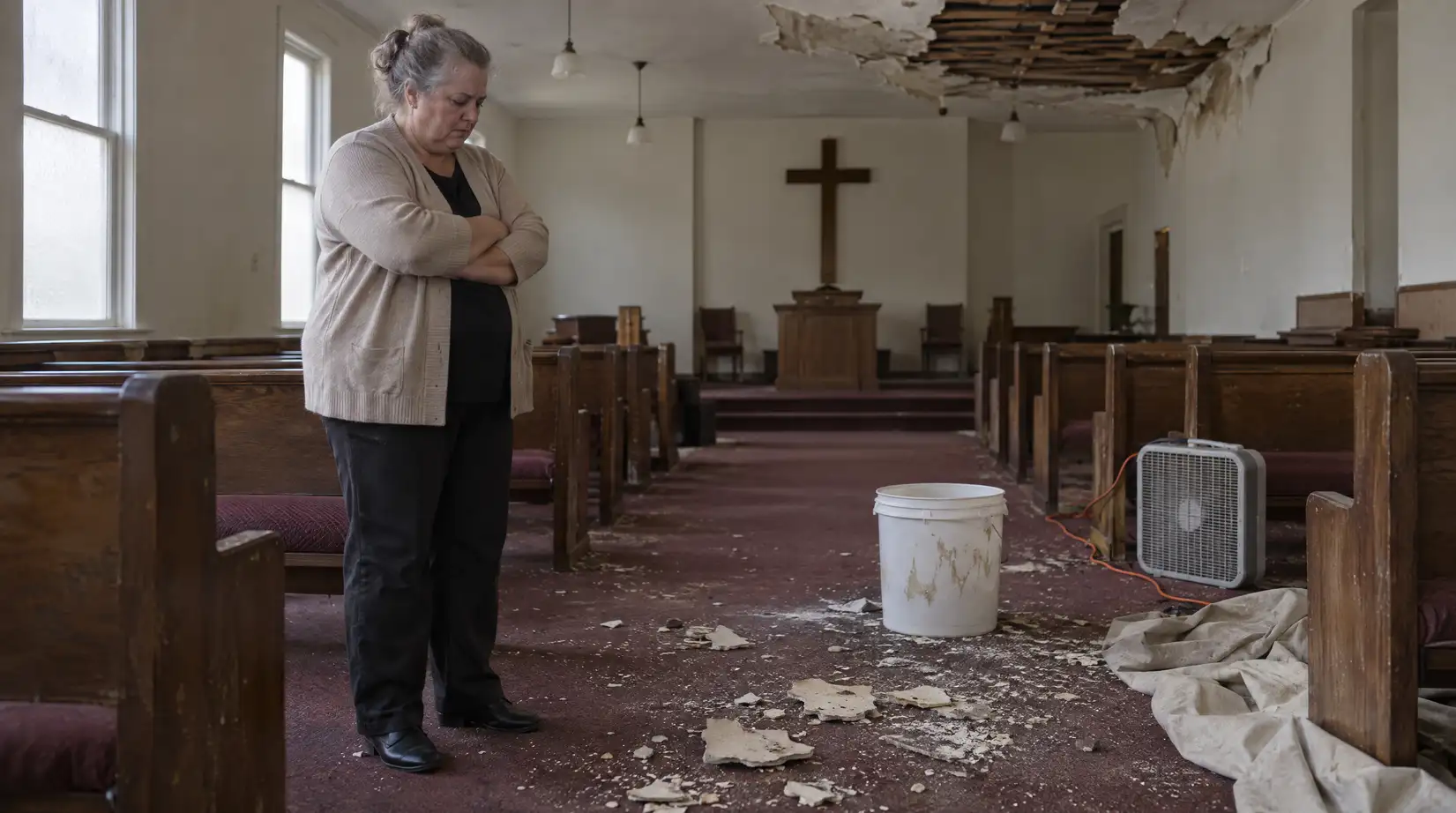
A non-renewal notice does not erase a loss that already happened to your church. Church insurers are non-renewing property and casualty policies at a pace that has left many congregations scrambling — a Church Executive survey found 75% of church leaders reported difficulty securing or keeping coverage, with 50% of those struggles tied directly to claims history. But coverage on the date of loss survives the notice, and a properly documented claim under the old policy still has to be paid.
Key Takeaways
- What non-renewal means: Coverage ends only at the policy’s scheduled expiration date — it is legally distinct from mid-term cancellation.
- Why it’s happening: Industry commentary describes the church insurance market as hardening since 2019, driven by abuse-claim severity and elevated weather losses.
- Typical notice window: State windows run from 45 days in Florida to 60 days in Texas, Illinois, and Wisconsin — and 60 to 120 days for commercial policies in New York.
- Claims-history impact: 75% of surveyed church leaders reported coverage challenges, and 50% linked those challenges to claims history.
- Claim filing protection: Once a claim is filed in Texas, the insurer must acknowledge it, begin investigating, and request needed items within 15 days — one reason to file before your policy lapses.
Why Church Insurers Are Pulling Back From Renewals
Understanding why carriers are exiting the church market matters because it explains why your non-renewal notice may have nothing to do with anything your congregation did wrong. Carriers that specialize in insuring churches — Church Mutual, GuideOne, and Brotherhood Mutual among them — have seen their reserves shrink, and that has led them to drop churches they consider high risk in order to cut their losses [1].
Reinsurers that backstop those primary insurers are also reducing their exposure to certain claim types, which means church-focused carriers can’t offer as much coverage as they did in the past — as one broker put it, even small filed claims can now leave a church non-renewed or facing a dramatically higher premium [1].
United Policyholders attributes the broader pullback to insurers’ use of aerial imagery, AI and predictive models, construction cost increases, and destructive weather events [2].
Building age is a second factor. Underwriting teams at major church insurers point to aging electrical, plumbing, and roofing systems as a growing insurability challenge, since older structures are more vulnerable to wind, hail, snow, and ice damage and may require substantial upgrades to stay insurable [3].
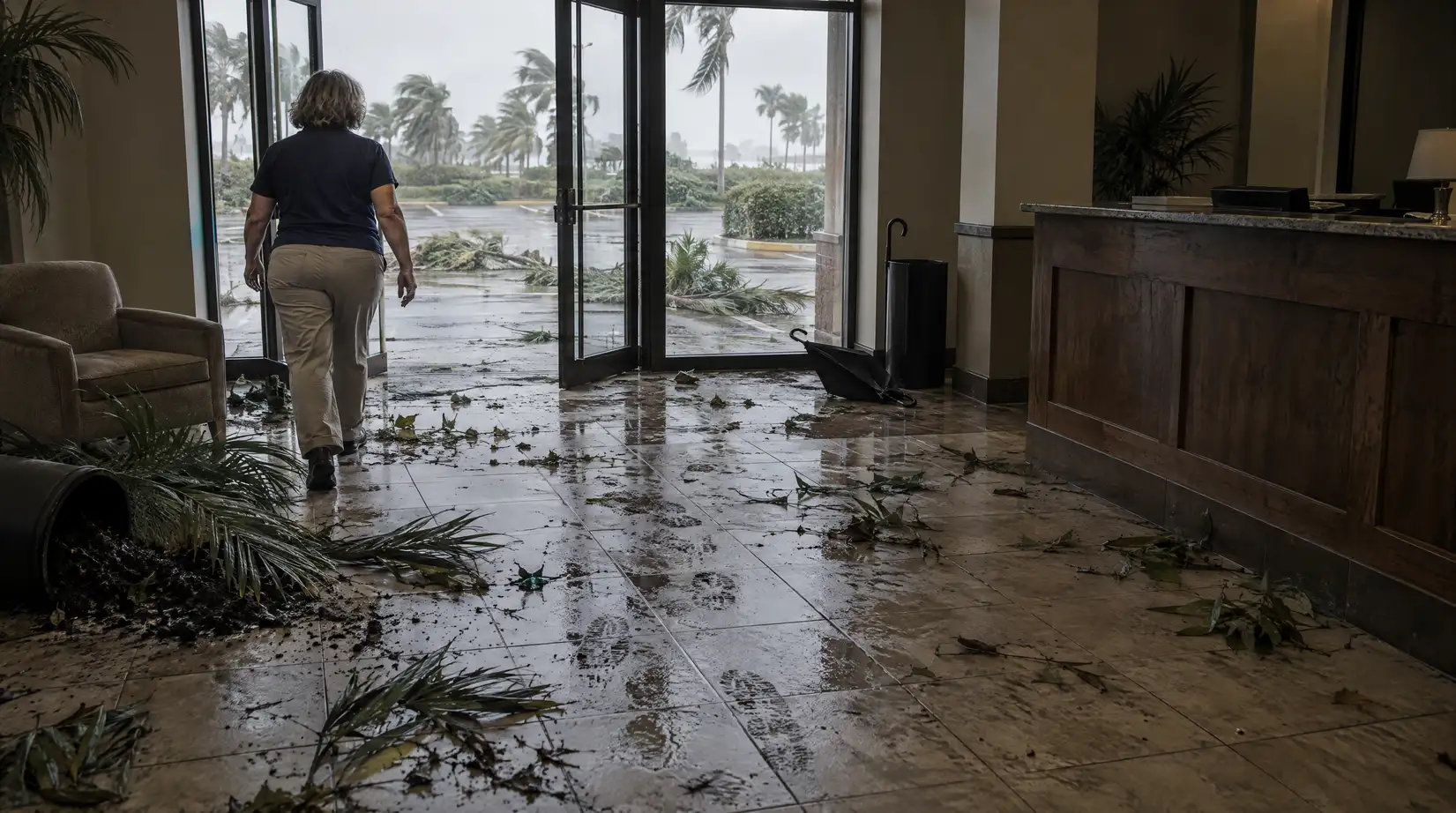
There have also been an unusual number of weather-related disasters recently that resulted in more claims than predicted, causing insurance companies to readjust their models [3]. Hail is the clearest example — recent hail seasons in Texas have repeatedly produced claim volumes well above what carrier models projected.
Layered on top of property risk is the structural reality of how houses of worship operate. Churches are open to the public across all ages — from infants to senior citizens — are frequently run by volunteers, and often occupy large, expensive buildings [1]. And because of the First Amendment and the separation of church and state, ministries are largely unregulated, and unregulated businesses are difficult to underwrite [1].
On top of ordinary weather-related property losses, industry reporting also describes the rising severity of abuse and misconduct claims as a distinct pressure on church insurers [4]. None of this means your specific claim was mishandled — it means the market you’re renewing into has changed.
Why a Non-Renewal Doesn’t Erase Your Open Claim
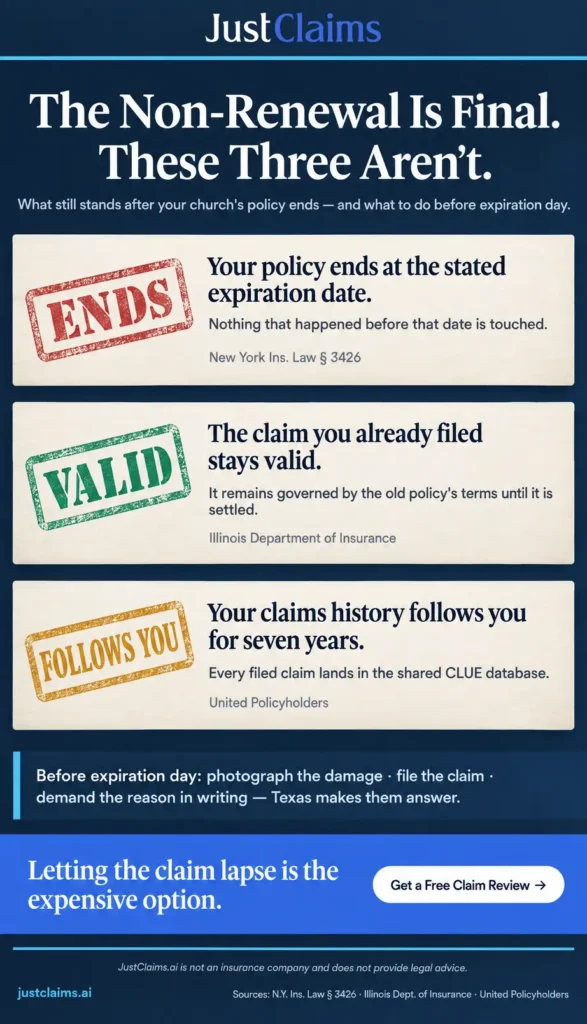
Because the central risk here is that a congregation assumes a non-renewal notice threatens an open claim, it’s worth stating plainly: it does not. Non-renewal and cancellation are legally distinct actions: cancellation terminates a policy before its expiration date, while non-renewal ends it at the expiration date — so coverage stays in force until that stated date, and a loss that occurred while the policy was active remains governed by that policy’s terms [5].
Under New York law, for example, a commercial insurer must give at least 60 — and no more than 120 — days’ advance written notice before non-renewing a policy [6].
Illinois regulators draw the same distinction by separating “rescission” — voiding a policy back to its inception and eliminating all coverage — from “nonrenewal,” which only ends coverage at the stated expiration date [5]. That means a valid claim tied to a loss that occurred while your policy was active isn’t voided simply because the carrier later decides not to renew. Notice windows and permitted grounds vary by state, which is why the table below matters — but in every state, a non-renewal decision has no effect on a loss that already happened.
The 90-Day Action Plan After a Non-Renewal Notice
Because that notice window is your best opportunity to protect an open claim before the old policy ends, a clear sequence of action matters more than the reason behind the non-renewal itself.
1. Document Damage Before the Policy Lapses
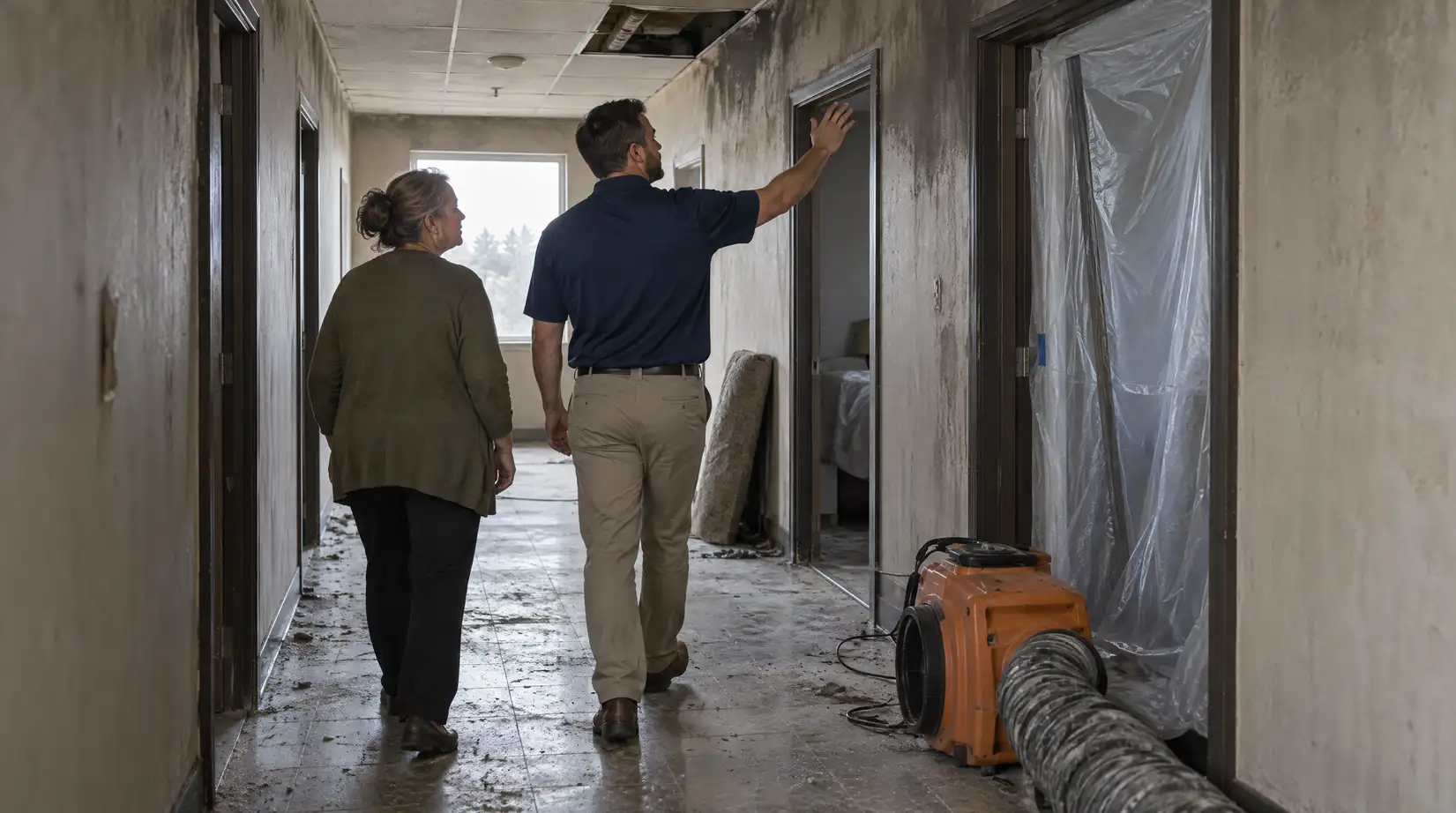
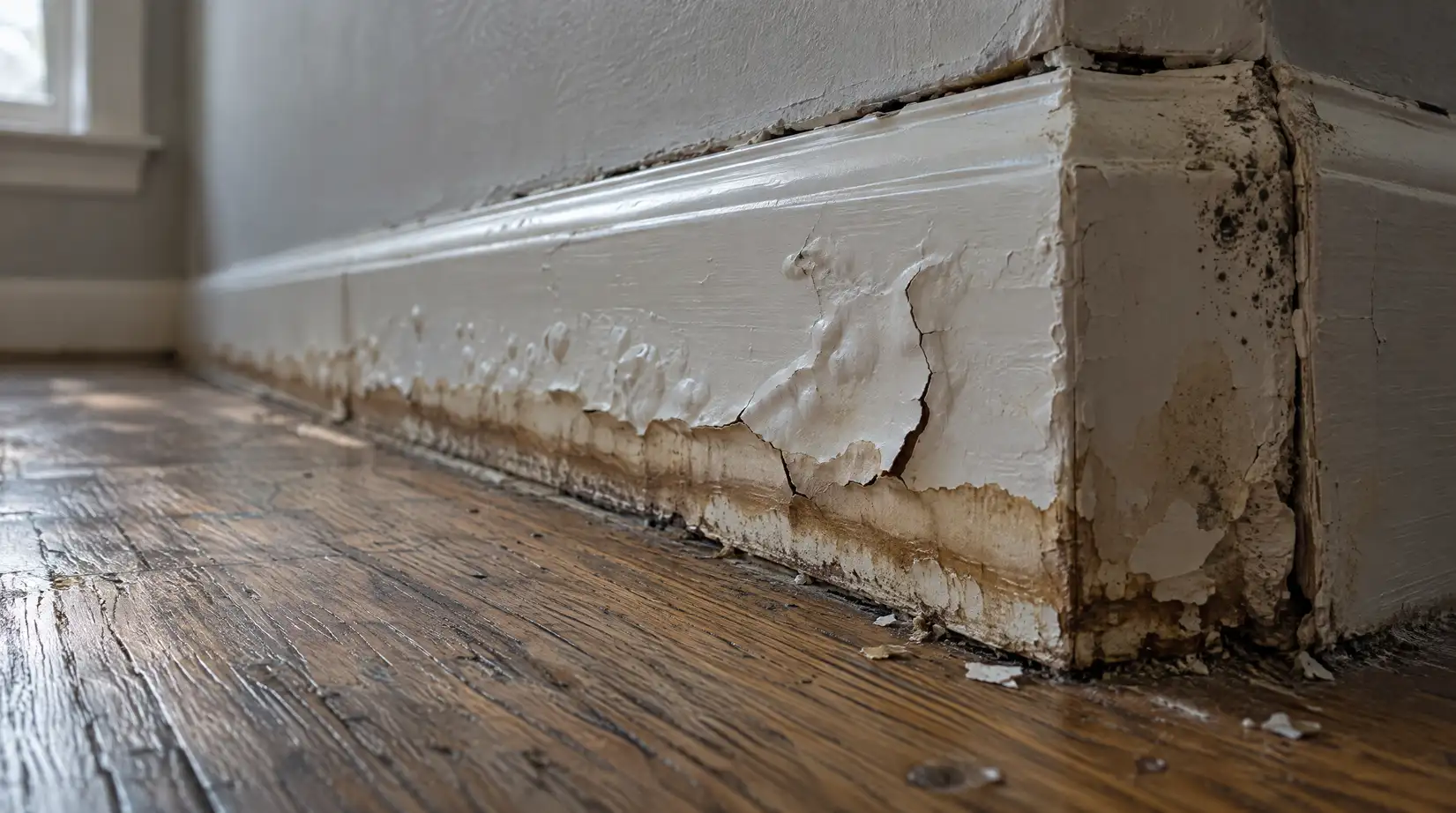
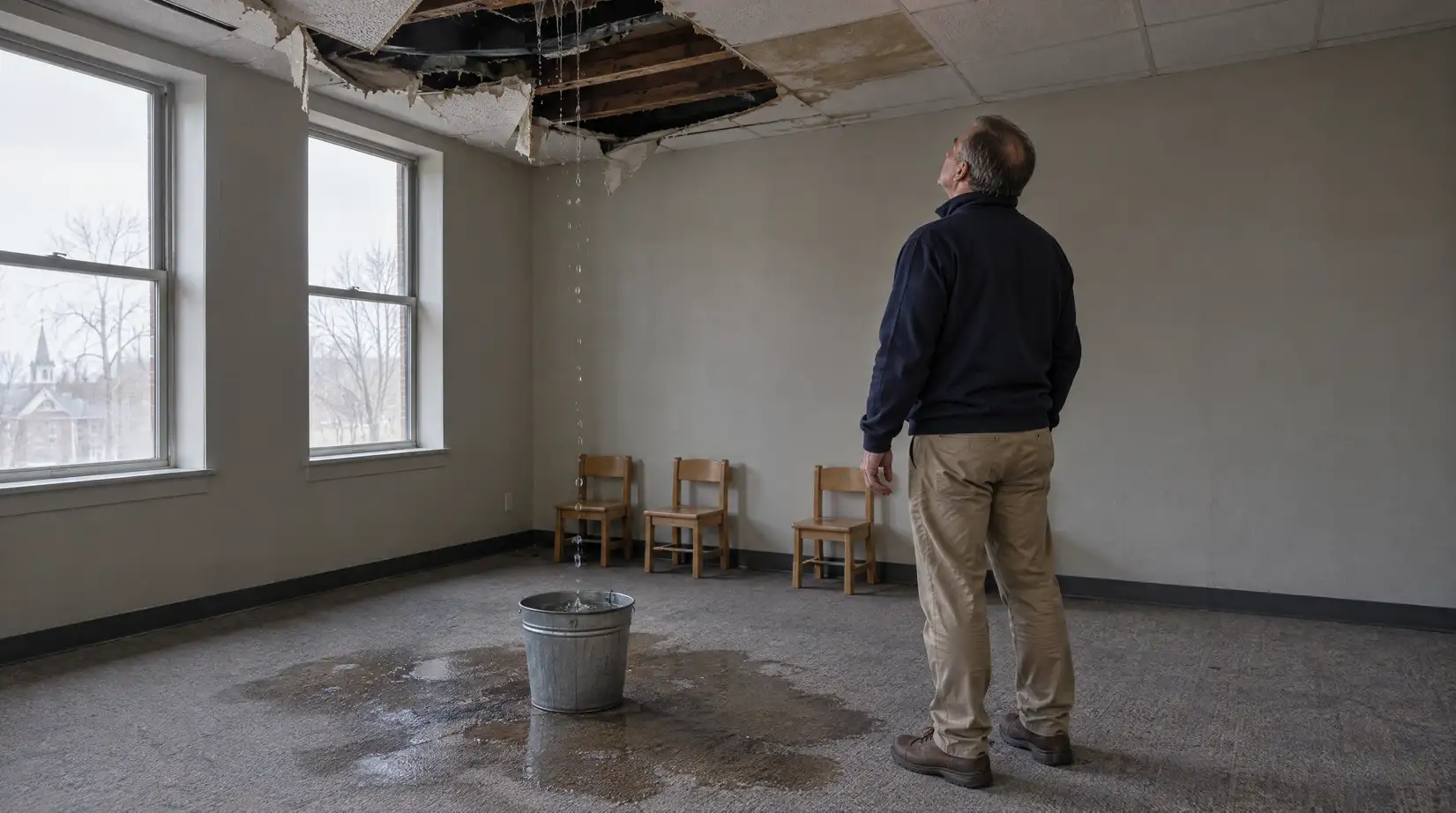
Photograph and log any covered damage — roof, water intrusion, storm impact — while the policy is still active, since coverage tied to a date of loss before expiration remains valid regardless of the non-renewal. The fastest way to preserve that evidence is a dated photo inventory taken before repairs or cleanup begin.
Notice timing varies by state: in Texas, an insurer’s non-renewal notice must be delivered or mailed no later than the 60th day before the policy expires — and if the carrier misses that deadline, coverage remains in effect until the 61st day after the notice is delivered or mailed [7].
In Florida, an insurer must give at least 45 days’ advance written notice before non-renewing a commercial property policy [8]. Before the notice period runs out, a public adjuster licensed in Florida can confirm whether the letter met the statutory requirements.
2. File the Claim Before the Deadline
File any open claim before your policy’s expiration date so statutory response protections still apply.
In Illinois, an insurer that intends to non-renew a commercial policy must mail written notice at least 60 days before expiration, and the notice must include a specific explanation of the reasons for the decision [9].
In Texas, once a claim is filed, the insurer must acknowledge receipt of the claim, begin investigating, and request the items it needs no later than the 15th day after receiving notice of the claim — protections that only apply if the claim is filed while the policy is active [10]. Texas is not the only state that puts the carrier on a clock — the deadlines insurers must meet to acknowledge, investigate, and pay a claim apply in every state.
3. Engage a Public Adjuster While a Broker Replaces the Policy
These two tasks can run in parallel without conflict. A broker’s job is finding replacement coverage for the next policy term; a public adjuster’s job is documenting and settling the open claim under the expiring policy. Keeping those roles separate helps your congregation avoid losing ground on an existing claim while focused on shopping for a new carrier.
| State | Non-Renewal Notice Requirement | Source |
|---|---|---|
| New York (commercial) | At least 60, and no more than 120, days’ advance written notice | [6] |
| Texas | By the 60th day before expiration; late notice keeps coverage until the 61st day after delivery | [7] |
| Florida (commercial property) | At least 45 days’ advance written notice | [8] |
| Illinois (commercial) | At least 60 days, with a specific explanation of the reasons | [9] |
| Wisconsin | At least 60 days, stating the reason; late notice extends prior coverage up to one year | [11] |
How This Claim Affects Your Church’s Next Policy
Since the way this claim is resolved shapes what the next carrier is willing to offer, how it gets closed out matters as much as getting it paid. Claims history doesn’t vanish when a policy ends: United Policyholders explains that CLUE — the Comprehensive Loss Underwriting Exchange — is a nationwide database insurers use to share loss and claim histories on current, past, and prospective customers, and that a CLUE report contains up to seven years of property claim history, including dates of loss, types of loss, and amounts paid [12]. And frequency matters as much as severity — as one broker told Religion News Service, “If small claims get filed, your coverage could be nonrenewed or your premium could go through the roof” [1].
Replacement coverage after a non-renewal is also expensive: Religion News Service documented congregations that went from paying $23,000 to $80,000 per year, and from $12,500 to about $73,000 for less coverage [1].
Risk-control leaders at major church insurers advise boards to respond with a documented self-review. One record worth requesting before that review is the outgoing carrier’s loss run — the claims-history report prospective insurers will ask for first when quoting replacement coverage.
Writing about churches that lost coverage after abuse-related claims, Eric Spacek, AVP of Risk Control at Church Mutual, recommends the governing body perform a self-critical analysis of what led to the claim, review and update procedures, and be prepared to show the next carrier evidence of that review and the improvements made [4].
Brian Gleason, Senior Risk Manager at GuideOne, adds that because carriers are involved in resolving abuse claims, they are “intimately familiar” with the safety efforts that weren’t in place — a reminder that a properly documented, cooperative claim resolution paired with a follow-up mitigation plan helps rebuild credibility with a future carrier [4].
When Non-Renewal Follows a Claim You Already Filed
Because the scenario changes when the non-renewal itself was triggered by a specific claim rather than broad market conditions, it deserves a narrower note here — the fuller playbook lives on a companion page about church insurance claims. Insurers can and do decline to renew after claims are filed — in the words of one broker describing the church market, “If small claims get filed, your coverage could be nonrenewed or your premium could go through the roof” [1].
Wisconsin’s insurance commissioner requires that a non-renewal notice state the specific reason for the decision and arrive at least 60 days before expiration; if the insurer misses that deadline, coverage must continue under the prior terms and premium for the remainder of the term or one year, whichever is less [11].
In Texas, for non-renewals on or after January 1, 2026, insurers must automatically provide a written statement explaining the reasons — including the precise incident, circumstance, or risk factors involved and the source of information relied on — documentation your congregation will want when shopping for replacement coverage after a claim-driven non-renewal [7].
For the general legal mechanics of how and when any insurer can decline to renew, see this overview.
Frequently Asked Questions
Does a non-renewal notice cancel my church’s current claim?
No. Non-renewal only ends the policy at its scheduled expiration date and has no retroactive effect on coverage for a loss that occurred while the policy was active [5]. The claim continues to be governed by the terms in place on the date of loss, separate from whatever happens at renewal.
How much notice does my church typically get before non-renewal?
It varies by state — at least 45 days in Florida, 60 days in Texas, Illinois, and Wisconsin, and 60 to 120 days for commercial policies in New York [6][7][8][9][11]. Some states, including Illinois and Wisconsin, also require the notice to state the specific reason for non-renewal [9][11]. Check your state insurance department’s rules, since the exact window differs.
Can I still file a new claim after receiving a non-renewal notice?
Yes, as long as the loss occurred and the claim is filed before the policy’s stated expiration date. Filing promptly also matters procedurally — in Texas, for instance, the insurer must acknowledge receipt of the claim, begin its investigation, and request needed items within 15 days after receiving notice of the claim, a protection that only applies while the policy remains active [10].
Will a public adjuster interfere with my broker finding a new policy?
No — the two roles serve different purposes and don’t compete. A broker’s task is securing replacement coverage for the next term, while a public adjuster’s task is documenting and settling the claim tied to the expiring policy, and both can proceed at the same time.
Does claims history disappear after a few years?
Not entirely. Carriers share loss and claim histories through CLUE, a nationwide database that holds up to seven years of property claim history — dates of loss, types of loss, and amounts paid — so older claims carry less weight over time, but they don’t simply vanish [12].
Document Your Open Claim Before the Policy Ends
The strongest position your congregation can take after a non-renewal notice is to treat the old policy and the new policy as two separate tracks. Let a broker handle finding replacement coverage for next year, and use the time before expiration to make sure any existing damage is documented, filed, and pursued to a fair settlement under the policy that was actually in force when the loss occurred. A poorly documented or rushed settlement on the way out the door can also weaken your position with the next carrier, so getting this claim right matters beyond just the dollar amount.
Not sure what your current policy actually covers before it expires? Get a free AI policy analysis from Justin to see whether the policy in force on the date of loss still owes your ministry coverage the non-renewal notice doesn’t erase.
This content is for informational purposes only and does not constitute legal or insurance advice. Coverage decisions depend on the specific terms, conditions, and exclusions of each policy and the laws of the applicable jurisdiction; policyholders and contractors should consult with a qualified professional for advice on their particular situation.
Sources
[1] How a perfect storm sent church insurance rates skyrocketing — Religion News Service
[2] Dropped by Your Home Insurer? Information for Texas Residents — United Policyholders
[3] 2025 Underwriting Trends for Churches — Church Executive
[4] My Insurance Has Been Non-Renewed — Now What? — Church Executive
[5] If Your Homeowners Insurance Policy Is Non-Renewed — Illinois Department of Insurance
[6] New York Insurance Law § 3426 — New York State Senate
[7] Texas Insurance Code Chapter 551 (§§ 551.002, 551.054) — Texas Constitution and Statutes
[8] Florida Statute § 627.4133 — Online Sunshine, Florida Legislature
[9] 215 ILCS 5/143.17a — Illinois General Assembly
[10] Texas Insurance Code § 542.055 — Texas Constitution and Statutes

Taylor Bezek

As the General Manager at JustClaims, Taylor Bezek brings over a decade of experience managing complex residential, commercial, and large-loss claims. A licensed Public Adjuster in TX (#2125659), FL (#W455048), CO (#769172), and 10 additional states, Taylor founded his own firm before joining JustClaims to scale a tech-forward solution for the insured. He is committed to combining industry expertise with AI to enhance speed, clarity, and outcomes for every policyholder. Taylor's mission is to modernize the public adjusting profession and ensure owners get exactly what they are entitled to.