Preparing for Texas Hail Season and Filing Successful Claims
June 02, 2026
Written by Taylor Bezek
Share


Texas leads the United States in wind and hail losses, recording 902 major hail events in 2025 alone [3]. Because the state consistently ranks as the top region for severe weather damage, property owners face significant financial exposure during peak storm months. Preparing your property and understanding the insurance claim process can help mitigate these severe weather risks.
Key Takeaways
- National ranking: In 2020, Texas led the United States in wind and hail losses.
- Storm frequency: The state recorded 601 distinct hail events in 2020.
- Claim volume: Texas recorded 637,977 hail loss claims over a three-year period from 2017 to 2019.
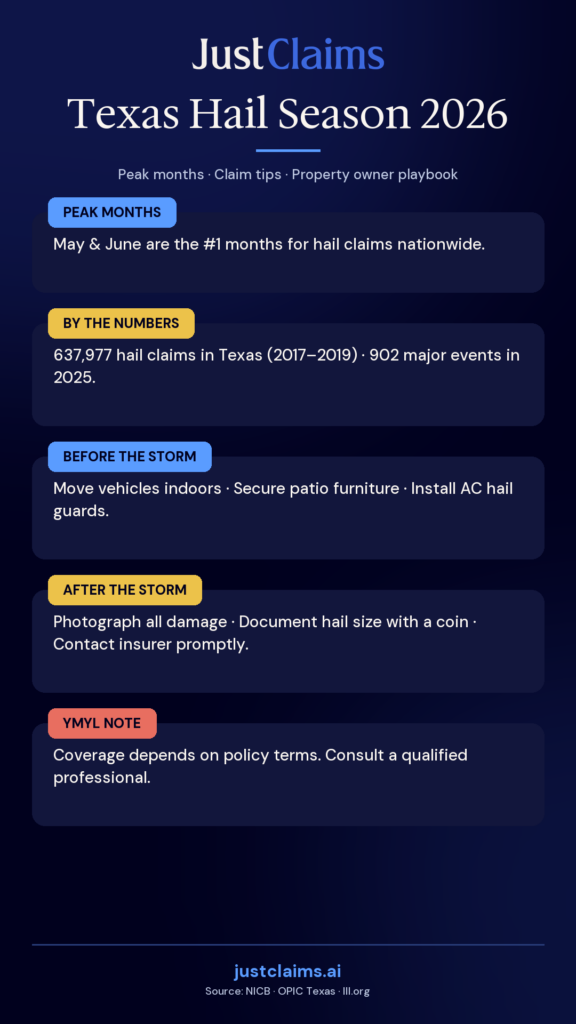
- Peak timing: May and June are the peak months for hail loss claims nationwide.
Peak Months and Volatile Weather Patterns
Texas consistently ranks as the top state for hail loss claims, recording 637,977 claims over a three-year period from 2017 to 2019 [2]. The peak months for hail loss claims nationwide are May and June, making spring and early summer a highly critical time for preparation [2]. During these months, atmospheric instability and clashing air masses create the ideal conditions for severe thunderstorms.
Property owners should be aware that these volatile weather patterns often produce significant hail, leading to extensive property damage. The transition from cooler spring temperatures to intense summer heat generates powerful updrafts within storm clouds. These updrafts suspend moisture high in the freezing levels of the atmosphere, allowing hailstones to grow larger before gravity pulls them to the ground. Understanding this seasonal timeline allows property owners to schedule maintenance and inspections before the most dangerous weather arrives.
Regional Variations Across Texas
Because Texas consistently leads the nation in wind and hail losses, understanding how these storms impact different regions is essential for property owners [1]. Certain geographic areas of Texas — including the Panhandle, North Texas, and the I-35 corridor — tend to experience higher rates of intense hail activity due to atmospheric and topographic conditions.
1. North Texas Exposure
The northern region of the state sits within a highly active weather corridor where cold fronts frequently collide with warm, moist air from the Gulf of Mexico. This collision often generates supercell thunderstorms capable of producing large, destructive hail. Property owners in this area face a heightened risk during the spring months and should prioritize impact-resistant roofing materials when undertaking repairs.
2. Central Texas Vulnerability
Central Texas also experiences severe hail events, though the timing and frequency can vary slightly from the northern counties. The topography and atmospheric dynamics in this region contribute to sudden, intense storms that can develop with little warning. Preparing structures for these localized weather events is a necessary step for property owners looking to minimize exterior damage.
3. Coastal and Southern Considerations
While less famous for hail than the northern and central regions, southern and coastal areas still face severe weather threats. Hail events here are often tied to broader storm systems moving inland, requiring property owners to maintain year-round vigilance. Even smaller hail driven by high coastal winds can compromise roofing shingles and window seals over time.
Immediate Steps When a Storm is Forecasted
Given that the state recorded 601 distinct hail events in 2020, taking immediate action when a storm approaches can help minimize damage [1]. Property owners should implement a clear physical protection plan before the first warning is issued by local meteorologists.
1. Vehicle and Equipment Protection
Relocate vehicles, tractors, and outdoor equipment into garages or covered carports as soon as a severe thunderstorm watch is announced. If permanent shelter is unavailable, utilizing heavy-duty hail blankets or thick moving pads can offer a layer of defense against falling ice. Protecting vehicles not only preserves their value but also prevents complex, overlapping auto and property insurance claims.
2. Securing Outdoor Fixtures
Patio furniture, potted plants, and loose landscaping materials can become dangerous projectiles during the high winds that typically accompany hail storms. Move these items indoors or secure them firmly to the ground. Taking this step helps prevent secondary impact damage to ground-floor windows, sliding glass doors, and vinyl siding.
3. Shielding Vulnerable Property Components
To prepare for hail season, the Texas Office of Public Insurance Counsel recommends installing protective shields for air conditioning units and adding storm shutters [1]. Deploying these physical barriers before the storm hits helps protect fragile mechanical fins and exterior glass from direct strikes. Maintaining these shields year-round helps you are never caught off guard by a sudden weather shift.
Post-Storm Inspection and Claim Preparation
Because the peak months for hail loss claims nationwide are May and June, property owners must know how to assess damage safely once the weather clears [2]. Documenting the aftermath accurately supports the position that a thorough insurance review is warranted.
1. Ground-Level Visual Assessment
Begin by inspecting the property from the ground to identify obvious signs of impact. Look for dented gutters, damaged window screens, and chipped paint on siding or fencing. The Texas Office of Public Insurance Counsel recommends inspecting roofs regularly, but property owners should avoid climbing onto a potentially compromised roof themselves [1]. Instead, rely on binoculars to spot missing or bruised shingles from the safety of the driveway.
2. Documenting the Evidence
Take clear, time-stamped photographs of all visible damage, including any hail stones still on the ground before they melt. Placing a common object, such as a coin or tape measure, next to the hail can help demonstrate the size of the ice to the insurance adjuster. Comprehensive photographic evidence puts the carrier on notice regarding the severity of the localized weather event.
3. Initiating the Insurance Process
Review your insurance policy to understand your specific filing deadlines, deductible requirements, and coverage limits for wind and hail damage. Promptly notifying your carrier about the damage initiates the formal evaluation process. Keep a detailed log of all communications with the insurance company, including dates, times, and the names of the representatives you speak with.
Frequently Asked Questions
When does hail season typically peak in Texas?
Nationwide, the highest volume of hail-related insurance claims occurs during May and June [2]. For Texas property owners, this means the late spring and early summer months require the highest level of weather awareness and proactive property preparation.
How many hail claims does Texas usually see?
Texas is the leading state for these types of property losses. Over a specific three-year window from 2017 to 2019, the state logged 637,977 claims related to hail damage [2].
What can I do to protect my air conditioning unit from hail?
State insurance officials advise installing physical barriers over vulnerable mechanical equipment. Installing purpose-designed hail guards on HVAC units can help protect condenser fins from hail damage Be sure to consult with the manufacturer prior to installation to ensure that operating efficiencies or equipment warranties will not be compromised [1].
How many distinct hail events occurred recently in Texas?
The state experiences a massive volume of severe weather incidents annually. In 2020, Texas registered 601 separate hail events, and the state continued to lead the country with 902 major hail events recorded in 2025, according to the Insurance Information Institute [3].
How to Protect Your Property This Hail Season
Navigating the aftermath of a severe Texas storm requires prompt action and thorough documentation. By understanding the peak risk months and securing your property in advance, you can mitigate extensive physical damage to your exterior structures. When storms do strike, capturing clear evidence and understanding your policy limits are essential steps in the financial recovery process. Upload your claim documents to JustClaims to see in minutes if your insurer missed coverage you’re owed.
This content is for informational purposes only and does not constitute legal or insurance advice. Coverage decisions depend on the specific terms, conditions, and exclusions of each policy and the laws of the applicable jurisdiction; policyholders and contractors should consult with a qualified professional for advice on their particular situation.
Sources
[1] https://www.opic.texas.gov/news/hail-season/
[2] https://www.nicb.org/news/news-releases/top-5-states-hail-claims-2017-2019-data
[3] https://www.iii.org/fact-statistic/facts-statistics-hail

Taylor Bezek

As the General Manager at JustClaims, Taylor Bezek brings over a decade of experience managing complex residential, commercial, and large-loss claims. A licensed Public Adjuster in TX (#2125659), FL (#W455048), CO (#769172), and 10 additional states, Taylor founded his own firm before joining JustClaims to scale a tech-forward solution for the insured. He is committed to combining industry expertise with AI to enhance speed, clarity, and outcomes for every policyholder. Taylor's mission is to modernize the public adjusting profession and ensure owners get exactly what they are entitled to.