NC Statute of Limitations: 2026 Guide to Legal Limits
October 02, 2026
Written by Stephane Elias
Share


North Carolina law sets a three-year window for most property damage lawsuits, and the clock can start when damage becomes apparent rather than when it occurs. For property owners, missing that window can end a claim before it is ever heard.
Key Takeaways
- Governing statute: N.C. Gen. Stat. § 1-52 is titled “Three years.”
- Real property: An action for trespass upon real property must be brought within three years.
- Personal property: Under G.S. 1-52, an action for injuring goods or chattels must be brought within three years.
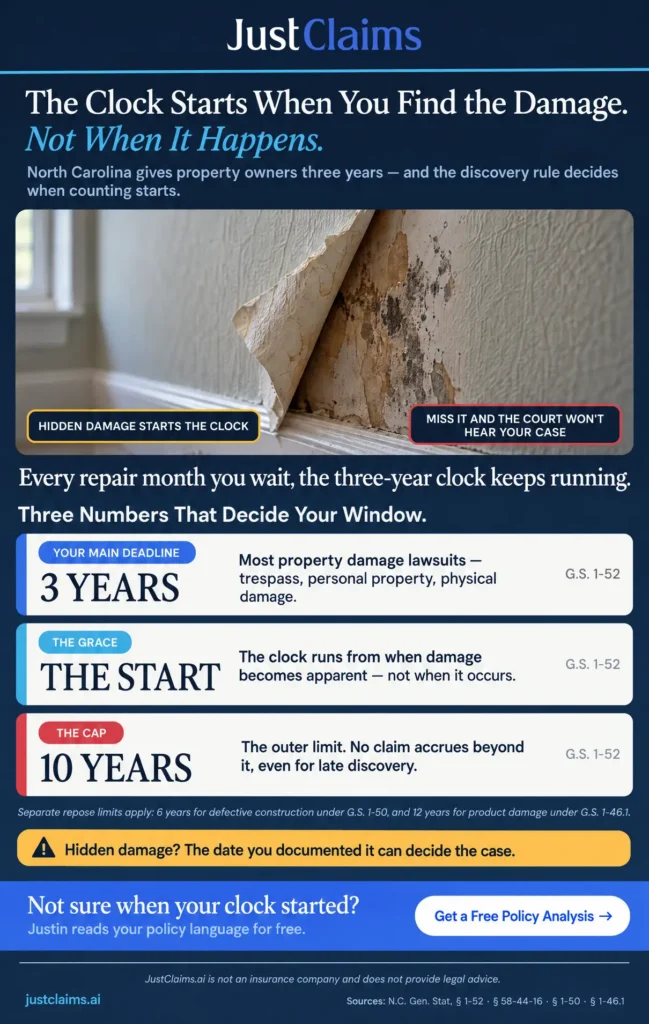
- Discovery rule: Under G.S. 1-52, a claim for physical damage to property does not accrue until the damage becomes apparent or ought reasonably to have become apparent.
- Repose limit: No cause of action accrues more than 10 years from the defendant’s last act or omission, subject to listed exceptions.
- Insurance losses: G.S. 1-52 applies the three-year limit to covered insurance policy losses subject to G.S. 58-44-16.
What a Statute of Limitations Means for Property Damage Claims
A statute of limitations is a legal deadline for filing a lawsuit. Once it passes, a court may dismiss the claim no matter how strong the underlying facts are. For a North Carolina property owner dealing with storm damage, a negligent contractor, or a denied insurance claim, the deadline is an important date in the case.
Two questions drive most deadline disputes: how long you have, and when the clock starts. North Carolina answers the first with a general three-year rule for property claims [1]. It answers the second with a discovery rule that, in some situations, delays the start of the clock until the damage is apparent [1].
The sections below cover both, along with the limits on those rules and the practical steps that help protect your position.
Civil Deadlines for Property Damage in North Carolina
Because the three-year limit is the foundation of every property damage deadline, it helps to see how it applies to each type of loss. N.C. Gen. Stat. § 1-52 is titled “Three years” and covers several kinds of property claims [1].
Trespass and Damage to Real Property
An action for trespass upon real property must be brought within three years [1]. For a continuing trespass, the action must be commenced within three years of the original trespass [1]. In practice, a property owner cannot treat an ongoing problem as a reason to wait indefinitely, because the count runs from the original event.
Damage to Personal Property
Under G.S. 1-52, an action for taking, detaining, converting, or injuring goods or chattels must also be filed within three years [1]. This category covers movable belongings such as furniture, vehicles, and equipment, as opposed to the land and structures themselves.
Insurance Policy Losses
G.S. 1-52 applies the same limit to claims for loss covered by an insurance policy that is subject to the limitation in G.S. 58-44-16. [1] [2] This is the statutory source for the deadline on property insurance claims. Your policy may also contain its own notice and filing conditions, so read it alongside the statute.
The most pressing of those conditions is usually the sworn proof of loss, which comes due long before the lawsuit window closes.
Quick Reference Table
| Type of Claim | Deadline | Statutory Reference |
|---|---|---|
| Trespass upon real property | Three years | G.S. 1-52 [1] |
| Continuing trespass | Three years from the original trespass | G.S. 1-52 [1] |
| Injury to goods or chattels (personal property) | Three years | G.S. 1-52 [1] |
| Physical damage to claimant’s property | Accrues when damage is apparent or should have been | G.S. 1-52 [1] |
| Covered insurance policy loss | Three years | G.S. 1-52 [1] |
Criminal Case Limits Versus Civil Property Claims
Criminal deadlines follow a separate statute. G.S. 15-1, titled “Statute of limitations for misdemeanors,” requires most misdemeanors to be charged within two years of the offense, with a ten-year period for certain listed misdemeanors. [3] The three-year limit in G.S. 1-52 governs most civil property damage actions [1].
If property damage resulted from conduct that may also be criminal, such as vandalism or arson, a criminal report and a civil or insurance claim run on separate tracks. An attorney can confirm which deadlines apply to your situation.
Discovery Rule, Repose, and Other Exceptions
A common pain point in property cases is hidden damage, so the exceptions to the standard clock can matter as much as the three-year rule itself.
The Discovery Rule
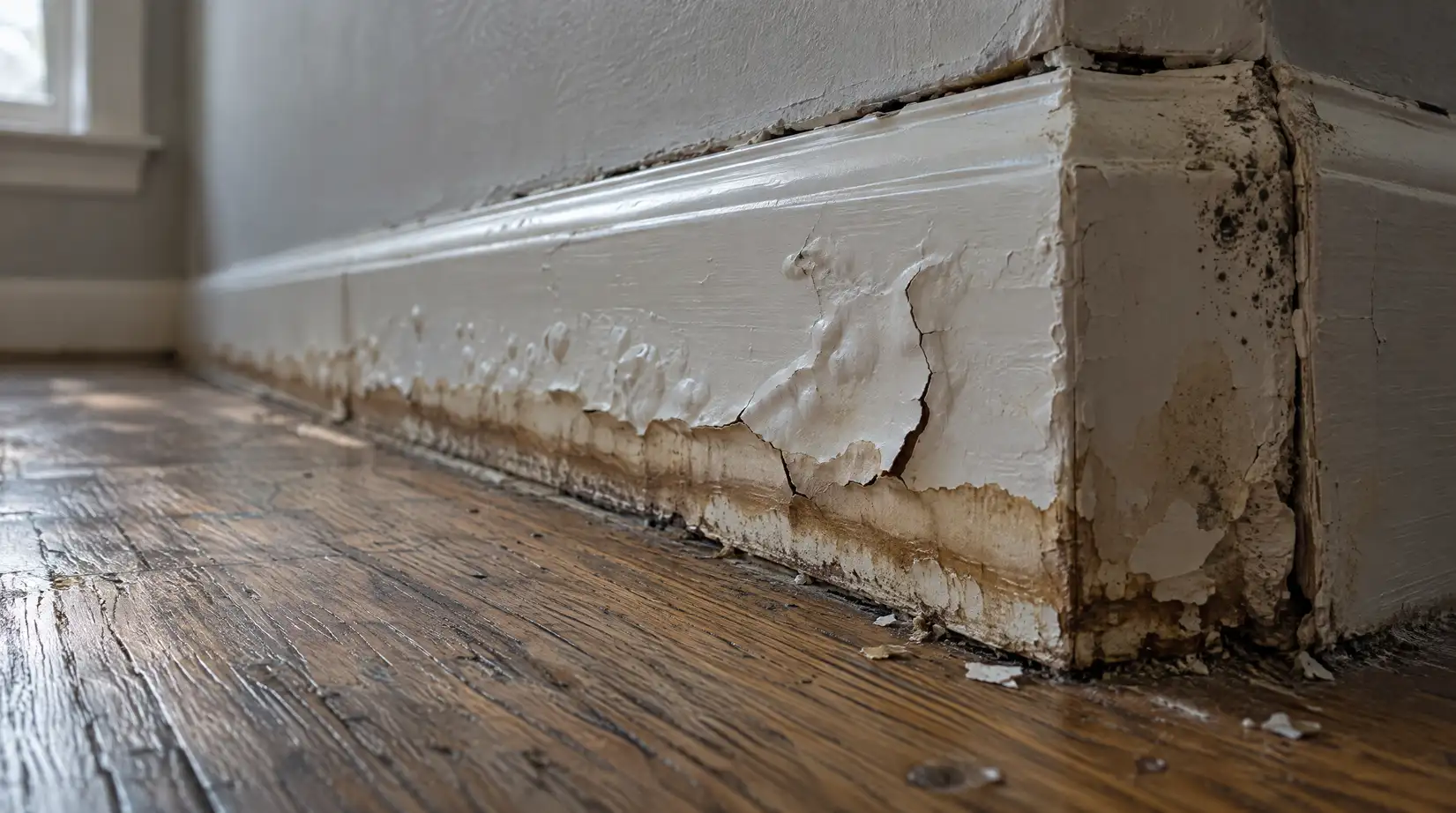
Under G.S. 1-52, a cause of action for physical damage to the claimant’s property does not accrue until the damage becomes apparent or ought reasonably to have become apparent, whichever comes first [1]. Water intrusion behind walls or deterioration beneath roofing are examples where the harm may not be visible right away. The “ought reasonably to have become apparent” language cuts both ways. If signs of damage were visible earlier, a court may treat the clock as having started earlier.
The Repose Limit
The same subsection sets an outer boundary. Except as provided in G.S. 130A-26.3 or G.S. 1-17(d) and (e), no cause of action accrues more than 10 years from the last act or omission of the defendant giving rise to the cause of action [1].
Even with the discovery rule, that outer limit can bar a claim that surfaces very late. Damage that surfaces only after the carrier has closed its file raises a separate question — reopening a closed claim follows its own set of timing rules.
Other repose periods can also apply depending on the claim. Defective or unsafe improvements to real property carry a six-year statute of repose under G.S. 1-50(a)(5), running from the later of the defendant’s last act or substantial completion [4]. Product-related property damage falls under a separate twelve-year repose measured from the date of initial purchase [5].
Other Tolling Situations
North Carolina law may pause or extend filing deadlines in limited circumstances, including claims involving minors or defendants who are outside the state. Those rules have their own conditions and are not detailed in the statute sections reviewed for this guide. Do not assume an exception applies without confirming it with a licensed attorney.
When to Consult an Attorney About Your Deadline
Because the discovery rule makes the start date arguable, the sooner the date is documented, the stronger your position can be. A few steps help:
- Record when you first noticed the damage. Notes, dated photos, and inspection reports can help show when the damage became apparent.
- Keep every communication with your carrier or contractor. Written records help establish what was reported and when.
- Ask an attorney to calculate your deadline. An attorney can identify which subsection applies, whether the discovery rule helps you, and whether the repose limit is a concern.
For disputes that go beyond a deadline calculation, choosing between a lawyer and a public adjuster depends on whether the fight is about coverage or the amount of the loss. - Check your policy for its own conditions. Notice requirements and claim procedures in the policy sit alongside the statute.
Frequently Asked Questions
How long do I have to sue for property damage in North Carolina?
Most property damage claims must be brought within three years under N.C. Gen. Stat. § 1-52. [1] The start date depends on the type of claim, and for physical damage it may be when the damage became apparent.
Does the clock start when the damage happens or when I find it?
For physical damage to your property, the claim does not accrue until the damage is apparent or should reasonably have been apparent to you, whichever is earlier. [1] A court may look at whether visible signs existed before you actually noticed the problem.
Does the same deadline apply to insurance claims?
Yes, for covered policy losses subject to the relevant limitation, the limit is three years after inception of the loss. [1] [2] Your policy may add its own notice and filing conditions, so review it promptly after a loss.
Is there a final cutoff even if I discover damage late?
Yes. The statute includes a repose provision stating that, with listed exceptions, no claim accrues more than 10 years after the defendant’s last act or omission [1]. Late-discovered damage can therefore still fall outside the law’s reach.
How to Protect Your Property Claim Rights
Property damage deadlines in North Carolina turn mainly on the three-year limit, the date the damage became apparent, and the type of claim [1]. The repose limit caps even late-discovered claims, so waiting for certainty can carry real risk [1]. Document when you first saw the damage, keep your insurer correspondence organized, and have an attorney confirm your filing date. Once the filing date is protected, attention can shift to the separate deadline for paying the claim.
To check how these deadlines intersect with your own policy language, upload your policy to Justin — the free AI insurance policy analyzer from JustClaims.ai — and review your coverage for gaps and likely underpayments while you still have time to act.
This content is for informational purposes only and does not constitute legal or insurance advice. Coverage decisions depend on the specific terms, conditions, and exclusions of each policy and the laws of the applicable jurisdiction; policyholders and contractors should consult with a qualified professional for advice on their particular situation.
Sources
[1] N.C. Gen. Stat. § 1-52 — Three years — North Carolina General Assembly
[3] N.C. Gen. Stat. § 15-1 — Statute of limitations for misdemeanors — North Carolina General Assembly
[5] N.C. Gen. Stat. § 1-46.1 — Twelve-year product liability repose — North Carolina General Assembly

Stephane Elias

A seasoned insurance professional with nearly a decade of experience, Stephane Elias is currently serving as a Senior Claims Professional and Public Adjuster with JustClaims. Throughout his career, Stephane has represented policyholders through leading public adjusting firms and served as a loss consultant for law firms specializing in insurance litigation, giving him extensive expertise in complex property insurance claims. A licensed public adjuster in TX (#2645032), FL (#W564547), and six other states, he specializes in commercial and residential property claims, claims management, appraisals, mediation, and strategic partnerships. Stephane is passionate about helping policyholders overcome delayed, denied, and underpaid insurance claims, ensuring they receive the full recovery they’re entitled to under their policy.