Sworn Statement in Proof of Loss: Guide & Tips 2026

September 22, 2026
Written by Stephane Elias
Share


Missing a single form deadline can cost a contractor’s client the entire value of an otherwise valid property damage claim. Courts across multiple states have confirmed that a sworn statement in proof of loss is not a formality — compliance with it is generally treated as a condition precedent to recovery under the policy, meaning an insurer can deny payment on a covered loss purely because the sworn statement arrived late or unnotarized.
Key Takeaways
- What it is: A sworn statement in proof of loss is a notarized document stating the amount of money being claimed and the basis for that figure.
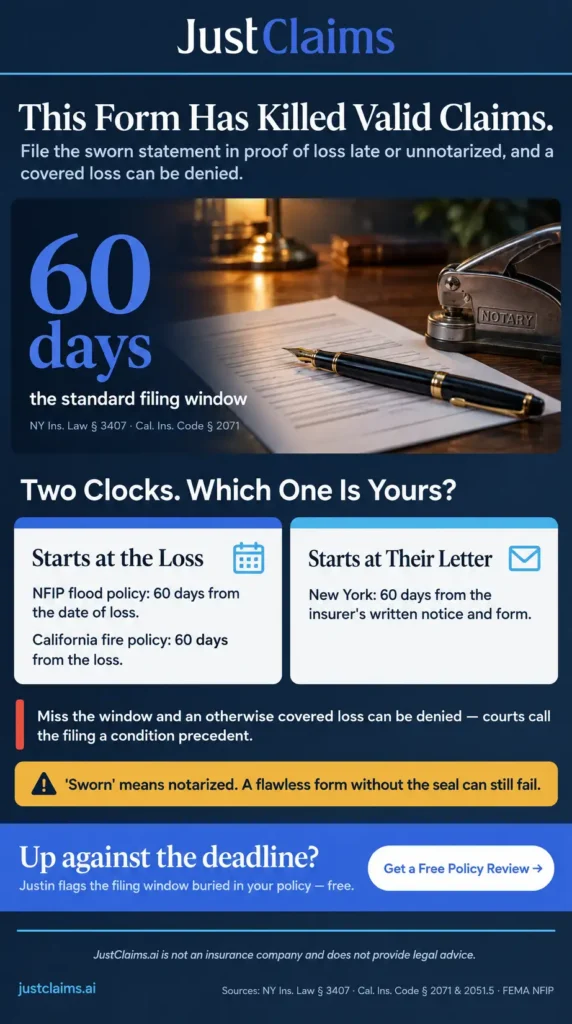
- Standard filing window: Many standard property policies require the sworn statement within 60 days of the insurer’s written request — New York codifies this in NY Ins. Law § 3407 — but the window and its trigger date vary by state and policy form.
- Flood insurance deadline: FEMA’s NFIP Standard Flood Insurance Policy requires a signed, completed proof of loss within 60 days of the date of loss itself, unless FEMA grants an extension.
- California disaster extension: Under Cal. Ins. Code § 2051.5(b)(3), insurers cannot require a sworn proof of loss sooner than 100 days after a loss connected to a Governor-declared state of emergency.
- Notarization requirement: Under Illinois law, “sworn” specifically means notarized — a notarization cannot be transplanted from one document to another.
- Governing statute example: New York Insurance Law § 3407 requires the proof of loss to be furnished within 60 days after the insurer requests it and provides the form.
Definition and Legal Significance
A sworn statement in proof of loss is the formal, notarized document on which a policyholder details the property damaged, the cause of loss, and the exact dollar amount being requested from the insurer. Courts have described its purpose as giving the insurer “an adequate opportunity for investigation, to prevent fraud and imposition upon it, and to enable it to form an intelligent estimate of its rights and liabilities before it is obliged to pay” [1].
That legal framing matters for contractors: the document is not a summary of a repair estimate — it is a sworn representation that carries real evidentiary weight if the claim is later disputed.
Several states codify this directly. New York Insurance Law § 3407 requires a policyholder to furnish the proof of loss within 60 days after the insurer requests it and provides the form [2].
Georgia Code § 33-24-39 requires insurers to furnish the form upon written request, and Georgia courts treat the filing of a proof of loss as a condition precedent to recovery under the policy [3][4]. Louisiana Revised Statute 22:1892.3 goes further, providing a model form and structure that establishes the document’s statutory weight in claims processing [5].
The word “sworn” is doing real legal work here. An Illinois appellate court read the standard policy language as requiring the proof of loss to be “signed” by the insured and “‘sworn,’ i.e., notarized” — and held that an earlier submission of repair estimates was no substitute for the sworn statement itself [6]. For a contractor supporting a property owner’s claim, this distinction is the difference between a document that satisfies the policy and one that an adjuster can reject outright.
Step-by-Step Filing Process
Because a technical defect in this form can undo months of legitimate repair documentation, the filing process has to be treated as a controlled sequence rather than a single form to fill out and sign.
Building the Loss Package
A proof-of-loss filing should be assembled as a full package built around cause, scope, and cost — not just the form itself. United Policyholders’ guidance for contents claims is blunt about the core discipline: document, list, and value every damaged or destroyed item, and produce available receipts, photographs, and other evidence [7].
Contractors preparing scope documents for a property owner should keep this package assembled in parallel with the repair estimate, since California’s statutory standard fire policy under Cal. Ins. Code § 2071 requires the signed and sworn proof of loss within 60 days after the loss unless the insurer extends that window in writing [8].
Completing the Sworn Statement Field by Field
Filling out the form is a field-by-field exercise: capture the basics (insured, insurer, policy number, claim number, property, and loss details), establish property interests (ownership, mortgagee, occupancy), and quantify the loss using the policy’s actual valuation rules rather than shortcut formulas. This is where contractor-prepared estimates are most useful — but the estimate has to map directly onto the policy’s valuation method, not a generic per-square-foot number, and every line item should tie back to documented damage with receipts, photographs, or other evidence [7]. The difference between RCV and ACV decides what those line items are ultimately worth.
Notarizing and Submitting the Form
Once completed, the form must be notarized: the filer signs and dates it in front of a notary, who validates and signs to confirm the signature. Under the Illinois appellate reading of standard policy language, “sworn” means notarized — so a form submitted without notarization can fail the policy’s literal requirements regardless of how accurate the underlying numbers are [6].
Before sending, it is worth saving a complete copy of the exact form, cover letter, and every attachment, then following the insurer’s specified delivery method — portal, email, or trackable mail — and preserving the confirmation as proof of delivery.
Critical Deadlines: The 60-Day Standard
Because so many proof of loss disputes hinge on timing rather than the underlying damage, the deadline itself is often the single highest-risk element of the filing.
| Policy or Program Type | Filing Deadline | Trigger Date |
|---|---|---|
| NFIP Standard Flood Insurance Policy | 60 days | Date of loss [9] |
| New York (Ins. Law § 3407) | 60 days | Receipt of insurer’s notice and form [2] |
| California standard fire policy (Ins. Code § 2071) | 60 days | Date of loss [8] |
| California, Governor-declared emergency (§ 2051.5(b)(3)) | Not less than 100 days | Date of loss [10] |
The distinction between “days from the date of loss” and “days from the insurer’s written request” is not a technicality — it changes when the clock starts. New York counts 60 days from the insurer’s notice [2], while California’s standard fire policy and the NFIP count from the date of loss [8][9] — so the trigger date must be confirmed against the specific policy and jurisdiction.
Georgia’s appellate courts have described the filing of a proof of loss as a condition precedent to recovery, which means a missed window can put an otherwise covered loss at risk [4]. California’s emergency extension under § 2051.5(b)(3) is a rare exception where insurers must also grant further extensions for good cause when delays are outside the policyholder’s control [10].
Common Pitfalls: Underestimated Costs and Missed Dates
Since the central risk here is technical denial rather than a genuine coverage dispute, most pitfalls trace back to two root causes: timing confusion and incomplete documentation.
Missing the deadline is the first recurring mistake. Some policies count the filing window from the date of loss, while others count it only after the insurer requests the form — New York’s 60-day window runs from the insurer’s notice, while the NFIP and California’s standard fire policy run from the date of loss [2][8][9].
The NFIP requires a signed, sworn proof of loss within 60 days of the date of loss, and extensions exist only where FEMA grants them [9].
Forgetting notarization is the second recurring error. The notary’s witnessing and seal is what legally transforms the document into the sworn statement the policy requires — under the Illinois appellate reading, “sworn” means notarized, and a flawlessly prepared form can still fall short of the policy’s requirements if it was never notarized [6].
Underestimating costs is the third. A complete submission should include an itemized inventory of damaged property with values, itemized contractor or repair estimates, dated photographs and video, and receipts or other evidence of ownership and value — the same documentation discipline United Policyholders prescribes for contents claims [7].
Every gap left in the package is time spent reconstructing records while the filing window continues to run. A room-by-room contents inventory built before the loss makes those values far easier to defend.
Frequently Asked Questions
What is a sworn statement in proof of loss?
It is a notarized document a policyholder submits to their insurer stating the amount of money being requested for a covered loss, along with supporting details about the cause and scope of damage. Its legal purpose is to give the insurer enough information to evaluate liability before payment is owed [1].
How long do I have to file a proof of loss?
The most common window is 60 days, but the starting point varies by policy and state — New York counts from the insurer’s written request, while NFIP flood policies and California’s standard fire policy count from the date of loss itself [2][8][9]. Always confirm the trigger date in the specific policy before assuming a deadline.
What happens if the proof of loss deadline is missed?
Missing the deadline can put an otherwise covered loss at risk — Georgia’s courts treat the filing as a condition precedent to recovery — unless the insurer has agreed to waive or extend the timeframe [4]. Some states, such as California during a declared emergency, require insurers to extend that window and grant further extensions for good cause [10].
Does a sworn statement in proof of loss need to be notarized?
Yes. An Illinois appellate court read “signed and sworn” to mean the insured’s signature plus notarization — and held that earlier, unsworn submissions like repair estimates do not satisfy the requirement [6]. Submitting the form without a valid notarization can jeopardize an otherwise well-documented claim.
Can a contractor fill out the proof of loss for a property owner?
A contractor can help assemble the supporting documentation — the itemized inventory, repair estimate, and photo evidence — but the sworn statement itself is signed and notarized by the policyholder, since it is their sworn representation to the insurer [6]. Contractors are still the best-positioned party to make sure the cost figures in that statement reflect the true scope of repair work rather than a shortcut estimate, backed by the receipts, photographs, and itemized records that support the claimed values [7].
How You Can Avoid Proof of Loss Denials
The pattern across every state statute and policy form cited here is the same: insurers are permitted to deny a claim over a missed date or an unnotarized signature, even when the underlying damage is fully covered. Property owners and the contractors supporting their claims reduce that risk by tracking the deadline from the correct trigger date, building the documentation package before the form is due, and confirming notarization before submission rather than after a denial letter arrives.
If a proof of loss was rejected or underpaid over a technical filing issue, the next step is understanding exactly what the policy required in the first place — upload your policy for a free commercial property insurance policy review and Justin will flag the proof-of-loss provisions, deadlines, and conditions that decide whether the claim can go back to the carrier with a clearer basis for payment.
This content is for informational purposes only and does not constitute legal or insurance advice. Coverage decisions depend on the specific terms, conditions, and exclusions of each policy and the laws of the applicable jurisdiction; policyholders and contractors should consult with a qualified professional for advice on their particular situation.
Sources
[1] Sutton v. Fire Insurance Exchange, 509 P.2d 418 (Or. 1973) — Justia
[2] New York Insurance Law § 3407 — NYSenate.gov
[3] Georgia Code § 33-24-39 — Justia
[5] Louisiana Revised Statute 22:1892.3 — Louisiana State Legislature
[7] Home Inventory and Contents Claim Tips — United Policyholders
[8] California Insurance Code § 2071 — California Legislative Information
[9] NFIP Claims Manual (June 2025) — FEMA
[10] Ask an Expert: Proof of Loss (Cal. Ins. Code § 2051.5(b)(3)) — United Policyholders

Stephane Elias

A seasoned insurance professional with nearly a decade of experience, Stephane Elias is currently serving as a Senior Claims Professional and Public Adjuster with JustClaims. Throughout his career, Stephane has represented policyholders through leading public adjusting firms and served as a loss consultant for law firms specializing in insurance litigation, giving him extensive expertise in complex property insurance claims. A licensed public adjuster in TX (#2645032), FL (#W564547), and six other states, he specializes in commercial and residential property claims, claims management, appraisals, mediation, and strategic partnerships. Stephane is passionate about helping policyholders overcome delayed, denied, and underpaid insurance claims, ensuring they receive the full recovery they’re entitled to under their policy.