Denominational Church Insurance Claims: 2026 Guide
September 30, 2026
Written by Taylor Bezek
Share


A Texas jury once awarded Green Acres Baptist Church $4.8 million in actual damages and $35 million in punitive damages after Brotherhood Mutual disputed a hailstorm claim — a verdict the trial court later set aside, but one that shows how differently insurers treat churches when governance and ownership questions get tangled up in the claim file. Every denomination handles property claims through its own chain of approval, and confusion over who actually has authority to sign off on repairs can stall payment for months. Understanding your denomination’s specific claim vocabulary — diocese, synod, session, vestry, charge conference — is often the difference between a fair settlement and a denied or underpaid one.
Key Takeaways
- Case precedent: A Texas jury awarded Green Acres Baptist Church $4.8 million in actual damages and $35 million in punitive damages against Brotherhood Mutual over a disputed hailstorm claim, though the trial court later set the award aside.
- Diocese settlement: The Catholic Diocese of Winona-Rochester reached a $30 million settlement with United States Fire Insurance Company in August 2026.
- Survivors covered: That settlement resolved claims tied to more than 145 survivors.
- Bankruptcy filing: The diocese filed Chapter 11 bankruptcy in 2018 before finalizing the settlement.
- Prior settlement: The diocese had reached a $21.5 million settlement in 2021 with a creditors’ committee representing those survivors.
- Wildfire response: The Episcopal Diocese of Los Angeles provided cash assistance to affected parishes following the 2025 Southern California wildfires.
Why Church Governance Changes How a Claim Gets Filed
A denied or underpaid claim rarely starts with the damage itself — it starts with confusion over who has the authority to sign the proof of loss, approve repair estimates, or accept a settlement offer. Insurance carriers routinely ask for documentation of governance authority before releasing payment, and a delay in producing that documentation can stall a claim for months. The signature question starts with the policy itself: who is listed as the named insured — the congregation, the diocese, or a separate title-holding entity — determines whose authority the carrier checks first.
Case law involving University Baptist Church of Fort Worth and Lexington Insurance, which reached the Fifth Circuit Court of Appeals, centered partly on how long an insurer’s delay in approving a claim can deprive a congregation of the benefit of its policy [1].
Property owners who understand their denomination’s exact approval chain — and can produce the right meeting minutes or diocesan letter quickly — put themselves in a stronger position when a carrier starts asking procedural questions instead of paying the claim.
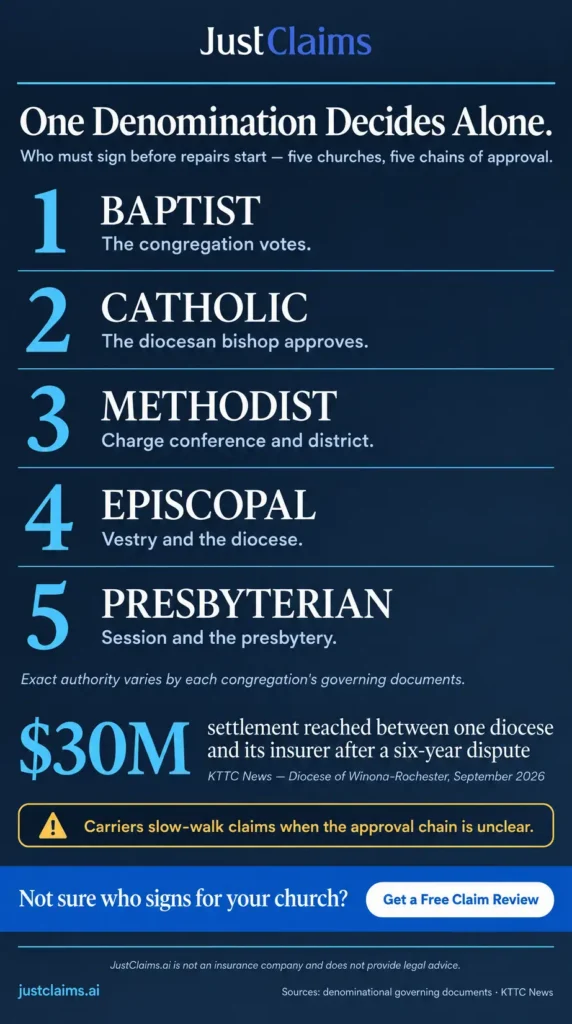
| Denomination | Who Approves the Claim | Who Owns the Property | Filing Authority |
|---|---|---|---|
| Baptist | Congregation vote, deacons and trustees | Local congregation (autonomous) | Trustees, acting on congregation vote |
| Catholic | Pastor administers, under the bishop or Ordinary’s oversight | The juridic person that acquired it; civil title varies by state | Diocesan finance office or chancery, with the parish |
| Methodist | Charge conference and board of trustees | Held in trust for the annual conference | Board of trustees, with District Superintendent notified |
| Episcopal | Vestry, with rector and wardens | Parish corporation, under diocesan canons | Senior warden or vestry-designated officer |
| Presbyterian | Session, with larger matters escalated to presbytery | Local church, held in trust for the denomination | Clerk of session, presbytery notified |
Typical structures, summarized from each denomination’s own governing documents: the Baptist Faith and Message (congregational autonomy) [2], the Code of Canon Law (cc. 1256, 1276) [3], the United Methodist Book of Discipline trust clause (¶ 2503) [4], the Episcopal Church’s Canon I.7.4 [5], and the PC(USA) Book of Order (G-4.0203) [6]. Your congregation’s own bylaws, deeds, and diocesan or conference offices control — verify them before you file.
Baptist Churches: Congregation Vote, Deacons and Trustees
Because Baptist congregations are governed by local autonomy rather than a regional hierarchy, a carrier cannot simply point to a diocesan office and demand sign-off — the approval trail runs through the congregation itself.
The Green Acres Baptist Church case illustrates how high the stakes can get when a hailstorm claim turns into a bad-faith dispute: the initial jury award of $4.8 million in actual damages and $35 million in punitive damages against Brotherhood Mutual reflected how seriously courts can treat bad-faith allegations against a Baptist congregation’s insurer, even though the trial court set the verdict aside in July 2025 [7].
Trustees who keep dated meeting minutes authorizing claim-related decisions can respond faster when a carrier requests proof of authority.
What to Do When a Baptist Church Insurance Claim Is Underpaid
First Baptist Church of LaPlace alleged in a 2022 federal lawsuit that Church Mutual grossly underpaid its storm damage claim, paid outside Louisiana’s 30-day statutory window, and attributed Hurricane Ida damage to an earlier storm (E.D. La. No. 2:22-cv-00884) [10].
When a congregation believes an insurer’s payout does not match the actual cost of repairs, the trustees should request a detailed line-item breakdown of the adjuster’s estimate and compare it against at least one independent contractor bid. Documenting the gap between the two figures, in writing, before accepting a settlement check gives the congregation leverage if the dispute later requires an appraisal or litigation. That written gap is also the foundation for pushing back on a low settlement — carriers revise estimates when the shortfall is documented line by line.
Catholic Parishes, Dioceses and Archdioceses: Who Signs the Claim
Catholic property claims raise a governance question that other denominations rarely face: the parish that suffered the damage, the diocese that oversees it, and the civil title holder are not always the same party, and canon law vests oversight of church property in the diocesan bishop [3].
That structure sits behind the Catholic Diocese of Winona-Rochester’s $30 million settlement with United States Fire Insurance Company, announced in August 2026, which resolved claims tied to more than 145 survivors[8] — following the diocese’s Chapter 11 bankruptcy filing in November 2018 and an earlier $21.5 million settlement in 2021 with a creditors’ committee representing those survivors [9].
Parish staff who assume they can negotiate directly with an adjuster may find the carrier will not finalize payment without diocesan sign-off, adding weeks to the timeline if that step is not anticipated early.
What to Do When a Catholic Church Insurance Claim Is Denied
When a Catholic parish’s claim is denied or underpaid, the diocesan finance office should request the carrier’s full written denial rationale, including the specific policy exclusion cited, before any repair work begins. Parishes that document damage with dated photographs and a licensed contractor’s inspection report — and route that documentation through the diocese rather than handling it informally — build a stronger record if the diocese later decides to pursue a bad-faith claim.
Methodist Churches: Charge Conference and Board of Trustees
Methodist polity places claim authority with the local church’s board of trustees, but major decisions typically require charge conference approval, and the District Superintendent often plays a coordinating role once a claim escalates. I
n Iowa, United Methodist churches have faced escalating insurance rate hikes and, in some cases, lost coverage entirely following hail and wind damage claims, prompting the Iowa Annual Conference to direct affected churches to contact their District Superintendent for support navigating hail and wind claims [11]. A carrier non-renewing after hail claims is not unique to Iowa — whether an insurer can drop you after a claim depends on state rules and the policy’s own terms.
Boards of trustees that loop in the District Superintendent early — rather than after a denial letter arrives — may have an easier time coordinating a response, since the conference office often has visibility into how other churches in the region have fared with the same carrier.
Episcopal Churches: Vestry, Rector and Wardens
Episcopal parishes operate under a governance model where the vestry, working with the rector and wardens, holds authority over most property and financial decisions, though the underlying real property is typically held subject to diocesan canons. When disaster strikes at scale, diocesan support structures become critical to individual parish recovery.
The Episcopal Diocese of Los Angeles, in partnership with Episcopal Relief & Development, provided cash assistance and technical support to parishes affected by the 2025 Southern California wildfires as part of a coordinated claim and recovery response [12].
Vestries facing a major loss should confirm with the diocesan office whether disaster-specific support — beyond the standard insurance claim — is available before finalizing a settlement with the carrier. A loss on that scale changes the settlement math, and the catastrophic claims payout playbook applies whether the disaster is wildfire, hail, or hurricane.
Presbyterian Churches: Session, Presbytery and Synod
Presbyterian governance runs through the session at the local level, with larger property decisions frequently requiring notice to or approval from the presbytery, and in some cases the synod. Because local church property in the Presbyterian Church (U.S.A.) is held in trust for the denomination under the Book of Order [6], the session’s clerk should confirm early in the claims process whether presbytery approval is a prerequisite for accepting a settlement offer or entering a repair contract.
Sessions that treat the presbytery as a resource rather than an obstacle — requesting guidance on carrier communication or documentation standards — often move through the claims process with fewer procedural delays.
Frequently Asked Questions
Who has the legal authority to sign a diocesan property insurance claim?
Under canon law, ownership of church property belongs to the juridic person that acquired it, while the diocesan bishop exercises oversight of how it is administered[3]. In practice, the required signature can sit with the parish, the diocese, or both — the diocesan finance office or chancery can confirm who must sign. Confirming this early prevents a carrier from stalling payment over a signature authority question.
What happens if a Catholic church insurance claim is denied?
The parish or diocese should request the carrier’s complete written denial explanation, including the exact policy exclusion cited, and compare that language against the actual damage documentation. Litigation such as the First Baptist Church of LaPlace case in Louisiana shows that congregations can challenge an insurer that underpays a storm damage claim [10].
How does a Methodist church’s District Superintendent help with an insurance claim?
The District Superintendent often serves as a coordinating resource between the local board of trustees and the annual conference office, particularly for storm-related claims. In Iowa, the Annual Conference now directs churches facing hail and wind claim disputes to reach out to their District Superintendent for support [11].
Does an Episcopal parish need diocesan approval before accepting a settlement?
While the vestry generally manages day-to-day financial decisions, real property in Episcopal parishes is held subject to diocesan canons, so major settlements or repair contracts may require coordination with the diocesan office. Diocesan disaster-response programs, like the wildfire recovery support offered by the Diocese of Los Angeles, can also provide resources beyond what the insurance claim alone covers [12].
How to Get Your Church’s Claim Reviewed
Whatever your denomination’s structure, the underlying problem is the same: carriers move faster when they can identify a clear decision-maker, and they slow down — or deny outright — when governance questions are unresolved. Congregations that map out their approval chain before filing, and that keep dated records of trustee votes, vestry minutes, or diocesan correspondence, are better positioned to challenge a denial or an underpaid settlement — the same documentation at the center of the Green Acres Baptist Church and First Baptist Church of LaPlace cases. Reviewing your denomination’s specific claim workflow against your policy language before you accept an adjuster’s first offer can reveal gaps the carrier is counting on you not to notice.
Get a free AI policy review from Justin — to see whether your diocese-, synod-, or session-approved claim was underpaid relative to your actual coverage.
This content is for informational purposes only and does not constitute legal or insurance advice. Coverage decisions depend on the specific terms, conditions, and exclusions of each policy and the laws of the applicable jurisdiction; policyholders and contractors should consult with a qualified professional for advice on their particular situation.
Sources
[2] The Baptist Faith and Message 2000, Article VI: The Church — Southern Baptist Convention
[3] Code of Canon Law, Book V: The Temporal Goods of the Church (Cann. 1254–1310) — The Holy See
[6] Book of Order 2025–2027, G-4.0203 (Property Held in Trust) — Presbyterian Church (U.S.A.)
[10] Louisiana Church Sues Insurer for Alleged Inadequate Storm Damage Coverage — Insurance Journal
[12] Responding to the Wildfires in Southern California — Episcopal Relief & Development

Taylor Bezek

As the General Manager at JustClaims, Taylor Bezek brings over a decade of experience managing complex residential, commercial, and large-loss claims. A licensed Public Adjuster in TX (#2125659), FL (#W455048), CO (#769172), and 10 additional states, Taylor founded his own firm before joining JustClaims to scale a tech-forward solution for the insured. He is committed to combining industry expertise with AI to enhance speed, clarity, and outcomes for every policyholder. Taylor's mission is to modernize the public adjusting profession and ensure owners get exactly what they are entitled to.