Maximum Flood Insurance Coverage: NFIP Limits 2026

September 25, 2026
Written by Collin Corcoran
Share


Commercial flood policies written through the National Flood Insurance Program cap building coverage at $500,000 and contents coverage at a separate $500,000 — ceilings that have not moved even as construction and replacement costs have climbed. For a mid-size commercial property, that combined $1 million ceiling can represent only a fraction of actual rebuild value after a major flood. A single overlooked valuation gap, or the assumption that federal limits equal full protection, can cost an organization millions in uncovered losses.
Key Takeaways
- Residential building cap: NFIP dwelling coverage tops out at $250,000 for the structure, with contents capped at $100,000.
- Commercial building cap: NFIP commercial policies allow up to $500,000 in building coverage and a separate $500,000 in contents coverage.
- High-value exposure: the median U.S. existing single-family home price hit a new high of $412,500 in 2024, exceeding the NFIP’s residential building limit.
- Excess flood layering: private-market excess flood insurance builds on an NFIP base policy — the NAIC notes excess flood buyers must carry NFIP coverage first — adding building and contents protection above the federal caps.
- Basement exclusions: NFIP basement coverage excludes finished flooring, finished walls, and personal property, covering only specific power-connected equipment like furnaces and sump pumps.
- Detached structures: Only 10 percent of a dwelling’s building coverage may be applied to a detached garage, and other appurtenant structures require separate policies.
NFIP Residential Limits ($250,000 Structure / $100,000 Contents)
Even for commercial property owners who primarily insure business assets, understanding the residential side of the NFIP schedule matters — many portfolios include mixed-use or small multifamily buildings governed by the same rules. Under the NFIP Dwelling Form, a residential building can be insured for up to $250,000 in building coverage, and personal belongings inside that structure can be insured up to $100,000 in contents coverage [1][2][3]. These figures apply per building, not per unit, which becomes significant for owners of small multifamily assets.
The Congressional Research Service confirms that single-family dwellings — including individual units inside a 2-4 family building — are held to the same $250,000 building and $100,000 contents ceiling, while other residential structures such as larger apartment buildings can qualify for building coverage up to $500,000, though contents remain capped at $100,000 [4].
Property owners should also note that any Increased Cost of Compliance (ICC) claim, which helps pay for bringing a damaged structure up to current floodplain codes, is drawn from the same $250,000 building limit rather than added on top of it [2]. That structural detail alone has caused many claims to fall short of full rebuild costs.
Commercial Coverage Caps ($500,000 / $500,000)
Because federal limits were designed decades ago around residential loss patterns, the caps governing commercial buildings tell a similarly restrictive story — one with far greater financial stakes for business owners.
The NFIP extends flood coverage to commercial buildings and commercial personal property, with up to $500,000 available for each type of policy [5][6]. That means a commercial property owner can secure a maximum of $500,000 for the physical structure and a separate $500,000 for contents such as furniture, fixtures, inventory, machinery, and equipment [7]. When that contents ceiling becomes the real constraint, a commercial contents inventory compiled before any loss is what makes the recoverable fraction defensible.
For a small retail location or a modest warehouse, that ceiling may align reasonably well with replacement value. For a manufacturing facility, a multi-tenant office building, or a property carrying significant inventory, the same $1 million combined ceiling can represent only a fraction of actual exposure.
The Congressional Research Service and FEMA both confirm that $500,000 for building coverage and $500,000 for contents coverage represent the maximum available under a standard NFIP commercial policy — the federal program itself offers no higher limits [4][3]. Owners evaluating whether that combined coverage total is adequate should weigh it against current replacement cost estimates, not original purchase price, since construction costs have risen substantially since many policies were first written.
| Coverage Category | Residential (NFIP) | Commercial (NFIP) |
|---|---|---|
| Building coverage | $250,000 | $500,000 |
| Contents coverage | $100,000 | $500,000 |
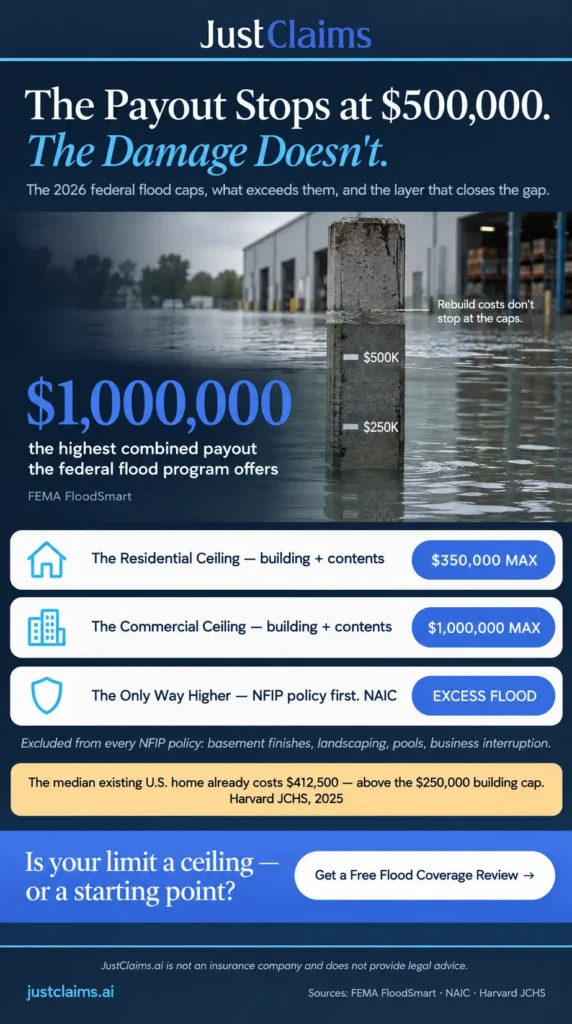
| Combined maximum | $350,000 | $1,000,000 |
The Role of Excess Flood Insurance for High-Value Properties
Given that both residential and commercial NFIP limits were fixed well below what modern construction and asset values require, excess flood insurance exists specifically to close that documented gap. For residential structures, NFIP building and contents coverage combine for a maximum of $350,000, calculated from the $250,000 building limit plus the $100,000 contents limit [3].
The median U.S. existing single-family home price hit a new high of $412,500 in 2024 — a figure that alone exceeds the residential building cap before contents, mortgage payoff, or rebuild-cost inflation are even considered [8].
Commercial property owners face a parallel — and often larger — mismatch, since the combined $1 million in NFIP building and contents coverage rarely reflects the replacement value of a mid-size commercial asset.
| Coverage Type | NFIP Base Limit | Excess Flood Layer (Private Market) |
|---|---|---|
| Building | $250,000 (residential) / $500,000 (commercial) | Pays covered building losses above the NFIP limit, up to the excess policy’s own limit |
| Contents | $100,000 (residential) / $500,000 (commercial) | Pays covered contents losses above the NFIP limit, up to the excess policy’s own limit |
Under a typical excess flood structure, the owner first carries an NFIP policy up to its maximum, and the private excess policy pays covered losses above that federal limit, up to its own limit — the NAIC notes that excess flood insurance requires NFIP coverage in place first [9].
The mechanics get harder once a claim spans both layers — managing layered flood claims usually means keeping one documented timeline while two carriers sort out order of response.
Property owners carrying assets valued well above the federal ceiling should request a current replacement-cost valuation before assuming NFIP coverage alone is sufficient — a minor valuation error at this stage can translate into an uncovered loss worth millions once a major flood event occurs.
Layered claims that span an NFIP base policy and a private excess policy also require confirming which policy responds first and how each limit applies — a review best done before a loss, not after.
What Flood Insurance Doesn’t Cover
Because federal and excess flood limits define the ceiling of coverage, property owners also need to understand the floor — the categories of loss that no flood policy, federal or private, will pay for at all. FEMA excludes basement improvements from flood coverage entirely, including finished flooring, finished walls, bathroom fixtures, and other built-ins, along with personal property such as couches, computers, televisions, and generators [10]. Sorting the excluded categories from the recoverable remainder is what flood damage insurance claim assistance exists to do — before a mislisted document writes basement losses to zero.
Coverage in a basement — defined by the NFIP as any area with a floor below ground level on all sides, including sunken living rooms, crawlspaces, and lower levels of split-level buildings — is limited to specific power-connected equipment like furnaces, water heaters, sump pumps, and central air units, plus a short list of contents such as portable or window air conditioning units, clothes washers and dryers, and food freezers with the food inside them [11].
Landscaping, crops, and other items located outside a building are not insurable under the NFIP, and the same exclusion applies to swimming pools, fences, docks, driveways, open pavilions, detached carports with open sides, and gas or liquid storage tanks [11].
Detached structures carry their own restriction: only 10 percent of a dwelling’s building coverage may be applied to a detached garage, and other appurtenant structures such as sheds, pool houses, or guesthouses require a separate policy rather than automatic inclusion [11].
Commercial property owners with equipment yards, detached warehouses, or outdoor inventory storage should confirm which structures are actually scheduled under their policy, since an assumption of blanket coverage is one of the more common — and costly — gaps found during a post-loss review. Bringing in a licensed public adjuster for that snapshot before renewal usually costs less than discovering the gap after a total loss.
Lenders cannot use the NFIP’s mandatory purchase requirement to force coverage on items the program excludes outright, such as vehicles, business expenses, landscaping, and vacant lots, even on federally backed loans [11]. Property owners should treat this exclusion list as a planning tool: any asset that falls into one of these categories needs a separate policy, a different coverage line, or an accepted risk decision made well before a flood event, not after a denied claim arrives.
Frequently Asked Questions
What is the maximum amount of NFIP flood insurance coverage for a home?
NFIP dwelling policies max out at $250,000 for the building and $100,000 for contents, for a combined ceiling of $350,000 [1][3]. Owners of higher-value homes typically need a private excess flood policy to close the remaining gap between that ceiling and actual replacement cost.
How much NFIP flood coverage can a commercial property owner get?
A commercial NFIP policy allows up to $500,000 for the building and a separate $500,000 for contents such as inventory, fixtures, and equipment [5][7]. Larger commercial assets generally require excess flood insurance layered on top of those federal limits to reach full replacement value.
Does flood insurance cover a finished basement?
No — the NFIP excludes finished basement improvements like flooring, drywall, and built-in fixtures, along with most personal belongings [10][11]. Only specific mechanical equipment connected to the structure’s power supply, such as furnaces and sump pumps, is covered inside a basement.
Is landscaping covered under a flood insurance policy?
Landscaping is explicitly excluded from NFIP coverage, along with items like pools, fences, driveways, and outdoor storage tanks [11]. Property owners with significant outdoor or hardscape investments need to plan for those losses separately, since no standard flood policy treats them as insurable building property.
What is excess flood insurance and who needs it?
Excess flood insurance is a private-market policy that sits on top of an NFIP base policy and pays covered losses above the federal limits, up to the excess policy’s own limit [9]. Property owners whose replacement value exceeds the $250,000 residential or $500,000 commercial NFIP ceiling are the primary candidates for this additional layer of protection.
How to Close Your Flood Coverage Gap
Federal flood insurance limits were set as a floor for basic protection, not a ceiling engineered around modern asset values. Commercial property owners carrying replacement costs above the $500,000 NFIP building and contents caps face a documented exposure that excess flood insurance is specifically built to address, while categories like basements, landscaping, and detached structures remain outside any flood policy’s reach entirely.
Before the next flood season, property owners should compare current NFIP declarations pages against an up-to-date replacement-cost estimate and identify any detached or below-grade assets that may need separate coverage. NFIP policies do not cover business interruption or loss-of-use losses [5], so owners carrying income exposure should weigh private or excess options with that gap in mind.
Upload your flood policy and valuation documents for a free flood insurance coverage review from Justin to see whether your building and contents limits match your property’s actual replacement value.
This content is for informational purposes only and does not constitute legal or insurance advice. Coverage decisions depend on the specific terms, conditions, and exclusions of each policy and the laws of the applicable jurisdiction; policyholders and contractors should consult with a qualified professional for advice on their particular situation.
Sources
[1] Types of Flood Insurance Coverage — NFIP FloodSmart (FEMA)
[2] NFIP Summary of Coverage — North Carolina Department of Insurance (FEMA)
[3] Reducing Damage from Localized Flooding: A Guide for Communities, Chapter 11 (FEMA 511) — FEMA
[5] The Ins and Outs of NFIP Commercial Coverage — NFIP FloodSmart (FEMA)
[6] What Is NFIP Coverage for Commercial Properties? — FDIC
[8] The State of the Nation’s Housing 2025 — Harvard Joint Center for Housing Studies
[9] Flood Insurance — National Association of Insurance Commissioners (NAIC)
[10] What Does Flood Insurance Cover in a Basement? — FEMA
[11] NFIP Study Guide Unit 9: Flood Insurance and Floodplain Management — FEMA

Collin Corcoran

Experienced Public Adjuster and Property Claims Specialist, Collin is licensed in New York (#1603393), New Jersey (#3003700204), and Connecticut (#19820270). With 20+ years of hands-on construction and property damage experience, he specializes in residential and commercial claims, complex loss inspections, policy review, detailed estimating, and strategic negotiation. Collin’s background in construction, asset management, emergency response, and claims documentation allows him to accurately identify damage, understand repair requirements, and advocate effectively for policyholders. He works with homeowners, business owners, contractors, and insurance professionals to move claims forward with clarity, accuracy, and confidence. Collin is committed to transparency, technical precision, strong communication, and securing fair outcomes for policyholders.