Can Insurance Drop You? 2026 Guide to Policy Rights
September 23, 2026
Written by Collin Corcoran
Share


A single insurance claim can be enough to trigger a non-renewal notice, and depending on the state, a carrier may only be required to give as little as 30 days’ warning before that coverage disappears. For contractors and property owners already managing an open claim, that timeline can feel like the ground shifting under a completed job. Understanding the legal difference between cancellation and non-renewal — and the notice rules built to protect you — is the first step to keeping your policy intact.
Key Takeaways
- Cancellation vs. Non-renewal: Cancellation ends a policy mid-term; non-renewal simply declines to continue coverage at the scheduled expiration date.
- Texas cancellation window: Insurers can cancel an auto policy within the first 60 days for any reason, but after 60 days only for nonpayment, fraud, or license suspension/revocation.
- South Carolina claim rule: A homeowners policy can be non-renewed based on claims even when the policyholder wasn’t at fault, provided the carrier gives 60 days’ written notice.
- New York notice window: Nonrenewal notice must arrive at least 45 days, but no more than 60 days, before the policy’s expiration date.
- Colorado notice period: Insurers must give a 30-day notice of non-renewal, or 10 days if canceling for nonpayment.
- California wildfire protection: A mandatory one-year moratorium bars insurers from canceling or non-renewing residential policies within a declared wildfire disaster perimeter.
Cancellation vs. Non-Renewal: The Legal Reasons a Carrier Can Drop You
Mid-Term Cancellation Rules
Cancellation ends coverage before the policy term is up, and most states set narrow windows for when a carrier can do this. In Texas, an auto insurer can cancel a policy within the first 60 days for any reason at all, but after that point, cancellation is limited to nonpayment of premium, a fraudulent claim, or a suspended or revoked license or registration [1].
Wisconsin follows a similar structure: insurers may cancel most policy types without giving a reason within the first 59 days of coverage, but no cancellation takes effect until at least 10 days after the insurer mails or delivers written notice under Wis. Stat. § 631.36(2)(c) [2]. Once a Wisconsin policy is past that initial window, midterm cancellation is generally restricted to nonpayment of premium under Wis. Stat. § 631.36(2)(b), and the same 10-day written-notice rule applies [2].
Non-Renewal at the End of Your Term
Non-renewal is a different event — it happens at the scheduled expiration of the policy, not in the middle of it, and carriers generally have more latitude to decline continued coverage. Texas allows non-renewal for a broader set of reasons, including a DUI or DWI conviction, multiple at-fault accidents or tickets, a pattern of claims, or failure to cooperate with a claim investigation [1]. Even so, the carrier must give written notice before nonrenewing a policy and must disclose the reason for the decision if the policyholder asks [1].
Property owners and contractors reviewing a non-renewal letter should also know that starting Jan. 1, 2026, Texas insurers are required to provide a written statement explaining exactly why a policy was declined, canceled, or nonrenewed [1].
The Claim Myth: Can One Claim Get You Dropped?
Because the fear driving most non-renewal anxiety is the belief that filing a single claim is an automatic red flag, it’s worth separating the myth from what state law actually allows. The short answer is that yes, in many states, one claim can legally lead to non-renewal — but a carrier can’t do it quietly.
South Carolina permits non-renewal for nearly any reason, including a claim that wasn’t the policyholder’s fault, as long as the carrier gives 60 days’ written notice stating the precise reason [3]. That protection has one important limit: insurers are prohibited from using “Act of God” claims, such as hurricane or hail damage, on their own, to calculate claim frequency for non-renewal purposes [3].
Washington reaches a comparable result through RCW 48.18.2901, which allows a carrier to decline renewal after a single claim as long as it gives the same 60 days’ notice and includes a statement of the actual reason [4].
Wisconsin and New York apply a similar standard: the number of claims filed doesn’t exempt a policyholder from the notice process, but the carrier must disclose why the policy is being dropped and follow its state’s specific timing rule — for Wisconsin, midterm cancellation is limited to nonpayment under Wis. Stat. § 631.36(2)(b), and for New York, notice must land at least 45 days, but no more than 60 days, before expiration [2][5].
Illinois splits the standard differently — insurers can decline for a short list of specific reasons with 30 days’ notice, or for nearly any reason at all, including a claim, if they satisfy the state’s broader non-renewal notice requirements [6].
State-by-State Notice Requirements
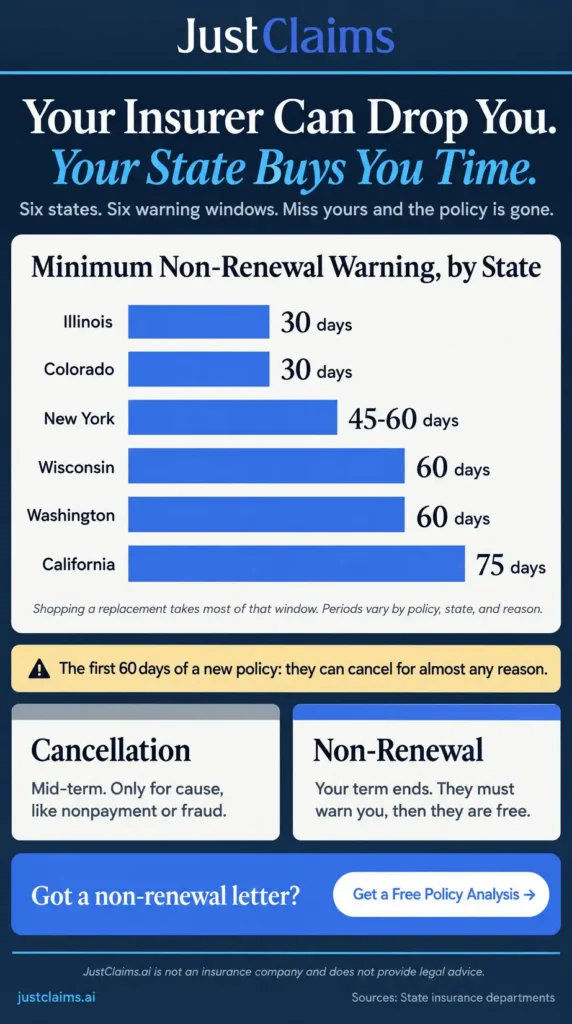
Because notice timing determines how much runway a policyholder has to challenge a decision or line up replacement coverage, comparing state rules side by side matters more than any single state’s language.
| State | Non-Renewal Notice | Key Rule |
|---|---|---|
| Texas | 60 days | Must state reason if asked; written explanation required starting Jan. 1, 2026 [1] |
| Wisconsin | 60 days | Midterm cancellation limited to nonpayment under Wis. Stat. § 631.36(2)(b); 10 days’ notice for cancellation [2] |
| South Carolina | 60 days | Reason must be stated; “Act of God” claims can’t be used alone [3] |
| Illinois | 30 days | Specific reason required in writing [6] |
| Washington | 60 days | Statement of actual reason required under RCW 48.18.2901 [4] |
| New York | 45–60 days | Notice window is bounded on both ends [5] |
| Colorado | 30 days (10 days for nonpayment) | Consumer Services team available if notice is insufficient [7] |
| California | 75 days | One-year moratorium applies in declared wildfire disaster perimeters [8][9] |
What to Do If You Receive a Non-Renewal Notice
Because a non-renewal notice starts a clock rather than closing the door, knowing how to respond in the days after it arrives matters more than the notice itself. Reading the stated reason against the actual policy language and claim history is the first step — a carrier’s explanation should match what actually happened on the account. When it does not, whether to bring in a public adjuster or an attorney is the next decision worth making.
- Shop immediately. Texas guidance advises starting the search for a new policy as soon as a non-renewal notice arrives and having replacement coverage in place before the current policy expires; policyholders also retain the right to cancel an existing policy early if a better option is found [10].
- Challenge an unclear or unfair reason. New York policyholders who believe the stated reason for non-renewal is unjustified can file a complaint with the Department of Financial Services [5].
- Escalate to the state regulator. Colorado residents facing a non-renewal that seems inappropriate, or who received insufficient notice, can contact the Division of Insurance’s Consumer Services team and file a formal complaint if needed [7].
- Appeal directly. Illinois policyholders who believe their insurer skipped required steps in the non-renewal process can appeal the decision directly to the Director of Insurance [6].
- Use the state hotline. California residents who don’t receive the required 75 days’ notice can contact the California Department of Insurance consumer hotline at 1-800-927-HELP (4357) or visit insurance.ca.gov [8].
Reducing Non-Renewal Risk When Filing a Claim
Because carriers weigh claim frequency heavily when deciding whether to continue coverage, how a claim is documented can matter as much as whether one is filed at all. Property owners and contractors who read a non-renewal notice against the underlying policy language — rather than accepting the carrier’s stated reason at face value — are often better positioned to spot a decision that doesn’t line up with the facts.
Some protections exist regardless of claim frequency: California’s one-year moratorium bars insurers from canceling or non-renewing residential policies within a declared wildfire disaster perimeter, regardless of how many claims were filed in that period [8][9].
Illinois still requires a written notice stating the specific reason for nonrenewal within its 30-day statutory window, and New York’s bounded 45-to-60-day notice range applies no matter how the claim was resolved [6][5].
Colorado’s Division of Insurance encourages anyone who receives a non-renewal notice to begin shopping for replacement coverage right away rather than waiting to see if the decision is reversed [7].
Frequently Asked Questions
Is cancellation the same thing as non-renewal?
No — cancellation ends a policy before its scheduled expiration date, while non-renewal simply means the carrier chooses not to continue the policy once the current term ends. The rules governing each are different, and cancellation is generally far more restricted once a policy has been active for a period of time [1][2].
Can my insurance company drop me for filing one claim?
In many states, yes — a single claim can legally support a non-renewal decision, but the carrier must still follow strict notice rules and, in most states, disclose the actual reason. South Carolina and Washington both allow non-renewal after one claim as long as proper notice and a stated reason accompany the decision [3][4].
How much notice does an insurer have to give before non-renewing my policy?
Notice periods vary by state, ranging from around 30 days in Illinois and Colorado to a bounded window of 45 to 60 days in New York. Texas, South Carolina, and Washington generally require 60 days’ notice along with a stated reason [1][3][6][4][5][7].
What should I do first if I get a non-renewal letter?
Start shopping for replacement coverage immediately and compare the carrier’s stated reason against your actual policy language and claim history. If the reason seems inaccurate or the notice period was too short, most states offer a path to file a complaint with the state insurance regulator [7][10].
Are claims from natural disasters treated differently for non-renewal purposes?
In some states, yes. South Carolina specifically prohibits insurers from using “Act of God” claims, such as hurricane or hail damage, on their own to calculate claim frequency for non-renewal decisions, and California imposes a one-year moratorium on cancellations and non-renewals within declared wildfire disaster areas [3][8][9].
How to Protect Your Policy Rights
A non-renewal notice is not the end of a policy — it is the start of a window to respond, and the states covered here all build some form of notice and disclosure requirement into that window. Reading the carrier’s stated reason against your actual claim history and policy language is the surest way to know whether a non-renewal decision holds up, and shopping for replacement coverage early protects your ability to keep working without a lapse.
Upload your policy and non-renewal notice to Justin — JustClaims’ free insurance policy analyzer — to check whether your insurer’s stated reason matches your policy’s actual language before the notice window closes.
This content is for informational purposes only and does not constitute legal or insurance advice. Coverage decisions depend on the specific terms, conditions, and exclusions of each policy and the laws of the applicable jurisdiction; policyholders and contractors should consult with a qualified professional for advice on their particular situation.
Sources
[1] Was Your Auto Insurance Not Renewed or Canceled? — Texas Department of Insurance
[3] Homeowners Insurance FAQs — South Carolina Department of Insurance
[4] Dropped by Your Insurer? Where to Go for Help in Washington — United Policyholders
[5] Cancellations and Nonrenewals — New York State Department of Financial Services
[6] If Your Homeowners Insurance Policy Is Non-Renewed — Illinois Department of Insurance
[7] Consumer Advisory: When Your Homeowners Insurance Doesn’t Renew — Colorado Division of Insurance
[8] Residential Insurance: Homeowners and Renters — California Department of Insurance
[9] Mandatory One-Year Moratorium on Non-Renewals — California Department of Insurance
[10] Was Your Home Insurance Canceled or Not Renewed? — Texas Department of Insurance

Collin Corcoran

Experienced Public Adjuster and Property Claims Specialist, Collin is licensed in New York (#1603393), New Jersey (#3003700204), and Connecticut (#19820270). With 20+ years of hands-on construction and property damage experience, he specializes in residential and commercial claims, complex loss inspections, policy review, detailed estimating, and strategic negotiation. Collin’s background in construction, asset management, emergency response, and claims documentation allows him to accurately identify damage, understand repair requirements, and advocate effectively for policyholders. He works with homeowners, business owners, contractors, and insurance professionals to move claims forward with clarity, accuracy, and confidence. Collin is committed to transparency, technical precision, strong communication, and securing fair outcomes for policyholders.