Sublimits in Insurance: Guide to Coverage Caps 2026

September 29, 2026
Written by Collin Corcoran
Share


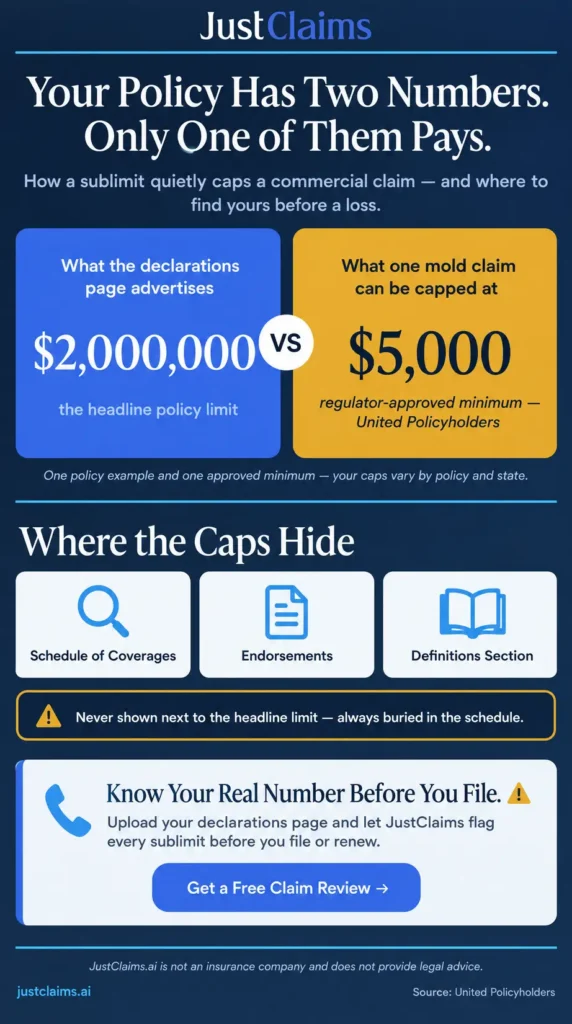
A commercial property policy advertised with a $2 million limit can still leave an owner paying most of a loss out of pocket if the damage falls under a sublimit — some regulators have approved mold coverage limits as low as $5,000 unless the policyholder pays for broader protection, while a serious commercial mold remediation can exceed that cap many times over. These caps rarely surface until a claim is already filed, and a modest valuation error on a declarations page can translate into a shortfall worth millions once several sublimited categories are triggered by a single event.
Key Takeaways
- What it is: A sublimit caps coverage for a specific loss type within a larger overall policy limit — for example, a $100,000 flood cap inside a $2 million policy.
- Debris removal example: Standard commercial property forms sublimit debris removal to 25% of the direct damage loss amount.
- Ordinance or law: Standard causes-of-loss language excludes the added cost of rebuilding to current code; an ordinance or law endorsement pays those costs up to its own chosen limit.
- Mold coverage gap: Some regulators approve mold coverage limits as low as $5,000 unless the policyholder buys broader coverage separately.
- Historical origin: Insurers moved to cap or exclude mold after high-profile lawsuits in the early 2000s; by 2003, some 40 state insurance departments had approved mold exclusions or limitations on homeowners policies.
- Common categories: Flood, earthquake, and coastal wind commonly carry separate sublimits and higher deductibles, while mold and code-upgrade costs are commonly excluded or capped.
What Is a Sublimit in Commercial Property Insurance?
A sublimit is a limitation on the amount of coverage available for a specific category of loss, set inside a policy’s larger overall limit [1]. A commercial property policy carrying a $2 million overall limit, for instance, might still cap flood losses at $100,000, earthquake losses at $500,000, and debris removal costs at 25% of the direct damage loss amount [1]. That 25% debris line item is a sublimit in its own right, and how the debris removal cap works is different from the dwelling limit once a demolition-heavy loss hits.
The headline limit on the declarations page is not the amount a business will actually receive for every kind of loss — it is a ceiling that applies only to losses not otherwise restricted elsewhere in the policy. This distinction matters because a single misread line item can determine whether a claim is fully paid or only partially covered.
Because sublimits often go unnoticed until a loss occurs, a minor valuation or classification error on a policy schedule can turn into a shortfall reaching well into six or seven figures once a major event triggers multiple sublimited categories at once — water intrusion, equipment failure, and code-upgrade costs, for example, arising from a single storm.
The Sublimit Categories That Create the Biggest Exposure
Because a single overlooked cap can convert an otherwise covered loss into a major out-of-pocket expense, understanding which categories are most commonly sublimited helps a business owner anticipate where a policy is likely to fall short.
Beyond the categories detailed below, policies may also carry separate caps for high-value contents such as valuable papers, computer equipment, or jewelry [2], as well as professional liability endorsements — amounts vary by carrier and should be confirmed individually rather than assumed.
1. Flood, Earthquake, and Wind
Commercial property policies commonly apply separate sublimits and higher deductibles to the perils of flood, earthquake, and coastal wind [3]. Deductibles attached to these coverages can be a flat dollar amount or a percentage of insured value — in hurricane-exposed states, for example, Florida law requires insurers to offer hurricane deductible options equal to $500, 2%, 5%, and 10% of the dwelling limit [4] — which further reduces the net payout a business receives after a covered event. Flood shows the pattern at its most extreme: the maximum flood insurance coverage available through standard programs can sit far below what a commercial structure actually costs to rebuild.
A property owner reviewing a renewal quote should confirm both the sublimit amount and the deductible structure for each of these categories rather than assuming the overall limit applies.
2. Mold and Fungi Coverage
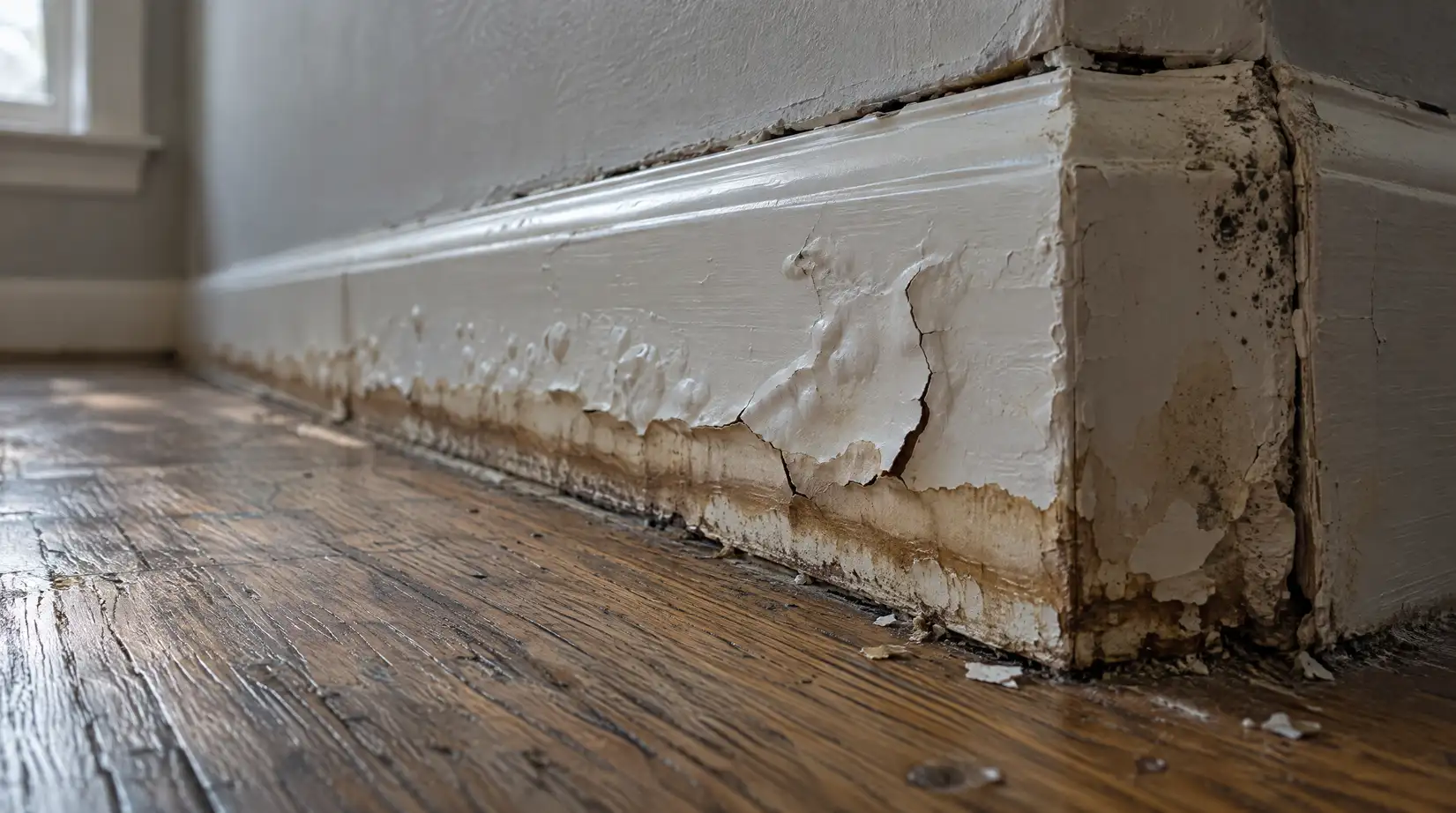
Mold remediation represents one of the widest gaps in commercial property coverage. Most property policies exclude damage caused by mold, wet or dry rot, and similar conditions, with only narrow exceptions that provide very limited coverage [5]. Some state regulators have approved minimum mold coverage limits as low as $5,000 unless the policyholder buys broader coverage separately [5] — a cap that a serious commercial remediation project can exceed many times over.
The gap traces back to a wave of high-profile mold lawsuits in the early 2000s: after a 2001 Texas case produced a $32 million jury verdict, carriers moved to cap or exclude mold coverage, and by 2003 some 40 state insurance departments had approved mold exclusions or limitations on homeowners policies [6].
3. Ordinance or Law Coverage
Ordinance or law coverage pays the extra expense of rebuilding in compliance with building codes that did not exist when the structure was built, and it is typically delivered as an endorsement carrying its own chosen limit [7].
Standard ISO Causes of Loss – Special Form language excludes the increased costs of complying with ordinances or laws regulating construction, repair, renovation, remodeling, or demolition — including the cost of removing the debris [8].
A business rebuilding after a fire or major storm may discover that the base policy covers only a fraction of what updated electrical, plumbing, or accessibility requirements actually cost — a gap that becomes apparent only once a complex claim requires forensic-level analysis of the rebuild estimate against the endorsement language. That estimate-against-language review is exactly where forensic-level claim documentation decides whether a complex commercial loss gets paid in full.
Why Insurers Build Sublimits Into Commercial Policies
Because a single overlooked sublimit can convert a fully covered loss into a significant shortfall, understanding why insurers structure policies this way helps a property owner negotiate broader terms before a loss ever occurs. Insurers price a policy’s overall limit around the statistical likelihood and typical severity of the perils covered under standard terms.
Categories like flood, earthquake, mold, and code-upgrade costs tend to carry disproportionately high or unpredictable severity relative to more routine fire or theft losses, so carriers use sublimits to offer broad coverage categories in principle while containing exposure to the costliest and least predictable claims [1][3]. This approach allows an insurer to keep premiums lower for the majority of policyholders who never trigger those specific caps, at the expense of the smaller number who do.
How to Identify Sublimits on Your Declarations Page
Because sublimits are contractual limits buried in policy schedules rather than stated as part of the headline coverage amount, locating them before a loss is the only reliable way to avoid a claim-time surprise. Start by reviewing the schedule of coverages attached to the declarations page — going down the full list of coverages, not just the headline limit — which typically lists any special or sublimited amounts separately from the main property limit [5].
Endorsements — separate forms attached to the policy — often contain the actual sublimit language for water damage, equipment breakdown, mold, and ordinance or law coverage, so the declarations page alone may not tell the full story.
A property owner should also check the policy’s definitions section for terms like “special limits” or “limitation of loss,” cross-reference any debris removal or ordinance/law endorsement against the base policy limit, and confirm whether deductibles for named storm or water losses are flat amounts or percentages of insured value.
Comparing every sublimited category against current replacement cost estimates — rather than the figure used at the last renewal — is one of the most effective ways to catch a gap before it becomes a claim dispute. A building that is not insured to value makes every sublimit proportionally more dangerous, because construction inflation widens the gap between the cap and the true rebuild cost at every renewal.
Strategies to Increase or Manage Sublimit Coverage
Once a sublimit gap is identified, a property owner has several contractual options for closing it before a loss occurs rather than discovering it during a claim. Scheduled endorsements or riders can raise the coverage amount for a specific category — mold remediation, for example, where regulators permit only low minimum limits unless broader coverage is purchased separately [5] — above the standard sublimit built into the base policy. Ordinance or law coverage is commonly added by endorsement, paying the extra expense of rebuilding to current code up to the limit selected for that endorsement [7].
Because complex claims require forensic-level analysis to determine whether a loss falls under the base limit, a sublimit, or an exclusion entirely, resolving these questions in advance reduces the risk of a dispute when a claim is filed.
Frequently Asked Questions
What is the difference between a sublimit and a deductible?
A sublimit caps the maximum amount a policy will pay for a specific type of loss [1], while a deductible is the amount the policyholder agrees to pay out of pocket before the insurer pays the remainder [9].
A single loss can be subject to both — for example, a named storm deductible calculated as a percentage of insured value, applied against a water damage sublimit that is itself lower than the overall policy limit.
Can I increase a sublimit on my commercial property policy?
In many cases, yes — scheduled endorsements or riders can raise coverage for specific categories such as mold or ordinance and law above the standard sublimit [5][7]. Availability and cost depend on the carrier and the specific risk being scheduled, so this typically requires a direct request to a broker or underwriter rather than a standard renewal adjustment.
Why is mold coverage sublimited so much lower than the actual cost of remediation?
Insurers moved to cap or exclude mold coverage after a wave of high-profile lawsuits in the early 2000s, and by 2003 some 40 state insurance departments had approved mold exclusions or limitations on homeowners policies [6].
Because some regulators approve minimum mold coverage limits as low as $5,000 unless broader coverage is purchased separately [5], a mold loss can leave a substantial gap between actual repair costs and what the policy actually pays.
What happens if my loss exceeds the sublimit for that category?
Once a loss exceeds the applicable sublimit, the policy generally will not pay beyond that capped amount for that category, regardless of how much coverage remains under the overall policy limit [1].
Any remaining cost becomes the policyholder’s responsibility unless a separate endorsement, buy-back provision, or excess policy was purchased in advance to extend coverage for that specific type of loss.
Review Your Declarations Page Before Renewal
Sublimits are contractual details, not headline coverage amounts, which is exactly why they create claim-time surprises for commercial property owners who assume their overall limit applies to every type of loss. An annual review of the declarations page and attached endorsements — checking flood, wind, mold, and ordinance or law caps against current rebuild and remediation costs — is one of the most effective ways to catch a gap before a loss forces the issue.
Upload your policy declarations and claim documentation to JustClaims’ free insurance policy analyzer to see whether sublimits on Business Interruption or Law & Ordinance coverage are leaving forensic-level gaps in your payout.
This content is for informational purposes only and does not constitute legal or insurance advice. Coverage decisions depend on the specific terms, conditions, and exclusions of each policy and the laws of the applicable jurisdiction; policyholders and contractors should consult with a qualified professional for advice on their particular situation.
Sources
[1] Sublimit (Insurance Definition) — IRMI
[2] A Guide to Your Homeowners Policy — United Policyholders
[3] Guide to FHWA Funded Wrap-Up Projects — Federal Highway Administration (U.S. DOT)
[4] Florida Statutes § 627.701 (2022) — Online Sunshine / Florida Senate
[5] Mold Contamination Insurance Coverage 101: The Basics — United Policyholders
[7] A Consumer’s Guide to Home Insurance — NAIC
[9] Commercial Insurance Guide — Maryland Insurance Administration

Collin Corcoran

Experienced Public Adjuster and Property Claims Specialist, Collin is licensed in New York (#1603393), New Jersey (#3003700204), and Connecticut (#19820270). With 20+ years of hands-on construction and property damage experience, he specializes in residential and commercial claims, complex loss inspections, policy review, detailed estimating, and strategic negotiation. Collin’s background in construction, asset management, emergency response, and claims documentation allows him to accurately identify damage, understand repair requirements, and advocate effectively for policyholders. He works with homeowners, business owners, contractors, and insurance professionals to move claims forward with clarity, accuracy, and confidence. Collin is committed to transparency, technical precision, strong communication, and securing fair outcomes for policyholders.