Ordinance or Law Coverage A, B & C: 2026 Guide
September 21, 2026
Written by Taylor Bezek
Share


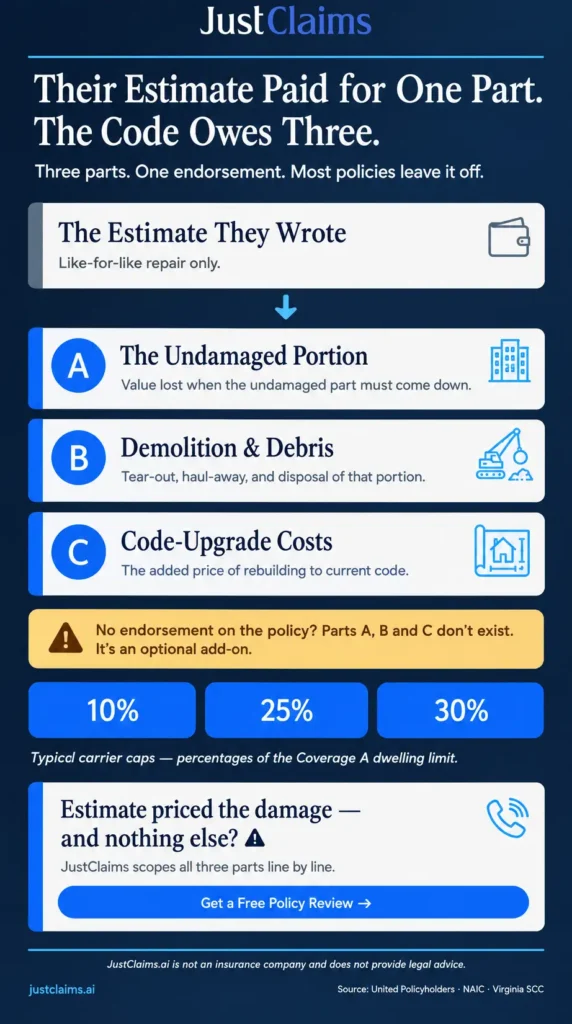
When a covered loss triggers a local building code upgrade, the difference between a like-kind repair and a fully compliant rebuild can quietly rewrite a contractor’s entire scope of work. Ordinance or Law coverage is generally split into three distinct parts—A, B, and C—and each one addresses a different cost that standard replacement cost coverage does not pick up. Limits for this protection are commonly set at 10%, 25%, or 30% of the Coverage A dwelling limit, which means the dollars available to close a code-upgrade gap can vary widely from one policy to the next.
Key Takeaways
- What it is: Ordinance or Law coverage is typically divided into three parts—A, B, and C—each addressing a different cost triggered by an updated building code.
- Coverage A: Pays for the loss to the undamaged portion of a building when a code or ordinance requires the entire structure to be brought into compliance after a covered loss.
- Coverage B: Pays the cost to demolish and haul away debris from the undamaged portion of the structure, typically written on a specified, purchased limit rather than a whatever-it-takes basis.
- Coverage C: Pays the increased cost of construction needed to meet current code and generally applies to both the damaged and undamaged portions of the building, including foundations.
- Typical limits: Coverage amounts are commonly expressed as 10%, 25%, or 30% of the Coverage A dwelling limit.
- Terminology varies: Carriers may label this protection differently—”Ordinance or Law A, B, C,” “Building Ordinance Coverage,” or “Code Upgrade Endorsement”
The Three Parts of Ordinance or Law Coverage
Contractors bidding a rebuild after a fire, wind, or water loss often assume the policy’s dwelling limit covers whatever it takes to restore the structure to code. In practice, most standard property policies exclude the cost of complying with current building ordinances unless a separate Ordinance or Law endorsement is in place [1].
Understanding which of the three parts applies to a given job helps a contractor scope the project accurately and helps a policyholder know what documentation to request from the adjuster before work begins.
1. Coverage A: Loss to the Undamaged Portion
Coverage A applies when a local code requires an entire structure—not just the damaged section—to be brought into compliance following a covered loss [2]. If a code triggers a full-structure upgrade because a portion of the building was damaged, this part of the coverage pays for the value lost when the undamaged portion must also be torn down or replaced.
Coverage A is triggered when an ordinance or law requires demolition of, or causes loss in value to, the undamaged portion of the building following covered damage — the notice’s specific wording about ‘whole structure’ vs. ‘damaged area’ is not itself the sole determining factor.
2. Coverage B: Demolition Costs
Coverage B pays the cost to demolish and haul away debris from the undamaged portion of a building when an ordinance requires that portion to be torn down [3]. Unlike a typical debris removal clause tied to the damaged area, this coverage is usually written on a specified or purchased limit rather than an open-ended basis [3].
Contractors should confirm the dollar limit attached to this coverage early in the estimate process, since demolition of undamaged square footage can consume a limit faster than expected on larger structures. Standard debris removal coverage for the damaged portion carries its own limits and sub limits — our guide explains how both sides are typically structured.
3. Coverage C: Increased Cost of Construction
Coverage C pays the increased cost of construction needed to repair or rebuild a damaged structure to meet current code requirements [3]. This part typically applies to both the damaged and undamaged portions of the building, including foundation work that may not have been required under the original construction standards [3].
For contractors, this is often the coverage that determines whether items like upgraded electrical panels, fire-rated assemblies, or accessibility retrofits get funded through the claim or become a change-order dispute with the property owner.
How Coverage Limits Are Typically Structured
Because the three coverage parts function independently, the dollar amount attached to each one matters as much as whether the coverage exists at all. Code compliance and upgrade limits are usually expressed as a percentage of the Coverage A dwelling limit, and this add-on may or may not be automatically included depending on the carrier [2]..
| Common Limit | Basis |
|---|---|
| 10% | Percentage of the Coverage A dwelling limit |
| 25% | Percentage of the Coverage A dwelling limit |
| 30% | Percentage of the Coverage A dwelling limit |
This coverage often sits under a policy’s “Additional Coverages” section, sometimes labeled simply “Ordinance or Law” [2]. Contractors preparing a scope of work should ask the property owner to pull this section of the declarations page before finalizing a bid, since a policy with a lower percentage limit may not cover the full cost of a code-mandated upgrade even when the coverage technically exists.
Ordinance or Law Coverage vs. Standard Replacement Cost
The scope disputes that arise on code-driven rebuilds usually trace back to a mismatch between what replacement cost coverage pays for and what the code actually requires. Standard replacement cost coverage restores a structure to its pre-loss condition using materials and methods comparable to the original construction—it does not account for code changes adopted since the building was first built [4]. The valuation question underneath that mismatch — RCV vs. ACV — is its own dispute; our contractor guide walks through both sides of that call.
Ordinance or Law coverage exists specifically to bridge that gap, covering the undamaged-portion loss, demolition, and increased construction costs that a code update can create.
Real-World Claim Scenarios
A commercial roof damaged by wind may only need partial replacement under a like-kind standard, but if local code now requires an upgraded fire-rated assembly across the entire roof once any repair work begins, Coverage A and Coverage C can both come into play—Coverage A for the undamaged roof area required to be brought into compliance, and Coverage C for the incremental cost of the upgraded materials [2][3].
A fire-damaged multi-family building may require the undamaged wing to be demolished if code now prohibits repairing that construction type in place. In that scenario, Coverage B funds the demolition and debris removal for the undamaged wing, while Coverage C funds the cost difference between rebuilding to the old standard and rebuilding to current code, including foundation work if required [3].
Contractors documenting either scenario should photograph the code enforcement notice itself, since that document is typically what supports the position that Ordinance or Law coverage applies to the loss.
Frequently Asked Questions
Does every property insurance policy include Ordinance or Law coverage automatically?
No. This coverage is often listed as an optional add-on under “Additional Coverages” and may not be included unless it was specifically purchased or endorsed onto the policy [5]. Contractors should ask the property owner to confirm this section exists in the declarations before assuming code-upgrade costs will be funded by the claim.
What is the difference between Coverage A, B, and C in plain terms?
Coverage A addresses the value lost when an undamaged portion of the building must be torn down to meet code, Coverage B pays for demolishing and hauling away that undamaged portion, and Coverage C pays the extra construction cost needed to meet current code standards [2][3]. Each part is typically subject to its own limit, so a policy can have strong coverage in one area and weak or absent coverage in another.
Why might two policies use different names for the same coverage?
Carriers are not required to use identical terminology, so the same protection may appear as “Ordinance or Law A, B, C,” “Building Ordinance Coverage,” or a “Code Upgrade Endorsement” depending on the insurer [2]. Contractors reviewing an unfamiliar policy should look for language describing code-triggered demolition or increased construction costs rather than searching for one specific label.
How do contractors know if a code upgrade actually qualifies for this coverage?
Permit paperwork is the supporting document that matters here—any application for repairs or remodeling is expected to come into compliance with current codes, so request and photograph whatever documentation the jurisdiction issues [2].
Is the increased cost of construction limited to visible upgrades like materials?
No. Coverage C can extend to structural elements such as foundations when current code requires changes there as part of the rebuild, not just to visible finishes or systems [3]. Contractors should account for below-grade and structural code changes in their estimate, not only the upgrades that are easiest to see on a walk-through.
What Contractors Should Do Before Rebuilding
Confirm whether Ordinance or Law coverage exists on the policy, identify which of the three parts applies to the specific code trigger, and separate the estimate into pre-loss repair costs versus current-code compliance costs before submitting a scope to the adjuster [2].
Getting that breakdown right at the estimate stage—which our sources show adjusters often require to reach an agreement—protects the scope of work and cuts the back-and-forth that stalls payment. When the carrier pushes back on the code-driven lines, our guide explains why carriers deny code upgrades and how to win them.
If a code-upgrade claim comes back underpaid or denied, upload the policy to JustClaims’ free insurance policy analyzer: it reads the language against your documentation and flags likely underpayments so you take the claim back to the carrier with evidence in hand.
This content is for informational purposes only and does not constitute legal or insurance advice. Coverage decisions depend on the specific terms, conditions, and exclusions of each policy and the laws of the applicable jurisdiction; policyholders and contractors should consult with a qualified professional for advice on their particular situation.
Sources
[2] Building Code, Ordinance or Law Compliance — United Policyholders
[3] Virginia Consumer’s Guide for Homeowners Insurance — State Corporation Commission
[4] A Consumer’s Guide to Home Insurance — National Association of Insurance Commissioners (NAIC)
[5] Commercial Property Insurance Guide — Texas Department of Insurance

Taylor Bezek

As the General Manager at JustClaims, Taylor Bezek brings over a decade of experience managing complex residential, commercial, and large-loss claims. A licensed Public Adjuster in TX (#2125659), FL (#W455048), CO (#769172), and 10 additional states, Taylor founded his own firm before joining JustClaims to scale a tech-forward solution for the insured. He is committed to combining industry expertise with AI to enhance speed, clarity, and outcomes for every policyholder. Taylor's mission is to modernize the public adjusting profession and ensure owners get exactly what they are entitled to.