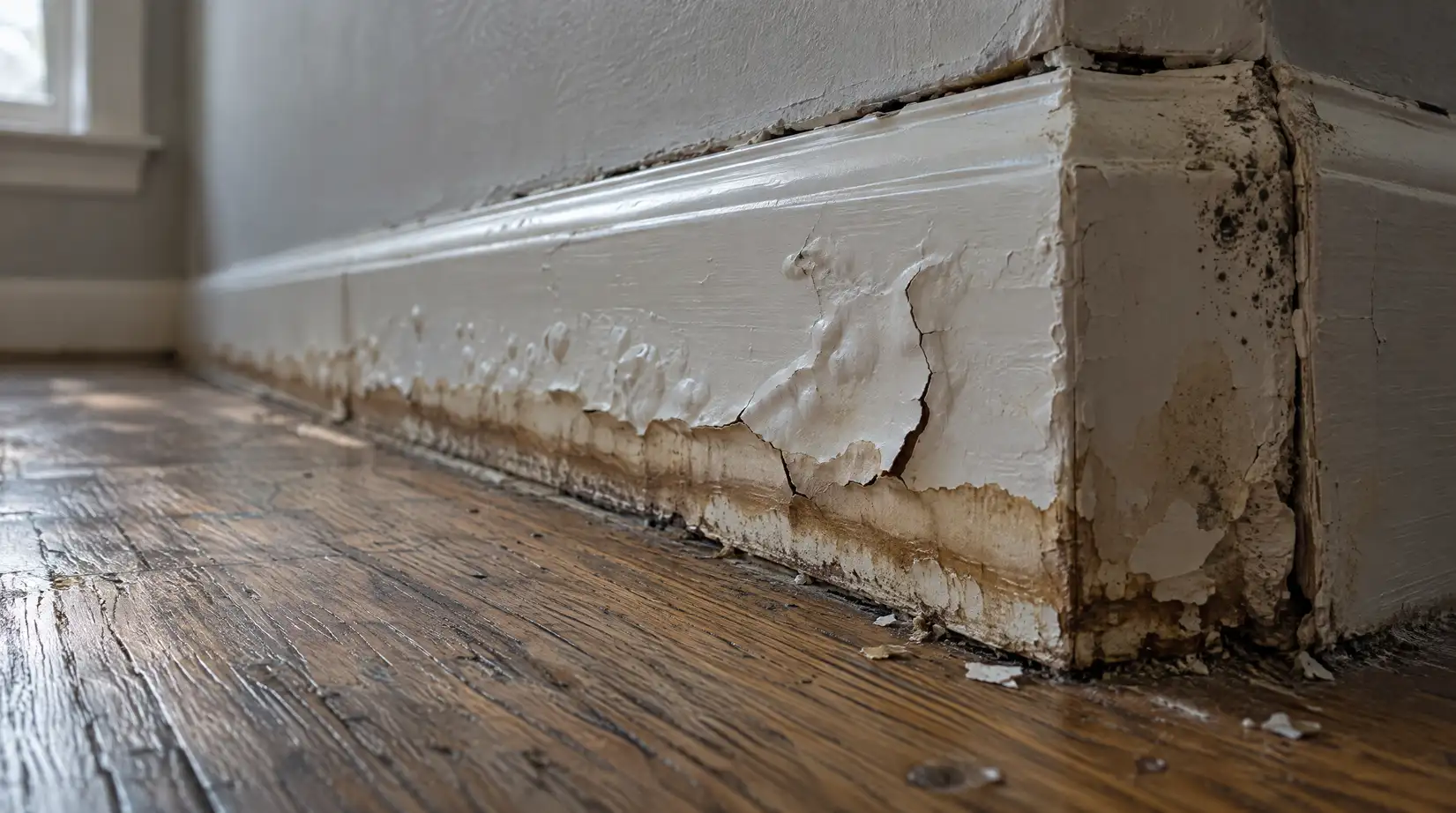
Breach of Insurance Contract: Rights & Legal Remedies
October 06, 2026
Written by Collin Corcoran
Share


A policyholder who sues for first-party bad faith generally has to show two things: that benefits owed under the policy were wrongfully withheld, and that the insurer’s conduct in withholding them was unreasonable, arbitrary, or without proper cause. That standard separates an ordinary coverage disagreement from a breach that may carry legal remedies. Knowing where that line sits helps property owners judge whether a denial, delay, or low offer deserves a closer legal look.
Key Takeaways
- What bad faith means: Bad faith is an insurer’s unreasonable conduct in handling a claim.
- First-party elements: A policyholder generally must show wrongfully withheld benefits and unreasonable insurer conduct.
- Contract-only remedy: In many states, a pure contract claim limits recovery to damages foreseeable when the contract was made, while tort-based bad-faith claims may allow broader damages.
- Tort remedy: Punitive damages standards vary by state, and many states require conduct that is reckless, intentional, malicious, or fraudulent.
- Complaint route: A policyholder can file a complaint with the state department of insurance if the insurer is not cooperating.
Defining Breach: Failure to Pay, Delay, and Bad Faith
A breach of an insurance contract occurs when the insurer does not do what the policy promises. Whether that breach also counts as bad faith depends on how the insurer behaved while handling the claim [1].
Failure to Pay Valid Benefits
A common breach is withholding benefits the policy owes. A first-party bad faith claim applies to denied, delayed, or underpaid benefits. United Policyholders, a national consumer insurance nonprofit, puts the standard plainly: when an insurance company is being unreasonable in handling the claim you filed for your loss, it is acting in bad faith [1].
Colorado’s civil jury instructions, for example, require the policyholder to prove that the insurer acted unreasonably and that it knew its conduct was unreasonable or recklessly disregarded that fact [2].
Unreasonable Delay
Delay can be a breach even when the insurer eventually pays. United Policyholders advises that your insurer should pay what it owes without delay and should not hold back part of your benefits while another part is still uncertain or under investigation [3].
Colorado’s civil jury instructions give that principle legal force: unreasonable delay or denial of an undisputed part of a claim may create liability even when the insurer reasonably disputes other parts [2]. State law sets how quickly an insurer must pay, so keep a dated record of every request and response from the first day.
Bad Faith Conduct
Bad faith concerns the insurer’s behavior, not just the outcome. Courts across jurisdictions look for conduct that is arbitrary, reckless, intentional, malicious, or fraudulent, and mere negligence is not enough [4].
Common Examples of Insurer Misconduct
Because the line between a disagreement and a breach turns on conduct, it helps to know what state regulators treat as improper. California’s Insurance Code § 790.03(h), [5] Washington’s WAC 284-30-330, [6] and Arizona’s A.R.S. § 20-461 [7] prohibit unfair claims settlement practices that include:
- Misrepresenting pertinent facts or policy provisions
- Failing to acknowledge and act reasonably promptly on claim communications
- Failing to adopt reasonable standards for the prompt investigation of claims
- Refusing to pay claims without conducting a reasonable investigation
- Failing to affirm or deny coverage within a reasonable time after a completed proof of loss
- Not attempting in good faith to reach a prompt, fair settlement once liability is reasonably clear
- Offering substantially less than the amounts ultimately recovered through litigation, arbitration, or appraisal
- Delaying the investigation or payment of a claim by requiring repeated submissions of substantially the same information
- Failing to promptly explain the policy basis for a denial or a compromise offer
Washington’s rule gets more specific on October 18, 2026, when an amendment takes effect: “denying or refusing to pay claims in part or in full without conducting a reasonable investigation” becomes an enumerated unfair practice, and a reasonable investigation “may not rely solely on the use of a database,” including estimating software [6].
The amended rule also prohibits unfairly treating a claimant differently because they are represented by a public adjuster [6]. These are state-specific rules, so the provisions that apply to you depend on where the property is located.
Legal Remedies: Damages, Fees, and Punitive Awards
Which remedies are available often depends on how a court classifies the insurer’s conduct as contract breach or as tort.
Contract-Only Remedies
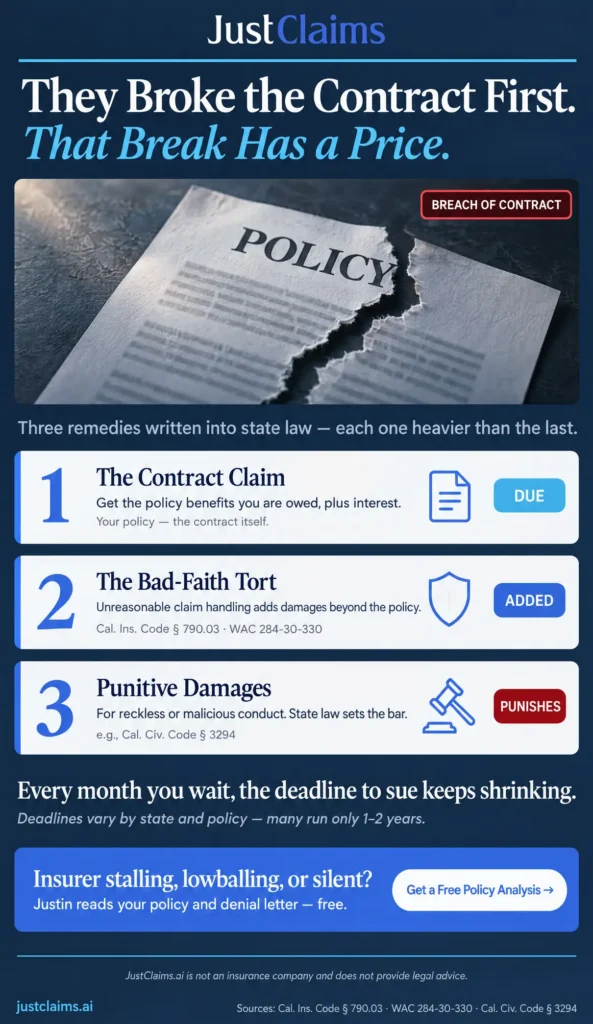
About half of the states recognize bad faith as a tort. Where a court decides the case purely under contract law, recovery is generally limited to consequential damages — those foreseeable when the contract was made — while a tort-based bad-faith claim can open the door to broader damages [4]. Either classification still starts with proving what the policy owes, which is why documenting the full value of your claim matters long before any lawsuit is filed.
Tort and Punitive Damages
If a court accepts bad faith as a tort, available damages widen. Punitive damages standards vary by state, and many states require conduct that is reckless, intentional, malicious, or fraudulent [4]. In California, oppression, fraud, or malice proven by clear and convincing evidence under Civil Code § 3294 may support punitive damages [8].
Other Statutory and Federal Considerations
Civil RICO defendants can face treble damages and attorney’s fees, and the U.S. Supreme Court in Humana Inc. v. Forsyth (1999) allowed a RICO claim against an insurer to proceed alongside state-law remedies [4].
ERISA limits remedies for employer-sponsored benefit plans, but bad-faith claims on insurance that is not part of an employee benefit plan — such as property casualty and personal lines — can still be brought [4]. A residential property policy typically falls into that second category.
Steps to Take After a Suspected Breach
When an insurer’s handling looks like a breach, what the policyholder documents and files early often shapes the options later.
Document Every Communication
Keep the policy, every claim submission, payment records, and denial letters. NAIC recommends gathering your policy number, documentation, bills, and records, and creating a record of all communication with your insurer — emails, letters, phone calls, dates, and times [9].
File an Appeal, a Complaint, or Both
The Washington Office of the Insurance Commissioner distinguishes the two. File an appeal if you disagree with a coverage or payment decision. File a complaint if you think an insurer or agent violated the law or treated you or your claim unfairly [10].
NAIC’s consumer guidance on denied health claims, which describes the general appeal process, says there are typically an internal appeal and an external review. It advises sending a letter that is as specific as possible about why the claim should be paid, with supporting evidence [11]. Property policies may use different procedures, so check your policy and denial letter.
For a complaint, gather the denial, your policy, and a record of your communications. Once a state department of insurance accepts a complaint for investigation, it forwards the complaint to the insurer, and the insurer must respond with its explanation. [9] A complaint goes to your state department of insurance, and NAIC advises contacting it if the insurer is not cooperating with the appeals process [11].
Consult Legal Counsel Before Deadlines Pass
Appeal deadlines vary by policy and plan type. For employer-sponsored group health plans, federal claims-procedure rules require the plan to give claimants at least 180 days after an adverse benefit determination to appeal; most other ERISA plans must allow at least 60 days [12].
Property claims follow the deadlines written into the policy and state law instead. Because statutes of limitations cut off the right to sue once they pass, United Policyholders recommends consulting a qualified attorney at least a month before the one-year anniversary of the loss [13]. If you are unsure who should handle the claim while the deadline runs, the roles lawyers and public adjusters play are worth understanding before you hire anyone.
Frequently Asked Questions
What is the difference between breach of contract and bad faith?
A breach of contract means the insurer did not deliver the benefits the policy promises. Bad faith adds the question of how the insurer behaved — whether its conduct in handling the claim was unreasonable [1].
Where a court decides the case purely under contract law, recovery is generally limited to foreseeable consequential damages, while a tort-based bad-faith claim may allow broader damages [4].
How long can an insurer take to pay a claim?
The answer depends on state law and the policy. Regulations in states like Washington require the insurer to affirm or deny coverage within a reasonable time [6].
Can I recover punitive damages if my insurer acted in bad faith?
Sometimes, but the bar is high. Mere negligence does not establish bad faith. Punitive damages standards vary by state, and many states require conduct that is reckless, intentional, malicious, or fraudulent [4]. In California, oppression, fraud, or malice proven by clear and convincing evidence may support them [8].
Should I file an appeal or a complaint with the state?
They serve different purposes. An appeal challenges a coverage or payment decision, while a complaint alleges that the insurer broke the law or treated you unfairly [10]. Many policyholders may need both, and the regulator forwards the complaint to the insurer, which must respond with its explanation [9].
What records should I keep if I suspect my insurer is acting in bad faith?
Keep the policy, every claim submission, payment records, denial letters, and a record of all calls, emails, and letters with the insurer [9]. Repeated requests for the same documents, unexplained delays, and denials without clear written explanations track the specific practices that state unfair-claims rules prohibit [6].
How to Protect Your Rights After a Breach
Because the dividing line between a coverage dispute and a breach rests on the insurer’s conduct, your strongest position comes from a clear record and timely action. Document every exchange, confirm the appeal and filing deadlines in your policy, and consider a complaint to your state department of insurance if the carrier is unresponsive [11][10].
Have a qualified attorney review the facts, since remedies and standards vary by state [4]. Then put your documents to work: get a free insurance policy analysis from Justin — upload your denial letter and policy to see where the insurer’s handling may conflict with your coverage.
This content is for informational purposes only and does not constitute legal or insurance advice. Coverage decisions depend on the specific terms, conditions, and exclusions of each policy and the laws of the applicable jurisdiction; policyholders and contractors should consult with a qualified professional for advice on their particular situation.
Sources
[1] A Guide to Your Insurance Legal Rights in California — United Policyholders
[3] Insurance Consumer Rights in Colorado — United Policyholders
[4] Insurance Bad Faith and Treble Damages (2004-R-0280) — Connecticut Office of Legislative Research
[5] California Insurance Code § 790.03 — California Legislative Information
[6] WAC 284-30-330: Specific Unfair Claims Settlement Practices Defined — Washington State Legislature
[7] A.R.S. § 20-461: Unfair Claim Settlement Practices — Arizona State Legislature
[8] California Civil Code § 3294 — California Legislative Information
[9] How to File a Complaint — National Association of Insurance Commissioners
[10] Appeals — Washington State Office of the Insurance Commissioner
[12] 29 C.F.R. § 2560.503-1: Claims Procedure — U.S. Department of Labor (eCFR)
[13] Hiring an Attorney for an Insurance Claim Q&A — United Policyholders

Collin Corcoran

Experienced Public Adjuster and Property Claims Specialist, Collin is licensed in New York (#1603393), New Jersey (#3003700204), and Connecticut (#19820270). With 20+ years of hands-on construction and property damage experience, he specializes in residential and commercial claims, complex loss inspections, policy review, detailed estimating, and strategic negotiation. Collin’s background in construction, asset management, emergency response, and claims documentation allows him to accurately identify damage, understand repair requirements, and advocate effectively for policyholders. He works with homeowners, business owners, contractors, and insurance professionals to move claims forward with clarity, accuracy, and confidence. Collin is committed to transparency, technical precision, strong communication, and securing fair outcomes for policyholders.