File an Insurance Commission Complaint: 2026 Guide

October 06, 2026
Written by Taylor Bezek
Share


When an insurance company denies or delays a claim, state regulators run formal complaint systems that property owners can use. Each state sets its own rules for where and how to file, and some, such as Arizona, allow only one chance to attach documents. Knowing those rules before you start can keep your complaint from stalling at the first step.
Key Takeaways
- What it is: A formal complaint filed with your state insurance regulator about a denied or delayed claim.
- First check: Arizona’s department does a preliminary review to confirm it has jurisdiction over the complaint.
- Document timing: Arizona’s online complaint form allows only one opportunity to attach documents.
- Filing channel (Virginia): The State Corporation Commission does not accept insurance complaints by phone or email.
- Filing channel (Colorado): Consumers can submit complaints through a secure portal or mail a downloadable Complaint Form / Request for Assistance.
- Before you file (Georgia): The Office of Commissioner of Insurance advises stating the complaint to the company’s representative first.
When Filing a Complaint Makes Sense
A denied, delayed, or ignored claim is often a regulatory matter as well as a dispute between you and your carrier. State insurance departments exist to receive complaints about how carriers handle claims, and that gives you a formal channel when ordinary phone calls stop producing answers [1][2].
Denials You Believe Are Wrong
If your carrier denied all or part of a property claim and the stated reason does not match your policy language or the damage you documented, a complaint puts the dispute in front of a regulator.
Regulators generally start by confirming that they have authority over the type of insurance and the company involved. Arizona’s department, for example, does a preliminary review for jurisdiction and tells the consumer if it has no authority to assist [1].
Delays and Silence From the Carrier
Slow payouts and unanswered calls are frustrations that often lead property owners to consider a complaint. If your carrier has stopped communicating, or keeps requesting information you already sent, a complaint creates an official record of the problem. Keep a dated log of every call, email, and missed callback so the regulator can see the pattern. Before you conclude the delay is unreasonable, check how long an insurer can take to pay a claim under your state’s rules.
Suspected Bad Faith Handling
Bad faith generally means a carrier handled your claim unreasonably, such as by ignoring evidence, misrepresenting policy terms, or stalling without cause, though the legal standard and available remedies vary by state. A regulator complaint is one way to raise those concerns.
Whether a carrier’s conduct legally qualifies as bad faith is a separate question that depends on your state’s law, and an attorney is better placed to answer it.[1]
Documentation Checklist Before You File
Because a complaint is stronger when it is backed by records, gather your materials before you open any form. Arizona’s system allows one opportunity to attach documents to the online form, and the department advises consumers to have their documents ready before they start [1].
Collect the following:
- Policy information: your declarations page, the full policy with endorsements, and your policy and claim numbers.
- Claim history: the date of loss, the date you reported it, adjuster names, and every claim status update you received.
- Correspondence: denial or partial-payment letters, emails, and notes from phone calls with dates and names.
- Damage evidence: dated photos and video, contractor estimates, repair invoices, and any inspection reports.
- Your own timeline: a short written summary of what happened, what you asked for, and how the carrier responded.
Save everything as clearly named files so you can upload them quickly, since some portals also require supporting documentation at submission [3].
Step-by-Step Filing Process
Since delays and denials are common reasons property owners contact a regulator, the filing process should be treated as an organized sequence rather than a single form. These three steps cover the common ground across states.
1. Raise the Dispute With the Carrier First
Georgia’s Office of Commissioner of Insurance advises consumers to state the complaint to the company’s representative first. Ask what the company needs to submit a dispute, such as a formal letter of complaint, specific forms, or supporting documentation [4]. Following that guidance gives you a written record that you tried to resolve the problem directly.
2. Choose the Correct Filing Channel
Channels differ by state, so check your own regulator’s page before you start:
- Colorado: a secure portal, or a downloadable Complaint Form / Request for Assistance that you can mail [2].
- Virginia: the Insurance Complaint Portal, with mail or fax available through SCC forms if you cannot use the portal. The SCC does not accept insurance complaints by phone or email [3].
- Georgia: the state’s Consumer Complaint Portal, after you have first raised the issue with the company [4].
- Arizona: an online form with a single opportunity to attach documents [1].
3. Submit Your Complaint and Keep Copies
Describe the loss, the carrier’s decision, and the outcome you are requesting in plain, factual language. Attach your documents, then save a copy of the submission and any confirmation. Keep your tone factual and leave out opinions about the adjuster.
What Happens After You File
Once your complaint is on record, the next phase is waiting and responding, which is where many property owners lose momentum. The regulator typically begins with a review to determine whether it has jurisdiction, and it will tell you if it cannot assist [1].
Investigation timelines vary by state and by how complex the dispute is, so check your regulator’s website for current expectations rather than assuming a fixed schedule. If the carrier’s final position is a payment that is still too low, the steps for challenging an underpaid claim run in parallel with the regulator’s review.
In Colorado, after logging in to the portal, you can message the Division about your complaint by adding comments [2]. Use that feature to send new information, such as a revised estimate or a new carrier letter.
While the complaint is pending:
- Keep responding to carrier requests in writing.
- Do not stop documenting damage or repair costs.
- Respond promptly if the regulator asks for more information.
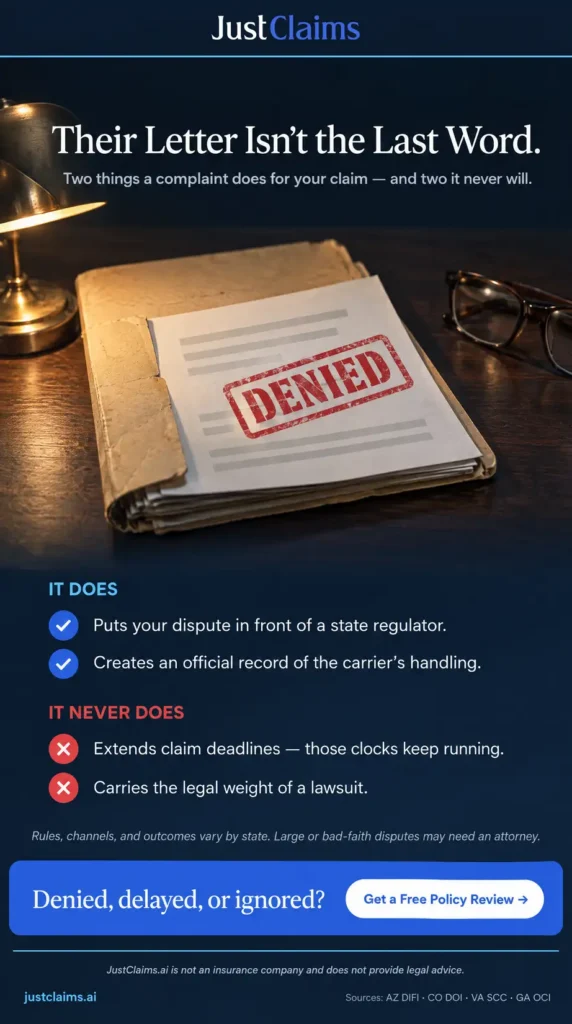
A regulator complaint is a review process. It does not carry the same legal weight as a lawsuit, and the outcome depends on the facts and your state’s rules.
Complaint vs. Attorney: Choosing the Right Path
Because a complaint addresses how a carrier handled your claim, it is not always the right tool for every dispute. Regulators confirm their jurisdiction before acting, and some matters fall outside what they can address [1].
A complaint may fit when:
- The carrier is unresponsive or slow.
- You need an official record of the carrier’s handling.
- You want a regulator to review a denial or a lack of communication.
Consulting a licensed attorney may be the better step when:
- The claim is large or the denial rests on complex coverage questions.
- You believe the carrier acted in bad faith and want to explore legal remedies.
- A contractual or statutory deadline may be approaching — filing a complaint does not extend time limits set by policy provisions, statutes, or regulations.[1]
The two paths are not mutually exclusive. Many property owners file a complaint to create a record and speak with an attorney in parallel. A public adjuster is the third option in that mix, and how property damage lawyers differ from public adjusters is worth understanding before you decide who handles the claim.
Frequently Asked Questions
Can I file an insurance complaint by phone?
It depends on your state. Virginia’s State Corporation Commission does not take insurance complaints by phone or email and directs consumers to its portal, mail, or fax options [3]. Check your own regulator’s website to confirm which channels it accepts.
Should I contact my insurance company before filing a complaint?
Often, yes. Georgia’s insurance office advises consumers to raise the complaint with the company’s representative first and to ask what the company needs to process a dispute, such as a formal letter or supporting paperwork [4]. Doing so also leaves a written trail showing you tried to resolve it directly.
What if the regulator says it can’t help with my complaint?
Regulators begin by checking whether the matter falls within their authority, and Arizona’s department says it will notify consumers when it has none [1]. If that happens, consider speaking with a licensed attorney about other options, and keep your documentation organized.
Can I add information after I submit my complaint?
In some systems you can. Colorado’s secure portal lets consumers message the Division by adding comments after logging in [2]. Arizona’s online form allows just one opportunity to attach documents, so gather everything before you submit [1].
How to Put Your Complaint on Record
A denial or delay does not have to be the end of the conversation with your carrier. Start by raising the issue with the company in writing, gather your policy, correspondence, and damage evidence, and then file through the channel your state regulator accepts [1][2][3][4]. Keep copies of everything you submit and respond promptly to any follow-up requests. If the dispute involves large sums or possible bad faith, consider consulting an attorney alongside the complaint.
Before you file, upload your denial letter and policy to Justin for a free commercial property policy review — see where the carrier’s reasoning departs from your coverage and flag likely underpayments.
This content is for informational purposes only and does not constitute legal or insurance advice. Coverage decisions depend on the specific terms, conditions, and exclusions of each policy and the laws of the applicable jurisdiction; policyholders and contractors should consult with a qualified professional for advice on their particular situation.
Sources
[1] File a Complaint — Arizona Department of Insurance and Financial Institutions (DIFI)
[2] File a Complaint — Colorado Division of Insurance (DORA)
[3] File an Insurance Complaint — Virginia State Corporation Commission, Bureau of Insurance
[4] File a Consumer Insurance Complaint — Georgia Office of Commissioner of Insurance and Safety Fire

Taylor Bezek

As the General Manager at JustClaims, Taylor Bezek brings over a decade of experience managing complex residential, commercial, and large-loss claims. A licensed Public Adjuster in TX (#2125659), FL (#W455048), CO (#769172), and 10 additional states, Taylor founded his own firm before joining JustClaims to scale a tech-forward solution for the insured. He is committed to combining industry expertise with AI to enhance speed, clarity, and outcomes for every policyholder. Taylor's mission is to modernize the public adjusting profession and ensure owners get exactly what they are entitled to.