How Long Does Insurance Have to Pay a Claim? 2026 Guide

July 22, 2026
Written by Collin Corcoran
Share


When property damage occurs, waiting in limbo for a settlement check can halt your recovery efforts and drain your resources. Fortunately, state laws establish strict timelines that dictate exactly how long an insurance company has to acknowledge, investigate, and pay your claim. Understanding these statutory deadlines helps you hold your carrier accountable and prevents unnecessary delays in your rebuilding process.
Key Takeaways
- Statutory protections: State laws dictate specific timeframes for insurers to process property damage claims.
- Three core phases: Carriers must adhere to distinct deadlines for acknowledging the claim, completing the investigation, and issuing payment.
- Unfair Claims Settlement Practices Acts: These state-specific regulations define what constitutes an unreasonable delay or bad-faith tactic.
- Written documentation: Responding to delay tactics in writing establishes a paper trail that supports formal complaints if deadlines are missed.
The 3 Legal Deadlines That Apply to Your Claim
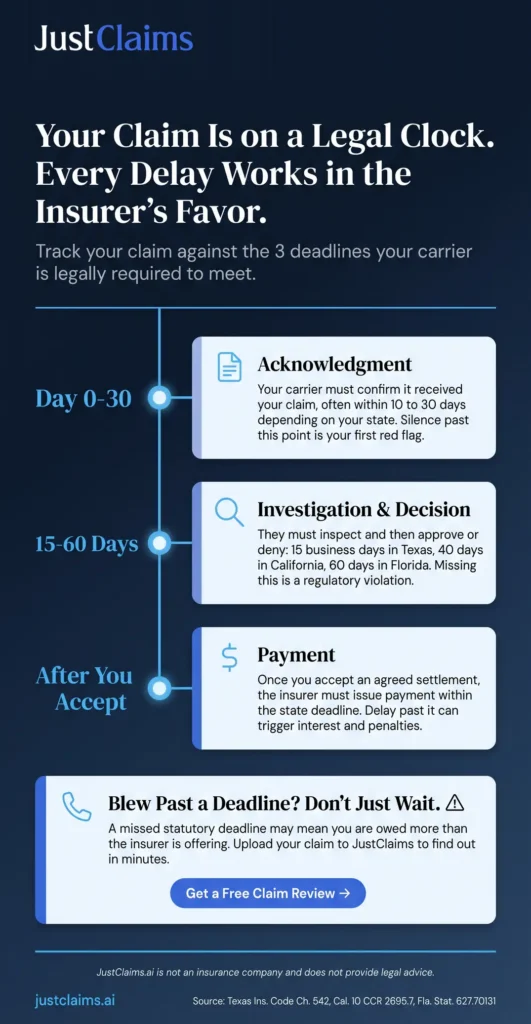
Because prolonged waiting periods can severely disrupt a property owner’s recovery, state insurance codes divide the claims process into distinct, legally binding phases. Acknowledgment windows typically range from 10 to 30 days depending on the state. Investigation and decision deadlines vary more widely — from 15 business days in Texas to 40 calendar days in California [3] to 60 days in Florida — and some states apply a ‘reasonable time’ standard rather than a fixed day count.
1. The Initial Acknowledgment Window
Once you file a claim, the insurance company cannot simply ignore your submission. State laws require carriers to formally acknowledge receipt of the claim within a specific statutory window. During this initial phase, the insurer typically assigns an adjuster and provides you with a claim number. This deadline puts the carrier on notice that the regulatory clock has started ticking.
2. The Investigation and Decision Timeframe
After acknowledgment, the carrier enters the investigation phase, which is also governed by strict time limits. The insurer must inspect the damage, review your documentation, and issue a formal decision—either an approval or a denial—by the deadline. Requirements for written notice of extensions vary by state. In Texas, insurers must provide written notice with a valid reason to extend their decision deadline [2]. In Florida, insurers cannot unilaterally extend deadlines — only the state regulator may do so under specific circumstances [4]. Policyholders should verify the rules in their state.
3. The Final Payment Deadline
Once the insurance company agrees to cover the loss and you accept the settlement offer, the final statutory clock begins. Carriers are required to issue the actual payment within a set timeframe following the agreement. Failing to disburse funds by this deadline often constitutes a regulatory violation, giving property owners grounds to escalate the issue.
How to Find Your State’s Unfair Claims Settlement Practices Act
Since the exact number of days allowed for each phase varies significantly depending on where you live, locating your state’s specific regulations is a vital step in protecting your financial recovery.
Most jurisdictions have adopted a version of the Unfair Claims Settlement Practices Act, which outlines the legal expectations for insurance companies operating within that state [1]. To find your specific timeline, visit your state’s Department of Insurance website and search for “claims settlement practices” or “policyholder bill of rights”. These official resources detail the exact deadlines your carrier must follow. Reviewing these guidelines helps demonstrate to your adjuster that you are aware of your rights and expect the process to move forward lawfully.
Common Carrier Delay Tactics and How to Respond
Even with strict laws in place, property owners often encounter administrative hurdles that stall the settlement process.
Repeated and Piecemeal Document Requests
A frequent tactic involves the adjuster asking for documentation one piece at a time rather than requesting all necessary information upfront. This resets the investigation clock in many jurisdictions, prolonging the final decision. To counter this, ask the adjuster to provide a comprehensive, written list of every document, photo, and estimate required to complete the review. Fulfilling a single, exhaustive list prevents the carrier from claiming they are waiting on additional information.
The “Still Under Review” Loop
Some policyholders report receiving vague status communications that do not specify the reason for a delay, which can be a sign of improper claims handling. When you encounter this vague status, reply in writing to ask exactly what is being reviewed and what specific steps remain. Request a concrete date for the next update. Documenting these interactions supports your position if you later need to prove the carrier engaged in unreasonable delays.
Rotating Adjusters and Lost Files
High turnover within insurance companies often leads to a claim being reassigned to multiple adjusters. Each new representative may claim they need time to review the history or state that previous documents are missing from the file. Maintain a complete, organized digital folder of every document, photo, and email you have submitted. When a new adjuster takes over, immediately forward the complete file to eliminate any excuse for starting the investigation over from scratch.
When a Delay Crosses Into Bad-Faith Territory
While some delays stem from genuine administrative backlogs, intentionally stalling a claim to frustrate a property owner crosses the line into bad-faith practices.
Bad faith standards vary by state. Some states require the insurer to have acted intentionally or with reckless disregard; others define bad faith as a failure to pay within a specific period (for example, 60 days after a formal demand in Tennessee) [5]. Policyholders should consult their own state’s statutes. If your carrier repeatedly ignores communication, fabricates reasons to deny coverage, or withholds payment long after an agreement is reached, they may be violating state law. In these situations, property owners can file a formal complaint with their state’s insurance commissioner. This regulatory action prompts the state to investigate the carrier’s behavior. If the department finds the insurer acted in bad faith, the carrier may face fines, and the property owner may have grounds to pursue further legal remedies to recover the owed funds.
Frequently Asked Questions
Can an insurance company delay my claim indefinitely?
No, state regulations prohibit carriers from stalling the process forever. Insurance companies must adhere to statutory deadlines for acknowledging, investigating, and paying out claims. If they require an extension, they are generally required to provide a valid, documented reason in writing.
What should I do if the adjuster ignores my emails?
If your assigned representative stops responding, escalate the communication by contacting their supervisor or the claims department manager. Keep a detailed log of every unreturned call and email, as this paper trail is essential if you need to file a formal complaint with your state’s insurance regulatory body.
Does the payment deadline change if I dispute the settlement amount?
When you contest a settlement offer, the carrier is typically still required to pay the undisputed portion of the claim within the standard legal timeframe. The disputed amount will be negotiated or appraised separately, but the initial agreed-upon funds should not be withheld during that secondary process.
How do state insurance departments enforce these timelines?
State insurance commissioners monitor carrier behavior through policyholder complaints and routine audits. When a company is found to be violating the Unfair Claims Settlement Practices Act by missing deadlines, the department can issue warnings, levy financial penalties, or mandate corrective actions to resolve the delayed files.
How to Protect Your Settlement Rights
Navigating the aftermath of property damage is challenging enough without facing unnecessary administrative roadblocks from your carrier. By understanding your state’s specific deadlines for acknowledgment, investigation, and payment, you can hold your insurer accountable and keep your recovery on track. Always communicate in writing, maintain meticulous records of every document submitted, and do not hesitate to escalate the issue if the carrier relies on endless delay tactics. Upload your claim documents to JustIn to see in minutes if your insurer missed coverage you’re owed.
This content is for informational purposes only and does not constitute legal or insurance advice. Coverage decisions depend on the specific terms, conditions, and exclusions of each policy and the laws of the applicable jurisdiction; policyholders and contractors should consult with a qualified professional for advice on their particular situation.
Sources
[1] National Association of Insurance Commissioners — Unfair Claims Settlement Practices Act (Model 900). https://content.naic.org/sites/default/files/model-law-900.pdf
[2] Texas Insurance Code, Chapter 542 — Prompt Payment of Claims. https://statutes.capitol.texas.gov/Docs/IN/pdf/IN.542.pdf
[3] California Code of Regulations, Title 10, §2695.7 — Standards for Prompt, Fair and Equitable Settlements. https://www.law.cornell.edu/regulations/california/10-CCR-2695.7
[4] Florida Statutes §627.70131 — Insurer’s duty to acknowledge communications and act promptly on claims. https://www.flsenate.gov/Laws/Statutes/2024/627.70131
[5] Tennessee Code Annotated §56-7-105 — Bad-faith failure to pay. https://codes.findlaw.com/tn/title-56-insurance/tn-code-sect-56-7-105/

Collin Corcoran

Experienced Public Adjuster and Property Claims Specialist, Collin is licensed in New York (#1603393), New Jersey (#3003700204), and Connecticut (#19820270). With 20+ years of hands-on construction and property damage experience, he specializes in residential and commercial claims, complex loss inspections, policy review, detailed estimating, and strategic negotiation. Collin’s background in construction, asset management, emergency response, and claims documentation allows him to accurately identify damage, understand repair requirements, and advocate effectively for policyholders. He works with homeowners, business owners, contractors, and insurance professionals to move claims forward with clarity, accuracy, and confidence. Collin is committed to transparency, technical precision, strong communication, and securing fair outcomes for policyholders.