Property Damage Claim Help: Maximize Your Payout 2026
August 10, 2026
Written by Collin Corcoran
Share


Commercial property damage claims often involve complex policy language where minor valuation errors can cost millions. A Florida government study revealed that policyholders using expert representation for non-catastrophe claims received settlements that were 574% higher than those who navigated the process alone. Because complex claims demand detailed documentation and valuation, securing professional assistance is a vital step in recovering your full policy value.
Key Takeaways
- Non-catastrophe settlement impact: Policyholders using public adjusters received settlements 574% higher than unrepresented owners.
- Catastrophe settlement impact: For claims related to the 2005 hurricanes, represented policyholders saw payments 747% higher.
- Representation duty: Public adjusters work exclusively on behalf of the policyholder, unlike company or independent adjusters.
- Fee structure: State departments of insurance license these professionals and often cap their percentage-based fees, such as Texas limiting fees to 10% of the insurance settlement.
The Financial Impact of Professional Claim Representation
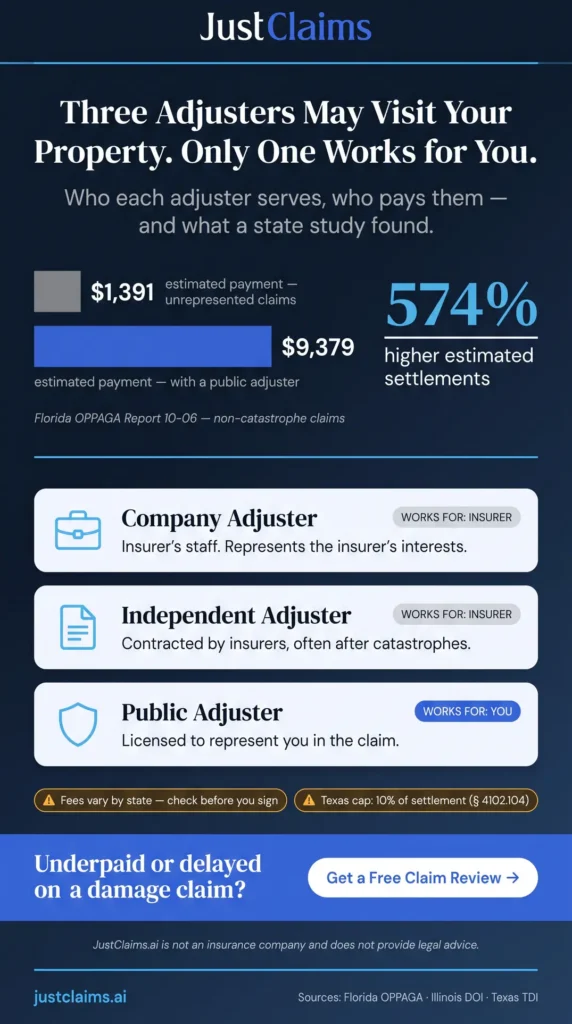
Because minor valuation errors can cost millions in commercial property losses, understanding the financial impact of professional claim representation is essential for protecting your business assets. A comprehensive Florida government study analyzed the difference in outcomes for policyholders who navigated the process alone versus those who hired experts. For non-catastrophe claims, policyholders who used public adjusters received an estimated $9,379 on their claim, compared to $1,391 for those who did not — a difference of 574% [1].
The financial disparity remained significant during major weather events. For catastrophe claims related to the 2005 hurricanes, public adjuster claims resulted in payments that were 747% higher [1]. Represented claims did take longer to close, and net settlements are reduced by adjuster fees paid from the settlement [1].
The Three Types of Adjusters in Commercial Claims
Given the substantial settlement differences highlighted in government studies, property owners must recognize who each adjuster in the process actually represents.
1. Company Adjusters
Insurance carriers employ company adjusters directly to investigate and evaluate property damage. Knowing whose interests each insurance adjuster actually represents is the first piece of leverage a policyholder has. A company adjuster is an employee of your insurance company — they represent the interest of the insurance company and are paid by the insurance company [2]. They will not charge you a fee [2].
2. Independent Adjusters
An independent adjuster is hired on a contract basis by your insurance company to represent the insurance company’s interest in the settlement of your claim [2]. They are paid by your insurance company and will not charge you a fee — but they do not represent the property owner’s interests [2].
3. Public Adjusters
Unlike company or independent adjusters, a public adjuster does not work for any insurance company — they work for you [2]. Their dedicated role is to assist in the preparation, presentation and settlement of your claim, and they are required to serve with objectivity and complete loyalty for your interests alone [2].
Navigating State Regulations and Fee Structures
While expert assistance often supports the position that a higher payout is warranted, commercial property owners should understand how these professionals are regulated and compensated. State oversight helps maintain ethical standards and provides a predictable cost structure for policyholders seeking representation.
Public adjusters are licensed by state departments of insurance [3]. In Texas, for example, licensed public adjusters must complete 24 hours of continuing education every two years, including three hours of ethics or consumer protection [4]. These professionals typically charge a fee based on a percentage of the claim settlement rather than billing by the hour — and because the fee can be based on the total settlement amount, you may owe it even if the insurer does not increase its offer [3]. To protect consumers from excessive costs, many jurisdictions implement fee limits: in Texas, the total commission may not exceed 10 percent of the amount of the insurance settlement on the claim [5]. Understanding these regulatory frameworks allows property owners to engage expert help with clear financial expectations. Where the numbers are genuinely contested, property damage consulting brings a forensic-level reading of the loss to the table.
Frequently Asked Questions
How much more do represented policyholders receive for non-catastrophe claims?
Research from Florida indicates that policyholders utilizing professional advocates for non-catastrophe property losses received settlements 574% higher than those who filed independently [1]. This significant margin highlights how expert documentation can uncover covered damages that might otherwise go uncompensated.
Do public adjusters help with hurricane damage claims?
Absolutely, expert advocates play a vital role in post-storm recovery efforts. Florida government data on Citizens Property Insurance Corporation claims from the 2004 and 2005 hurricane seasons shows that policyholders with public adjuster representation received higher gross settlements than unrepresented policyholders, though claims took longer to close and net settlements were reduced by adjuster fees [1].
Who does a public adjuster actually work for?
These licensed professionals work for you — not for any insurance company — and are required to serve with complete loyalty for your interests alone [2]. They focus solely on assisting in the preparation, presentation and settlement of your claim [2].
How are claim representatives compensated?
State-licensed public adjusters typically charge a percentage of the claim settlement rather than billing by the hour — and you may owe the fee even if the insurer does not increase its offer [3]. To ensure fair pricing, state law may cap these fees; in Texas, the total commission may not exceed 10 percent of the insurance settlement [5].
How to Protect Your Commercial Claim Settlement
Commercial property damage claims demand meticulous attention to detail, as minor valuation errors can cost millions in unrecovered funds. Because complex claims require detailed documentation and valuation, relying solely on the carrier’s assessment often leaves substantial capital on the table. Most of those valuation errors surface line by line, which is why Xactimate estimates deserve the same scrutiny as the policy itself. Run your property damage claim through JustClaims‘ expert team — accelerated by our bespoke AI — to identify the coverage gaps your insurer used against you.
This content is for informational purposes only and does not constitute legal or insurance advice. Coverage decisions depend on the specific terms, conditions, and exclusions of each policy and the laws of the applicable jurisdiction; policyholders and contractors should consult with a qualified professional for advice on their particular situation.
Sources
[2] Commercial Property Insurance Public Adjusters — Illinois Department of Insurance
[5] Texas Insurance Code § 4102.104 — Commissions (10% Cap on Public Adjuster Fees) — Texas Legislature

Collin Corcoran

Experienced Public Adjuster and Property Claims Specialist, Collin is licensed in New York (#1603393), New Jersey (#3003700204), and Connecticut (#19820270). With 20+ years of hands-on construction and property damage experience, he specializes in residential and commercial claims, complex loss inspections, policy review, detailed estimating, and strategic negotiation. Collin’s background in construction, asset management, emergency response, and claims documentation allows him to accurately identify damage, understand repair requirements, and advocate effectively for policyholders. He works with homeowners, business owners, contractors, and insurance professionals to move claims forward with clarity, accuracy, and confidence. Collin is committed to transparency, technical precision, strong communication, and securing fair outcomes for policyholders.