



Recoverable Depreciation: How to Get Your Full Payout 2026
July 20, 2026
Written by Taylor Bezek
Share


Insurance companies routinely withhold part of your property damage payout as recoverable depreciation — money you only unlock by proving repairs are complete. Deadlines to claim it vary by insurer and state law; many policies require you to notify your carrier of your intent to recover within 180 days of the date of loss, though some windows run longer or shorter, so always check your policy. Miss that window or fall short on documentation, and thousands of dollars can be forfeited to the insurer for good.
Key Takeaways
- What it is: Recoverable depreciation represents the financial gap between an item’s replacement cost value (RCV) and its actual cash value (ACV) after factoring in age and wear.
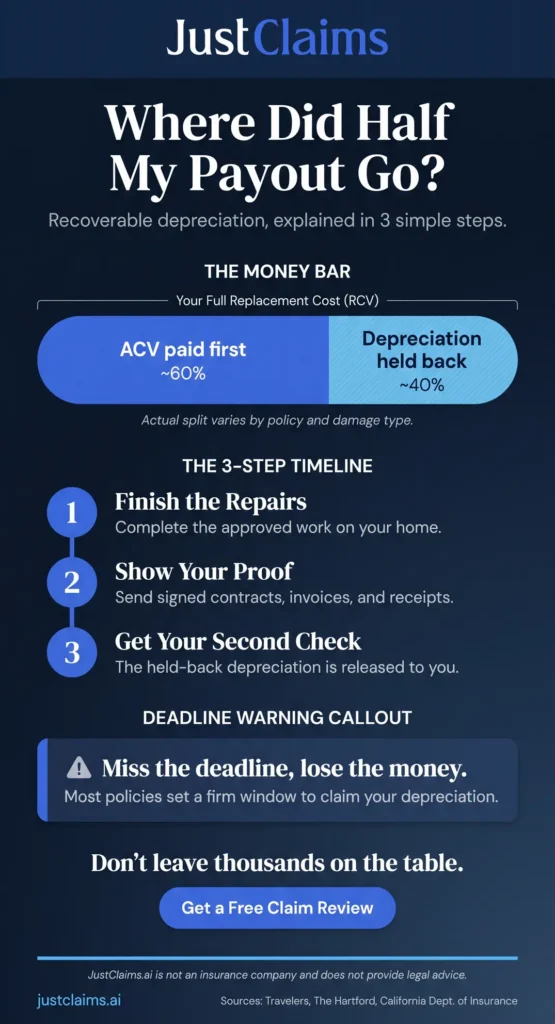
- How it is paid: Insurance companies typically issue claim payouts in multiple stages, starting with an initial payment for the actual cash value (ACV) minus the deductible, followed by a second payment for the recoverable depreciation once repairs are completed.
- Required documentation: To collect the withheld depreciation, policyholders must submit proof of repair or replacement, such as signed contracts, invoices, receipts, or canceled checks.
- Payout limits: Policyholders can only recover the actual amount spent on repairs or replacements; if the replacement costs less than the estimated replacement cost value, the final payout will be adjusted accordingly.
- Notification deadline: Insurance policies generally impose a strict deadline for policyholders to notify their claim professional of their intent to recover depreciation. Always check your specific policy and consult your claim professional.
Understanding the Two-Part Insurance Payout Process
When a property suffers damage, insurance companies typically issue claim payouts in multiple stages [2]. The initial check you receive is rarely the full amount required to fix the damage. Instead, it represents the actual cash value (ACV) minus your deductible [2]. The remaining balance is held back as recoverable depreciation, which represents the financial gap between an item’s replacement cost value (RCV) and its actual cash value (ACV) after factoring in age and wear [3].
Recovering the full replacement cost also depends on carrying enough coverage in the first place; if your building is underinsured relative to its insurance to value, a coinsurance penalty can shrink the payout before depreciation is ever released.
Carriers structure payments this way to verify that the settlement funds are actually used to restore the property. The second payment for the recoverable depreciation is only released once repairs are completed [2].
To illustrate, consider a hypothetical roof replacement estimated at a $20,000 replacement cost value. If the roof is older, the carrier might assess $8,000 in depreciation, leaving a $12,000 actual cash value. After applying a $2,000 deductible, the initial ACV check would be $10,000. The $8,000 difference remains withheld as recoverable depreciation. Property owners must fund the initial stages of the repair using the ACV check and their own resources, only receiving the final $8,000 once the work is finished and documented. The mortgage adds another step, which is why your check lists your lender.
The Repair Completion Requirement and Strict Deadlines
Because the initial ACV payment is often insufficient to cover full restoration costs, understanding the timeline to claim your withheld funds is your primary financial recovery tool. Deadlines vary by insurer and state law — many policies ask policyholders to notify their carrier of intent to recover depreciation within 180 days of the date of loss, but some states and policies allow longer or shorter windows. Always check your specific policy and consult your claim professional.
Property owners must complete the work and submit their documentation within that window to access the remaining funds. Managing this timeline requires coordination with contractors, as material delays or scheduling conflicts do not automatically extend your policy’s notification window. If you anticipate that repairs will take longer than the allotted timeframe, you should formally request an extension from your adjuster before the deadline expires.
The 3 Requirements to Release Your Depreciation Check
Since missing the notification window can cost you thousands, submitting the correct documentation on time is the most reliable way to release the second check. Property owners must navigate three distinct requirements to successfully recover their withheld funds.
1. Complete the Approved Property Repairs
Insurance companies structure payouts to verify that settlement funds are used for their intended purpose. Property owners must ensure the work aligns with the carrier’s approved scope of loss. Once the depreciation math is clear, how to negotiate a cash settlement with insurance company becomes the next step. If you choose to upgrade materials or alter the repair plan, the carrier will only release depreciation up to the cost of restoring the property to its pre-loss condition [4].
2. Submit Acceptable Financial Proof
To collect the withheld depreciation, policyholders must submit proof of repair or replacement, such as signed contracts, invoices, receipts, or canceled checks [2]. Providing clear, organized records puts the carrier on notice that the conditions for releasing the funds have been met. Hand-written receipts or vague contractor invoices often trigger additional scrutiny, so property owners should request detailed, itemized final bills from their service providers.
3. Meet the Actual Cost Limitation
Policyholders can only recover the actual amount spent on repairs or replacements; if the replacement costs less than the estimated replacement cost value, the final payout will be adjusted accordingly [2]. For example, if your carrier estimated a repair at $15,000, but your contractor completes the exact same scope of work for $13,000, you can only recover depreciation up to that $13,000 total. The insurance company retains the difference.
Navigating Missed Deadlines and Carrier Disputes
Because carriers adjust the final payout based on the actual amount spent, disputes over repair completion and documentation are common hurdles for property owners. If the deadline passes without notification, the carrier may close the claim and refuse to release the withheld funds.
In some cases, insurers may dispute whether the repairs match the original scope of loss or question the validity of the submitted invoices. When a disagreement over the repair amount reaches an impasse, you can invoke the appraisal clause to settle the dispute over the amount of loss. Professional claim documentation helps demonstrate that all work was completed according to the carrier’s approved estimate. Providing clear, organized receipts and signed contracts supports the position that the property owner has fulfilled all policy obligations. When property owners maintain meticulous records of every dollar spent, they are better positioned to address adjuster questions and secure the release of their final check.
Frequently Asked Questions
What exactly is recoverable depreciation?
It is the monetary difference between the cost to buy a brand-new replacement item and the current depreciated value of the damaged item, accounting for its age and physical condition [1]. Insurers hold this amount back until you prove the item has been replaced or repaired.
When do I receive the withheld depreciation funds?
Carriers release the second portion of your settlement only after you have finished the necessary property repairs and provided evidence of the completed work [2]. Your initial check will only cover the depreciated value minus your deductible.
What documents do I need to prove my repairs are finished?
you should supply your insurance adjuster with tangible evidence of your expenses to release the funds [2]. Acceptable proof includes finalized contractor agreements, paid invoices, material receipts, or copies of cleared checks [2].
Can I keep the extra money if my repairs cost less than the estimate?
No, you are restricted to claiming only the exact funds you disbursed for the restoration [2]. If your final contractor bill is lower than the insurance company’s projected replacement cost, your final depreciation check will be reduced to match your actual spending [2].
How to Recover Your Withheld Depreciation
Securing the second half of your insurance settlement requires strict attention to detail and timely submission of all repair documentation. Property owners must track their expenses carefully and notify their carrier before the deadline expires. Upload your claim documents to JustIn to see in minutes if your insurer missed coverage you’re owed.
This content is for informational purposes only and does not constitute legal or insurance advice. Coverage decisions depend on the specific terms, conditions, and exclusions of each policy and the laws of the applicable jurisdiction; policyholders and contractors should consult with a qualified professional for advice on their particular situation.
Sources
[1] The Hartford — Recoverable Depreciation: https://www.thehartford.com/aarp/homeowners-insurance/recoverable-depreciation
[2] Travelers — Understanding Depreciation: https://www.travelers.com/claims/guides/understanding-depreciation
[3] California Department of Insurance — Residential Property Claims Guide: https://www.insurance.ca.gov/01-consumers/105-type/95-guides/03-res/res-prop-claim.cfm
[4] Insurance Information Institute — Insurance for Your House and Personal Possessions: https://www.iii.org/article/insurance-for-your-house-and-personal-possessions

Taylor Bezek

As the General Manager at JustClaims, Taylor Bezek brings over a decade of experience managing complex residential, commercial, and large-loss claims. A licensed Public Adjuster in TX (#2125659), FL (#W455048), CO (#769172), and 10 additional states, Taylor founded his own firm before joining JustClaims to scale a tech-forward solution for the insured. He is committed to combining industry expertise with AI to enhance speed, clarity, and outcomes for every policyholder. Taylor's mission is to modernize the public adjusting profession and ensure owners get exactly what they are entitled to.


